



Abstract
1. Discharges have been recorded from afferents of the soleus muscle following reinnervation by the nerve of a fast twitch muscle, extensor digitorum longus. Recordings were made 227-449 d post-operatively.
2. The gross afferent discharge from the cross-reinnervated soleus suggested the presence of fewer mechanosensitive receptors than in normal muscles, as judged by discharges seen during a maximal muscle twitch.
3. A comparison of receptors in the cross-reinnervated muscle with afferents from a self-reinnervated muscle showed that many of the responses in the self-reinnervated muscle were also abnormal. It was concluded that much of the disruption resulted from the surgical interference and that rather less could be attributed to the foreign nerve.
4. A detailed analysis of response characteristics of receptors in cross-reinnervated soleus muscles of five cats showed that afferent conduction velocities of identified spindles and tendon organs were generally lower than normal and responses to muscle stretch or vibration were often atypical. A large number of afferents which could not be classified as muscle spindles or tendon organs included a group called contraction receptors. These responded generally only during maximal muscle contractions and with a rather feeble discharge. A second group consisted of afferents in which impulses could be elicited by electrical stimulation of the nerve but not by any mechanical activity in the muscle.
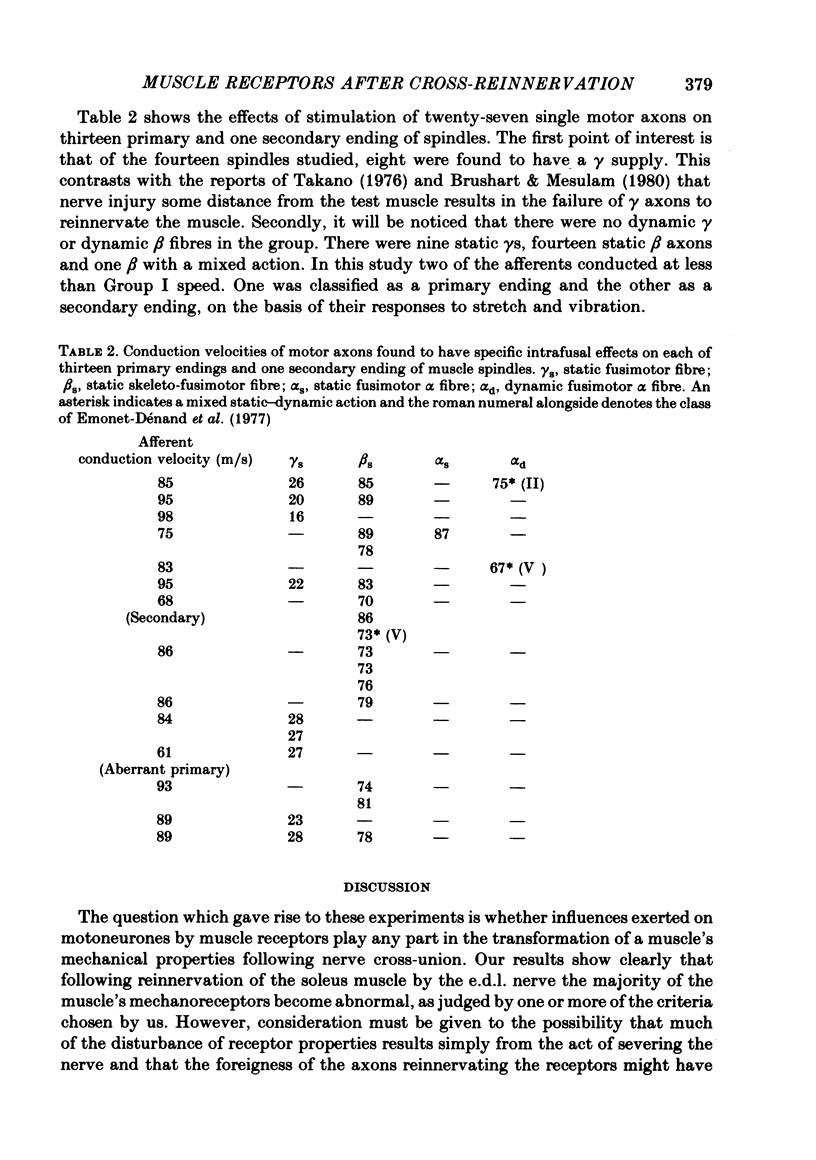
5. In a further five animals a detailed study was made of the motor supply of muscle spindles. A fusimotor innervation was common, but invariably stimulation of the γ fibre had a static action on the spindle. No purely dynamic fusimotor fibres were encountered. There were many static β fibres (skeletofusimotor) no dynamic βs and three axons conducting in the α range, which developed no tension, yet produced specific intrafusal effects. Two of these had a mixed static—dynamic action while the third was purely static.
6. It was concluded that in the cross-reinnervated soleus muscle the majority of afferents were abnormal in one or other respect. The central action of such abnormal receptors would have to be taken into account when seeking explanations of the transformation of a muscle's mechanical properties following reinnervation by a foreign nerve.
Full text
PDF




Selected References
These references are in PubMed. This may not be the complete list of references from this article.
- Bagust J., Lewis D. M., Westerman R. A. Motor units in cross-reinnervated fast and slow twitch muscle of the cat. J Physiol. 1981;313:223–235. doi: 10.1113/jphysiol.1981.sp013660. [DOI] [PMC free article] [PubMed] [Google Scholar]
- Bessou P., Laporte Y., Pagès B. Observations sur la ré-innervation de fuseaux neuro-musculaires de chat. C R Seances Soc Biol Fil. 1966;160(2):408–411. [PubMed] [Google Scholar]
- Brown M. C., Butler R. G. Regeneration of afferent and efferent fibres to muscle spindles after nerve injury in adults cats. J Physiol. 1976 Sep;260(2):253–266. doi: 10.1113/jphysiol.1976.sp011514. [DOI] [PMC free article] [PubMed] [Google Scholar]
- Brown M. C., Engberg I., Matthews P. B. The relative sensitivity to vibration of muscle receptors of the cat. J Physiol. 1967 Oct;192(3):773–800. doi: 10.1113/jphysiol.1967.sp008330. [DOI] [PMC free article] [PubMed] [Google Scholar]
- Brushart T. M., Mesulam M. M. Alteration in connections between muscle and anterior horn motoneurons after peripheral nerve repair. Science. 1980 May 9;208(4444):603–605. doi: 10.1126/science.7367884. [DOI] [PubMed] [Google Scholar]
- CRAGG B. G., THOMAS P. K. Changes in conduction velocity and fibre size proximal to peripheral nerve lesions. J Physiol. 1961 Jul;157:315–327. doi: 10.1113/jphysiol.1961.sp006724. [DOI] [PMC free article] [PubMed] [Google Scholar]
- ECCLES J. C., ECCLES R. M., MAGNI F. Monosynaptic excitatory action on motoneurones regenerated to antagonistic muscles. J Physiol. 1960 Nov;154:68–88. doi: 10.1113/jphysiol.1960.sp006565. [DOI] [PMC free article] [PubMed] [Google Scholar]
- Ellaway P. H., Emonet-Denand F., Joffroy M., Laporte Y. Lack of exclusively fusimotor -axons in flexor and extensor leg muscles of the cat. J Neurophysiol. 1972 Jan;35(1):149–153. doi: 10.1152/jn.1972.35.1.149. [DOI] [PubMed] [Google Scholar]
- Emonet-Dénand F., Jami L., Laporte Y. Skeleto-fusimotor axons in the hind-limb muscles of the cat. J Physiol. 1975 Jul;249(1):153–166. doi: 10.1113/jphysiol.1975.sp011008. [DOI] [PMC free article] [PubMed] [Google Scholar]
- Emonet-Dénand F., Laporte Y., Matthews P. B., Petit J. On the subdivision of static and dynamic fusimotor actions on the primary ending of the cat muscle spindle. J Physiol. 1977 Jul;268(3):827–861. doi: 10.1113/jphysiol.1977.sp011884. [DOI] [PMC free article] [PubMed] [Google Scholar]
- Gallego R., Kuno M., Núez R., Snider W. D. Enhancement of synaptic function in cat motoneurones during peripheral sensory regeneration. J Physiol. 1980 Sep;306:205–218. doi: 10.1113/jphysiol.1980.sp013392. [DOI] [PMC free article] [PubMed] [Google Scholar]
- Goldring J. M., Kuno M., Núez R., Snider W. D. Reaction of synapses on motoneurones to section and restoration of peripheral sensory connexions in the cat. J Physiol. 1980 Dec;309:185–198. doi: 10.1113/jphysiol.1980.sp013503. [DOI] [PMC free article] [PubMed] [Google Scholar]
- Gordon T., Hoffer J. A., Jhamandas J., Stein R. B. Long-term effects of axotomy on neural activity during cat locomotion. J Physiol. 1980 Jun;303:243–263. doi: 10.1113/jphysiol.1980.sp013283. [DOI] [PMC free article] [PubMed] [Google Scholar]
- Gregory J. E., Proske U. The responses of Golgi tendon organs to stimulation of different combinations of motor units. J Physiol. 1979 Oct;295:251–262. doi: 10.1113/jphysiol.1979.sp012966. [DOI] [PMC free article] [PubMed] [Google Scholar]
- HUNT C. C. Relation of function to diameter in afferent fibers of muscle nerves. J Gen Physiol. 1954 Sep 20;38(1):117–131. doi: 10.1085/jgp.38.1.117. [DOI] [PMC free article] [PubMed] [Google Scholar]
- Horch K. W., Lisney S. J. On the number and nature of regenerating myelinated axons after lesions of cutaneous nerves in the cat. J Physiol. 1981;313:275–286. doi: 10.1113/jphysiol.1981.sp013664. [DOI] [PMC free article] [PubMed] [Google Scholar]
- Ip M. C., Vrbová G., Westbury D. R. The sensory reinnervation of hind limb muscles of the cat following denervation and de-efferentation. Neuroscience. 1977;2(3):423–434. doi: 10.1016/0306-4522(77)90007-0. [DOI] [PubMed] [Google Scholar]
- Lennerstrand G., Thoden U. Muscle spindle responses to concomitant variations in lenght and in fusimotor activation. Acta Physiol Scand. 1968 Sep-Oct;74(1):153–165. doi: 10.1111/j.1748-1716.1968.tb04224.x. [DOI] [PubMed] [Google Scholar]
- Luff A. R. Dynamic properties of fast and slow skeletal muscles in the cat and rat following cross-reinnervation. J Physiol. 1975 Jun;248(1):83–96. doi: 10.1113/jphysiol.1975.sp010963. [DOI] [PMC free article] [PubMed] [Google Scholar]
- MATTHEWS P. B. THE RESPONSE OF DE-EFFERENTED MUSCLE SPINDLE RECEPTORS TO STRETCHING AT DIFFERENT VELOCITIES. J Physiol. 1963 Oct;168:660–678. doi: 10.1113/jphysiol.1963.sp007214. [DOI] [PMC free article] [PubMed] [Google Scholar]
- Takano K. Absence of the gamma-spindle loop in the reinnervated hind leg muscles of the cat: "alpha-muscle". Exp Brain Res. 1976 Nov 23;26(4):343–354. doi: 10.1007/BF00234218. [DOI] [PubMed] [Google Scholar]