



Abstract
Background:
Early prognosis of patients with spontaneous intracerebral hemorrhage (ICH) can help create individualized and optimized treatment plans for the patients.
Aims:
This study evaluates short-term mortality and identifies risk factors in ICH patients at 115 People’s Hospital within 30 days.
Design and methods:
A retrospective cohort study was conducted involving 598 patients diagnosed with ICH by neurologists from December 2022 to June 2023. Diagnosis was confirmed by imaging, with symptoms appearing within 24 h of admission. Short-term mortality was defined as death within 30 days of onset.
Results:
Among the 598 patients (mean age 58.4; 40% female), 110 (18.4%) died, while 488 (81.6%) survived. The ICH score (AUC = 95.75%; p < 0.001; optimal cutoff = 1.5) was more prognostic for mortality than the NIHSS score (AUC = 94.61%; optimal cutoff = 17.5; p < 0.001). Identified risk factors included age ≥ 80 (RR = 2.2, p = 0.002), ICH score ≥ 2 (RR = 38.4, p < 0.001), NIHSS score ≥ 16 (RR = 15.1, p < 0.001), hematoma volume ≥ 30 cm3 (RR = 15.1, p < 0.001), and the presence of intraventricular (RR = 7.2, p < 0.001) or subtentorial hemorrhage (RR = 2.8, p < 0.001).
Conclusions:
The mortality rate for ICH was significant. The ICH score, NIHSS, and hematoma volume are effective in predicting mortality in spontaneous ICH patients.
Keywords: intracranial hemorrhage, short-term mortality prognosis, ICH score, NIHSS score, Vietnam
Introduction
Spontaneous intracerebral hemorrhage (ICH) accounts for 10%–15% of all stroke cases and is associated with high morbidity and mortality rates. 1 In Vietnam, there are approximately 200,000 stroke cases annually, with an incidence rate of nearly 300 per 100,000 people. Cerebrovascular disease (stroke) is one of the top 10 causes of death in Vietnam, with a mortality rate of 86 per 100,000 people. 2 The incidence rate of sICH is 51.8 per 100,000 people in Asians, which is double that of Caucasians (24.2 per 100,000). 3 In order to accurately diagnose patients with intracranial bleeding, in addition to clinical symptoms, patients need to undergo blood tests and have imaging evidence of the hemorrhage site (CT-scan, MRI).4,5 Effective internal medical treatment directly influences mortality and disability. 5 Neurosurgical intervention is indicated for cases with a maximum diameter of the hematoma > 3 cm in the posterior fossa or significant compression of the ventricles or bleeding into the subarachnoid space in young individuals (<50 years old) with rapid deterioration of consciousness. 5 Severe ICH can lead to dangerous complications such as brain herniation and cerebral edema.6,7 The volume of the hematoma increases in one-third of cases within the first 4 hours. 8 A study by Brott et al. revealed that 26% of ICH patients had hematoma enlargement within 1 h after the initial CT scan. 9
To assess the severity and mortality of non-traumatic ICH patients, neurologists often use the ICH score, with a total score ranging from 0 (best prognosis) to 6 (worst prognosis). 10 The ICH score is a quick and effective clinical scoring system that includes five factors: One point was given for age >80 years, one point for infratentorial origin, one point for ICH volume >30 mL, one point for intraventricular extension of ICH, one point for a GCS of 5–12, and two points for a GCS of 3–4.11,12 Another measure of value is the NIHSS, 13 with NIHSS < 6, indicating mild neurological deficit, which can also be considered a criterion to only require parenchymal imaging without further vascular assessment; a score of 6–15 indicates moderate severity, and a score above 15 indicates severe neurological deficit. 14
With the aging population and limited public awareness of disease prevention, coupled with the high costs of screening for cerebrovascular diseases that exceed the income levels of many individuals, these issues suggest that the incidence of ICH is likely to continue rising in the future. Short-term mortality prognosis for patients aims to tailor treatment plans, estimate recovery potential, and assess treatment costs, helping the patient’s family make decisions regarding continuing or discontinuing treatment. There is currently very little research on this issue in Vietnam.
Materials and methods
Participants
The patient was diagnosed as having spontaneous intracranial hemorrhage by a neurologist, supported by imaging evidence, with symptoms onset within 24 h prior to hospital admission. The exclusion criteria included secondary hemorrhage due to trauma, vascular malformation, aneurysm, subdural/extradural hematoma, hemorrhage following fibrinolytic therapy, patient transfer, or insufficient data collection.
Study design
This retrospective cohort study was conducted at the General Emergency Department of People’s Hospital 115, Ho Chi Minh City, Vietnam, with data collected from December 2022 to June 2023.
Sample size and sampling method
We used a total population sampling method. We selected all patients with spontaneous ICH who were admitted to the emergency department during the study period from December 2022 to June 2023; ultimately, a total of 598 patients met the selection criteria with ICD (International Classification of Diseases) codes ranging from I60 to I69.
Data collection
After explaining the purpose and significance of the study, patients/family members agreed to participate voluntarily, and then information was collected based on medical records. We defined short-term mortality as mortality within 30 days from onset. We identified a mortality case using one of two methods: (1) in-hospital mortality; or (2) 30-day mortality, determined by contacting the patient using the contact information provided at the time of admission.
Data processing and analysis
The data were analyzed using Stata software version 17.0. Descriptive statistics included means, standard deviations for quantitative variables, and percentages for categorical variables. Analytical statistics included χ2 tests for categorical variables and t-tests for quantitative outcome variables. Risk factors for mortality were reported as relative risks (RR) with 95% confidence intervals (95% CI). The area under the curve (AUC) was used to evaluate predictive accuracy, with the following interpretation: 0.5–0.6: useless; 0.6–0.7: poor; 0.7–0.8: fair; 0.8–0.9: good; >0.9: excellent, in assessing the predictive value of the main outcome compared to actual clinical progression. Multivariable logistic regression models were used to identify independent quantitative variables influencing the outcome. The ROC curve was used to determine the predictive value, and the optimal cutoff point was determined using the Youden index. A p-value < 0.05 was considered statistically significant.
Ethical guidelines
The study was ethically approved and recognized by the Department of Health of Ho Chi Minh City, Vietnam as completing the research project at People’s Hospital 115 (Decision No. 2310/QD-BVND115 issued on October 10, 2023). Participants in the study or their representatives were informed about the research objectives and provided written consent to participate. All participants have the right to withdraw from the study at any time. Anonymity and privacy of the participants are maintained throughout the data collection and reporting process.
Results
The overall average age of the patients is 58.8 years, with significant differences between deceased patients (61.6 years) and survivors (57.7 years; p = 0.004). The average GCS score is 12.5, showing notable differences between the deceased group (6.9) and the surviving group (13.8) (p < 0.001). The average NIHSS score is 10.1, with the deceased group averaging 23.4 and the survivors averaging 7.2 (p < 0.001). The average ICH score is 1.0, with the deceased group averaging 2.9 and the surviving group averaging 0.5 (p < 0.001). The average hematoma volume is 17.5 cm3, with significant differences observed between deceased patients (49.3 cm3) and survivors (10.3 cm3) (p < 0.001). Gender was not found to be associated with mortality risk in patients with intracerebral hemorrhage (p = 0.513; Table 1).
Table 1.
Analyze the univariate distribution of factors according to the survival status of patients with intracranial hemorrhage.
| Values | Total | Mortality (n = 110) | Survivor (n = 488) | RR (95% CI) | p-Value |
|---|---|---|---|---|---|
| Age, mean (SD), years | 58.4 (12.9) | 61.6 (13.9) | 57.7 (12.5) | 0.004 | |
| <80 years old, n (col %) | 564 (94.3) | 97 (88.2) | 467 (95.7) | 1 | 0.002 |
| ≥80 years old, n (col %) | 34 (5.7) | 13 (11.8) | 21 (4.3) | 2.2 (1.4–3.5) | |
| Gender, n (col %) | |||||
| Female | 239 (40.0) | 47 (42.7) | 192 (39.3) | 1 | 0.513 |
| Male | 359 (60.0) | 63 (57.3) | 296 (60.7) | 0.87 (0.57–1.3) | |
| Glasgow, mean (SD) | 12.5 (3.4) | 6.9 (3.3) | 13.8 (1.7) | <0.001 | |
| <10, n (col %) | 109 (18.2) | 89 (80.9) | 20 (4.1) | 1 | <0.001 |
| ≥10, n (col %) | 489 (81.8) | 21 (19.1) | 468 (95.9) | 0.05 (0.03–0.08) | |
| NIHSS score, mean (SD) | 10.1 (8.8) | 23.4 (7.1) | 7.2 (5.8) | <0.001 | |
| 0–15, n (col %) | 454 (75.9) | 19 (17.3) | 435 (89.1) | 1 | |
| ≥16, n (col %) | 144 (24.1) | 91 (82.7) | 53 (10.9) | 15.1 (9.6–23.9) | <0.001 |
| ICH score, mean (SD) | 1.0 (1.2) | 2.9 (1.1) | 0.5 (0.7) | <0.001 | |
| 0–1, n (col %) | 449 (75.1) | 8 (7.3) | 441 (90.4) | 1 | |
| ≥2, n (col %) | 149 (24.9) | 102 (92.7) | 47 (9.6) | 38.4 (19.2–77.0) | <0.001 |
| Hematoma vol., mean (SD) | 17.5 (23.8) | 49.3 (35.1) | 10.3 (11.8) | <0.001 | |
| <30 cm3, n (col %) | 109 (18.2) | 74 (67.3) | 35 (7.2) | 1 | |
| ≥30 cm3, n (col %) | 489 (81.8) | 36 (32.7) | 453 (92.8) | 9.2 (6.6–13.0) | <0.001 |
| Intraventricular hemorrhage | |||||
| No, n (col %) | 441 (73.7) | 31 (28.2) | 410 (84.0) | 1 | |
| Yes, n (col %) | 157 (26.3) | 79 (71.8) | 78 (16.0) | 7.2 (4.9–10.4) | <0.001 |
| Infratentorial hemorrhage | |||||
| No, n (col %) | 539 (90.1) | 84 (76.4) | 455 (93.2) | 1 | |
| Yes, n (col %) | 59 (9.9) | 26 (23.6) | 33 (6.8) | 2.8 (2.0–4.0) | <0.001 |
| Length of hospital stay | |||||
| <5 days, n (col %) | 269 (45.0) | 97 (88.2) | 172 (35.3) | 1 | |
| ≥5 days, n (col %) | 329 (55.0) | 13 (11.8) | 316 (64.7) | 0.11 (0.06–0.19) | <0.001 |
NIHSS: National Institutes of Health Stroke Scale; ICH: intracerebral hemorrhage; SD: standard deviation; n: frequency; col%: column percentage.
The analysis results identified eight risk factors for short-term mortality in ICH patients: (1) Patients aged 80 years and above had a mortality rate 3 times higher than younger patients (RR = 3.0; 95% CI: 1.4–6.2; p = 0.003); (2) According to the level of consciousness classification, patients with a GCS score ≥ 10 had a 95% reduced risk of mortality compared to patients with a GCS < 10 (RR = 0.05; 95% CI: 0.03–0.08; p < 0.001); (3) According to the Neurological Deficit Severity scale, patients with a NIHSS score ≥ 16 had a 15.1-fold higher risk of mortality compared to patients with lower scores (RR = 15.1; 95% CI: 9.6–23.9; p < 0.001); (4) Patients with an ICH score ≥ 2 had a 38.4-fold higher risk of mortality compared to patients with a score of 0–1 (RR = 38.4; 95% CI: 19.2–77.0; p < 0.001); (5) Patients with a hematoma volume ≥ 30 cm3 had a 9.2-fold higher mortality rate compared to patients with a smaller hematoma volume (RR = 9.2; 95% CI: 6.6–13.0; p < 0.001); (6) Patients with intraventricular hemorrhage had a 7.2-fold higher risk of mortality than those without (RR = 7.2; 95% CI: 4.9–10.4; p < 0.001); (7) Patients with infratentorial hemorrhage had a 2.8-fold higher risk of mortality than those without (RR = 2.8; 95% CI: 2.0–4.0; p < 0.001); (8) Patients with infratentorial hemorrhage had a 2.8-fold higher risk of mortality than those without (RR = 2.8; 95% CI: 2.0–4.0; p < 0.001); (8) ICH patients with a hospital stay of 5 days or longer had an 89% reduced risk of mortality compared to patients with a shorter length of stay (RR = 0.11; 95% CI: 0.06–0.19; p < 0.001; Table 1).
All patients with an ICH score of ≥4 died within 30 days. The majority of patients with low ICH scores (0–1) did not experience mortality. Patients with an ICH score of 2 had a mortality rate that was more than twice the predicted rate (44.8% compared to 26%). There is a significant correlation between the ICH score and patient outcomes, with p < 0.001 (Table 2).
Table 2.
Survival rate distributed on ICH score.
| ICH score | p-Value | ||
|---|---|---|---|
| Points | Mortality, n (row %) | Survivor, n (row %) | |
| 0 | 1 (0.3) | 283 (99.7) | <0.001 |
| 1 | 7 (4.2) | 158 (95.8) | |
| 2 | 30 (44.8) | 37 (55.2) | |
| 3 | 40 (80.0) | 10 (20.0) | |
| 4 | 25 (100.0) | 0 (0.0) | |
| 5 | 6 (100.0) | 0 (0.0) | |
| 6 | 1 (100.0) | 0 (0.0) | |
ICH: intracerebral hemorrhage; n: frequency; %: percentage.
ROC curve was used to evaluate the predictive value of the studied scores in determining the 30-day mortality rates in patients (Figure 1). The NIHSS score, ICH score, mICH score, and hematoma volume (high or low) have the ability to predict short-term mortality in patients with intracranial hemorrhage. Among these factors, the ICH score had the highest predictive value for mortality in patients with intracranial hemorrhage, with an AUC of 95.75% and the optimal cutoff value was 1.5 (p < 0.001). It was followed by the NIHSS score with an AUC of 94.61% and the optimal cutoff value was 17.5 (p < 0.001), and the hematoma volume (cm3) with an AUC of 86.85% and the optimal cutoff value was 19.5 cm3 (p < 0.001; Table 3).
Figure 1.
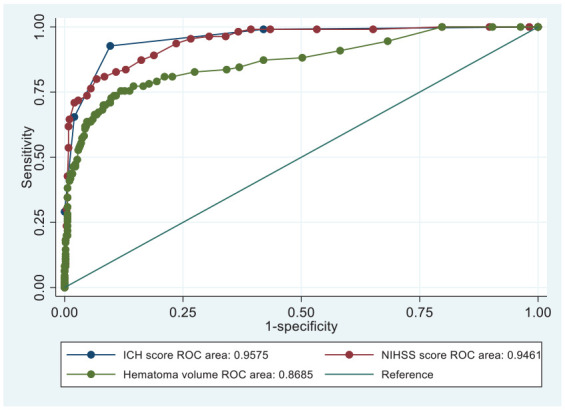
ROC curve analysis of ICH score, NIHSS score, and hematoma volume in predicting 30-day mortality in patients.
ICH: intracerebral hemorrhage; NIHSS: National Institutes of Health Stroke Scale.
Table 3.
Results of ROC curve analysis of factors and mortality.
| Variables | Cut-off points | Sensitivity | Specificity | AUC (95% CI) | p-Value |
|---|---|---|---|---|---|
| ICH score | 1.5 | 0.93 | 0.90 | 0.96 (0.94–0.98) | <0.001 |
| NIHSS score | 17.5 | 0.80 | 0.93 | 0.95 (0.92–0.97) | <0.001 |
| Hematoma volume | 19.5 | 0.75 | 0.88 | 0.87 (0.83–0.91 | <0.001 |
ICH: intracerebral hemorrhage; NIHSS: National Institutes of Health Stroke Scale; CI: confidence interval.
Discussion
The study was conducted on patients with acute spontaneous ICH, all of whom were treated according to the treatment protocol, while evaluating the ICH, NIHSS, and GCS scales upon admission to predict the 30-day mortality risk in patients after ICH. The variables were analyzed and divided into two groups: the Mortality group and the Survival group.
Older age is a significant risk factor for stroke, and older stroke patients have a higher risk of mortality. In this study, the average age of deceased patients was 61.6, while the average age of surviving patients was 57.7. The Glasgow Coma Scale, which assesses the level of consciousness, had an average score of 12.5 in the study group, 6.9 in the deceased group, and 13.8 in the survival group. The NIHSS score, which evaluates the severity of neurological impairment due to stroke, had an average score of 10.1 for both groups, with the mortality group having a score of 23.4 and the survival group having a score of 7.2. This average NIHSS score is higher compared to other hospitals in Vietnam, such as a study conducted at S.I.S Can Tho Hospital with an NIHSS score of 7.5 ± 3.7, 15 and at 103 Military Hospital in Hanoi with an NIHSS score of 7.47 ± 5.80. 16 People’s Hospital 115 is a leading hospital specializing in stroke treatment in the southern region of Vietnam, receiving many critically ill patients, particularly those with severe stroke symptoms. Additionally, many patients are transferred from lower-level hospitals or other areas when their symptoms have worsened, contributing to an increase in the average NIHSS score among patients.
The ICH score is commonly used to assess the severity of ICH. 17 Older age reduces recovery potential, while decreased GCS scores, increased ICH scores, and higher NIHSS scores directly indicate severe brain injury and lower survival rates. Early recognition and management of these factors are crucial for improving prognosis in stroke patients. Older adults generally have poorer health status compared to younger individuals, and they also have a higher mortality risk.18,19 Advanced age is often associated with various health issues, such as atherosclerosis, which elevate the risk of hemorrhage, ischemic events, leading to a higher risk of complications and a reduced response to treatment. Additionally, a weakened immune system makes them more susceptible to infections and complications, increasing mortality rates following hemorrhagic strokes. 20 A reduced Glasgow score reflects impaired consciousness, usually due to significant brain injury, cerebral edema, or increased intracranial pressure. Low scores indicate severe brain damage, diminishing recovery potential and raising the risk of complications such as respiratory failure, aspiration pneumonia, or multi-organ dysfunction. Numerous studies have shown that lower Glasgow scores are closely associated with higher mortality rates in both hemorrhagic and ischemic strokes. 21 Higher ICH scores indicate more extensive or dangerous hemorrhages, increasing mortality risk. Major hemorrhages can lead to cerebral edema and elevated intracranial pressure, compromising neurological function and threatening life. Furthermore, severe bleeding may disrupt cerebral circulation, cardiovascular, and respiratory functions, contributing to higher death rates.21,22 Elevated NIHSS scores signify widespread or severe damage, affecting motor function, consciousness, language, and sensation. These scores are also linked to complications like cerebral edema, transformation hemorrhage, and multi-system dysfunction. Patients with high NIHSS scores typically face challenges in recovery, require prolonged treatment, and are at greater risk for complications such as pneumonia, deep vein thrombosis, or infections. 23 Age, GCS score, ICH score, and NIHSS score frequently interact, reflecting the severity of brain injury and recovery potential. For example, elderly patients often exhibit lower GCS scores due to more extensive brain damage. Severe intracerebral hemorrhages typically result in elevated NIHSS scores and reduced GCS scores, collectively increasing the risk of mortality. The interplay of these factors creates a cumulative effect, diminishing treatment responsiveness, raising the risk of complications, and negatively impacting overall prognosis.
The results of this study showed no gender difference in the mortality rate, with 47 out of 239 female patients (42.7%) and 63 out of 359 male patients (57.3%) experiencing mortality (p = 0.513). In Roquer et al.’s study, there was no significant difference in mortality rates between men and women, with 44.1% in women and 41.1% in men (p = 0.656) after 3 months. 24 Unlike our findings, a study by Marini et al. found that being male was independently associated with mortality rates at 90 days. 25
ICH volume can provide a preliminary assessment of the patient’s severity. The average volume is 17.5 cm3, with the mortality group having a volume of 49.3 cm3 and the survival group having a volume of 10.3 cm3. Patients with a infratentorial hemorrhage location had more severe clinical symptoms compared to other locations. 26 This is consistent with other studies where mortality rates are also associated with hemorrhage volume or ventricular hemorrhage.27,28 Continued hospital treatment helps reduce the risk of mortality, patients with a hospital stay of 5 days or longer had an 89% lower risk of mortality compared to patients with a shorter length of stay . This result contradicts the study by Faghih-Jouybari et al. 29 ; Prolonged hospitalization depends on the patient’s economic status, as the cost of treating this condition is high, especially in cases of severe illness and multiple complications. Severe and economically disadvantaged patients are often taken home by their families to await death because they cannot afford treatment or surgery. Lisk et al. concluded that the most important prognostic factors in these patients are the amount of bleeding, age, ventricular dilation, and the patient’s GCS score. 30 Similarly, in a study by Juvela, factors including low GCS score, hypertension, smoking, ventricular hemorrhage, surgery, intracerebral hematoma, age, and alcohol consumption in the week before the hemorrhage were the most significant predictors. 31 In contrast, the results of the Fric-Shamji et al. study did not find a relationship between ICH volume and mortality in ICH patients. 32
The use of the ICH score is practical and easy to use, and it can predict the risk of mortality very well from the time the patient arrives at the hospital. In this study, all patients with an ICH score of 4 or higher died, similar to the study by Hemphill et al. 11 In the study by Fernandes et al., they concluded that all patients with an ICH score of 5 or 6 died. 33 In this study, the area under the curve (AUC) of the ICH score (95.75%) had a very good predictive value for the patient’s mortality rate. This result is higher than the study by Houben et al. in the Netherlands, with an AUC for the ICH score of 0.837, 12 and Schmidt et al. in Chicago, USA, with an AUC for the ICH score of 0.81. 34 In addition to the ICH score, the ROC space limits of the NIHSS score and the hematoma volume were 94.61% and 86.85%, respectively. These are also very good prognostic measures for mortality in ICH patients, higher than the study by Quanwei He in China, with an AUC of 0.752 for the NIHSS score and 0.767 for the hematoma volume. 35
Different study populations, with variations in demographics, socioeconomic characteristics, and advancements in treatment, can lead to differences in research outcomes among these groups. A limitation of our study is that we assessed mortality rates solely based on statistical data regarding demographic characteristics and clinical status, without considering the impact of treatment interventions, care techniques, or medications used on the mortality rates of patients with hemorrhagic stroke. Therefore, we propose future research to evaluate the impact of treatment interventions on this condition.
Conclusion
The mortality rate for intracerebral hemorrhage was high. The ICH score, NIHSS, and hematoma volume are useful tools in predicting mortality in patients with spontaneous intracerebral hemorrhage. The prognostic factors for short-term mortality are high ICH score, high NIHSS score, large hematoma volume, and the presence of infratentorial hemorrhage.
Acknowledgments
We would like to express our sincere gratitude to all the individuals who willingly and actively participated in this study. Additionally, we extend our heartfelt appreciation to HCMC 115 People’s Hospital for their valuable support in data collection for this research. We would also like to thank Can Tho University of Medicine and Pharmacy and Can Tho Stroke International Services Hospital for their invaluable expertise in stroke research and manuscript review. Their contributions greatly facilitated the completion of this study.
Footnotes
ORCID iDs: Tran Ba Lan  https://orcid.org/0009-0007-4212-836X
Nguyen Hoang Thien Thu
https://orcid.org/0009-0007-9293-3404
Nguyen Quynh Truc
https://orcid.org/0009-0003-3448-4066
Minh Huu Le
https://orcid.org/0000-0003-2618-9377
Quoc Si Huynh
https://orcid.org/0009-0001-6221-8203
Tuyen Thi Hong Nguyen
https://orcid.org/0000-0002-1332-5862
Ethical considerations: Ethical approved and recognized by the Department of Health of Ho Chi Minh City, Vietnam as completing the research project at People’s Hospital 115 (Decision No. 2310/QD-BVND115 issued on October 10, 2023).
Consent to participate: Participants were informed about the study objectives, gave informed consent, and had the freedom to withdraw. Anonymity, privacy, and participant well-being were carefully ensured during data collection and reporting.
Author contributions: All authors have made equally significant contributions to this research study. B.L. Tran, H.T.A. Cao and Q.T. Nguyen designed the details of the study; T.L.A. Nguyen, D.K. Tran, and H.T.T. Nguyen investigated the data and ensured accurate and strict exclusions according to the study criteria; The analysis, interpreted the analysis and wrote the paper was carried out by T.T.H. Nguyen and B.L. Tran; M.H. Le and Q.S. Huynh contributed to the critical evaluation and revision of the manuscript. B.L. Tran and T.T.H. Nguyen shaped the final version, and all authors approved the final version of the article.
Funding: The author(s) received no financial support for the research, authorship, and/or publication of this article.
The author(s) declared no potential conflicts of interest with respect to the research, authorship, and/or publication of this article.
Data availability statement: The data sets during and/or analyzed during the current study are available from the corresponding author on reasonable request.
References
- 1. Ziai WC, Carhuapoma JR. Intracerebral hemorrhage. Continuum 2018; 24(6): 1603–1622. [DOI] [PubMed] [Google Scholar]
- 2. Ministry of Health of Vietnam. Every year Vietnam has about 200,000 stroke cases, many young people suffer from this dangerous disease. 2022. https://moh.gov.vn/tin-noi-bat/-/asset_publisher/3Yst7YhbkA5j/content/moi-nam-viet-nam-co-khoang-200-000-ca-ot-quy-nhieu-nguoi-tre-tuoi-mac-benh-nguy-hiem-nay (accessed 25 February 2024).
- 3. van Asch CJ, Luitse MJ, Rinkel GJ, et al. Incidence, case fatality, and functional outcome of intracerebral haemorrhage over time, according to age, sex, and ethnic origin: a systematic review and meta-analysis. Lancet Neurol 2010; 9(2): 167–176. [DOI] [PubMed] [Google Scholar]
- 4. Ministry of Health of Vietnam. Decision No. 5331/QD-BYT dated December 23, 2020 of the Ministry of Health of Vietnam promulgating the professional document “Guidelines for diagnosis and treatment of stroke. 2020. [Google Scholar]
- 5. Greenberg SM, Ziai WC, Cordonnier C, et al. 2022 guideline for the management of patients with spontaneous intracerebral hemorrhage: a guideline from the American Heart Association/American Stroke Association. Stroke 2022; 53(7): e282–e361. [DOI] [PubMed] [Google Scholar]
- 6. Caplan LR. Caplan’s Stroke: A Clinical Approach: Fourth Edition. Saunders, 2009. pp.1–656. [Google Scholar]
- 7. Rajashekar D, Liang JW. Intracerebral hemorrhage. StatPearls Publishing, 2024. [PubMed] [Google Scholar]
- 8. Chen S, Zhao B, Wang W, et al. Predictors of hematoma expansion predictors after intracerebral hemorrhage. Oncotarget 2017; 8(51): 89348–89363. [DOI] [PMC free article] [PubMed] [Google Scholar]
- 9. Brott T, Broderick J, Kothari R, et al. Early hemorrhage growth in patients with intracerebral hemorrhage. Stroke 1997; 28(1): 1–5. [DOI] [PubMed] [Google Scholar]
- 10. Garton ALA, Gupta VP, Sudesh S, et al. The intracerebral hemorrhage score: changing perspectives on mortality and disability. World Neurosurg 2020; 135: e573–e579. [DOI] [PubMed] [Google Scholar]
- 11. Hemphill JC, Bonovich DC, et al. The ICH score: a simple, reliable grading scale for intracerebral hemorrhage. Stroke 2001; 32(4): 891–897. [DOI] [PubMed] [Google Scholar]
- 12. Houben R, Schreuder FHBM, Bekelaar KJ, et al. Predicting prognosis of intracerebral hemorrhage (ICH): performance of ICH score is not improved by adding oral anticoagulant use. Front Neurol 2018; 9: 100. [DOI] [PMC free article] [PubMed] [Google Scholar]
- 13. Powers WJ, Rabinstein AA, Ackerson T, et al. Guidelines for the early management of patients with acute ischemic stroke: a guideline for healthcare professionals from the American Heart Association/American Stroke Association. Stroke 2018; 49(3): e46–e110. [DOI] [PubMed] [Google Scholar]
- 14. Farooque U, Lohano AK, Kumar A, et al. Validity of National Institutes of Health Stroke Scale for severity of stroke to predict mortality among patients presenting with symptoms of stroke. Cureus 2020; 12(9): e10255. [DOI] [PMC free article] [PubMed] [Google Scholar]
- 15. Huynh SQ, Tran CC, Nguyen TTH, et al. Predictive factors for lack of neurological improvement in acute stroke patients without large vessel occlusion treated with low-dose thrombolysis and screened with 3T MRI. Eur Rev Med Pharmacol Sci 2024; 28(23): 4646–4655. [DOI] [PubMed] [Google Scholar]
- 16. Nguyen VQ, Duong VD, Nguyen TK, et al. Investigate the relationship between the outcome at discharge and some stroke scales of patients with a non-cardiac ischemic stroke. Vietnam Med J 2021; 502(1): 234–239. [Google Scholar]
- 17. Morotti A, Goldstein JN. Diagnosis and management of acute intracerebral hemorrhage. Emerg Med Clin North Am 2016; 34(4): 883–899. [DOI] [PMC free article] [PubMed] [Google Scholar]
- 18. Perdue PW, Watts DD, Kaufmann CR, et al. Differences in mortality between elderly and younger adult trauma patients: geriatric status increases risk of delayed death. J Trauma 1998; 45(4): 805–810. [DOI] [PubMed] [Google Scholar]
- 19. Nguyen T, Thi Bich Vo P, Thi Minh Huynh H, et al. Performance of the GRACE 2.0 and EPICOR risk scores for predicting 1-year postdischarge mortality in Vietnamese patients with acute coronary syndrome. Pharm Sci 2021; 48(4): 367–374. [Google Scholar]
- 20. Sacco S, Marini C, Toni D, et al. Incidence and 10-year survival of intracerebral hemorrhage in a population-based registry. Stroke 2009; 40(2): 394–399. [DOI] [PubMed] [Google Scholar]
- 21. Chen HS, Hsieh CF, Chau TT, et al. Risk factors of in-hospital mortality of intracerebral hemorrhage and comparison of ICH scores in a Taiwanese population. Eur Neurol 2011; 66(1): 59–63. [DOI] [PubMed] [Google Scholar]
- 22. Wang S, Xu X, Yu Q, et al. Combining modified graeb score and intracerebral hemorrhage score to predict poor outcome in patients with spontaneous intracerebral hemorrhage undergoing surgical treatment. Front Neurol 2022; 13: 915370. [DOI] [PMC free article] [PubMed] [Google Scholar]
- 23. Fonarow GC, Saver JL, Smith EE, et al. Relationship of national institutes of health stroke scale to 30-day mortality in medicare beneficiaries with acute ischemic stroke. J Am Heart Assoc 2012; 1(1): 42–50. [DOI] [PMC free article] [PubMed] [Google Scholar]
- 24. Roquer J, Rodríguez-Campello A, Jiménez-Conde J, et al. Sex-related differences in primary intracerebral hemorrhage. Neurology 2016; 87(3): 257–262. [DOI] [PMC free article] [PubMed] [Google Scholar]
- 25. Marini S, Morotti A, Ayres AM, et al. Sex differences in intracerebral hemorrhage expansion and mortality. J Neurol Sci 2017; 379: 112–116. [DOI] [PMC free article] [PubMed] [Google Scholar]
- 26. Patel VD, Garcia RM, Swor DE, et al. Natural History of infratentorial intracerebral hemorrhages: two subgroups with distinct presentations and outcomes. J Stroke Cerebrovasc Dis 2020; 29(8): 104920. [DOI] [PMC free article] [PubMed] [Google Scholar]
- 27. Caceres JA, Goldstein JN. Intracranial hemorrhage. Emerg Med Clin North Am 2012; 30(3): 771–794. [DOI] [PMC free article] [PubMed] [Google Scholar]
- 28. Narayan S, Sivaprasad P, Sushma S, et al. Etiology and outcome determinants of intracerebral hemorrhage in a south Indian population: a hospital-based study. Ann Indian Acad Neurol 2012; 15(4): 263–266. [DOI] [PMC free article] [PubMed] [Google Scholar]
- 29. Faghih-Jouybari M, Raof MT, Abdollahzade S, et al. Mortality and morbidity in patients with spontaneous intracerebral hemorrhage: a single-center experience. Curr J Neurol 2021; 20(1): 32–36. [DOI] [PMC free article] [PubMed] [Google Scholar]
- 30. Lisk DR, Pasteur W, Rhoades H, et al. Early presentation of hemispheric intracerebral hemorrhage: prediction of outcome and guidelines for treatment allocation. Neurology 1994; 44(1): 133–139. [DOI] [PubMed] [Google Scholar]
- 31. Juvela S. Risk factors for impaired outcome after spontaneous intracerebral hemorrhage. Arch Neurol 1995; 52(12): 1193–1200. [DOI] [PubMed] [Google Scholar]
- 32. Fric-Shamji EC, Shamji MF, Cole J, et al. Modifiable risk factors for intracerebral hemorrhage: study of anticoagulated patients. Can Fam Physician 2008; 54(8): 1138–1139. [PMC free article] [PubMed] [Google Scholar]
- 33. Fernandes H, Gregson BA, Siddique MS, et al. Testing the ICH score. Stroke 2002; 33(6): 1455–1456, author reply 1455–6. [DOI] [PubMed] [Google Scholar]
- 34. Schmidt FA, Liotta EM, Prabhakaran S, et al. Assessment and comparison of the max-ICH score and ICH score by external validation. Neurology 2018; 91(10): e939–e946. [DOI] [PMC free article] [PubMed] [Google Scholar]
- 35. He Q, Guo H, Bi R, et al. Prediction of neurological deterioration after intracerebral hemorrhage: the SIGNALS Score. J Am Heart Assoc 2022; 11(15): e026379. [DOI] [PMC free article] [PubMed] [Google Scholar]