


Abstract
Background
Removing denture plaque may be essential for maintaining the oral health of edentulous people. Brushing and soaking in chemical products are two of the most commonly used methods of cleaning dentures.
Objectives
To evaluate the effectiveness and safety of different methods for cleansing removable dentures.
Search methods
We searched the following databases: the Cochrane Oral Health Group Trials Register (to May 2009); CENTRAL (The Cochrane Library 2009, Issue 2); MEDLINE (1965 to May 2009); EMBASE (1980 to May 2009); LILACS (1980 to May 2009); and CINAHL (1997 to May 2009). There were no language restrictions.
Selection criteria
Randomised controlled trials (RCTs) comparing any mechanical method (e.g. brushing or ultrasound) or chemical (e.g. enzymes, sodium hypochlorite, oral rinses or peroxide solutions) in adults over the age of 18 wearing removable partial dentures or complete dentures.
The primary outcomes considered were the health of denture bearing areas (soft tissues, periodontal tissues and teeth) and participants' satisfaction and preference. Secondary outcomes included denture plaque coverage area, indicators of halitosis and microbial counts on abutment teeth, soft tissues or denture base or saliva.
Data collection and analysis
Two independent review authors screened and extracted information from, and independently assessed the risk of bias in the included trials.
Main results
Although six RCTs were included in this review, the wide range of different interventions and outcome variables did not permit pooling of data in a meta‐analysis. Isolated reports indicated that chemicals and brushing appear to be more effective than placebo in the reduction of plaque coverage and microbial counts of anaerobes and aerobes on complete denture bases.
Authors' conclusions
There is a lack of evidence about the comparative effectiveness of the different denture cleaning methods considered in this review. Few well designed RCTs were found. Future research should focus on comparisons between mechanical and chemical methods; the assessment of the association of methods, primary variables and costs should also receive future attention.
Keywords: Adult, Humans, Denture Cleansers, Dentures, Toothbrushing, Ultrasonics, Dental Plaque, Dental Plaque/therapy, Oral Hygiene, Oral Hygiene/methods
Plain language summary
Interventions for cleaning dentures in adults
Plaque formed on the surfaces of removable dentures can have a significant impact on oral health, as long as it can lead to infection of denture‐supporting mucosa (stomatitis), gum inflammation (gingivitis) and tooth decay. Denture plaque can be removed by several different methods which include: brushing with paste, soaking in chemicals (e.g. effervescent tablets or bleach) and using special devices (a microwave oven or ultrasonic device).
This review found weak evidence in support of soaking of dentures in effervescent tablets or enzymatic solutions and that brushing with paste can remove plaque and kill microbes better than inactive treatments. It is, however, unclear which is the most effective and there is a paucity of data on the use of alternative methods.
Futures studies should aim to provide reliable information about which method is more effective in maintaining oral health of removable denture wearers. The scarce data found was restricted to the cleansing of complete dentures made from an acrylic resin base. Further research should also investigate how removable partial dentures can be cleaned, and in particular on the corrosive effects of cleaners on their metallic components.
Background
Denture plaque is a dense layer of microorganisms that can develop on the surface of complete dentures (CD) or removable partial dentures (RPD) (Nikawa 1999). It may cause denture stomatitis which is characterized by inflamed and tender mucosa and which occurs more commonly under upper dentures. Although many denture wearers are completely unaware of any problems associated with their dentures, some do experience discomfort which is often accompanied by a burning sensation or bad taste or both (Ramage 2004). Other undesirable effects are an unpleasant staining of the denture biofilm and the accumulation of calculus/tartar which can lead to periodontal disease and recurrent caries in the abutment teeth (Sheen 2000; Wöstmann 2005).
Epidemiology
Inadequate hygiene habits are the main cause for denture plaque formation (Jeganathan 1996). A study in 77 Brazilian CD wearers found 63% and 16.3% of them to have poor or deficient denture hygiene, respectively (Pires 2002). Denture cleanliness was found poor for 48.6% of a group composed of 70 Turkish CD wearers (Kulak‐Ozkan 2002). A study in Germany found that only 36.1% of 72 RPD users, after 10 years of use, had no hygienic problems (Wagner 2000).
Interventions
Two major approaches are generally recommended to patients for the removal of material from their dentures. Dentures can be cleaned mechanically or chemically. In this review, the term 'mechanical method' will be used when plaque is mainly removed by a mechanical force whereas the term 'chemical method' will be employed when cleansing is dependent on a chemical reaction. Mechanical methods include brushing (with water, soap, toothpaste or abrasives) and ultrasonic treatment. Chemical methods are classified according to their composition and mechanism of action (e.g. hypochlorites, peroxides, enzymes, acids and mouth washes (oral rinses) for dentures) (Nikawa 1999; Paranhos 2007). Brushing with toothpaste is one of the most common methods for denture hygiene and is considered simple, inexpensive and effective (Jagger 1995; Nikawa 1999). However, the abrasive action could result in the wear of denture materials (Haselden 1998). Ultrasonic treatment is less frequently used due to the lack of both professional and consumer information about this approach and high cost. Ultrasonic cleaning would make more sense in an institutional environment (Paranhos 2007; Shay 2000). Chemical methods for cleaning dentures mainly include soaking in a household or commercial solution (Shay 2000). These solutions are simple to use and can easily reach undercuts of the denture base. However, some agents used for denture cleaning are relatively expensive, and some can damage denture materials (Jagger 1995). A combination of mechanical and chemical methods is routinely recommended for denture cleansing (Keng 1996; Nikawa 1999; Shay 2000). Better results for CD cleansing were observed when testing exclusively either solutions (Chan 1991) or brushing (Tarbet 1984), or the combination method (Basson 1992; Paranhos 2007).
Objectives
To determine the effectiveness and safety of denture cleansing methods with regard to the health of oral mucosa, abutment teeth and periodontal tissues, and to plaque removal.
Methods
Criteria for considering studies for this review
Types of studies
Only randomised controlled trials (RCTs) were considered in this review.
Types of participants
Only studies which had recruited wearers of complete dentures (CD) or removable partial dentures (RPD) or both (including tooth‐supported or retained overdenture) over the age of 18 were considered. We excluded studies which have been conducted on participants with a history of corticosteroid or antimicrobial treatment within the previous 3 months as well as participants with implant‐retained prostheses as this is the topic of another Cochrane Review (seeGrusovin 2008).
Types of interventions
Any mechanical method (e.g. brushing or ultrasound) or chemical (e.g. enzymes, sodium hypochlorite, oral rinses or peroxide solutions) was considered. Microwave disinfection and the combination of two or more methods were also considered as valid interventions. Studies that evaluated these interventions against each other, sham procedures or no treatment were included.
Types of outcome measures
Primary outcomes
(1) Health of denture bearing areas: i. Soft tissues ‐ mucosa ii. Periodontal tissues (bleeding on blunt probing, gingival attachment, tooth mobility) iii. Hard tissues ‐ teeth (plaque scores, caries).
(2) Participants' satisfaction and preference.
Secondary outcomes
(1) Denture plaque coverage area as assessed by objective methods or validated scales on denture base.
(2) Indicators of halitosis as volatile sulphur compounds.
(3) Microbial counts on abutment teeth, soft tissues or denture base or saliva, as assessed by conventional microbiological or molecular methods.
Adverse effects
We considered any complications that happened during the use of cleansing methods. Complications included perceived damage to denture appearance, hypersensitivity or other adverse reactions to pharmacological agents (e.g. residual bad taste). Mechanical or chemical damage to denture materials were also to be recorded as an adverse effect. Whenever possible the severity of these complications were also recorded.
Costs
Direct costs of consumables, toothpastes or disposable items (e.g. toothbrushes). The cost of specific equipments such as ultrasonic cleansers were also considered.
Search methods for identification of studies
Electronic searches
For the identification of studies included or considered for this review, detailed search strategies were developed for each database to be searched. These were based on the search strategy developed for MEDLINE but revised appropriately for each database. For the MEDLINE search, the subject search was run with the Cochrane Highly Sensitive Search Strategy (CHSSS) for identifying randomised trials in MEDLINE: sensitivity maximising version (2008 revision) as referenced in Chapter 6.4.11.1 and detailed in box 6.4.c of the Cochrane Handbook for Systematic Reviews of Interventions 5.0.1 (updated September 2008) (Higgins 2008). For the LILACS search, we ran the search with the strategy for randomised controlled trials developed by the Brazilian Cochrane Center, available at http://www.centrocochranedobrasil.org.br/lilacs.asp (Castro 1997; Castro 1999). The search for CINAHL was carried out as in Appendix 6, without using a filter for specific study designs.
The following databases were searched:
Cochrane Oral Health Group Trials Register (to May 2009) (Appendix 1)
Cochrane Central Register of Controlled Trials (CENTRAL) (The Cochrane Library 2009, Issue 2) (Appendix 2)
MEDLINE (1965 to 26th May 2009) (Appendix 3)
EMBASE (1980 to 26th May 2009) (Appendix 4)
LILACS (1980 to 26th May 2009) (Appendix 5)
CINAHL (1997 to 26th May 2009) (Appendix 6).
There was no language restriction on included studies and we arranged to translate any relevant papers that were not written in English.
Searching other resources
We confirmed from the Cochrane Oral Health Group which journals have already been handsearched as part of their handsearching programme and conducted handsearching of the following journals:
International Journal of Prosthodontics
Journal of Oral Rehabilitation
Journal of Prosthetic Dentistry.
The reference lists of any clinical trials identified were cross checked for additional trials published outside the handsearched journals and we attempted to contact investigators of included studies by electronic mail to ask for details of additional published and unpublished trials. A search for existing meta‐analyses and non‐Cochrane systematic reviews was performed and their reference lists scanned for additional trials.
Data collection and analysis
Selection of studies
Two review authors (Claudia H Lovato da Silva (CL) and Cem A Gurgan (CG)) independently and in duplicate assessed the titles and abstracts of studies identified by the searches. Full copies of all relevant and potentially relevant studies, those appearing to meet the inclusion criteria, or for which there were insufficient information in the title and abstract to make a clear decision, were obtained. The full text papers were assessed independently and in duplicate by two review authors and any disagreement on the eligibility of included studies was resolved through discussion and consensus or if necessary through a third party (Raphael F de Souza (RF)). All irrelevant records were excluded and details of the studies and the reasons for their exclusion were noted in the Characteristics of excluded studies table in Review Manager (RevMan) 5 (RevMan 2008).
Data extraction and management
Study details were entered into the Characteristics of included studies table in RevMan 5. Two review authors (RF and Zbys Fedorowicz (ZF)) collected outcome data independently and in duplicate using a pre‐determined form designed for this purpose. The review authors only included data if there was an independently reached consensus, any disagreements were resolved by consulting with a third review author (Helena de Freitas O Paranhos (HF)).
The following details were extracted. (1) Trial methods: (a) method of allocation (b) masking of participants and outcomes (c) exclusion of participants after sequence generation and proportion of losses at follow up.
(2) Participants: (a) demographic characteristics including normal denture hygiene habits (b) source of recruitment (c) country of origin (d) sample size for each group (e) age (f) gender (g) inclusion and exclusion criteria (h) type of denture (e.g. complete denture (CD), removable partial denture (RPD), or overdenture) (i) denture material.
(3) Intervention: (a) type, dose and frequency of the intervention (b) duration and length of time of follow up (c) who intervention was delivered/carried out by (self or caregiver administered).
(4) Control: (a) type, dose and frequency of the control or placebo or no treatment (b) duration and length of time of follow up in the control group (c) who control was delivered/carried out by (self or caregiver administered).
(5) Outcomes: (a) primary and secondary outcomes, adverse effects and costs.
(6) Funding: We also recorded any sources of funding reported in the included trials. This information was used to assess heterogeneity and the external validity of the trials.
Assessment of risk of bias in included studies
Each of two review authors (RF and Layla Abu‐Naba'a (LA)) graded the selected trials using a simple contingency form and followed the domain‐based evaluation described in the Cochrane Handbook for Systematic Reviews of Interventions 5.0.1 (Higgins 2008). The evaluations were compared and any inconsistencies between the review authors were discussed and resolved.
The following domains were assessed as 'Yes' (i.e. low risk of bias), 'Unclear' (uncertain risk of bias) or 'No' (i.e. high risk of bias):
sequence generation;
allocation concealment;
blinding (of participants, personnel, outcome assessors and data analyst);
incomplete outcome data;
selective outcome reporting;
other potential threats to validity.
Risk of bias in any included study was categorised according to the following:
Low risk of bias (plausible bias unlikely to seriously alter the results) if all criteria were met;
Moderate risk of bias (plausible bias that raises some doubt about the results) if one or more criteria were partly met; or
High risk of bias (plausible bias that seriously weakens confidence in the results) if one or more criteria were not met.
These assessments are reported in the Risk of bias in included studies table.
Measures of treatment effect
For dichotomous data, the estimates of effect of an intervention were expressed as risk ratios together with 95% confidence intervals. For continuous outcomes, mean differences and 95% confidence intervals were used to summarise the data for each group where they are calculable from the data presented.
Assessment of heterogeneity
The review authors assessed clinical heterogeneity by examining the characteristics of the included studies; the differences between the types of participants, the interventions and the outcomes within and across the trials. We had planned to assess statistical homogeneity using a χ2 test in addition to the I2 statistic, where I2 values over 50% indicate moderate to high heterogeneity (Higgins 2003) but an insufficient number of studies were included in this review.
Assessment of reporting biases
Reporting bias was not assessed due to insufficient studies. If we identify a sufficient number of included studies in future updates, we will attempt to assess publication bias using a funnel plot (Egger 1997).
Data synthesis
In view of significant clinical heterogeneity between the studies in terms of the interventions included in this review we were unable to combine the results in a meta‐analysis and therefore only present a descriptive analysis. If studies of similar comparisons reporting the same outcome variables are available in future updates, we will combine data in a meta‐analysis. For the synthesis and meta‐analysis of any quantitative data, we will primarily use a random‐effects model.
Subgroup analysis and investigation of heterogeneity
Subgroup analyses were not possible due to insufficient data. If further data are available in future updates we will conduct analyses based on separate age groups, healthy versus subjects with special needs (mental or physical), type of denture (CD, RPD, or overdenture) and type of material. We will also include oral hygiene instruction for caregivers or nursing personnel against direct instructions for participants in any subgroup analysis.
Sensitivity analysis
We did not conduct any sensitivity analyses but if additional trials are found, we will conduct sensitivity analyses to assess the robustness of the results of our review by repeating the analysis with the following adjustments: exclusion of trials with unclear allocation concealment and unclear or lack of blinding.
Results
Description of studies
Results of the search
The search strategy retrieved 747 (155 Cochrane Oral Health Group Trials Register, 77 CENTRAL, 129 MEDLINE, 267 EMBASE, 76 LILACS, 43 CINAHL) references to studies, which after de‐duplication resulted in 266 potentially eligible studies. After examination of the titles and abstracts of these references, all but 27 were eliminated and excluded from further review. Only six studies were included after examination of full text copies.
Included studies
The Budtz‐Jorgensen 1978a study was a parallel group randomised controlled trial (RCT) of institutionalised elderly in Denmark who were assigned to have their dentures cleaned by either an enzyme soaking solution (E) or a placebo solution (Plac). The interventions were carried out by caregivers. Outcome variables comprised caregivers' opinions about improvement of denture cleanliness, and scores for the amount of visible plaque over the fitting surface of the maxillary complete dentures (CDs). A further score was used for the presence of hyphae and bacteria in smears obtained from the same surface.
Budtz‐Jorgensen 1983b was a Latin‐square trial on maxillary and mandibular CD wearers in Denmark. Two of the 14 intervention periods consisted of routine brushing for each participant, 11 involved the exclusive use of experimental denture cleanser formulae combining the enzyme subtilisin and detergents. One of the periods combined brushing with one of the cleansing formulae ((enzyme, 0.5 g + detergent, 1 g) / 150 mL). The outcome variable was a score for denture plaque coverage over the fitting surface.
The participants in Chan 1991 included 18 maxillary CD wearers in Canada. The report provided limited data on the characteristics of the participants i.e. age, gender and source of recruitment. Each intervention which was carried out by the investigators once after 48 hours without denture hygiene comprised (1) no cleansing method, (2) soaking in a effervescent solution, (3) brushing with a specific paste for denture hygiene, and (4) the combination of brushing and soaking. Two bacterial counts of fusobacteria and total anaerobes were collected by swabbing of the maxillary CDs' fitting surface.
Moore 1984 involved 12 participants from a nursing home in the USA. Although characteristics such as gender and age were missing, the domains of sequence generation, blinding and handling of withdrawals and losses were well described and adequate. Researchers cleansed participants' dentures with six chemical cleansers and by brushing with soap and soaking in distilled water. Microbial counts from the CD's fitting surface were then compared after each method; and the outcomes for this study were counts for total aerobes, anaerobes and yeasts.
The Sheen 2000 study was a parallel group RCT conducted on CD wearers in the UK. An experimental solution containing a silicone surfactant was compared with water. This trial employed a special device for soaking, which was used by the participants. Biofilm coverage area was measured by two methods.
Another parallel group trial involved three groups with approximately 25 American CD wearers each (Tarbet 1984). Two types of effervescent tablets were compared with brushing. A visual plaque score was recorded after 12 weeks and served as an outcome variable.
For further details please see the Characteristics of included studies table.
Excluded studies
All 21 records which did not match our inclusion criteria were excluded and the reasons for their exclusion were noted in the Characteristics of excluded studies table.
Several studies did not use adequate methods of sequence generation (Glass 2001; Gornitsky 2002; Ito 1998; Murray 1986; Paranhos 2007; Salles 2007) and thus were excluded.
Some reports were excluded due to low quality and incompleteness of data (Abelson 1981; Augsburger 1982; Budtz‐Jorgensen 1984; Ghalichebaf 1982; Mähönen 1998). In those cases, characteristics of participants, interventions and outcome variables were poorly described, and statistical analyses were incomplete or incorrect.
Other reports were excluded mainly because the participants had characteristics that were not compatible with our objectives (Barnabé 2004; Budtz‐Jorgensen 1977a; Budtz‐Jorgensen 1977b; Budtz‐Jorgensen 1978b; Hedegard 1976).
Two in situ studies were excluded: the Lima 2006 study evaluated denture hygiene methods on palatal appliances inserted in dentate participants and Connor 1977 assessed plaque formation over gold alloy discs fixed on denture bases.
Two studies assessed interventions which did not match our inclusion criteria: the Chamberlain 1985 trial used behavioural interventions for the improvement of denture hygiene, and Katay 1987 studied recall protocols for denture wearing participants.
The Murray 1995 study assessed an outcome variable that was not appropriate for this review (i.e. the abrasion of artificial teeth).
Risk of bias in included studies
All six of the included studies were classified as high risk of bias.
None of the included studies provided a clear description of methods used to conceal the allocation sequence. Two studies (Chan 1991; Moore 1984) provided a clear description of sequence generation, whereas the remaining (Budtz‐Jorgensen 1978a; Budtz‐Jorgensen 1983b; Sheen 2000; Tarbet 1984) merely reported the use of randomisation.
Blinding was used for control of bias by five studies (Budtz‐Jorgensen 1978a; Budtz‐Jorgensen 1983b; Moore 1984; Sheen 2000; Tarbet 1984), and addressing of incomplete outcome data was clearly described in four of the reports (Budtz‐Jorgensen 1978a; Budtz‐Jorgensen 1983b; Moore 1984; Sheen 2000).
All of the studies illustrated selective outcome reporting. Only three studies could be clearly classified as free of other forms of bias (Budtz‐Jorgensen 1978a; Moore 1984; Tarbet 1984), although only the Chan 1991 study presented strong potential for other biases.
After contacting the authors by e‐mail, we were able to change the assessment for Budtz‐Jorgensen 1978a regarding sequence generation and allocation concealment.
For further details seeFigure 1 and Figure 2.
1.
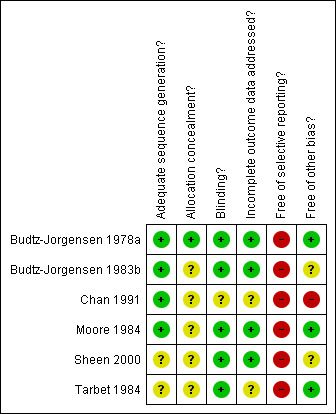
Methodological quality summary: review authors' judgements about each methodological quality item for each included study.
2.
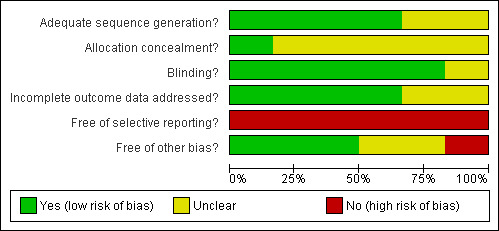
Methodological quality graph: review authors' judgements about each methodological quality item presented as percentages across all included studies.
Effects of interventions
Comparison 1. Enzyme cleanser versus placebo
Only one trial (Budtz‐Jorgensen 1978a) compared these two interventions. After 12 weeks using an enzyme denture cleanser ('E'), 8 of 18 caregivers perceived some improvement in CD cleanliness. After using a placebo solution ('Plac'), only 2 of 17 perceived some improvement (Figure 3). Both interventions reduced biofilm scores after 2 weeks. However, plaque scores were significantly lower for 'E' after 5 weeks (P < 0.05) and 3 months (P < 0.01), as assessed by Chi2 test. Lower hyphal and bacterial scores were also found for 'E' when compared with 'Plac' after 12 weeks. It was not possible to extract adequate data for plaque, hyphal and bacterial scores, as the investigators did not provide standard deviations.
3.

Forest plot of Comparison 1. Enzyme cleanser versus placebo, Outcome 1.1. Improvement on denture cleanliness (Caregivers' opinion).
Comparison 2. Enzyme cleanser versus brushing
Only Budtz‐Jorgensen 1983b compared these two interventions. Standard deviations were not reported for the relevant data so these have not been included in the analysis. Reduction of plaque scores was associated with enzyme concentration (ANOVA, P < 0.001). Brushing alone and immersion in a 500 mg enzyme solution produced similar results; moreover, the association of both methods produced the lowest mean scores.
Comparison 3. Silicone cleanser versus placebo
The investigators in Sheen 2000 compared a silicone surfactant‐based cleanser with a placebo solution for chemical cleansing. The active intervention produced a significantly lower degree of plaque than the placebo, with a mean difference of ‐1.02 units for the visual plaque score (95% confidence interval (CI): ‐1.13 to ‐0.91) (Figure 4) after 2 days, and ‐0.88 units for the visual plaque score (95% CI: ‐1.00 to ‐0.76) (Figure 5) after 14 days. Computerized image assessment of the seven treated areas showed improved results for the silicone cleanser.
4.

Forest plot of Comparison 3. Silicone cleanser versus placebo, Outcome 3.1. Visual plaque score after 2 days.
5.

Forest plot of Comparison 3. Silicone cleanser versus placebo, Outcome 3.2. Visual plaque score after 14 days.
Comparisons 4, 5. Brushing or effervescent tablets versus no treatment
Two studies compared these two interventions.
The Moore 1984 study found that the seven tested methods were similar and resulted in a significant reduction in total aerobes and anaerobes when compared with immersion in distilled water (paired t test, P < 0.05). Some chemical methods (Kleenite, Miller's, and Mersene) and brushing were more efficacious than three soaking methods (Clorox and Calgon, Polident, and Effedent) and distilled water for the reduction of yeasts. No standard deviations were available for these data and thus they have not been entered into the analysis.
Chan 1991 compared brushing and effervescent tablets with no treatment. Mean differences (colony forming units, after log transformation) after brushing were fusobacteria (‐0.89) (Figure 6) and total anaerobes (‐1.06) (Figure 7) (95% CI: ‐1.55 to ‐0.23, and ‐1.39 to ‐0.73, respectively). There was no difference between no treatment and brushing (ANCOVA, P > 0.05) for both outcomes. Comparison between soaking in effervescent solution and no treatment resulted in a mean difference of fusobacteria (‐3.71) (Figure 8) and total anaerobes (‐5.5) (Figure 9) (95% CI: ‐4.16 to ‐3.26, and ‐6.55 to ‐4.45, respectively). The differences were significant for both outcomes (P < 0.01).
6.

Forest plot of Comparison 4. Brushing versus no treatment, Outcome 4.1. Fusobacteria.
7.

Forest plot of Comparison 4. Brushing versus no treatment, Outcome 4.2. Total anaerobes.
8.

Forest plot of Comparison 5. Effervescent tablets versus no treatment, Outcome 5.1. Fusobacteria.
9.

Forest plot of Comparison 5. Effervescent tablets versus no treatment, Outcome 5.2. Total anaerobes.
Comparison 6. Brushing versus effervescent tablets
Two studies compared these two interventions.
The Tarbet 1984 study compared brushing with two effervescent tablets. No standard deviations were reported and therefore no data were entered for this outcome. Brushing was associated with significantly lower plaque scores than the use of tablets (Chi2 test: P < 0.05). Chan 1991 found lower microbial counts after soaking in a effervescent solution. Mean differences were fusobacteria (3.62) (Figure 10) and total anaerobes (4.44) (Figure 11) (95% CI: 2.98 to 4.26, and 3.36 to 5.52, respectively).
10.

Forest plot of Comparison 6. Brushing versus effervescent tablets, Outcome 6.1. Fusobacteria.
11.

Forest plot of Comparison 6. Brushing versus effervescent tablets, Outcome 6.2. Total anaerobes.
Comparisons 7, 8, 9. Association (brushing + effervescent) versus no treatment, brushing and effervescent tablets
One study compared these interventions.
Chan 1991 also compared an association of methods (brushing and soaking in effervescent tablets) with no treatment, brushing and effervescent tablets. The association method and no treatment presented a mean difference of ‐3.75 for fusobacteria (Figure 12) and ‐6.70 for total anaerobes (Figure 13) (95% CI: ‐4.16 to ‐3.34, and ‐7.45 to ‐5.95, respectively). Mean differences between association and brushing were fusobacteria (2.86) (Figure 14) and total anaerobes (5.64) (Figure 15) (95% CI: 2.25 to 3.47, and 4.86 to 6.42, respectively). Comparison between association and effervescent tablets provided lower mean differences, as follows: fusobacteria (0.04) (Figure 16) and total anaerobes (1.20) (Figure 17) (95% CI: ‐0.33 to 0.41, and ‐0.08 to 2.48, respectively).
12.

Forest plot of Comparison 7. Association (brushing + effervescent) versus no treatment, Outcome 7.1. Fusobacteria.
13.

Forest plot of Comparison 7. Association (brushing + effervescent) versus no treatment, Outcome 7.2. Total anaerobes.
14.

Forest plot of Comparison 8. Brushing versus association (brushing + effervescent), Outcome 8.1. Fusobacteria.
15.

Forest plot of Comparison 8. Brushing versus association (brushing + effervescent), Outcome 8.2. Total anaerobes.
16.

Forest plot of Comparison 9. Effervescent tablets versus association (brushing + effervescent), Outcome 9.1. Fusobacteria.
17.

Forest plot of Comparison 9. Effervescent tablets versus association (brushing + effervescent), Outcome 9.2. Total anaerobes.
Pairwise comparisons (Fisher's protected LSD test) found that association was similar to soaking but more effective than the other methods for the reduction of fusobacteria. Regarding the reduction of total anaerobes, the association method was more effective than the others.
Discussion
Denture cleansing has been the subject of extensive search over the years. However, a surprisingly small number of studies was found to be suitable for inclusion in this review. More surprising was the fact that none of those studies specifically assessed the cleansing of removable partial dentures (RPDs).
This review provided some evidence for the effectiveness of several cleansing methods for complete dentures (CDs), but as there was substantial clinical heterogeneity between these studies their results should be interpreted with caution. The settings and characteristics of participants varied extensively: some were institutionalised and others were former patients from university clinics. Interventions were wide ranging, although all studies focused on the use of some form of chemical cleansing method. Based on the results of these studies, enzyme cleansers appeared to be more effective than placebo. This is the only conclusion that can be drawn from primary outcome variables; however, it is based on a single study (Budtz‐Jorgensen 1978a) and the results may not be generalisable.
Another important gap and limitation of this review was the noticeable absence of reports about costs of materials or adverse effects associated with their usage. The use of chemicals could present some form of adverse effect, as the empirically evident aftertaste for sodium hypochlorite, but no study assessed the extent of this problem. Those effects could influence the acceptability of certain treatments by consumers and thus their effectiveness in a daily use setting could be lower than shown by short‐term trials.
The remaining results are based on secondary outcome variables and mostly derived from single studies. It appears that enzyme cleansers were more effective in plaque removal than a placebo solution and can be more effective for long‐term soaking (8 hours) than effervescent tablets; for shorter periods (15 minutes), both options would be equally effective. Enzymatic solutions can also, provided that a minimal concentration is used, remove the same amount of plaque as brushing. This is noteworthy, as long as brushing is able to remove more plaque than alkaline peroxide‐based effervescent tablets. A silicone‐based chemical cleanser was also tested and showed more plaque removal than a placebo solution. One of the drawbacks of this last comparison was the additional use of a special device for chemical cleansing, which might confound outcomes assessment in addition to raising the costs of the intervention. Moreover, there was no parameter for silicone cleansers such as comparing with other active method.
Microbial counts were lower after chemical cleansing for several tested species. Despite the lower clinical relevance of these variables, a noteworthy difference in results was found in two studies (Chan 1991; Moore 1984). Moore 1984 found similar reduction in total aerobes, anaerobes and yeasts for brushing and several chemical methods, whereas Chan 1991 showed better results for chemical cleansers. The last report studied only anaerobes and a certain alkaline peroxide solution; it is known that anaerobes die easily when exposed to oxygen free radicals, which is the main principle of most effervescent tablets. If one considers that aerobes and yeasts are easier to work with, and the support from the chemical cleanser's manufacturer, it is tempting to take selective reporting of outcomes as a possible source of bias for the Chan 1991 trial.
All included studies were classified as presenting high risk of bias mainly due to problems associated with selective outcome reporting. This should be an important concern, as long as trials about denture cleansers could be easily planned for minimizing risk of bias and provide some conclusive results after a short follow up. The possible and effective use of washout periods would enable powerful cross‐over randomised controlled trials. However, this is not the present scenario, where several studies were discarded due to problems on their design or the quality of their reporting. It should also be reinforced that future trials about denture cleansing should adhere to guidelines such as CONSORT in order to provide conclusive evidence. Another important approach to be considered is the planning of trials for measuring adverse effects and costs.
Authors' conclusions
Implications for practice.
There is no evidence that any denture cleaning method is more beneficial for the health of denture bearing areas or patients' satisfaction and preference when compared with another.
Implications for research.
Future studies should be better designed and reported in order to improve their quality. Trials on both independent and institutionalised participants should be developed, and comparisons among methods such as soaking, brushing and their association should be carried out. No included study assessed removable partial denture wearers. The effectiveness of ultrasonic or microwave devices as an intervention for routine use was not studied according to a randomised controlled trial design. An emphasis on secondary variables was noticed, so future trials should include primary outcome measures, cost and adverse effects.
Acknowledgements
The review authors would like to thank the Cochrane Oral Health Group for their help in developing this review.
Appendices
Appendix 1. Cochrane Oral Health Group Trials Register search strategy
denture* AND (dentifrice* or toothpaste* or (denture* and paste*) or "denture clean*" or "denture clens*" or (microwave and disinfect*) or toothbrush* or tooth‐brush* or "tooth brush*" or (denture AND brush*) or (denture* AND soak*) or ((clean* or clens*) AND solution*) or ((ultrasound or ultrasonic*) AND (clean* or clens*)) or "Eladent" or "Kukident" or "Steradent" or "Efferdent" or "Dentu‐creme" or mouthrinse* or mouth‐rinse* or "oral‐rinse*" or "oral rinse*" or mouthwash* or mouth‐wash* or saniti* or decontaminat* or (((denture* AND hygiene) or (plaque AND remov*)) AND denture*))
Appendix 2. CENTRAL search strategy
1. DENTURES/ 2. Exp DENTURE, COMPLETE/ 3. DENTURE,OVERLAY/ 4. Exp DENTURE,PARTIAL/ 5. complete denture* or full denture* 6. part* NEAR/3 denture* 7. OR/1‐6 8. Exp DENTIFRICES/ 9. (denture* NEAR (clean* or clens*)) 10. microwave* NEAR/3 disinfect* 11. toothbrush* or tooth‐brush* or tooth brush* 12. ((denture* NEAR/4 brush*) or (denture* NEAR/4 soak*)) 13. (toothpaste* or dentifrice* or (denture NEAR/3 paste*)) 14. (((clean* or clens*) NEAR solution*) or (clean* NEAR ultrasound) or (clean* NEAR ultrasonic*)) 15. Eladent or Kukident or Steradent or Efferdent or Dentu‐Creme 16. mouthrinse* or mouth‐rinse* or oral rinse* or mouthwash* or mouth‐wash* 17. saniti* 18. decontaminat* 19. ((denture NEAR/4 hygiene) or ((plaque NEAR/4 remov*) AND denture*)) 20. OR/8‐19 21. 7 AND 20
Appendix 3. MEDLINE via OVID search strategy
1. DENTURES/ 2. Exp DENTURE, COMPLETE/ 3. DENTURE,OVERLAY/ 4. Exp DENTURE,PARTIAL/ 5. complete denture$ or full denture$ 6. part$ adj3 denture$ 7. OR/1‐6 8. Exp DENTIFRICES/ 9. (denture$ adj6 (clean$ or clens$)) 10. microwave$ adj3 disinfect$ 11. toothbrush$ or tooth‐brush$ or tooth brush$ 12. ((denture$ adj4 brush$) or (denture$ adj4 soak$)) 13. (toothpaste$ or dentifrice$ or (denture adj3 paste$)) 14. (((clean$ or clens$) adj6 solution$) or (clean$ adj6 ultrasound) or (clean$ adj6 ultrasonic$)) 15. Eladent or Kukident or Steradent or Efferdent or Dentu‐Creme 16. mouthrinse$ or mouth‐rinse$ or oral rinse$ or mouthwash$ or mouth‐wash$ 17. saniti$ 18. decontaminat$ 19. ((denture adj4 hygiene) or ((plaque adj4 remov$) AND denture$)) 20. OR/8‐19 21. 7 AND 20
Appendix 4. EMBASE via OVID search strategy
1. Dentures/ 2. Denture, Overlay/ 3. exp Denture, Complete/ 4. exp Denture, Partial/ 5. ("complete denture$" or "full denture$").mp. [mp=title, original title, abstract, name of substance word, subject heading word] 6. (part$ adj3 denture$).mp. [mp=title, original title, abstract, name of substance word, subject heading word] 7. or/1‐6 8. exp Dentifrices/ 9. (denture$ adj6 (clean$ or clens$)).mp. [mp=title, original title, abstract, name of substance word, subject heading word] 10. (microwave$ adj3 disinfect$).mp. [mp=title, original title, abstract, name of substance word, subject heading word] 11. (toothbrush$ or tooth‐brush$ or "tooth brush$").mp. [mp=title, original title, abstract, name of substance word, subject heading word] 12. ((denture$ adj4 brush$) or (denture$ adj4 soak$)).mp. [mp=title, original title, abstract, name of substance word, subject heading word] 13. (toothpaste$ or dentifrice$ or (denture$ adj4 paste$)).mp. [mp=title, original title, abstract, name of substance word, subject heading word] 14. (((clean$ or clens$) adj6 solution$) or (clean$ adj6 ultrasouns) or (clean$ adj6 ultrasonic$)).mp. [mp=title, original title, abstract, name of substance word, subject heading word] 15. (Eladent or Kukident or Steradent or Efferdent or Dentu‐Creme).mp. [mp=title, original title, abstract, name of substance word, subject heading word] 16. (mouthrinse$ or mouth‐rinse$ or "oral rinse$" or mouthwash$ or mouth‐wash$).mp. [mp=title, original title, abstract, name of substance word, subject heading word] 17. saniti$.mp. [mp=title, original title, abstract, name of substance word, subject heading word] 18. decontaminat$.mp. [mp=title, original title, abstract, name of substance word, subject heading word] 19. ((denture adj4 hygiene) or ((plaque adj4 remov$) and denture$)).mp. [mp=title, original title, abstract, name of substance word, subject heading word] 20. or/8‐19 21. 7 and 20
Filter for EMBASE via OVID
1. random$.ti,ab. 2. factorial$.ti,ab. 3. (crossover$ or cross over$ or cross‐over$).ti,ab. 4. placebo$.ti,ab. 5. (doubl$ adj blind$).ti,ab. 6. (singl$ adj blind$).ti,ab. 7. assign$.ti,ab. 8. allocat$.ti,ab. 9. volunteer$.ti,ab. 10. CROSSOVER PROCEDURE.sh. 11. DOUBLE‐BLIND PROCEDURE.sh. 12. RANDOMIZED CONTROLLED TRIAL.sh. 13. SINGLE BLIND PROCEDURE.sh. 14. or/1‐13 15. ANIMAL/ or NONHUMAN/ or ANIMAL EXPERIMENT/ 16. HUMAN/ 17. 16 and 15 18. 15 not 17 19. 14 not 18
Appendix 5. LILACS search strategy
1. DENTURES [Palavras] 2. DENTURE, COMPLETE [Palavras] 3. DENTURE,OVERLAY [Palavras] 4. DENTURE, PARTIAL [Palavras] 5. complete denture$ [Palavras] or full denture$ [Palavras] 6. part$ denture$ [Palavras] 7. OR/1‐6 8. DENTIFRICES [Palavras] 9. denture$ [Palavras] and (clean$ or clens$) [Palavras] 10. microwave$ [Palavras] and disinfect$ [Palavras] 11. toothbrush$ or tooth‐brush$ or "tooth brush$" [Palavras] 12. ((denture$ and brush$) or (denture$ and soak$)) [Palavras] 13. (toothpaste$ or dentifrice$ or (denture and paste$)) [Palavras] 14. (((clean$ or clens$) and solution$) or (clean$ and ultrasound) or (clean$ and ultrsonic$)) [Palavras] 15. Eladent or Kukident or Steradent or Efferdent or Dentu‐Creme [Palavras] 16. mouthrinse$ or mouth‐rinse$ or "oral rinse$" or mouthwash$ or mouth‐wash$ [Palavras] 17. saniti$ [Palavras] 18. decontaminat$ [Palavras] 19. ((denture and hygiene) or ((plaque and remov$) AND denture$)) [Palavras] 20. OR/8‐19 21. 7 AND 20
Appendix 6. CINAHL search strategy
1. DENTURES 2. COMPLETE DENTURE 3. OVERLAY DENTURE 4. PARTIAL DENTURE 5. complete denture$ or full denture$ 6. part$ and denture$ 7. OR/1‐6 8. DENTIFRICES 9. (denture$ and (clean$ or clens$)) 10. microwave$ and disinfect$ 11. toothbrush$ or tooth‐brush$ or tooth brush$ 12. ((denture$ and brush$) or (denture$ and soak$)) 13. (toothpaste$ or dentifrice$ or (denture and paste$)) 14. (((clean$ or clens$) and solution$) or (clean$ and ultrasound) or (clean$ and ultrasonic$)) 15. Eladent or Kukident or Steradent or Efferdent or Dentu‐Creme 16. mouthrinse$ or mouth‐rinse$ or oral rinse$ or mouthwash$ or mouth‐wash$ 17. saniti$ 18. decontaminat$ 19. ((denture and hygiene) or ((plaque and remov$) AND denture$)) 20. OR/8‐19 21. 7 AND 20
Data and analyses
Comparison 1. Enzyme cleanser versus placebo.
| Outcome or subgroup title | No. of studies | No. of participants | Statistical method | Effect size |
|---|---|---|---|---|
| 1 Improvement on denture cleanliness (Caregivers' opinion) | 1 | Risk Ratio (M‐H, Random, 95% CI) | Totals not selected |
1.1. Analysis.
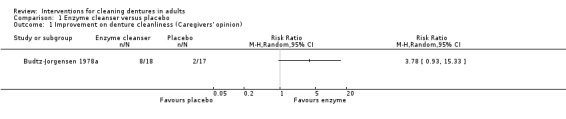
Comparison 1 Enzyme cleanser versus placebo, Outcome 1 Improvement on denture cleanliness (Caregivers' opinion).
Comparison 3. Silicone cleanser versus placebo.
| Outcome or subgroup title | No. of studies | No. of participants | Statistical method | Effect size |
|---|---|---|---|---|
| 1 Visual plaque score after 2 days | 1 | Mean Difference (IV, Random, 95% CI) | Totals not selected | |
| 2 Visual plaque score after 14 days | 1 | Mean Difference (IV, Random, 95% CI) | Totals not selected |
3.1. Analysis.
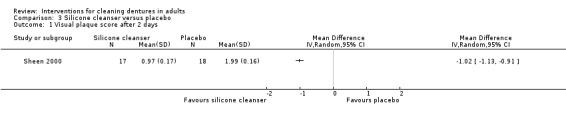
Comparison 3 Silicone cleanser versus placebo, Outcome 1 Visual plaque score after 2 days.
3.2. Analysis.

Comparison 3 Silicone cleanser versus placebo, Outcome 2 Visual plaque score after 14 days.
Comparison 4. Brushing versus no treatment.
| Outcome or subgroup title | No. of studies | No. of participants | Statistical method | Effect size |
|---|---|---|---|---|
| 1 Fusobacteria | 1 | Mean Difference (IV, Random, 95% CI) | Totals not selected | |
| 2 Total anaerobes | 1 | Mean Difference (IV, Random, 95% CI) | Totals not selected |
4.1. Analysis.

Comparison 4 Brushing versus no treatment, Outcome 1 Fusobacteria.
4.2. Analysis.
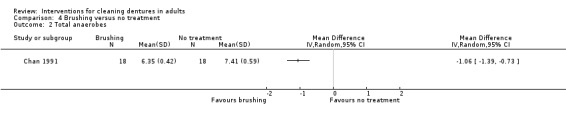
Comparison 4 Brushing versus no treatment, Outcome 2 Total anaerobes.
Comparison 5. Effervescent tablets versus no treatment.
| Outcome or subgroup title | No. of studies | No. of participants | Statistical method | Effect size |
|---|---|---|---|---|
| 1 Fusobacteria | 1 | Mean Difference (IV, Random, 95% CI) | Totals not selected | |
| 2 Total anaerobes | 1 | Mean Difference (IV, Random, 95% CI) | Totals not selected |
5.1. Analysis.
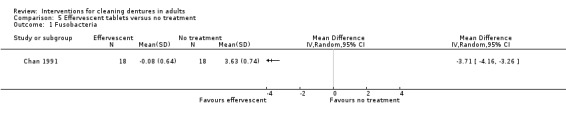
Comparison 5 Effervescent tablets versus no treatment, Outcome 1 Fusobacteria.
5.2. Analysis.

Comparison 5 Effervescent tablets versus no treatment, Outcome 2 Total anaerobes.
Comparison 6. Brushing versus effervescent tablets.
| Outcome or subgroup title | No. of studies | No. of participants | Statistical method | Effect size |
|---|---|---|---|---|
| 1 Fusobacteria | 1 | Mean Difference (IV, Random, 95% CI) | Totals not selected | |
| 2 Total anaerobes | 1 | Mean Difference (IV, Random, 95% CI) | Totals not selected |
6.1. Analysis.
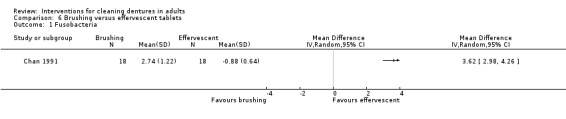
Comparison 6 Brushing versus effervescent tablets, Outcome 1 Fusobacteria.
6.2. Analysis.
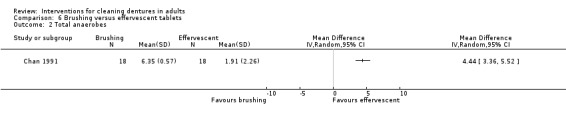
Comparison 6 Brushing versus effervescent tablets, Outcome 2 Total anaerobes.
Comparison 7. Association (brushing + effervescent) versus no treatment.
| Outcome or subgroup title | No. of studies | No. of participants | Statistical method | Effect size |
|---|---|---|---|---|
| 1 Fusobacteria | 1 | Mean Difference (IV, Random, 95% CI) | Totals not selected | |
| 2 Total anaerobes | 1 | Mean Difference (IV, Random, 95% CI) | Totals not selected |
7.1. Analysis.
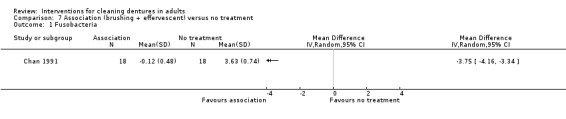
Comparison 7 Association (brushing + effervescent) versus no treatment, Outcome 1 Fusobacteria.
7.2. Analysis.

Comparison 7 Association (brushing + effervescent) versus no treatment, Outcome 2 Total anaerobes.
Comparison 8. Brushing versus association (brushing + effervescent).
| Outcome or subgroup title | No. of studies | No. of participants | Statistical method | Effect size |
|---|---|---|---|---|
| 1 Fusobacteria | 1 | Mean Difference (IV, Random, 95% CI) | Totals not selected | |
| 2 Total anaerobes | 1 | Mean Difference (IV, Random, 95% CI) | Totals not selected |
8.1. Analysis.

Comparison 8 Brushing versus association (brushing + effervescent), Outcome 1 Fusobacteria.
8.2. Analysis.
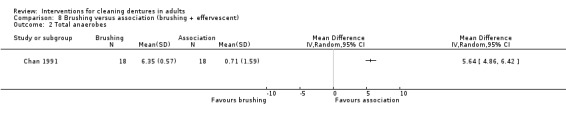
Comparison 8 Brushing versus association (brushing + effervescent), Outcome 2 Total anaerobes.
Comparison 9. Effervescent tablets versus association (brushing + effervescent).
| Outcome or subgroup title | No. of studies | No. of participants | Statistical method | Effect size |
|---|---|---|---|---|
| 1 Fusobacteria | 1 | Mean Difference (IV, Random, 95% CI) | Totals not selected | |
| 2 Total anaerobes | 1 | Mean Difference (IV, Random, 95% CI) | Totals not selected |
9.1. Analysis.
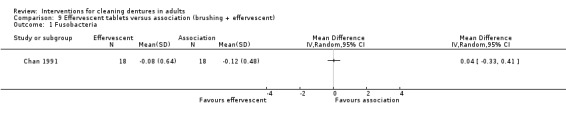
Comparison 9 Effervescent tablets versus association (brushing + effervescent), Outcome 1 Fusobacteria.
9.2. Analysis.
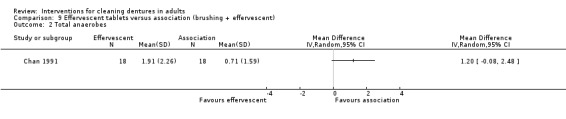
Comparison 9 Effervescent tablets versus association (brushing + effervescent), Outcome 2 Total anaerobes.
Characteristics of studies
Characteristics of included studies [ordered by study ID]
Budtz‐Jorgensen 1978a.
| Methods | A parallel group trial in Denmark. Participants were "assigned randomly to either an enzyme group (Group E) or a placebo group (Group Plac)". No further information about sequence generation was provided. 5 participants (2 in Group E and 3 in Group Plac) did not complete the study ‐ 1 had died and 4 were not cooperative. Low level of drop outs/losses. |
|
| Participants | Institutionalised people, older than 70 years. Routine denture cleansing was performed by their caregivers (nurses) once daily using brush and soap; 40% kept their dentures in water overnight. No description of gender, all were CD wearers. Group E: n = 18, Group Plac: n = 17; routine hygiene was continued during the trial. |
|
| Interventions | Group E: enzyme tablet (protease + mutanase) in 150 mL of warm water (37º C). Soaking once per day for 15 minutes. Intervention was carried out during 3 months by caregivers. Group Plac: similar to Group E, except for the use of a placebo tablet. |
|
| Outcomes | Assessment immediately after the 3 months period. 1. Caregivers' opinion. 2. Visual plaque score (range: 0‐4). 3. Presence of bacteria and candida cells in smears from maxillary CD internal surface (score; range: 0‐3). |
|
| Notes | ||
| Risk of bias | ||
| Bias | Authors' judgement | Support for judgement |
| Adequate sequence generation? | Low risk | After contacting the corresponding author. |
| Allocation concealment? | Low risk | After contacting the corresponding author. |
| Blinding? All outcomes | Low risk | (a) Participants: Yes. (b) Researcher: Unclear. (c) Outcome assessor: Yes. (d) Data analyst: Unclear. |
| Incomplete outcome data addressed? All outcomes | Low risk | Adequate description of losses. |
| Free of selective reporting? | High risk | This study considered several expected outcomes. However, several outcomes were reported incompletely and could not be entered into a meta‐analysis. |
| Free of other bias? | Low risk | No other evident source of bias. |
Budtz‐Jorgensen 1983b.
| Methods | A Latin‐square RCT in Denmark. The authors cite that the sequence of interventions was randomised, but do not explain how. | |
| Participants | 17 participants (9 women; mean age: 61.4±7.6 years) wearing maxillary and mandibular complete dentures. Their experience as denture wearers consisted on 21.6±8.8 years. Inclusion criteria were (1) wearing complete dentures for more than 10 years; (2) healthy palatal mucosa; and (3) visible plaque on the fitting surface of maxillary denture. |
|
| Interventions | A chemical cleanser (150 mL) combining different concentrations of an enzyme (0, 15, 30, 60, 100, 300, 500 or 1000 mg) and detergent (0 or 1000 mg), and denture brushing. Chemical cleansers were used once daily for 15 minutes and brushing as usual before enrolment. Both were employed during 1 week periods by the participants. |
|
| Outcomes | Denture plaque coverage area on the fitting surface. Determined visually by examiners according to 10% intervals (0‐100%). | |
| Notes | ||
| Risk of bias | ||
| Bias | Authors' judgement | Support for judgement |
| Adequate sequence generation? | Low risk | "The sequence of treatments for each subject was randomized". |
| Allocation concealment? | Unclear risk | Unclear. |
| Blinding? All outcomes | Low risk | (a) Participants: Yes. (b) Researcher: Unclear. (c) Outcome assessor: Yes. (d) Data analyst: Unclear. |
| Incomplete outcome data addressed? All outcomes | Low risk | A‐ Yes (11 participants completed all 14 treatment periods). |
| Free of selective reporting? | High risk | Incompletely reported outcome. |
| Free of other bias? | Unclear risk | Although no sponsorship was declared in the report, the enzyme tablets were prepared by a private manufacturer for the study. |
Chan 1991.
| Methods | Latin‐square trial in Canada, with no further information about the research setting. Participants "were randomly assigned to one of four treatment regimens". | |
| Participants | 18 participants without description of how many were initially enrolled. They were older than 18 years and of both genders, but no further description was available. Inclusion criteria: maxillary CD wearers, not taking systemic antibiotics or steroidal antiinflammatory drugs. Dentures should present intact surfaces and no relining. Participants should refrain from denture cleansing for 48 hours before each intervention. |
|
| Interventions | Each intervention was applied once after the 48‐hour period without cleansing. Outcome assessment was carried out immediately after. A: No cleansing method. B: Brushing with dentifrice for removable dentures. C: Soaking in effervescent cleanser. D: 'B' followed by 'C'. |
|
| Outcomes | Counting of fusobacteria and total anaerobe bacteria collected by swab of the internal side of dentures. This measure was assessed after log10 transformation. | |
| Notes | This study was supported by a grant from a private company. | |
| Risk of bias | ||
| Bias | Authors' judgement | Support for judgement |
| Adequate sequence generation? | Low risk | Interventions were "assigned by random code". |
| Allocation concealment? | Unclear risk | Unclear. |
| Blinding? All outcomes | Unclear risk | (a) Participants: Not applicable. (b) Researcher: Unclear. (c) Outcome assessor: Unclear. (d) Data analyst: Unclear. |
| Incomplete outcome data addressed? All outcomes | Unclear risk | Unclear. |
| Free of selective reporting? | High risk | The study provided only data about anaerobes and fusobacteria, whereas aerobe bacteria and candida species would be more clinically relevant. The latter species would be less affected by oxygen free radicals, which constitutes the mechanism of action for the chemical method tested. |
| Free of other bias? | High risk | The high risk of selective reporting is associated with funding by private company. Results are probably influenced by conflict of interest. |
Moore 1984.
| Methods | Latin‐square RCT conducted in the USA. Several issues associated with control of bias, i.e. sequence generation, blinding and handling of withdrawals, are well described. | |
| Participants | 12 participants wearing at least 1 complete denture with acrylic resin bases, enrolled from a nursing home. Inclusion criteria comprised willingness to participate, dentures with more than 1 year of use, and at least 10 hours/day of denture wearing. Before the interventions, participants should be wearing their dentures as usual, storing them in tap water when removed. No abrasive or chemical cleanser should be used during the study, other than the ones assigned by the researchers. |
|
| Interventions | Soaking in 6 chemical cleansers (1‐ Mersene; 2‐ Polident; 3‐ Efferdent; 4‐ Miller's; 5‐ Kleenite; 6‐ Clorox+Calgon). Other interventions were 7‐ brushing with soap and 8‐ soaking in distilled water. The duration was 30 minutes for each, except for 7 (60 seconds). Each intervention was carried out once by the researchers, and outcome assessment was done immediately after. |
|
| Outcomes | Microbial colony counts from denture's impression surface. Total aerobes, anaerobes and yeasts were assessed. | |
| Notes | Supported by a governmental funding agency. | |
| Risk of bias | ||
| Bias | Authors' judgement | Support for judgement |
| Adequate sequence generation? | Low risk | Interventions were predetermined from a table of random numbers. |
| Allocation concealment? | Unclear risk | Unclear. |
| Blinding? All outcomes | Low risk | (a) Participants: Yes. (b) Researcher: Not applicable. (c) Outcome assessor: Yes. (d) Data analyst: No. |
| Incomplete outcome data addressed? All outcomes | Low risk | The report describes that 2 participants decided not to return after the second appointment. |
| Free of selective reporting? | High risk | Although the authors attempted a comprehensive assessment of microbial variables, outcomes were incompletely reported. |
| Free of other bias? | Low risk | No other evident source of bias. |
Sheen 2000.
| Methods | Parallel group trial in the UK, with a 7 days run‐in period. Allocation method was not described. | |
| Participants | Healthy adults wearing maxillary and mandibular CDs for at least 1 year. 40 participants were enrolled from the University of Bristol Dental School ‐ Clinical Trial Unit, but 3 were excluded before the study started and 2 violated the protocol. Use of intention‐to‐treat analysis was reported. Active group: n = 17; Control group: n = 18. 14 men (mean age: 74.6 years; range: 60‐87) and 21 women (mean age: 70.95 years; range: 60‐78). Inclusion criteria: no antibiotics within 14 days and prebaseline denture plaque score different to 0. Participants wearing porous CDs were excluded. Participants continued brushing during the study. |
|
| Interventions | Soaking in silicone surfactant‐based denture cleansing solution (active) or water (control), once a day during 15 minutes. Assessment immediately after 2 and 14 days of use. Interventions were carried out by the participant, by soaking in a special device. |
|
| Outcomes | Amount of biofilm was assessed after staining by fluorescein. 2 variables (1‐ Plaque coverage area by computerized image assessment 7 regions of interest from each maxillary CD; 2‐ Visual plaque score ‐ possible range: 0‐4) were studied. | |
| Notes | Financial support from a private company. | |
| Risk of bias | ||
| Bias | Authors' judgement | Support for judgement |
| Adequate sequence generation? | Unclear risk | Unclear. |
| Allocation concealment? | Unclear risk | Unclear. |
| Blinding? All outcomes | Low risk | (a) Participants: Unclear. (b) Researcher: Unclear. (c) Outcome assessor: Yes. (d) Data analyst: Unclear. |
| Incomplete outcome data addressed? All outcomes | Low risk | A clear description of withdrawals and losses was provided, and intention‐to‐treat analysis was attempted. |
| Free of selective reporting? | High risk | Only biofilm coverage area was assessed. |
| Free of other bias? | Unclear risk | It is unclear how the sponsorship of this study could have influenced results. |
Tarbet 1984.
| Methods | Parallel group trial in the USA. Participants "assigned on a random base" (method not specified). Denture hygiene was suspended by 2 weeks before the trial (run‐in period). No description of enrolment, source of recruitment or losses. Blinding of outcome assessor was cited in the study. | |
| Participants | 75 participants completed the trial. They were maxillary CD wearers, divided into 3 groups, according to the chemical denture cleansers tested (A: n = 24; B: n = 25; C: n = 26). Other hygiene methods were prohibited except for overnight soaking in water. Participants with visual plaque score lower than 2 after run‐in were excluded. Further details about participants were not described. |
|
| Interventions | A and B: 2 brands of effervescent tablets, used during 12 weeks by the participant. C: brushing with low‐abrasion dentifrice. No further information about interventions were available, i.e. frequency of use, except that they should be used according to their manufacturers. |
|
| Outcomes | Visual plaque score (possible range: 0‐4), after disclosing. | |
| Notes | ||
| Risk of bias | ||
| Bias | Authors' judgement | Support for judgement |
| Adequate sequence generation? | Unclear risk | Unclear. |
| Allocation concealment? | Unclear risk | Unclear. |
| Blinding? All outcomes | Low risk | (a) Participants: Unclear. (b) Researcher: Unclear. (c) Outcome assessor: Yes. (d) Data analyst: Unclear. |
| Incomplete outcome data addressed? All outcomes | Unclear risk | Unclear. |
| Free of selective reporting? | High risk | Only biofilm coverage area was assessed. Incomplete outcome data. |
| Free of other bias? | Low risk | No other evident source of bias. |
CD = complete dentures; RCT = randomised controlled trial.
Characteristics of excluded studies [ordered by study ID]
| Study | Reason for exclusion |
|---|---|
| Abelson 1981 | Poor quality and incomplete data. |
| Augsburger 1982 | Poor quality and incomplete data. |
| Barnabé 2004 | Participants could not be considered. |
| Budtz‐Jorgensen 1977a | Participants could not be considered. |
| Budtz‐Jorgensen 1977b | Participants could not be considered. |
| Budtz‐Jorgensen 1978b | Participants could not be considered. |
| Budtz‐Jorgensen 1984 | Poor quality and incomplete data. |
| Chamberlain 1985 | Interventions outside the criteria of this review. |
| Connor 1977 | In situ study with gold disks on complete denture bases, with incomplete data. |
| Ghalichebaf 1982 | Poor quality and incomplete data. |
| Glass 2001 | Non RCT. |
| Gornitsky 2002 | Comparisons were not randomised. |
| Hedegard 1976 | Poor quality, participants could not be considered. |
| Ito 1998 | Non RCT. |
| Katay 1987 | Poor quality, interventions outside the criteria of this review. |
| Lima 2006 | In situ study with dentate participants wearing palatal appliances (no removable denture wearer). |
| Murray 1986 | No outcome variable could be considered. |
| Murray 1995 | Comparisons were not randomised. |
| Mähönen 1998 | Poor quality and incomplete data. |
| Paranhos 2007 | Sequence generation was not adequate. |
| Salles 2007 | Non RCT. |
RCT = randomised controlled trial.
Contributions of authors
Raphael F de Souza (RF), Helena de Freitas O Paranhos (HF), Zbys Fedorowicz (ZF), Cem A Gurgan (CG) and Claudia H Lovato da Silva (CL) were responsible for designing and co‐ordinating the review. HF and CL organised the retrieval of papers. RF, Layla Abu‐Naba'a (LA), CL and CG were responsible for: writing to authors of papers for additional information; screening search results; screening retrieved papers against inclusion criteria; appraising the quality of papers; data collection for the review; obtaining and screening data on unpublished studies. RF and ZF were responsible for: obtaining copies of trials; extracting data from papers and entering the data into RevMan. All review authors contributed to analysis and interpretation of the data, and to writing the review. RF and HF conceived the idea for the review and are the guarantors for the review.
Declarations of interest
None known.
New
References
References to studies included in this review
Budtz‐Jorgensen 1978a {published data only}
- Budtz‐Jorgensen E. A 3‐months' study of enzymes as denture cleansers. British Dental Journal 1978;145(8):226. [DOI] [PubMed] [Google Scholar]
- Budtz‐Jorgensen E. A 3‐months' study of enzymes as denture cleansers. Journal of Oral Rehabilitation 1978;5(1):35‐9. [DOI] [PubMed] [Google Scholar]
Budtz‐Jorgensen 1983b {published data only}
- Budtz‐Jørgensen E, Kelstrup J, Poulsen S. Reduction of formation of denture plaque by a protease (Alcalase). Acta Odontologica Scandinavica 1983;41(2):93‐8. [DOI] [PubMed] [Google Scholar]
Chan 1991 {published data only}
- Chan EC, Iugovaz I, Siboo R, Bilyk M, Barolet R, Amsel R, et al. Comparison of two popular methods for removal and killing of bacteria from dentures. Journal of the Canadian Dental Association 1991;57(12):937‐9. [PubMed] [Google Scholar]
Moore 1984 {published data only}
- Moore TC, Smith DE, Kenny GE. Sanitization of dentures by several denture hygiene methods. Journal of Prosthetic Dentistry 1984;52(2):158‐63. [DOI] [PubMed] [Google Scholar]
Sheen 2000 {published data only}
- Sheen SR, Harrison A. Assessment of plaque prevention on dentures using an experimental cleanser. Journal of Prosthetic Dentistry 2000;84(6):594‐601. [DOI] [PubMed] [Google Scholar]
Tarbet 1984 {published data only}
- Tarbet WJ, Axelrod S, Minkoff S, Fratarcangelo PA. Denture cleansing: a comparison of two methods. Journal of Prosthetic Dentistry 1984;51(3):322‐5. [DOI] [PubMed] [Google Scholar]
References to studies excluded from this review
Abelson 1981 {published data only}
- Abelson DC. Denture plaque and denture cleansers. Journal of Prosthetic Dentistry 1981;45(4):376‐9. [DOI] [PubMed] [Google Scholar]
Augsburger 1982 {published data only}
- Augsburger RH, Elahi JM. Evaluation of seven proprietary denture cleansers. Journal of Prosthetic Dentistry 1982;47(4):356‐9. [DOI] [PubMed] [Google Scholar]
Barnabé 2004 {published data only}
- Barnabé W, Mendonça Neto T, Pimenta FC, Pegoraro LF, Scolaro JM. Efficacy of sodium hypochlorite and coconut soap used as disinfecting agents in the reduction of denture stomatitis, Streptococcus mutans and Candida albicans. Journal of Oral Rehabilitation 2004;31(5):453‐9. [DOI] [PubMed] [Google Scholar]
Budtz‐Jorgensen 1977a {published data only}
- Budtz‐Jorgensen E. Prevention of denture plaque formation by an enzyme denture cleanser. Journal de Biologie Buccale 1977;5(3):239‐44. [PubMed] [Google Scholar]
Budtz‐Jorgensen 1977b {published data only}
- Budtz‐Jörgensen E, Kelstrup J. Enzymes as denture cleansers. Scandinavian Journal of Dental Research 1977;85(3):209‐15. [DOI] [PubMed] [Google Scholar]
Budtz‐Jorgensen 1978b {published data only}
- Budtz‐Jorgensen E, Milton Knudsen A. Chlorhexidine gel and Steradent employed in cleaning dentures. Acta Odontologica Scandinavica 1978;36(2):83‐7. [DOI] [PubMed] [Google Scholar]
Budtz‐Jorgensen 1984 {published data only}
- Budtz‐Jorgensen E, Attström R. A clinical evaluation of octapinol as a denture cleanser. Journal of Dental Research 1983;62(April (Divisional Abstracts)):495 (Abs No 128). [Google Scholar]
- Budtz‐Jorgensen E, Attström R. The effect of Octapinol, a substance with low antibacterial activity, on denture plaque and denture‐induced stomatitis. Clinical Preventive Dentistry 1984;6(1):23‐7. [PubMed] [Google Scholar]
Chamberlain 1985 {published data only}
- Chamberlain BB, Bernier SH, Bloem TJ, Razzoog ME. Denture plaque control and inflammation in the edentulous patient. Journal of Prosthetic Dentistry 1985;54(1):78‐81. [DOI] [PubMed] [Google Scholar]
Connor 1977 {published data only}
- Connor JN, Schoenfeld CM, Taylor RL. An evaluation of an enzyme denture cleanser. Journal of Prosthetic Dentistry 1977;37(2):147‐57. [DOI] [PubMed] [Google Scholar]
Ghalichebaf 1982 {published data only}
- Ghalichebaf M, Graser GN, Zander HA. The efficacy of denture‐cleansing agents. Journal of Prosthetic Dentistry 1982;48(5):515‐20. [DOI] [PubMed] [Google Scholar]
Glass 2001 {published data only}
- Glass RT, Goodson LB, Bullard JW, Conrad RS. Comparison of the effectiveness of several denture sanitizing systems: a clinical study. Compendium of Continuing Education in Dentistry 2001;22(12):1093‐6. [PubMed] [Google Scholar]
Gornitsky 2002 {published data only}
- Gornitsky M, ParadisI I, Landaverde G, Malo AM, Velly AM. A clinical and microbiological evaluation of denture cleansers for geriatric patients in long‐term care institutions. Journal of the Canadian Dental Association 2002;68(1):39‐45. [PubMed] [Google Scholar]
Hedegard 1976 {published data only}
- Hedegard B. Clinical evaluation of an hygiene program for patients with denture stomatitis [Klinische Wertung eines Hygieneprogamms für Patien‐. ten mit Prothesenstomatitis]. Deutsche zahnärztliche Zeitschrift 1976;31(2):156‐8. [PubMed] [Google Scholar]
Ito 1998 {published and unpublished data}
- Ito IY, Paranhos HFO, Candido RG, Lara EHG, Panzeri H. DENTAFRICIO "formulated paste" on the denture biofilm remotion after 180 and 360 days. Journal of Dental Research 1998;77(June Special Abstract Issue B):989 (Abs No 2857). [Google Scholar]
Katay 1987 {published data only}
- Katay L, Kerschbaum T. Intensive care for patients with removable dentures. Results after the 2d study‐year [Intensivbetreuung von Patienten mit herausnehmbarem Zahnersatz]. Deutsche zahnärztliche Zeitschrift 1987;42(4):330‐3. [PubMed] [Google Scholar]
Lima 2006 {published data only}
- Lima EM, Moura JS, Bel Cury AA, Garcia RC, Cury JA. Effect of enzymatic and NaOCl treatments on acrylic roughness and on biofilm accumulation. Journal of Oral Rehabilitation 2006;33(5):356‐62. [DOI] [PubMed] [Google Scholar]
Murray 1986 {published data only}
- Murray ID, McCabe JF, Storer R. Abrasivity of denture cleaning pastes in vitro and in situ. British Dental Journal 1986;161(4):137‐41. [DOI] [PubMed] [Google Scholar]
Murray 1995 {published data only}
- McCabe JF, Murray ID, Kelly PJ. The efficacy of denture cleansers. European Journal of Prosthodontics and Restorative Dentistry 1995;3(5):203‐7. [PubMed] [Google Scholar]
- Murray ID, McCabe JF. Efficacy of denture cleansing agents. Journal of Dental Research 1994;73(Special Issue IADR Abstracts):286 (Abs No 1478). [Google Scholar]
Mähönen 1998 {published data only}
- Mähönen K, Virtanen K, Larmas M. The effect of prosthesis disinfection on salivary microbial levels. Journal of Oral Rehabilitation 1998;25(4):304‐10. [DOI] [PubMed] [Google Scholar]
Paranhos 2007 {published and unpublished data}
- Paranhos HF, Silva‐Lovato CH, Souza RF, Cruz PC, Freitas KM, Peracini A. Effects of mechanical and chemical methods on denture biofilm accumulation. Journal of Oral Rehabilitation 2007;34(8):606‐12. [DOI] [PubMed] [Google Scholar]
Salles 2007 {published data only}
- Salles AE, Macedo LD, Fernandes RA, Silva‐Lovato CH, Paranhos Hde F. Comparative analysis of biofilm levels in complete upper and lower dentures after brushing associated with specific denture paste and neutral soap. Gerodontology 2007;24(4):217‐23. [DOI] [PubMed] [Google Scholar]
Additional references
Basson 1992
- Basson NJ, Quick AN, Thomas CJ. Household products as sanitising agents in denture cleansing. Journal of the Dental Association of South Africa 1992;47(10):437‐9. [PubMed] [Google Scholar]
Castro 1997
- Castro AA, Clark OA, Atallah AN. Optimal search strategy for clinical trials in the Latin American and Caribbean Health Science Literature Database (LILACS). Sao Paulo Medical Journal 1997;115(5):1423‐6. [DOI] [PubMed] [Google Scholar]
Castro 1999
- Castro AA, Clark OA, Atallah AN. Optimal search strategy for clinical trials in the Latin American and Caribbean Health Science Literature Database (LILACS database): update. Sao Paulo Medical Journal 1999;117(3):138‐9. [DOI] [PubMed] [Google Scholar]
Chan 1991
- Chan EC, Iugovaz I, Siboo R, Bilyk M, Barolet R, Amsel R, et al. Comparison of two popular methods for removal and killing of bacteria from dentures. Journal of the Canadian Dental Association 1991;57(12):937‐9. [PubMed] [Google Scholar]
Egger 1997
- Egger M, Davey Smith G, Schneider M, Minder C. Bias in meta‐analysis detected by a simple, graphical test. BMJ 1997;315(7109):629‐34. [DOI] [PMC free article] [PubMed] [Google Scholar]
Grusovin 2008
- Grusovin MG, Coulthard P, Jourabchian E, Worthington HV, Esposito MA. Interventions for replacing missing teeth: maintaining and recovering soft tissue health around dental implants. Cochrane Database of Systematic Reviews 2008, Issue 1. [Art. No.: CD003069. DOI: 10.1002/14651858.CD003069.pub3] [DOI] [PubMed] [Google Scholar]
Haselden 1998
- Haselden CA, Hobkirk JA, Pearson GJ, Davies EH. A comparison between the wear resistance of three types of denture resin to three different dentifrices. Journal of Oral Rehabilitation 1998;25(5):335‐9. [DOI] [PubMed] [Google Scholar]
Higgins 2003
- Higgins JP, Thompson SG, Deeks JJ, Altman DG. Measuring inconsistency in meta‐analyses. BMJ 2003;327(7414):557‐60. [DOI] [PMC free article] [PubMed] [Google Scholar]
Higgins 2008
- Higgins JPT, Green S (editors). Cochrane Handbook for Systematic Reviews of Interventions Version 5.0.1 [updated September 2008]. The Cochrane Collaboration, 2008. Available from www.cochrane‐handbook.org.
Jagger 1995
- Jagger DC, Harrison A. Denture cleansing‐the best approach. British Dental Journal 1995;178(11):413‐7. [DOI] [PubMed] [Google Scholar]
Jeganathan 1996
- Jeganathan S, Thean HP, Thong KT, Chan YC, Singh M. A clinically viable index for quantifying denture plaque. Quintessence International 1996;27(8):569‐73. [PubMed] [Google Scholar]
Keng 1996
- Keng SB, Lim M. Denture plaque distribution and the effectiveness of a perborate‐containing denture cleanser. Quintessence International 1996;27(5):341‐5. [PubMed] [Google Scholar]
Kulak‐Ozkan 2002
- Kulak‐Ozkan Y, Kazazoglu E, Arikan A. Oral hygiene habits, denture cleanliness, presence of yeasts and stomatitis in elderly people. Journal of Oral Rehabilitation 2002;29(3):300‐4. [DOI] [PubMed] [Google Scholar]
Nikawa 1999
- Nikawa H, Hamada T, Yamashiro H, Kumagai H. A review of in vitro and in vivo methods to evaluate the efficacy of denture cleansers. The International Journal of Prosthodontics 1999;12(2):153‐9. [PubMed] [Google Scholar]
Paranhos 2007
- Paranhos HF, Silva‐Lovato CH, Souza RF, Cruz PC, Freitas KM, Peracini A. Effects of mechanical and chemical methods on denture biofilm accumulation. Journal of Oral Rehabilitation 2007;34(8):606‐12. [DOI] [PubMed] [Google Scholar]
Pires 2002
- Pires FR, Santos EB, Bonan PR, Almeida OP, Lopes MA. Denture stomatitis and salivary Candida in Brazilian edentulous patients. Journal of Oral Rehabilitation 2002;29(11):1115‐9. [DOI] [PubMed] [Google Scholar]
Ramage 2004
- Ramage G, Tomsett K, Wickes BL, López‐Ribot JL, Redding SW. Denture stomatitis: a role for Candida biofilms. Oral Surgery, Oral Medicine, Oral Pathology, Oral Radiology and Endodontics 2004;98(1):53‐9. [DOI] [PubMed] [Google Scholar]
RevMan 2008 [Computer program]
- The Nordic Cochrane Centre, The Cochrane Collaboration. Review Manager (RevMan). Version 5.0. Copenhagen: The Nordic Cochrane Centre, The Cochrane Collaboration, 2008.
Shay 2000
- Shay K. Denture hygiene: a review and update. The Journal of Contemporary Dental Practice 2000;1(2):28‐41. [PubMed] [Google Scholar]
Sheen 2000
- Sheen SR, Harrison A. Assessment of plaque prevention on dentures using an experimental cleanser. The Journal of Prosthetic Dentistry 2000;84(6):594‐601. [DOI] [PubMed] [Google Scholar]
Tarbet 1984
- Tarbet WJ, Axelrod S, Minkoff S, Fratarcangelo PA. Denture cleansing: a comparison of two methods. The Journal of Prosthetic Dentistry 1984;51(3):322‐5. [DOI] [PubMed] [Google Scholar]
Wagner 2000
- Wagner B, Kern M. Clinical evaluation of removable partial dentures 10 years after insertion: success rates, hygienic problems, and technical failures. Clinical Oral Investigations 2000;4(2):74‐80. [DOI] [PubMed] [Google Scholar]
Wöstmann 2005
- Wöstmann B, Budtz‐Jørgensen E, Jepson N, Mushimoto E, Palmqvist S, Sofou A, et al. Indications for removable partial dentures: a literature review. The International Journal of Prosthodontics 2005;18(2):139‐45. [PubMed] [Google Scholar]