



Abstract
BACKGROUND:
This study explores the relationship between new media literacy (NML), psychological flexibility (PF), and unconditional self-acceptance (USA) in shaping the psychological wellbeing (PWB) of Generation Z.
MATERIALS AND METHODS:
With a focus on university students aged 18 to 25, this research employed a purposive sampling method to gather data from 233 participants through online surveys. The online survey consists of four sections: New media literacy scale, Acceptance and action questionnaire (AAQ-II), The Psychological Wellbeing Scale (PWBS), and Unconditional Self-Acceptance Questionnaire (USAQ).
RESULTS:
Statistical analysis using the Bootstrap method revealed that NML significantly impacts PWB both directly and indirectly through serial mediation by PF and USA. The results revealed a significant indirect effect of NML on PWB through PF and USA (b = -0.013, t = 1.800). Furthermore, the direct effect of NML on PWB in the presence of the mediators was also found to be significant (b = 0.156, P = 0.002).
CONCLUSION:
There is partial serial mediation of PF and USA on the relationship between NML and PWB. This study revealed the crucial role of MML in enhancing PWB through the serial mediation of PF and USA among Generation Z. These findings suggest the potential of targeted digital literacy programs as effective tools for improving mental health in this digitally immersed generation.
Keywords: Media literacy, mental health, psychological wellbeing, students, universities
Introduction
Psychological wellbeing (PWB) is important for every individual, including the members of generation Z (Gen-Z), the current youngest members of our workforce. The concept of PWB involves positive emotions and moods, life satisfaction, fulfilment, and positive functioning.[1] Contextually, Gen-Z members value individuality and mental health and prefer digital communication, which eventually put them to different development processes of PWB compared to their predecessors.[2] Unlike previous generations, Gen-Z experiences different effects from digital communication due to the exposure to platforms like TikTok, requiring shorter attention spans than its previous generation counterpart, such as YouTube or Facebook, which require them to comprehend more by reading longer.[3]
Consequentially, the vulnerability of PWB among Gen-Z is exacerbated by their shorter attention spans and lack of new media literacy (NML). Studies reveal that excessive social media use, driven by shorter attention spans, often results in information overload and social media fatigue, which negatively impact PWB.[4] Additionally, the pervasive spread of misinformation on social media platforms due to inadequate NML contributes to increased anxiety and decreased mental health among this cohort.[5] Furthermore, the preference for highly visual and interactive media over traditional forms of information contributes to their susceptibility to mental health issues.[6] In conclusion, the interplay of reduced attention spans and poor NML among Gen-Z significantly threatens their PWB by increasing exposure to harmful content and reducing their ability to critically assess information.
Due to the aforementioned differences, the strategies to improve PWB in Gen-Z should include promoting digital literacy, resilience training, and mental health services tailored to their digital experiences.[7] Their shorter attention span and less information that can be delivered in shorter nowadays media content might affect the way they see, comprehend, and interpret the social environment around them. Therefore, it is important for them to be literate in navigating themselves in the digital realm to avoid misinformation, misinterpretation, and lower PWB. The literacy in navigating oneself in the new media or NML is highly important for the Gen-Z and other individuals who live in the current time.[8]
NML refers to the ability to access, analyze, evaluate, and create digital content, enhancing critical thinking and decision-making.[9] Individuals with stronger NML tend to develop better mental health conditions as it improves the ability to filter and produce credible content, reducing misinformation and consequentially enhancing digital wellbeing.[10] Higher NML was also reported to make individuals more psychologically flexible.
Psychological Flexibility (PF), including mindfulness, acceptance, and cognitive diffusion, predicts lower anxiety and depression and higher emotional regulation and resilience.[11] PF promotes unconditional self-acceptance (USA), reducing negative self-evaluations and enhancing self-compassion.[12] In other words, individuals who are psychologically flexible tend to be able to accept themselves unconditionally as they evaluate themselves with more compassion, leading to better PWB.
The contribution of PF to USA is significant as it helps individuals manage distress while pursuing valued goals. PF involves acceptance and action-oriented processes that encourage individuals to embrace their experiences without self-judgment, fostering a sense of USA.[13] By promoting acceptance of one’s thoughts and emotions, PF reduces self-stigma and enhances self-compassion, which are crucial for achieving USA.[14] Moreover, PF’s focus on aligning actions with personal values helps individuals maintain a positive self-concept and self-worth, contributing to their overall psychological health.[15]
The significance of this study lies in its comprehensive examination of the intricate relationship between NML, PF, USA, and PWB among Generation Z. As digital natives, Gen Z is profoundly influenced by the pervasive presence of new media, which shapes their perceptions, behaviors, and overall mental health. By identifying NML as a significant factor that directly and indirectly influences PWB through the mediating roles of PF and USA, this research highlights the critical need for fostering digital literacy skills. Enhanced NML can empower individuals to navigate the digital landscape more effectively, leading to better psychological outcomes. Moreover, understanding the mediating effects of PF and USA provides deeper insights into the psychological mechanisms that underpin wellbeing in this cohort. This study underscores the potential of targeted digital literacy programs and interventions aimed at enhancing PF and self-acceptance, thereby offering practical implications for educational institutions, mental health practitioners, and policymakers. Ultimately, these findings contribute to the broader discourse on mental health promotion in the digital age, emphasizing the importance of equipping young people with the skills necessary to thrive in an increasingly complex media environment.
Theoretical framework
Figure 1 explains the theoretical framework of this study. The Psychological Flexibility Model by Hayes et al.[16] (2006) emphasizes adapting to changing situations, shifting perspectives, and balancing competing life domains through six core processes: acceptance, cognitive defusion, being present, self-as-context, values, and committed action. The Media Literacy Theory by Potter (2004) focuses on developing critical thinking skills and knowledge structures in five key areas—media content, media industries, media effects, the real world, and the self—while highlighting the importance of a strong personal locus and essential cognitive skills.[17] Integrating PFM with NML enables individuals to manage their emotional and cognitive responses to media, critically evaluate information, and engage mindfully, fostering informed decisions and balanced perspectives. This integration promotes healthier and more adaptive media interactions by encouraging a broader self-perspective and purposeful media engagement aligned with personal values.
Figure 1.
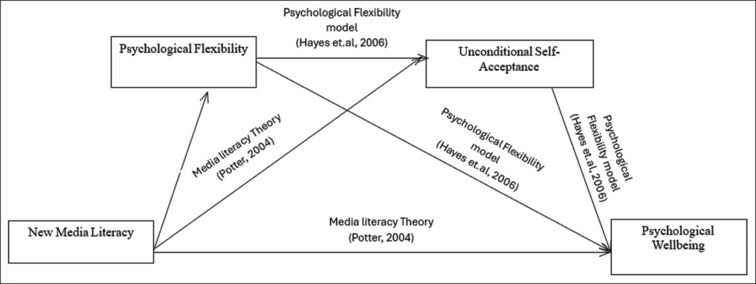
Theoretical framework
Materials and Methods
Study design and setting
A descriptive cross-sectional study was conducted in Klang Valley, Malaysia. This area was chosen to ensure a diverse sample, which can lead to more comprehensive and representative data, increasing the generalizability of the research findings.
Study participants and sampling
The research utilized a purposive sampling method to select participants, specifically targeting university students aged 18 to 25 years, which corresponds to the Generation Z demographic. This method involves selecting participants who meet specific criteria that align with the research objectives. The chosen age group represents a significant segment of Generation Z and is readily accessible through academic institutions, ensuring that the sample was representative of the target population and had characteristics pertinent to the study.
A total of 240 participants were initially recruited. However, seven participants were later excluded for not meeting the age criteria, leaving 233 participants in the final analysis. Before the study commenced, necessary approvals were obtained from the same ERB. The study was advertised on social media platforms like Facebook, Twitter, Instagram, WhatsApp, and LinkedIn through the investigator’s accounts. An online survey link was shared through these promotions, and participants who met the inclusion criteria voluntarily accessed and completed the Google form survey after consenting by clicking the ‘I agree’ button, ensuring their rights and privacy were protected. The survey included demographic questions and Sections B (NMLS), C (AAQ-II), D (PWBS), and E (USAQ), taking about 15 minutes to complete. Participants were thanked upon completion and encouraged to share the survey link with others. The investigator then analyzed the collected data.
Data collection tool and technique
The investigator created an online survey after reviewing recent relevant literature. The survey consisted of three sections.
Demographic information: Age, gender, and ethnicity were recorded.
New media literacy scale: The New Media Literacy Scale (NMLS) consists of 35 items categorized into four subscales, each aimed at measuring different facets of media literacy. Although the Cronbach’s alpha coefficients in this study were slightly below those reported in earlier studies by Koc and Barut[18]Click or tap here to enter text., they still exceeded. 7, demonstrating acceptable reliability.
Acceptance and action questionnaire (AAQ-II): The AAQ-II questionnaire, developed by Bond et al.[19], aims to measure PF, diversity, acceptance, experiential avoidance, and psychological inflexibility. Higher scores on the AAQ-II suggest increased psychological inflexibility. The initial version of the questionnaire showed good reliability, validity, and construct validity in psychometric assessments. Furthermore, the AAQ-II has shown better psychometric stability compared to the AAQ-I while assessing the same constructs in a similar way.
The Psychological Wellbeing Scale (PWBS): The PWBS, created by Ryff and Keyes[20] Click or tap here to enter text.is designed to assess the PWB of college students. It includes 18 items, each evaluated on a 6-point scale from 1 (strongly disagree) to 6 (strongly agree). The overall scores on the PWBS range from 18 to 108, with higher scores denoting better PWB. Prior studies have shown high reliability for the PWBS, with Cronbach’s alpha values between 0.87 and 0.93.
Unconditional Self-Acceptance Questionnaire (USAQ): The original USAQ included 20 items intended to reflect elements of the USA philosophy and practice according to REBT theory. It featured nine items where higher scores indicated greater USA and 11 items where lower scores reflected greater USA. The internal consistency of this revised USAQ was high, with a Cronbach’s alpha of. 86.
The statistical analysis was performed using the Bootstrap method with 5000 resamples at a 95% confidence interval, employing the PROCESS Macro for SPSS set to Model 6 for testing our serial mediation hypothesis. The Bootstrap method with 5000 resamples at a 95% confidence interval was selected for its robustness to traditional statistical assumptions like normality, enhancing the accuracy and stability of confidence interval estimates.
Ethical considerations
Ethical approval for this study was obtained from the Institutional Review Board of the research ethics committee at the Ethics Review Board (ERB) of the Faculty of Psychology and Social Sciences at the University of Cyberjaya, Malaysia, under clearance number UOC/FPSS/2024(4). The investigator adhered to the Declaration of Helsinki throughout the study.
Results
Table 1 shows a significant indirect effect of NML on PWB through PF and USA. Furthermore, the direct effect of NML on PWB in the presence of the mediators was also found to be significant (b = 0.156, P = 0.002). Hence, there is partial serial mediation of PF and USA on the relationship between NML and PWB. Mediation summary is presented in Table 1.
Table 1.
Direct Effects of NML on PWB
| Effect | SE | t | P | LLCI | ULCI | |||||
|---|---|---|---|---|---|---|---|---|---|---|
| 0.156 | 0.041 | 3.835 | 0.000 | 0.076 | 0.236 |
Table 1 depicts the significant direct contribution of NML on PWB among gen-z members, where every 1-point increase of NML predicts 0.156 points increase of PWB. The significance is indicated by the absence of zero value between the upper and lower limit confidence intervals. Furthermore, the mediating role of the mediator variables on the contribution of the predictor (NML) to the outcome (PWB) is depicted in Table 2 below.
Table 2.
Indirect Effects of NML on PWB
| Path | Effect | BootSE | BootLLCI | BootULCI | ||||
|---|---|---|---|---|---|---|---|---|
| Total | -0.0351 | 0.0215 | -0.0795 | 0.0048 | ||||
| NML→PF→PWB | -0.0297 | 0.0163* | -0.0660 | -0.0033 | ||||
| NML→USA→PWB | 0.0072 | 0.0111 | -0.0138 | 0.0311 | ||||
| NML→PF→USA→PWB | -0.0126* | 0.0070 | -0.0286 | -0.0016 |
Table 2 results show that there is a significant indirect effect of PF on the relationship between NML and PWB, β = -0.030. In addition, the indirect effect of USA in the relationship between NML and PWB is not significant, β = 0.007. Next, the study showed that there is a significant serial mediation of PF and USA on NML to PWB, β = -0.126.
Discussion
Our study’s results align with prior research that demonstrates the influence of NML on PWB, particularly through the mediating roles of PF and USA.[2,21] For instance, the result suggested the direct contribution of NML on PWB, and it is in line with studies of Liu et al.[4], and Appel et al.[6] The significant direct effect of NML on PWB noted in Table 2 parallels findings by Okhiai and Loo[22], who observed that effective NML enhances Gen-Z’s ability to manage digital stressors, positively impacting their PWB. However, our study extends these findings by elucidating the serial mediation role of PF and USA, a dynamic not extensively covered in the existing literature. This discrepancy may be attributed to our study’s unique focus on serial mediation models, which provides a deeper insight into the complex interrelations between these variables. The results also showed that there is a significant indirect effect of PF on the relationship between NML and PWB. Individuals with high-level NML will be more flexible. Hence, they developed higher PWB. Moreover, the indirect effect of USA in the relationship between NML and PWB is not significant, which indicate that individuals with high NML will always have high PWB regardless of level of USA.
However, our finding suggested that the serial mediation occurred partially, which means that the direct effect of NML on PWB among Gen-Z members is significant [Table 2]; youth with high NML might not develop PF or able to accept themselves unconditionally to have their mental wellbeing improved. In line with this, our finding also suggests that a single mediation of USA on the contribution of NML to PWB (without being mediated by PF) was not significant, against the findings of Kashdan et al.[23] and Pyszkowska and Stojek[14], who advocated that USA positively and significantly predicts PWB; as our finding meant that despite having adequate NML that led them to accept themselves unconditionally, Gen-Z members would not have their PWB improved if they were not psychologically flexible. In other words, the mediating role of USA on the link between NML and PWB can only be significant if it was a result of adequate PF. It can be stated that Gen-Z with critical skills in navigating themselves in the digital realm must also be psychologically flexible before they can accept themselves unconditionally in order to be psychologically well, and unconditionally accepting oneself would not be enough to protect one’s mental wellbeing; they need to be more flexible in assessing others and themselves.
A lack of PF has been linked to various psychological problems including chronic stress, anxiety, and depression,[24] demonstrating that PF is not merely a beneficial trait but a cornerstone of healthy PWB.[25,26] This point of view is in line with the suggestion of Hemi et al. (2023) and Pakenham et al., (2020) that PF is a robust predictor of PWB or mental health in general.[25,26] While our findings indicate similarity with some of the past studies, we offered further understanding of the sociocognitive path to the PWB through digital media.
Limitations and research implication
The study highlights both theoretical and practical implications by demonstrating the importance of integrating NML into models of PWB. Theoretically, it shows that NML can influence PWB through PF and USA, providing a deeper understanding of how NML impacts mental health. Practically, the findings suggest that enhancing NML among Generation Z (Gen-Z) could significantly improve their mental health by equipping them with digital literacy skills to navigate the digital environment, manage stressors, and foster healthier online interactions. Educational programs incorporating NML training can build resilience against digital challenges, helping Gen-Z develop critical thinking, evaluate digital content, and maintain a balanced perspective on digital experiences.[27]
Implementing NML training in educational and community settings offers far-reaching benefits by promoting PF and self-acceptance, essential for adapting to technological changes and maintaining mental health. Tailored NML programs addressing issues like cyberbullying, digital addiction, and misinformation can further enhance their relevance and effectiveness. The study underscores the potential of NML interventions to foster long-term psychological resilience, contributing to sustained well-being and reduced vulnerability to digital stressors. Policymakers and educators should prioritize NML as a key component of mental health strategies, recognizing its critical role in supporting the well-being of future generations.
Limitation and recommendation
Despite the significant findings, the study has limitations, including the use of self-reported measures, which can introduce response biases, and a cross-sectional design, which limits causal inference. Future research should incorporate objective measures, longitudinal designs, and diverse samples to enhance the external validity of the results.
Conclusion
In conclusion, this study highlights the critical importance of NML in enhancing PWB among Generation Z through the serial mediation of PF and USA. Previous research underscores the role of NML in managing digital stressors and fostering healthier interactions with digital media, especially among young adults. Both PF and USA are well-established factors in promoting mental health and resilience, indicating their potential in mediating the effects of various life skills on PWB. This study provides empirical evidence of how NML impacts PWB directly and through the sequential mediation of PF and USA, offering an understanding of these relationships within Generation Z.
The study’s findings delineate specific pathways through which NML influences PWB, emphasizing the sequential mediation by PF and subsequently USA. This underscores the interdependence of these factors in enhancing mental wellbeing and suggests that interventions aimed at improving NML among Generation Z could be crucial in fostering their PWB. The results point toward the effectiveness of targeted digital literacy programs as tools for enhancing mental health in a digitally immersed generation.
From a health policy perspective, these findings advocate for the incorporation of NML training within educational curricula. By equipping Generation Z with the skills to critically evaluate digital content, educational institutions can promote a healthier relationship with technology and foster long-term psychological resilience. Implementing such programs aligns with health policy benchmarks aimed at improving mental health outcomes and resilience among young people.
Moreover, these findings aligned with the objectives of the World Health Organization’s Comprehensive Mental Health Action Plan 2013–2030, which emphasizes mental health promotion, prevention strategies, and the integration of mental health into broader health and social policies. By aligning with this global health policy, NML-focused interventions can contribute significantly to global efforts in improving mental health outcomes, creating a resilient and mentally healthy generation equipped to handle the challenges of the digital age.
Abbreviation
| AAQ-II | Acceptance and action questionnaire | |
| ACT | Acceptance and Commitment Therapy | |
| NML | New media literacy | |
| NMLS | New Media Literacy Scale | |
| PF | Psychological flexibility | |
| PFM | Psychological Flexibility Model | |
| PWB | Psychological wellbeing | |
| PWBS | The Psychological Wellbeing Scale | |
| USA | Unconditional self-acceptance | |
| USAQ | Unconditional Self-Acceptance Questionnaire |
Conflicts of interest
There are no conflicts of interest.
Acknowledgments
The authors hereby express their gratitude to all supervisors and those who participated are highly appreciated.
Funding Statement
The present study was self-funded.
References
- 1.Ryff CD. Happiness is everything, or is it? Explorations on the meaning of psychological well-being. J Pers Soc Psychol. 1989;56(6):1069–81. [Google Scholar]
- 2.Bahramian E, Mazaheri MA, Hasanzadeh A. The relationship between media literacy and psychological well-being in adolescent girls in Semirom city. J Educ Health Promot. 2018;7(1):148. doi: 10.4103/jehp.jehp_41_18. doi: 10.4103/JEHP.JEHP_41_18. [DOI] [PMC free article] [PubMed] [Google Scholar]
- 3.Hernandez-de-Menendez M, Escobar Díaz CA, Morales-Menendez R. Educational experiences with generation. Int J Interact Design Manuf. 2020;14(3):847–59. [Google Scholar]
- 4.Liu H, Liu W, Yoganathan V, Osburg VS. COVID-19 information overload and generation Z’s social media discontinuance intention during the pandemic lockdown. Technol Forecast Soc Change. 2021;166:120600. doi: 10.1016/j.techfore.2021.120600. doi: 10.1016/J.TECHFORE.2021.120600. [DOI] [PMC free article] [PubMed] [Google Scholar]
- 5.Blandi L, Sabbatucci M, Dallagiacoma G, Alberti F, Bertuccio P, Odone A. Digital information approach through social media among gen z and millennials: The global scenario during the COVID-19 pandemic. Vaccines (Basel) 2022;10:11. doi: 10.3390/vaccines10111822. doi: 10.3390/VACCINES10111822. [DOI] [PMC free article] [PubMed] [Google Scholar]
- 6.Appel M, Marker C, Gnambs T. Are social media ruining our lives? A review of meta-analytic evidence. Rev Gen Psychol. 2020;24(1):60–74. [Google Scholar]
- 7.Benítez-Márquez MD, Sánchez-Teba EM, Bermúdez-González G, Núñez-Rydman ES. Generation Z within the workforce and in the workplace: A bibliometric analysis. Front Psychol. 2022;12:736820. doi: 10.3389/fpsyg.2021.736820. doi: 10.3389/FPSYG.2021.736820. [DOI] [PMC free article] [PubMed] [Google Scholar]
- 8.Daneshvar S, Ghaffari M, Ramazankhani A, Marashi T. Conceptual explanation of adolescents’ media health literacy: A qualitative content analysis. J Educ Health Promot. 2023;12:1. doi: 10.4103/jehp.jehp_129_23. doi: 10.4103/JEHP.JEHP_129_23. [DOI] [PMC free article] [PubMed] [Google Scholar]
- 9.Shin CY, Zanuddin H. New media literacy and media use among university students in Malaysia. Int J Eng Adv Technol. 2019;8(5):469–74. [Google Scholar]
- 10.Beyari H. The relationship between social media and the increase in mental health problems. Int J Environ Res Public Health. 2023;20:3. doi: 10.3390/ijerph20032383. doi: 10.3390/IJERPH 20032383. [DOI] [PMC free article] [PubMed] [Google Scholar]
- 11.Cherry KM, Vander Hoeven E, Patterson TS, Lumley MN. Defining and measuring “psychological flexibility”: A narrative scoping review of diverse flexibility and rigidity constructs and perspectives. Clin Psychol Rev. 2021:84. doi: 10.1016/j.cpr.2021.101973. [DOI] [PubMed] [Google Scholar]
- 12.Pyszkowska A. Personality predictors of self-compassion, ego-resiliency and psychological flexibility in the context of quality of life. Pers Individ Dif. 2020;161:109932. doi: 10.1016/J.PAID.2020.109932. [Google Scholar]
- 13.Sadeghi AH, Ahmadi SA, Ghodrati-Torbati A. The effectiveness of acceptance and commitment therapy on clinical symptoms and treatment adherence in dialysis patients, J Educ Health Promot 2024;13:1. doi: 10.4103/jehp.jehp_1704_22. doi: 10.4103/JEHP.JEHP_1704_22. [DOI] [PMC free article] [PubMed] [Google Scholar]
- 14.Pyszkowska A, Stojek MM. Early maladaptive schemas and self-stigma in people with physical disabilities: The role of self-compassion and psychological flexibility. Int J Environ Res Public Health. 2022;19:10854. doi: 10.3390/ijerph191710854. doi: 10.3390/IJERPH 191710854. [DOI] [PMC free article] [PubMed] [Google Scholar]
- 15.Lucas JJ, Moore KA. Psychological flexibility: Positive implications for mental health and life satisfaction. Health Promot Int. 2020;35(2):312–20. doi: 10.1093/heapro/daz036. doi: 10.1093/HEAPRO/DAZ036. [DOI] [PubMed] [Google Scholar]
- 16.Hayes SC, Luoma JB, Bond FW, Masuda A, Lillis J. Acceptance and commitment therapy: Model, processes and outcomes. Behav Res Ther. 2006;44:1–25. doi: 10.1016/j.brat.2005.06.006. doi: 10.1016/J.BRAT.2005.06.006. [DOI] [PubMed] [Google Scholar]
- 17.Potter WJ. USA: SAGE Publications; 2004. Theory of media literacy: A cognitive approach. Theory of Media Literacy: A Cognitive Approach; pp. 1–307. doi: 10.4135/9781483328881. [Google Scholar]
- 18.Koc M, Barut E. Development and validation of New Media Literacy Scale (NMLS) for university students. Comput Human Behav. 2016;63:834–43. [Google Scholar]
- 19.Bond FW, Hayes SC, Baer RA, Carpenter KM, Guenole N, Orcutt HK, Waltz T, Zettle RD. Preliminary psychometric properties of the acceptance and action questionnaire-ii: A revised measure of psychological inflexibility and experiential avoidance. Behaviour Therapy. 2011;42(4):678–88. doi: 10.1016/j.beth.2011.03.007. [DOI] [PubMed] [Google Scholar]
- 20.Ryff CD, Keyes CLM. The structure of psychological well-being revisited. J Pers Soc Psychol. 1995;69(4):719–27. doi: 10.1037//0022-3514.69.4.719. [DOI] [PubMed] [Google Scholar]
- 21.Browne A, Stafford O, Berry A, Murphy E, Taylor LK, Shevlin M, et al. Psychological flexibility mediates wellbeing for people with adverse childhood experiences during COVID-19. J Clin Med. 2022;11(2):377. doi: 10.3390/jcm11020377. doi: 10.3390/JCM11020377. [DOI] [PMC free article] [PubMed] [Google Scholar]
- 22.Okhiai L, Loo JL. using social media to improve mental and physical health literacy: the meeting of arts and sciences. BJPsych Open. 2022;8(S20):S31. [Google Scholar]
- 23.Kashdan T. B., Disabato D. J., Goodman F. R., Doorley J. D., McKnight P. E. Understanding psychological flexibility: A multimethod exploration of pursuing valued goals despite the presence of distress. Psychological Assessment. 2020;32(829):850. doi: 10.1037/pas0000834. [DOI] [PubMed] [Google Scholar]
- 24.Mofatteh M. Risk factors associated with stress, anxiety, and depression among university undergraduate students. AIMS Public Health. 2021;8(1):36. doi: 10.3934/publichealth.2021004. doi: 10.3934/PUBLICHEALTH.2021004. [DOI] [PMC free article] [PubMed] [Google Scholar]
- 25.Hemi A, Sopp MR, Bonanno G, Michael T, McGiffin J, Levy-Gigi E. Flexibility predicts chronic anxiety and depression during the first year of the COVID-19 pandemic-A longitudinal investigation of mental health trajectories. Psychol Trauma. 2024;16:961–70. doi: 10.1037/tra0001517. [DOI] [PubMed] [Google Scholar]
- 26.Pakenham KI, Landi G, Boccolini G, Furlani A, Grandi S, Tossani E. The moderating roles of psychological flexibility and inflexibility on the mental health impacts of COVID-19 pandemic and lockdown in Italy. J Contextual Behav Sci. 2020;17:109–18. doi: 10.1016/j.jcbs.2020.07.003. [DOI] [PMC free article] [PubMed] [Google Scholar]
- 27.Ronkainen H, Lundgren T, Kenttä G, Ihalainen J, Valtonen M, Lappalainen R. Psychological flexibility skills and mental wellbeing in athletes: An exploration of associations and gender differences. Psychol Behav Sci. 2024;13:42. doi: 10.11648/J.PBS.20241302.14. [Google Scholar]