


ABSTRACT
Natural lakes and ponds typically feature green areas where people engage in recreational and sporting activities. In Italy, these areas are often inhabited by non‐native freshwater turtles, even at high densities. However, freshwater turtles have been identified as natural carriers for various pathogens that can be transmitted to humans, making their sanitary monitoring crucial to prevent accidental transmission through direct or indirect contact. In this study, we investigated the presence of three potentially zoonotic pathogens, namely Salmonella, Leptospira and Cryptosporidium, in a group of 83 freshwater turtles (Trachemys scripta) captured in Piedmont, Northwest Italy.
Overall infection prevalence was 9.6%. Salmonella spp. was detected in ten specimens of T. s. elegans and Cryptosporidium ducismarci in one specimen of T. s. scripta. Salmonella enterica subsp. diarizonae was confirmed in ten freshwater turtles. No Leptospira DNA was detected. Our findings highlight that turtles, as asymptomatic carriers of zoonotic pathogens, contribute to environmental contamination and public health risks, underscoring the need for sanitary monitoring of invasive alien species under a ‘One Health’ approach.
Keywords: alien species, apicomplexan, pathogen, protozoan, reptile, zoonosis
Natural lakes and ponds typically feature green areas where people engage in recreational and sporting activities. In Italy, these areas are often inhabited by non‐native freshwater turtles, even at high densities. However, freshwater turtles have been identified as natural carriers for various pathogens that can be transmitted to humans, making their sanitary monitoring crucial to prevent accidental transmission through direct or indirect contact. In this study, we investigated the presence of three potentially zoonotic pathogens, namely Salmonella, Leptospira and Cryptosporidium in a group of 83 freshwater turtles (Trachemys scripta) captured in Piedmont, Northwest Italy. Overall infection prevalence was 9.6%. Salmonella spp. was detected in ten specimens of T. s. elegans and Cryptosporidium ducismarci in one specimen of T. s. scripta. Salmonella enterica subsp. diarizonae was confirmed in ten freshwater turtles. No Leptospira DNA was detected. Our findings highlight that turtles, as asymptomatic carriers of zoonotic pathogens, contribute to environmental contamination and public health risks, underscoring the need for sanitary monitoring of invasive alien species under a ‘One Health’ approach.

Summary
Alien freshwater turtles can act as silent carriers of zoonotic pathogens.
Salmonella enterica subsp. diarizonae was isolated from Trachemys scripta in Northwestern Italy.
Cryptosporidium spp. showed low prevalence in freshwater turtles, while Leptospira was not detected in faecal samples.
1. Introduction
The genus Trachemys (family Emydidae), commonly referred to as sliders, is regarded as one of the most species‐rich and broadly distributed among turtles, encompassing up to 17 species and various subspecies (Fritz et al. 2023). The geographical distribution of sliders extends from the Great Lakes region of North America, traversing Mexico and Central America, and extending to northern South America. Additionally, there are isolated populations in northeastern Brazil and the Rio de la Plata region, which spans parts of Brazil, Argentina, and Uruguay, as well as the Antillean islands (Fritz et al. 2023).
The pond slider, Trachemys scripta (Thunberg in Schoepff, 1792), is currently classified into three distinct subspecies, including Trachemys scripta scripta, Trachemys scripta elegans, and Trachemys scripta troostii (Vamberger et al. 2020). This species has been traded globally since the 1990s, rapidly becoming a popular pet due to its affordability and relatively simple care requirements. Indeed, pond sliders are likely the most commonly traded reptile, with over 52 million individuals exported from the U.S. between 1989 and 1997 (Telecky 2001). While the predominant market for these animals is the pet trade, in certain regions, such as Asia, they are also farmed for human consumption (Colon et al. 2022).
Despite the European Union's 1997 prohibition on the importation of T. s. elegans (Commission Regulation (EC) 2003; Council Regulation (EC) 1996) due to concerns regarding biological invasions, the other subspecies (T. s. scripta and T. s. troostii) and their hybrids have proliferated extensively across Europe (Scalera 2007). This expansion can be attributed to the easy availability of these turtles in exotic pet stores, local markets and aquarium shops. As a result, invasive turtles have spread far beyond their natural range, colonising many localities in Europe, including the entire Italian peninsula, especially in areas with abundant wetlands. The introduction of alien freshwater turtles into green areas and natural parks has primarily occurred through illicit releases by owners lacking the requisite knowledge and resources to provide long‐term care for large adults. Juvenile sliders, often sold when they measure only a few centimetres in length, have been observed to grow rapidly to around 30 cm (Teillac‐Deschamps et al. 2009).
Once released into the wild, T. scripta sspp. compete with native species for food and habitat, often outcompeting them due to their adaptability and aggressive behaviour. This dynamic has the potential to disrupt the ecological balance of local ecosystems, consequently exerting a detrimental effect on biodiversity. Their widespread presence and the ecological damage they cause have led to their classification as an invasive alien species (IAS) in Europe and Italy [see (Commission Implementing Regulation (EU) 2016; Governo Italiano 2017; Ministero della Transizione Ecologica 2022)].
In addition to harming native species, alien freshwater turtles are also considered reservoirs of various zoonotic pathogens, thus representing a potential threat to public health (Colon et al. 2022; Dezzutto et al. 2017; Rato et al. 2024). Pond sliders, like other reptile species, have been identified as asymptomatic carriers of Salmonella spp., as evidenced by recent studies reporting high Salmonella prevalence in both free‐ranging and pet turtles from Europe, Northern America and Asia (Colon et al. 2022; Bertrand et al. 2008; Hidalgo‐Vila et al. 2008; Marin et al. 2016; Mermin et al. 2004). These findings give rise to concerns about their potential role as reservoirs for Salmonella in lakes frequently used for recreation, as well as in households where new pet reptiles are adopted. Moreover, recent serological surveys have identified high seroprevalence rates of Leptospira spp. (up to 62.5%) in freshwater turtles and tortoises from Italy, suggesting the potential circulation of zoonotic spirochetes in urban ponds and green areas (Bonacina et al. 2021; Dezzutto et al. 2017; Marenzoni et al. 2022).
Cryptosporidium spp., a zoonotic apicomplexan parasite identified in the gastrointestinal tracts of both freshwater turtles and tortoises in Europe (Rzeżutka et al. 2020; Traversa et al. 2008), is another waterborne pathogen of public health concern. However, the current epidemiological status of this parasite in alien freshwater turtles in Italy remains unknown.
The present study aims to investigate the presence of potentially zoonotic bacteria and apicomplexans in free‐ranging alien freshwater turtles inhabiting lakes in Northwest Italy.
Specifically, analyses were focused on the detection of Cryptosporidium, Leptospira, and Salmonella in pond sliders.
2. Materials and Methods
2.1. Sampling Site
The sampling site is located in the Piedmont region, Northwestern Italy. The Avigliana Lakes — Lago Piccolo (60 hectares; 356 m above sea level) and Lago Grande (90 hectares; 352 m a.s.l.) — are two interconnected lakes of glacial origin situated in the lower Susa Valley, on the edge of the Turin plain (45°03’57’’ N, 07°23’14’’ E; Figure 1). The area is part of the Natura 2000 network (IT 1110007 Laghi di Avigliana).
FIGURE 1.
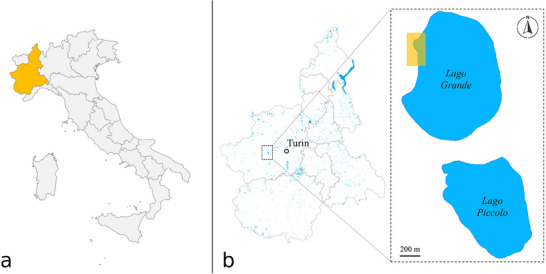
Map of location site: (a) Italy with the Piedmont region in yellow; (b) Avigliana Lakes (Lago Grande and Lago Piccolo), with the capture area in yellow.
2.2. Sampling Procedures
The freshwater turtles were collected following their accidental capture and subsequent death in baited traps that had been used during authorised monitoring and eradication activities for red swamp crayfish, Procambarus clarkii. The baited traps (90 cm, ⌀ 30 cm) were manually placed along the banks of Lago Grande at predetermined, geolocated points (Figure 1). The traps were submerged in water at varying depths (between ‐0.80 and ‐150 cm) and left in situ for a minimum of 24 h. Only turtles in good preservation status were stored in cool boxes and transported to the laboratory at the ‘Istituto Zooprofilattico Sperimentale del Piemonte, Liguria e Valle d'Aosta’ in Turin (Italy) for necropsy and health status monitoring.
The turtles were identified to species and subspecies level based on morphological characteristics (Di Nicola et al. 2021). The following morphological parameters were measured for each specimen: plastron length (mm) and plastron width (mm) (Fritz and Obst 1995). Additionally, the specimens were weighed (g) and sexed. The measurement of dimensional parameters was conducted using a tape measure, while the determination of weight was accomplished by means of a VEVOR Digital Analytical Laboratory Balance, with a precision of 0.01 g. Three aliquots of faeces (1 gram/animal) were collected in sterilised plastic tubes from each turtle and stored at ‐20°C until laboratory analysis. In case faeces were absent, three deep cloacal swabs were undertaken for each animal.
2.3. Salmonella Detection and Typing
Samples (faeces and cloacal swabs) were subjected to a standard procedure for the isolation of Salmonella spp. according to the UNI EN ISO 6579‐1:2020 standard (Issenhuth‐Jeanjean et al. 2014). Briefly, each sample was pre‐enriched at a ratio of 1:10 (w/v) in 2.5% buffered peptone water (BPW, Scharlau, Barcelona, Spain) and then incubated at 37 ± 1°C for 18 ± 2 h. After pre‐enrichment, samples were transferred to Modified Semisolid Rappaport Vassiliadis (MSRV, Oxoid, Thermo Fisher Scientific, Basingstoke, UK) agar plates and incubated at 41.5 ± 1°C for 24–48 h. The culture obtained in MSRV was then inoculated onto Xylose‐Lysine‐Desoxycholate (XLD, Merck Millipore, Darmstadt, Germany) and Xylose‐Lysine‐Tergitol‐4 (XLT4, Biokar Diagnostics, Pantin Cedex, France) agar plates and incubated at 37 ± 1°C for 24–48 h. All Salmonella isolates were initially identified at the genus level by matrix‐assisted laser desorption–ionisation‐time of flight (MALDI‐TOF) mass spectrometry (Bruker Daltonics GmbH, Bremen, Germany). For serotyping, isolates were subcultured on Columbia Blood Agar (Becton & Dickinson, Dickinson, MD, USA) at 37°C for 24 h and subsequently tested with O and H antisera (Statens Serum Institut, Copenhagen, Denmark) according to the White–Kauffmann–Le Minor scheme (Afgan et al. 2022).
2.4. Leptospira Detection
One gram of faeces or a cloacal swab from each animal was suspended in 1 mL phosphate‐buffered saline (PBS). A 200 µL aliquot of the homogenate was then subjected to DNA extraction using the Maxwell Viral Total Nucleic Acid Kit (Promega, Madison, WI, USA), according to the manufacturer's instructions.
The extracted DNA was analysed using the Invitrogen Platinum Quantitative PCR SuperMix‐UDG kit (Thermo Fisher Scientific, Waltham, MA, USA) in a 25 µL reaction. This included 5 µL of DNA extract, 3.5 µL of primer mix containing both LipL32‐45F (5'‐AAGCATTACCGCTTGTGGTG‐3') and LiPL32‐286R (5'‐GAACTCCCATTTCAGCGATT‐3') primers at a final concentration of 10 µM each, and 0.5 µL probe (Podgoršek et al. 2020).
The qPCR was performed on a Bio‐Rad CFX96 thermal cycler (Bio‐Rad, Hercules, CA, USA), using the following amplification protocol: 50°C for 2 min; 95°C for 5 min; and 45 cycles of 95°C for 15 s and 60°C for 45 s.
2.5. Cryptosporidium Detection
The DNA was extracted from the swabs using the ReliaPrep gDNA Tissue Miniprep System Kit (3.C. Protocol for Buccal Swabs; Promega Italia, Milan, Italy), in accordance with the manufacturer's instructions. Prior to extraction, an additional temperature shock step was incorporated into the protocol to facilitate the breakdown of the oocyst walls. The procedure entails subjecting the samples to a hot water bath at 95°C, followed by immersion in dry ice for three consecutive cycles.
The detection of Cryptosporidium species was conducted in accordance with the PCR protocol outlined by (Richter et al. 2011), targeting a 122 bp region of the 18S ribosomal gene. The PCR reaction was performed in a total volume of 25 µL containing 2 µL of template DNA, 2.5 µL of buffer, 5 µL of CG/Q solution, 1 µL of dNTPs, 1.5 µL of MgCl2 1 µL of primer F (5’‐CTCGTAGTTGGATTTCTGTT‐3’), 1 µL of primer R (5’‐TAAGCACTCTAATTTTCTCA‐3’), and 0.25 µL of Taq polymerase (HotstarTaq DNA Polymerase, Qiagen, Hilden, Germany). The PCR programme included: 95°C for 10 min, 40 denaturation cycles at 95°C for 30 s; annealing at 55°C for 30 s, extension at 72°C for 1 min and a final extension step at 72°C for 10 min. Subsequent to this, the PCR products were then revealed on 2% Gelgreen‐stained agarose gel (Biotium, CA, USA). In the event of a positive result, the DNA product was excised and purified using an ExtractMe DNA kit (Blirt, Qiagen, Hilden, Germany), following the manufacturer's instructions. The cycle sequencing reaction was then performed using the BrilliantDyeTM Terminator (v1.1) Cycle Sequencing Kit (NimaGen, Nijmegen, Netherlands), in accordance with the manufacturer's instructions. The obtained product was then purified using the DyeEx 2.0 Spin Kit (Qiagen, Hilden, Germany) according to the manufacturer's instructions and then denatured by the addition of 10 µL of highly deionised (Hi‐Di) formamide in a sequencing plate with 5 µL of the purified cycle sequencing products, using laboratory best practices. The products were analysed using a SeqStudio Genetic Analyser (4‐capillary, Thermo Fisher Scientific, Waltham, MA, USA). Subsequently, the obtained sequence was subjected to comparison through the NCBI‐Blast core‐nt database.
2.6. Statistical Analysis
The collected data were managed and analysed using Stata 17 (StataCorp 2021). The infection prevalence with associated 95% confidence intervals (CIs) was calculated for each pathogen. A logistic regression analysis was conducted to evaluate the potential relationship between the occurrence of pathogen infection and the age and sex of individuals. The adjusted effect of turtles’ age and sex was expressed in odds ratio (OR) and related 95% CI. For age estimation, the length and width of the plastron were employed as a proxy, with the area of the plastron calculated as an oval (π x 1/2 length x 1/2 width). Age was first included in the logistic regression model as a categorical variable: the individuals were grouped into three categories based on the 25th, 50th and 75th percentiles of the plastron area variable. As no significant differences were observed between categories, age was subsequently treated as a continuous variable to estimate the overall effect on the pathogens' presence. The statistical significance was set at a p‐value < 0.05.
3. Results
Between 2021 and 2022, a total of 83 pond sliders (Trachemys scripta sspp.) were collected. Of the specimens, 65 were identified as Trachemys scripta elegans, and 18 were identified as Trachemys scripta scripta (Table 1).
TABLE 1.
Mean biometric data and pathogen presence in the investigated Trachemys scripta sspp.
| Plastron dimensions (in mm) | Infected individuals | |||||||||
|---|---|---|---|---|---|---|---|---|---|---|
| Salmonella spp. | Cryptosporidium spp. | |||||||||
| Species | Sex | No. of individuals Tested (n = 83) | Weight (mean; SD in grams) | Lenght (mean; SD) | Width (mean; SD) | By sex | By sspp | By sex | By sspp | Leptospira spp. |
| T. s. elegans | M | 34 | 737.6 (±487.1) | 146.9 (±37.6) | 76.3 (±19.0) | 1 (2.9) | 10 (15.4) | 0 | 0 | 0 |
| F | 31 | 1294.0 (±614.9) | 184.7 (±31.9) | 99.3 (±22.3) | 9 (29.0) | 0 | 0 | |||
| T. s. scripta | M | 5 | 900.8 (±715.8) | 157 (±42.8) | 86.4 (±33.7) | 0 | 0 | 1 (20.0) | 1 (5.6) | 0 |
| F | 13 | 1160.7 (±609.3) | 185.9 (±42.7) | 112.7 (±42.0) | 0 | 0 | 0 | |||
| Overall infection prevalence (n; %) | 10 (12.0) | 1 (1.20) | 0 | |||||||
No macroscopic lesions were identified in the gastrointestinal and urinary tract during the necropsies.
The overall infection prevalence (expressed as positivity to at least one pathogen) was found to be 13.3% (95% CI = 6.8‐22.5). Turtle age was not a factor associated with the presence of pathogens (OR = 0.60; 95% CI = 0.25‐1.45). However, the turtle sex was found to be a contributing factor for pathogens' occurrence, with females showing a higher risk for pathogen occurrence (OR = 7.21; 95% CI = 1.17‐44.3) compared to males. Only single‐pathogen presence of Salmonella spp. and Cryptosporidium spp. were detected, while no evidence of Leptospira infections was observed in any of the individuals tested. Salmonella was the most frequently detected pathogen, with an overall prevalence of 12.0% (10/83; 95% CI = 5.93‐21.0). All positive individuals belonged to T. s. elegans, yielding a subspecies‐specific prevalence of 15.4% (10/65). Among these, one of 34 males (2.9%; 95% CI = 0.07‐15.3) and nine of 31 females (29.0%; 95% CI = 14.2‐48.0) tested positive. No Salmonella was detected in individuals of T. s. scripta. Salmonella enterica subsp. diarizonae was successfully identified from all infected individuals, with the serovars 47:K:1,5,7 and 35:r:z 35 being isolated from eight and two specimens, respectively. Additionally, a single infection by Cryptosporidium spp. was detected in one male specimen of T. s. scripta, resulting in an overall prevalence of 1.20% (95% CI = 0.03‐6.5). The isolate exhibited 96.04% of identity with Cryptosporidium ducismarci (max score 163, total score 163, query cover 95%, E‐value 3e‐36, GenBank accession number MF737079.1).
4. Discussion
Our study confirmed the presence of Salmonella and Cryptosporidium in freshwater turtles in Northwestern Italy, while Leptospira was not detected. The detection of Salmonella and Cryptosporidium in faecal samples reinforces the idea that turtles actively shed pathogens in the environment through water, posing a threat for environmental contamination and zoonotic transmission, particularly in areas with human or animal interaction.
Reptiles and amphibians are known carriers of Salmonella in their gastrointestinal tract, often as commensals (Mermin et al. 2004; Pees et al. 2023; Waltenburg et al. 2022). In previous studies, turtles have been identified as an asymptomatic source of Salmonella, contributing to zoonotic risk in aquatic habitats (Hernandez et al. 2021; Marin et al. 2013; Meletiadis et al. 2022). The detection of a 12% Salmonella prevalence in our study highlights the potential for rapid dissemination of waterborne pathogens within small, enclosed environments such as Lago Grande di Avigliana, even in the absence of clinical signs among hosts. This observation gains further relevance considering the hydrological connection between Lago Grande and Lago Piccolo, suggesting that, despite ecological differences, interlinked aquatic systems may facilitate cross‐ecosystem transmission of infectious agents. The Salmonella serotype identified in our sample was S. enterica subsp. diarizonae. Although primarily found in reptiles, this subspecies has also been isolated from sheep, cattle and humans (Colon et al. 2022; Giner‐Lamia et al. 2019). In Italy, it has been reported in wild boars and hedgehogs (Carrera et al. 2023; Chiari et al. 2013; Listorti et al. 2022; Zottola et al. 2013), suggesting broader environmental circulation beyond reptiles. Interestingly, S. enterica subsp. diarizonae has also been found in clinically healthy turtle and tortoise species in Central and Southern Italy, respectively (Casalino et al. 2021; Marenzoni et al. 2015). Overall, Salmonella prevalence ranged between 8 and 60% according to these studies (Casalino et al. 2021; Marenzoni et al. 2015), reinforcing the silent carriage of Salmonella among chelonians.
In Spain, free‐ranging and pet turtles have been found to shed multiple Salmonella subspecies and serotypes, including S. e. enterica, S. e. salamae, and S. e. diarizonae (Hidalgo‐Vila et al. 2008; Marin et al. 2016, Marin et al. 2013). Similarly, in wet markets in Hong Kong, S. e. enterica and S. e. diarizonae have been isolated from free‐living freshwater turtles destined for human consumption. The prevalence in the aforementioned reports ranged between 4% (Casalino et al. 2021; Colon et al. 2022) and 11.1% (Marin et al. 2013), which is consistent with our findings. We also observed no sex‐ or age‐related differences in Salmonella distribution, as previously reported in Italy (Casalino et al. 2021).
Moreover, Salmonella excreted by reptiles may contribute to antimicrobial resistance, as documented in pet turtles (Bertelloni et al. 2016). These strains may transfer resistance genes to other bacteria in aquatic environments.
Our findings underline the importance of considering free‐ranging and pet turtles in public health strategies, particularly in light of their potential to silently carry zoonotic pathogens (Meletiadis et al. 2024), making their introduction into new environments a public health concern. Cryptosporidium ducismarci was detected in one T. s. scripta (prevalence 1.2%). Among Cryptosporidium species, non‐human C. testudines and C. ducismarci are commonly reported in tortoises, where they may cause chronic diarrhoea and weight loss (Egan et al. 2024). Prevalence rates of Cryptosporidium in pet tortoises can vary significantly, with rates higher than 17% in the United States of America (McGuire et al. 2013), and 0.8% in the United Kingdom (Hedley et al. 2013). Nonetheless, in a study conducted in 40 captive freshwater turtles and 38 chelonians in Central Italy, no Cryptosporidium was found in the faeces (Marenzoni et al. 2015).
Data on Cryptosporidium diversity in wild reptiles are limited. Cryptosporidium ducismarci has primarily been identified in tortoises (T. marginata, T. hermanni, Geochelone sulcata) (Egan et al. 2024; Richter et al. 2011; Rostad et al. 2019; Traversa et al. 2008), while freshwater turtles remain understudied (Egan et al. 2024).
In a recent literature review, zoonotic species C. hominis and C. parvum, along with rodent species C. tyzzeri, C. muris, and C. andersoni, have been reported in reptiles (Egan et al. 2024). Reptiles may act as mechanical vectors of Cryptosporidium, either through ingestion of infected prey such as rodents and birds or via passive transmission facilitated by flies. In domestic settings, pet reptiles may come into direct contact with humans, whereas in natural environments, free‐ranging individuals may contribute to environmental or waterborne contamination. Zoonotic species such as C. hominis and C. parvum, responsible for >95% of human cryptosporidiosis (Yang et al. 2021), have occasionally been reported in reptiles (Egan et al. 2024), raising concerns about their potential public health role. However, many studies rely solely on molecular data, lacking clinical or pathological evidence to confirm disease association.
Silent carriage of intestinal protozoa appears to be common in wildlife (Jokelainen et al. 2019; Ortega et al. 2024; Perrucci et al. 2023; Robertson et al. 2019), suggesting a potential role as a reservoir for environmental contamination.
Leptospira DNA was not detected in this study. Although previous surveys in Italy showed seropositivity to various Leptospira serovars in freshwater turtles from Italy (Bonacina et al. 2021; Dezzutto et al. 2017), the actual role of turtles in bacterial excretion remains unclear. While serological surveys measure historical exposure to a pathogen, DNA detection or bacterial isolation indicates the presence of the pathogen at the time of sampling, which was not confirmed in our survey.
Further studies combining both approaches are needed to clarify the role of freshwater turtles in Leptospira epidemiology. Limitations of this study include the opportunistic sampling of carcasses, which precluded clinical assessments and blood collection.
Moreover, decomposition also prevented full pathological examinations. Although health monitoring of live turtles was not conducted, no significant die‐offs or disease symptoms were reported by park rangers. Necropsies revealed no macroscopic lesions in the gastrointestinal tract, supporting the assumption of asymptomatic carriage. A deeper understanding of the zoonotic risks associated with freshwater turtles will help raise awareness among pet owners, wildlife rescue operators and public health specialists. Additionally, it will encourage discussions on establishing clear guidelines for turtle management and sales, which could enhance animal welfare and protect public health, within a ‘One Health’ perspective.
In conclusion, monitoring IAS (like Trachemys spp. in Italy) is crucial for informing conservation policy and safeguarding public health. This study underscores the importance of enhanced pathogen surveillance and regulatory measures for expanding IAS populations in Europe.
Author Contributions
Barbara Moroni: conceptualisation, data curation, investigation, methodology, supervision, visualisation, writing – original draft, writing – review and editing. Arianna Meletiadis: data curation, investigation, methodology, writing – review and editing. Matteo Riccardo Di Nicola: data curation, visualisation, writing – original draft, writing – review and editing. Aitor Garcia‐Vozmediano: data curation, formal analysis, writing – review and editing. Monica Pitti: investigation. Gloria Dipietromaria: investigation. Simona Zoppi: resources, writing – review and editing. Stefania Bergagna: investigation. Vanessa Pinnelli: investigation. Cecilia Guasco: investigation. Pierluigi Acutis: resources, writing – review and editing. Paolo Pastorino: conceptualisation, data curation, investigation, methodology, writing – review and editing. Marino Prearo: resources, writing – review and editing. Giuseppe Esposito: conceptualisation, data curation, formal analysis, investigation, methodology, supervision, visualisation, writing – original draft, writing – review and editing.
Ethics Statement
The monitoring activities, including the placement of baited traps, were authorised by the managing authority of the Alpi Cozie Protected Areas (Council Resolution No. 30 of 2 August 2023). As all turtle specimens were found deceased during routine monitoring/eradication procedures, no active intervention or harm was caused by the researchers. The turtles were not intentionally captured or killed for the purposes of this study. Their collection was incidental to the established monitoring of Procambarus clarkii, and no procedures that would have required ethical approval, such as euthanasia or live handling, were performed. As such, no ministerial and/or ethical permission was necessary for the study, which strictly adhered to passive sampling and observation protocols.
Conflicts of Interest
The authors declare no conflicts of interest.
Acknowledgements
The authors wish to acknowledge all the technicians of the Istituto Zooprofilattico Sperimentale del Piemonte, Liguria e Valle d'Aosta for their invaluable support in the laboratory.
Open access funding provided by BIBLIOSAN.
Funding: The authors received no specific funding for this work.
Data Availability Statement
All data generated or analysed during this study are included in this published article.
References
- Afgan, E. , Nekrutenko A., Grüning B. A., et al. 2022. “The Galaxy Platform for Accessible, Reproducible and Collaborative Biomedical Analyses: 2022 Update.” Nucleic Acids Research 50: W345–W351. 10.1093/nar/gkac247. [DOI] [PMC free article] [PubMed] [Google Scholar]
- Bertelloni, F. , Chemaly M., Cerri D., Gall F. L., and Ebani V. V.. 2016. “Salmonella Infection in Healthy Pet Reptiles: Bacteriological Isolation and Study of some Pathogenic Characters.” Acta Microbiologica Et Immunologica Hungarica 63: 203–216. 10.1556/030.63.2016.2.5. [DOI] [PubMed] [Google Scholar]
- Bonacina, E. , Oltolina M., Robbiati R., Pinzauti P., and Ebani V. V.. 2021. “Serological Survey on the Occurrence of Anti‐Leptospira Spp. Antibodies in Red‐Eared Terrapins (Trachemys scripta elegans) Living in a Natural Park of Northern Italy.” Animals 11: 602. 10.3390/ani11030602. [DOI] [PMC free article] [PubMed] [Google Scholar]
- Carrera, M. , Tolini C., Trogu T., et al. 2023. “Spatiotemporal Distribution of Salmonella Enterica in European Hedgehogs in Northern Italy.” Pathogens 12: 946. 10.3390/pathogens12070946. [DOI] [PMC free article] [PubMed] [Google Scholar]
- Casalino, G. , Bellati A., Pugliese N., et al. 2021. “Salmonella Infection in Turtles: A Risk for Staff Involved in Wildlife Management?” Animals (Basel) 11: 1529. [DOI] [PMC free article] [PubMed] [Google Scholar]
- Chiari, M. , Zanoni M., Tagliabue S., Lavazza A., and Alborali L. G.. 2013. “Salmonella Serotypes in Wild Boars (Sus scrofa) Hunted in Northern Italy.” Acta Veterinaria Scandinavica 55: 42. 10.1186/1751-0147-55-42. [DOI] [PMC free article] [PubMed] [Google Scholar]
- Colon, V. A. , Lugsomya K., Lam H. K., et al. 2022. “Serotype Diversity and Antimicrobial Resistance Profile of Salmonella Enterica Isolates from Freshwater Turtles Sold for Human Consumption in Wet Markets in Hong Kong.” Frontiers in Veterinary Science 9: 912693. 10.3389/fvets.2022.912693. [DOI] [PMC free article] [PubMed] [Google Scholar]
- Commission Implementing Regulation (EU) . 2016. 2016/1141 of 13 July 2016 Adopting a List of Invasive Alien Species of Union Concern Pursuant to Regulation (EU) No 1143/2014 of the European Parliament and of the Council.
- Commission Regulation (EC) . 2003. No 349/2003 of 25 February 2003 Suspending the Introduction Into the Community of Specimens of Certain Species of wild Fauna and Flora.
- Council Regulation (EC) . 1996. No 338/97 of 9 December 1996 on the Protection of Species of Wild Fauna and Flora by Regulating Trade Therein. Official Journal of the European Communities, L 61, 3 March 1997, pp. 1–69. Accessed 15 March 2025, https://eur-lex.europa.eu/eli/reg/1997/338/oj.
- Dezzutto, D. , Barbero R., Canale G., et al. 2017. “Detection of Leptospira Spp. In Water Turtle (Trachemys scripta) Living in Ponds of Urban Parks.” Veterinary Sciences 4: 51. 10.3390/vetsci4040051. [DOI] [PMC free article] [PubMed] [Google Scholar]
- Di Nicola, M. R. , Cavigioli L., Luiselli L., and Andreone F.. 2021. “Anfibi & Rettili d'Italia.” In Edizione Aggiornata. Edizioni Belvedere. [Google Scholar]
- Editorial team . Bertrand, S. , Rimhanen‐Finne R., Weill F. X., et al. 2008. “Salmonella Infections Associated With Reptiles: The Current Situation in Europe.” Eurosurveillance 13: 18902. [PubMed] [Google Scholar]
- Egan, S. , Barbosa A. D., Feng Y., Xiao L., and Ryan U.. 2024. “Minimal Zoonotic Risk of Cryptosporidiosis and Giardiasis From Frogs and Reptiles.” European Journal of Protistology 93: 126066. 10.1016/j.ejop.2024.126066. [DOI] [PubMed] [Google Scholar]
- Fritz, U. , Kehlmaier C., Scott R. J., Fournier R., McCranie J. R., and Gallego‐García N.. 2023. “Central American Trachemys Revisited: New Sampling Questions Current Understanding of Taxonomy and Distribution (Testudines: Emydidae).” Vertebrate Zoology 73: 513–523. 10.3897/vz.73.e104438. [DOI] [Google Scholar]
- Fritz, U. , and Obst F. J.. 1995. “Morphologische Variabilität in den Intergradationszonen von Emys Orbicularis und E. o. hellenica.” Salamandra 31: 157–180. [Google Scholar]
- Giner‐Lamia, J. , Vinuesa P., Betancor L., et al. 2019. “Genome Analysis of Salmonella enterica Subsp. Diarizonae Isolates From Invasive Human Infections Reveals Enrichment of Virulence‐Related Functions in Lineage ST1256.” BMC Genomics [Electronic Resource] 20: 99. 10.1186/s12864-018-5352-z. [DOI] [PMC free article] [PubMed] [Google Scholar]
- Governo Italiano 2017 . Adeguamento della normativa nazionale alle disposizioni del regolamento (UE). n. 1143/2014 del Parlamento europeo e del Consiglio del 22 ottobre 2014, recante disposizioni volte a prevenire e gestire l'introduzione e la diffusione delle specie esotiche invasive. Gazzetta Ufficiale della Repubblica Italiana, Serie Generale, n. 24, 30 gennaio 2018, pp. 1–24. Accessed 15 March 2025. https://www.gazzettaufficiale.it/eli/id/2018/01/30/18G00012/SG.
- Hedley, J. , Eatwell K., and Shaw D. J.. 2013. “Gastrointestinal Parasitic Burdens in UK Tortoises: A Survey of Tortoise Owners and Potential Risk Factors.” The Veterinary Record 173: 525. [DOI] [PubMed] [Google Scholar]
- Hernandez, S. M. , Maurer J. J., Yabsley M. J., et al. 2021. “Free‐Living Aquatic Turtles as Sentinels of Salmonella Spp. For Water Bodies.” Frontiers in Veterinary Science 8: 674973. 10.3389/fvets.2021.674973. [DOI] [PMC free article] [PubMed] [Google Scholar]
- Hidalgo‐Vila, J. , Díaz‐Paniagua C., Pérez‐Santigosa N., De Frutos‐Escobar C., and Herrero‐Herrero A.. 2008. “Salmonella in Free‐Living Exotic and Native Turtles and in Pet Exotic Turtles From SW Spain.” Research in Veterinary Science 85: 449–452. 10.1016/j.rvsc.2008.01.011. [DOI] [PubMed] [Google Scholar]
- Issenhuth‐Jeanjean, S. , Roggentin P., Mikoleit M., et al. 2014. “Supplement 2008–2010 (no. 48) to the White–Kauffmann–Le Minor Scheme.” Research in Microbiology 165: 526–530. 10.1016/j.resmic.2014.07.004. [DOI] [PubMed] [Google Scholar]
- Jokelainen, P. , Moroni B., Hoberg E., Oksanen A., and Laaksonen S.. 2019. “Gastrointestinal Parasites in Reindeer (Rangifer tarandus tarandus) Calves From Fennoscandia: An Epidemiological Study.” Veterinary Parasitology: Regional Studies and Reports 16: 100277. 10.1016/j.vprsr.2019.100277. [DOI] [PubMed] [Google Scholar]
- Listorti, V. , Garcia‐Vozmediano A., Pitti M., et al. 2022. “Antimicrobial Resistance of Salmonella Strains Isolated From Human, Wild Boar, and Environmental Samples in 2018–2020 in the Northwest of Italy.” Pathogens 11: 1446. 10.3390/pathogens11121446. [DOI] [PMC free article] [PubMed] [Google Scholar]
- Marenzoni, M. , Zicavo A., and Veronesi F.. 2015. “Microbiological and Parasitological Investigation on Chelonians Reared in Italian Facilities.” Veterinaria Italiana 51: 173–178. 10.12834/VetIt.7.21.3. [DOI] [PubMed] [Google Scholar]
- Marenzoni, M. L. , Bellucci S., Stefanetti V., et al. 2022. “Molecular and Serological Detection of Leptospira Spp. In Italian Tortoises (Testudo spp.).” Journal of Herpetological Medicine and Surgery 32: 136–143. 10.5818/JHMS-D-21-00038. [DOI] [Google Scholar]
- Marin, C. , Ingresa‐Capaccioni S., Gonzalez‐Bodi S., Marco‐Jimenez F., and Vega S.. 2013. “Free‐Living Turtles Are a Reservoir for Salmonella but Not for Campylobacter.” PLoS ONE 8, no. 8:e72350. 10.1371/journal.pone.0072350. [DOI] [PMC free article] [PubMed] [Google Scholar]
- Marin, C. , Vega S., and Marco‐Jiménez F.. 2016. “Tiny Turtles Purchased at Pet Stores Are a Potential High Risk for Salmonella Human Infection in the Valencian Region, Eastern Spain.” Vector‐Borne and Zoonotic Diseases 16: 455–460. 10.1089/vbz.2016.1950. [DOI] [PubMed] [Google Scholar]
- McGuire, J. L. , Miller E. A., Norton T. M., Raphael B. L., Spratt J. S., and Yabsley M. J.. 2013. “Intestinal Parasites of the Gopher Tortoise (Gopherus polyphemus) From Eight Populations in Georgia.” Parasitology Research 112: 4205–4210. 10.1007/s00436-013-3612-z. [DOI] [PubMed] [Google Scholar]
- Meletiadis, A. , Biolatti C., Mugetti D., et al. 2022. “Surveys on Exposure to Reptile‐Associated Salmonellosis (RAS) in the Piedmont Region—Italy.” Animals 12: 906. 10.3390/ani12070906. [DOI] [PMC free article] [PubMed] [Google Scholar]
- Meletiadis, A. , Romano A., Moroni B., et al. 2024. “A Case of Food‐Borne Salmonellosis in a Corn Snake (Pantherophis guttatus) After a Feeder Mouse Meal.” Animals 14: 1722. 10.3390/ani14121722. [DOI] [PMC free article] [PubMed] [Google Scholar]
- Mermin, J. , Hutwagner L., Vugia D., et al. 2004. “Reptiles, Amphibians, and Human Salmonella Infection: A Population‐Based, Case‐Control Study.” Clinical Infectious Diseases 38: S253–S261. 10.1086/381594. [DOI] [PubMed] [Google Scholar]
- Ministero della Transizione Ecologica . 2022. “Decreto Ministeriale 28 settembre 2022, n. 370: Adozione Delle Misure di Gestione per la testuggine palustre americana (Trachemys scripta).” Gazzetta Ufficiale della Repubblica Italiana, Serie Generale no. 249. Ministry of Ecological Transition. Accessed 15 March 2025 https://www.gazzettaufficiale.it/eli/id/2022/11/11/22A06394/SG. [Google Scholar]
- Ortega, S. , Figueiredo A. M., Moroni B., et al. 2024. “Free‐Ranging Wolves (Canis lupus) Are Natural Reservoirs of Intestinal Microeukaryotes of Public Health Significance in Southwestern Europe.” Zoonoses andPublic Health 72, no. 3: 13202. 10.1111/zph.13202. [DOI] [PubMed] [Google Scholar]
- Pees, M. , Brockmann M., Steiner N., and Marschang R. E.. 2023. “Salmonella in Reptiles: A Review of Occurrence, Interactions, Shedding and Risk Factors for human Infections.” Frontiers in Cell and Developmental Biology 11: 1251036. 10.3389/fcell.2023.1251036. [DOI] [PMC free article] [PubMed] [Google Scholar]
- Perrucci, S. , Maestrini M., Coppola F., et al. 2023. “Gray Wolf (Canis lupus italicus) and Red Fox (Vulpes vulpes) Parasite Survey in Anthropized and Natural Areas of Central Italy.” Veterinary Sciences 10: 108. 10.3390/vetsci10020108. [DOI] [PMC free article] [PubMed] [Google Scholar]
- Podgoršek, D. , Ružić‐Sabljić E., Logar M., et al. 2020. “Evaluation of Real‐Time PCR Targeting the lipL32 Gene for Diagnosis of Leptospira Infection.” BMC Microbiology 20: 59. 10.1186/s12866-020-01744-4. [DOI] [PMC free article] [PubMed] [Google Scholar]
- Rato, J. , Xavier R., Harris D. J., Banha F., and Anastácio P.. 2024. “A Comprehensive Review of Disease‐Causing Agents in Freshwater Turtles: Implications for Conservation and Public Health.” Diversity 16: 171. 10.3390/d16030171. [DOI] [Google Scholar]
- Richter, B. , Nedorost N., Maderner A., and Weissenböck H.. 2011. “Detection of Cryptosporidium Species in Feces or Gastric Contents From Snakes and Lizards as Determined by Polymerase Chain Reaction Analysis and Partial Sequencing of the 18S Ribosomal RNA Gene.” Journal of Veterinary Diagnostic Investigation 23: 430–435. 10.1177/1040638711403415. [DOI] [PubMed] [Google Scholar]
- Robertson, L. J. , Clark C. G., Debenham J. J., et al. 2019. “Are Molecular Tools Clarifying or Confusing Our Understanding of the Public Health Threat From Zoonotic Enteric Protozoa in Wildlife?” International Journal for Parasitology: Parasites and Wildlife 9: 323–341. 10.1016/j.ijppaw.2019.01.010. [DOI] [PMC free article] [PubMed] [Google Scholar]
- Rostad, S. J. , Brandão J., Ramachandran A., Chien R. C., and Confer A. W.. 2019. “Austwickiosis in Captive African Spurred Tortoises (Geochelone sulcata) Co‐Infected With Cryptosporidium Ducismarci.” Journal of Comparative Pathology 173: 1–7. 10.1016/j.jcpa.2019.09.008. [DOI] [PubMed] [Google Scholar]
- Rzeżutka, A. , Kaupke A., and Gorzkowski B.. 2020. “Detection of Cryptosporidium Parvum in a Red‐Eared Slider Turtle (Trachemys scripta elegans), a Noted Invasive Alien Species, Captured in a Rural Aquatic Ecosystem in Eastern Poland.” Acta Parasitologic 65: 768–773. 10.2478/s11686-020-00180-8. [DOI] [PMC free article] [PubMed] [Google Scholar]
- Scalera, R. 2007. “Virtues and Shortcomings of EU Legal Provisions for Managing NIS: Rana catesbeiana and Trachemys scripta elegans as Case studies.” In Biological Invaders in Inland Waters: Profiles, Distribution, and Threats, Invading Nature—Springer Series in Invasion Ecology, edited by Gherardi F., 669–678. Springer Netherlands. 10.1007/978-1-4020-6029-8_37. [DOI] [Google Scholar]
- StataCorp . 2021. Stata Statistical Software: Release 17. StataCorp. https://www.stata.com/support/faqs/resources/citing‐software‐documentation‐faqs/. [Google Scholar]
- Teillac‐Deschamps, P. , Lorrillière R., Servais V., Delmas V., Cadi A., and Prévot‐Julliard A.‐C.. 2009. “Management Strategies in Urban Green Spaces: Models Based on an Introduced Exotic Pet Turtle.” Biological Conservation 142: 2258–2269. 10.1016/j.biocon.2009.05.004. [DOI] [Google Scholar]
- Telecky, T. M. 2001. “United States Import and Export of Live Turtles and Tortoises.” Turtle and Tortoise Newsletter 4: 8–13. [Google Scholar]
- Traversa, D. , Iorio R., Otranto D., Modrý D., and Šlapeta J.. 2008. “Cryptosporidium From Tortoises: Genetic Characterisation, Phylogeny and Zoonotic Implications.” Molecular and Cellular Probes 22: 122–128. 10.1016/j.mcp.2007.11.001. [DOI] [PubMed] [Google Scholar]
- Vamberger, M. , Ihlow F., Asztalos M., et al. 2020. “So Different, Yet so Alike: North American Slider Turtles (Trachemys scripta).” Vertebrate Zoology 70, no. 1: 87–96. 10.26049/VZ70-1-2020-06. [DOI] [Google Scholar]
- Waltenburg, M. A. , Perez A., Salah Z., et al. 2022. “Multistate Reptile‐ and amphibian‐associated Salmonellosis Outbreaks in Humans, United States, 2009–2018.” Zoonoses Public Health 69: 925–937. 10.1111/zph.12990. [DOI] [PMC free article] [PubMed] [Google Scholar]
- Yang, X. , Guo Y., Xiao L., and Feng Y.. 2021. “Molecular Epidemiology of Human Cryptosporidiosis in Low‐ and Middle‐Income Countries.” Clinical Microbiology Reviews 34: e00087–1e00089. 10.1128/CMR.00087-19. [DOI] [PMC free article] [PubMed] [Google Scholar]
- Zottola, T. , Montagnaro S., Magnapera C., et al. 2013. “Prevalence and Antimicrobial Susceptibility of Salmonella in European Wild Boar (Sus scrofa); Latium Region—Italy.” Comparative Immunology, Microbiology and Infectious Diseases 36: 161–168. 10.1016/j.cimid.2012.11.004. [DOI] [PubMed] [Google Scholar]
Associated Data
This section collects any data citations, data availability statements, or supplementary materials included in this article.
Data Availability Statement
All data generated or analysed during this study are included in this published article.