



ABSTRACT
Introduction:
The physiotherapeutic treatment of femoroacetabular impingement syndrome (FAIS) is a topic of growing interest in the literature. The aim of this study is to present all of the treatment modalities used in scientific research in order to analyze the extent to which the protocols are explicit.
Method:
This is a scoping review. The literature search was performed using the Cochrane, Embase and PubMed databases. The data was collected in various tables and the protocols were assessed using the Template for Intervention Description and Replication (TIDieR) and the Consensus on Exercise Reporting Template (CERT) tools.
Results:
Twenty-four studies were selected and 30 protocols were analyzed. The most frequently reported treatment modalities were strengthening (n = 25), manual therapy (n = 22) and stretching (n = 21). The average total score was 47% for studies evaluated by the TIDieR checklist and 40% for studies evaluated by the CERT checklist.
Discussion:
The treatment modalities identified are similar to those used for other musculoskeletal conditions. Specific treatments were found and were generally consistent with the clinical characteristics of FAIS. The lack of precision in the reporting of interventions compromises their clinical use. The same lack of detail is noted for other physiotherapeutic interventions in the musculoskeletal field.
Conclusion:
Numerous treatment methods are presented in the literature. However, the protocols lack in explicitness and the use of the TIDieR and CERT evaluation grids is not widespread.
Keywords: Femoroacetabular Impingement, Exercises, Physical Therapy, Intervention Protocol, TIDieR, CERT
What is already known about this topic?
A lot of treatment modalities are reported in the literature for the treatment of FAIS. The study protocols are described with varying degrees of precision, for example, the number of exercises prescribed, which compromises the evidence-based practice.
What does this study add?
This study gives an overview of the different modalities for the treatment of FAIS, from manual therapy to physical exercises. It also evaluates the explicitness of the protocols outlined in selected studies by the use of appropriate tools.
Introduction
FAIS is defined as a premature and symptomatic contact between the acetabulum and the proximal part of the femur (1). It can provoke severe pain, often impacting the participation in sports and activities of daily life (2). When poorly managed, FAIS can cause labral and cartilage lesions, progressing to osteoarthritis (3). FAIS is a concept recently described in the literature and is present in 40% of hip pathologies (2). Unfortunately, the current literature focuses mainly on more advanced degenerative hip diseases such as osteoarthritis and there are few meta-analyses on the physiotherapeutic rehabilitation of FAIS.
Physiotherapists and doctors are often unfamiliar with this condition. It is difficult to diagnose and it is not always clear how this type of pathology should be managed. Whether for conservative treatment or post-operative rehabilitation, the treatment modalities used in the literature can vary, from manual therapy to strengthening exercises. Understanding the best course of action can be difficult.
Study protocols are sometimes difficult to find and can lack precise information about the content of their interventions. For example, some important treatment parameters such as the type of exercise prescribed, the total number of sessions, or the number of sets per exercise are often poorly described. It is important that the intervention protocols are well described in order to understand which treatment was used and which obtained the best results. The detailed description of interventions also enables the transfer of results to clinical practice.
Therefore, the goal of this study is to investigate the physiotherapeutic protocols and exercises used for FAIS and to assess their level of explicitness.
Method
A scoping review was performed according to the guidelines for scoping reviews in Chapter 11 of the JBI Manual for Evidence Synthesis (4). The Preferred Reporting Items for Systematic Reviews and Meta-Analyses extension for Scoping Reviews (PRISMA-ScR) checklist published by Tricco et al. (5) was used to structure the entire document. The scoping review protocol was registered in osf.io. (DOI 10.17605/OSF.IO/GCQJX)
Search strategy
A web-based literature search was conducted on the 22nd of November 2023 with no date restriction, on the following databases: Cochrane, Embase, and PubMed. Additional records were not identified through the grey literature, but the reference lists of relevant studies and meta-analyses on the topic were checked.
Study selection criteria
Studies were included if their participants were aged 16 years old or older, with a diagnosis of FAIS, with or without labral injuries. A rehabilitation protocol must have been used for preoperative, postoperative, or conservative physiotherapeutic treatment. Studies were excluded if the rehabilitation protocol was not tested on the participants, and if the participants had other pathologies, such as arthritis, cysts, or dysplasia. Studies with mixed pathologies, meta-analyses, and systematic reviews were excluded.
Study selection process
The search strategy was created with different terms linked with FAIS. Details can be seen in Appendix 1 (Search strategy).
Two independent reviewers screened all titles and abstracts based on the selection criteria. A second screening was made by the examination of full texts. If two articles used the same rehabilitation protocol, the most recent article or the one with the better explanation was selected.
Data extraction
Data were collected using three separate Microsoft Excel sheets: study characteristics (author, publication year, publication type,…), protocol characteristics (number of treatment weeks, series, repetitions,…), and protocol content (treatment modalities).
To ensure consistency in data extraction, two authors independently extracted data from three protocols. A step-by-step data extraction guide was then developed based on this process. The remaining protocols were equally divided, with half assessed by author CB and half by author NR.
The explicitness of the treatment protocols was assessed using the TIDieR checklist (6) and the CERT (7). The TIDieR checklist is based on 12 items with a total possible score of 12 and the CERT checklist is based on 16 items with a total possible score of 19. These two checklists can be used in 3 different cases: for authors to report their interventions, in systematic reviews to evaluate the reporting of exercises, and for readers to better understand how the therapy has been or can be used. They represent the most recent and specific framework for assessing rehabilitation protocols. The TIDieR checklist is an extension of the CONSORT statement SOURCE and the CERT checklist is based on the EQUATOR Network (8). The TIDieR checklist is designed for the reporting of any type of intervention in scientific research. The CERT checklist is more specific for the reporting of exercise programs across all evaluative study designs for exercise research (7).
Statistical analysis
The scores of the TIDieR and CERT checklists (total score and score per item) were calculated with an Excel formula. The “NA” was used for items not reported or not described by the authors.
Results
Study selection
Twenty-five studies were chosen after the whole selection process. Details are presented in Figure 1: Flow chart.
FIGURE 1 -.

Flow chart of the study selection process.
Study characteristics
Following the Ascension Classification (9) of the level of evidence of study designs, eight case studies (10,10–17) (level of evidence = 5), six case series (11,18–22) (level of evidence = 4), two cohort studies (23,24) (level of evidence = 2), four pilot RCTs (17,25–27) (level of evidence = 1) and five RCTs (28–32) (level of evidence = 1) were selected.
Six protocols (24,28,30,32,33) referred to protocols from another article. Only the best-presented and/or the most complete versions were selected for this review.
In total, 31 protocols were analyzed since six articles (22,25,27,30,31,34) used two different protocols. Forty-eight percent were postoperative (n = 15) (12,16–19,21,23–25,30–35), 45% were conservative (n = 14) (10,11,13–15,17,20,22,27,28,30,34) and 6% were preoperative (n = 2) (25,26) protocols. Details can be found in appendix 2 (Study characteristics).
Protocol characteristics
Twenty-six protocols (84 %) (10,12–21,24–28,30,31,33–35) mentioned the duration of treatment, which was on average (± sd) 17,4 weeks (± 21.85). Fewer protocols (42 %) (13,14,16–19,26,27,30,32–34) detailed the number of treatment sessions which was on average 21.64 (± 16.6). Twenty-four protocols stated the number of supervised sessions, with an average of 11.77 supervised sessions (± 6.78). Only 13 protocols (17,18,25–28,30,31,33) out of the 31 mentioned an adhesion assessment method. The number of series per exercise was presented in 58 % (10,12–18,26,27,30,31,33,34) of the protocols and the number of repetitions in 65 % (10,12–18,25–27,30,31,33,34). A home exercise program was provided in 65 % (10,12,13,15,17,18,20,24,26–28,30,31,33–35) of the protocols and the material used was reported in 48 % (14,15,23–28,30,31,33,34) of the case. Eleven protocols (18,25–28,30–33) tailored their program to participants’ specific symptoms. This does not include the study cases, for which a tailored program was the norm. Progression criteria were indicated in 20 protocols (65 %) (10,12,14,16,18–20,22,24,26–28,30–34) and the goal of the treatment was indicated in 21 protocols (68 %)(10,12–15,17–20,24–26,28,30–35). Details can be found in appendix 3 (Protocol characteristics).
Content of the rehabilitation protocols
Active and passive treatment modalities were used as shown in Figure 2. Details about the content of the protocol can be found in appendix 4 (Content of the rehabilitation protocols).
FIGURE 2 -.
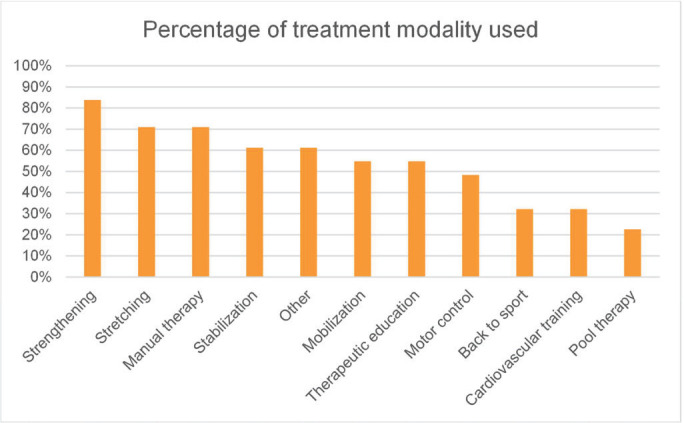
Percentage of use of each treatment modality.
Strengthening was the most frequently used treatment modality (n = 26) (10–19,21,22,24–28,30–35), with emphasis on different muscular groups as presented in Figure 3.
FIGURE 3 -.

Lower limb muscle groups most cited in the 26 strengthening protocols.
Other active modalities used were mobilization (n = 17) (12,17,19,20,22–25,27,28,30–33,35) in all three directions of movement, stabilization (n = 18) (10–12,14,15,18,19,21,22,24,25,27,28,30–35) of different body parts such as the trunk or the hips or motor control, which was global or joint-specific. Some studies also proposed exercises in a swimming pool. Passive modalities were also proposed, such as stretching (n = 22) (12–15,18–20,22,24,25,27,28,30–35) in different directions of movement (Fig. 4) and manual therapy (n = 22) (10,12,14–19,22,24,25,27,28,30–35) on soft tissue or on joints. Patient education was often mentioned (n = 17) (11,12,16–18,20,22,25,27,28,31–34) including activity modification or postural advice.
FIGURE 4 -.

Lower limb muscle groups cited in 22 stretching protocols.
Protocol explicitness
Only 2 protocols used the TIDieR checklist to rate their interventions. Figure 5 shows the score for each protocol and Figure 6 presents the average per item. The average score was 5.58 (± 3.24) and the median was 6.
FIGURE 5 -.

Number of total points for articles following TIDieR evaluation.
FIGURE 6 -.

Percentage of TIDieR items completely, not, or insufficiently reported according to all selected protocols.
None of the protocols selected used the CERT checklist to evaluate their intervention. Figure 7 shows the score of each protocol and Figure 8 presents the average per item. The average score was 7.35 (± 4.31) and the median was 8.
FIGURE 7 -.

Number of total points for articles following CERT evaluation.
FIGURE 8 -.

Percentage of CERT items completely, not, or insufficiently reported according to all selected protocols.
Discussion
Synthesis of results
Content of the protocols
The first goal of this study was to investigate which treatment modalities were used for FAIS rehabilitation. It was discovered that the most frequently trained direction of movement was hip extension even though it has been shown that patients who suffer from FAIS have a lack of strength in all movement directions (27,36–38). Strengthening is important but motor control also has a place in the rehabilitation of FAIS. Only three protocols (12,16,28) mentioned motor control exercises.
Trunk motor control was infrequently trained despite evidence showing that a lack of flexion in the lumbar spine can lead to compensation in the hips with increased flexion during sit-to-stand, which can lead to the development of FAIS (39).
Stabilization should also be trained by patients with FAIS. Freke et al. (37) showed that before a hip arthroscopy for FAIS, patients had a significant lack of unipedal balance compared to the control group. An improvement was observed after a three- and six-month rehabilitation, however, the results were still lower than in the control group. Global stabilization such as unipedal balance exercises should therefore also be performed during the final phase of rehabilitation and as part of conservative treatment.
Only a few articles mentioned manual therapy of the associated joints such as the knees, the sacroiliac joint, or the spine. Manual therapy of these joints can also influence the hip joint since their biomedical function is interdependent (40).
Manual therapy of soft tissues of the hip was often described in the protocols since it is recommended by Kuhns et al. (41) in the early stage of treatment post-surgery or for chronic hip pain. Twenty minutes per session is recommended to reduce stiffness. Manual therapy can improve the range of motion, and prevent global irritation, tendinopathy, or scar adherences (41,42).
Stretching of muscles and the capsule was often mentioned but there was little mention of pain tolerance during the stretching, even though it is suspected to exacerbate pain in patients with FAIS (43). However, psoas stretching associated with abdominal drawing-in can significantly increase the active range of motion with fewer compensations (44).
Protocol explicitness
The second goal of this study was to evaluate the intervention reporting. The results show that protocols are not explicit enough. Items concerning the name and the goal of the intervention were better described in the TIDieR checklist. Adherence is one important factor in the effectiveness of a treatment. Despite this, item 12 (How well, actual) and item 10 (Modification) produced very low scores. An explanation for this could be that these items are usually evaluated during or after an intervention and cannot be pre-planned. Similar conclusions can be drawn for the CERT checklist. Items related to protocol details were better described than those concerning how the intervention was delivered.
The variability in protocol duration, number of sessions, and adherence assessment affects the validity and the interpretation of study results. For instance, if a treatment modality is deemed statistically effective or superior to another, it is crucial to understand the specifics: how it was applied, how often, and to what extent. This clarity is essential for accurate interpretation and in order to replicate the results in clinical practice.
Future perspectives
Content of the protocols
Guidelines for sub-acromial conflict include similar treatment modalities as those presented here, except for the inclusion of electrotherapy, laser therapy, and shockwave therapy (45). It is interesting to compare the results of this scoping review with treatment recommendations for postoperative rehabilitation for FAIS (41). Similar treatment modalities were recommended. However, motor control exercises and pelvic stabilization were not included in the guidelines. Future research should investigate whether there is a lack of motor control or pelvic stabilization in the FAIS population.
Protocol explicitness
Protocols are not described in enough detail and the TIDieR and CERT checklists are too infrequently applied in studies on FAIS. These results are analogous to those of other studies of musculoskeletal conditions such as ACL injuries (46), back pain (47), cervical pain (48), rotator cuff pathologies (49), or Achilles tendon injuries (50). These studies reported between 5 and 8 out of 19 points for the CERT checklist, and half of the possible points on the TIDieR checklist.
A paper from Esterberger et al. (51) about hip pain in general showed similar results for the CERT checklist: 13 out of 19 items had similar scores (less than 25% difference) Only exercise therapy treatments were included and therefore only the CERT checklist was used. Our study can be considered as an update of the study from Esterberger et al. This study is more complete since other treatment modalities were included and assessed with the TIDieR checklist.The TIDieR and the CERT checklists are relatively recent frameworks, having been introduced in 2016, and thus are not yet widely recognized or used by authors. To improve intervention reporting, journals should require their implementation.
Strengths and limits
This article summarises the evidence in the field of FAIS and provides a large overview of the available treatment modalities and presents them in a useful table. Two assessment grids were selected to evaluate all of the treatment modalities, not only exercise-based interventions. This enhances the validity of the results. While these tools are valuable for assessing intervention reporting, their ratings are not entirely objective, despite existing guidelines for their use. To increase precision, a range of grades for each item could be useful (for example from 0 to 4, 0 = not described at all, 1 = barely described, 2 = described with some missing information, 3 = almost perfectly described, and 4 = perfectly described). Average and median values were used but no interpretation of cut-offs of CERT and TIDieR results exists. The creation of such an evaluation could be useful for future research.
Conclusion
This paper aims to be a reference for clinicians for the treatment of FAIS. It highlights the lack of evidence in reporting intervention in the scientific literature. The TIDieR and the CERT checklists could be revised to improve precision but are already useful tools to increase clarity in the reporting of interventions in future research.
Acknowledgment
Simone Gafner and Sophie Carrard for the supervision.
Laura Marguerettaz and Chris Brown for the substantive translation.
This is the final version of this article as stated in https://doi.org/10.33393/aop.2025.3879
Clinical Trial Protocol number:
DOI 10.17605/OSF.IO/GCQJX
Funding Statement
Financial support: This research received no specific grant from any funding agency in the public, commercial, or not-for-profit sectors.
Footnotes
Conflict of interest: The authors declare no conflict of interest.
This article includes supplementary material
References
- 1.Byrd JWT. Femoroacetabular impingement in athletes: current concepts. Am J Sports Med. 2014;42(3):737–751. doi: 10.1177/0363546513499136. [DOI] [PubMed] [Google Scholar]
- 2.Trigg SD, Schroeder JD, Hulsopple C. Femoroacetabular Impingement Syndrome. Curr Sports Med Rep. 2020;19(9):360–366. doi: 10.1249/JSR.0000000000000748. [DOI] [PubMed] [Google Scholar]
- 3.Charles T, Bloemers N, Deneubourg M, Schuind F, Jayankura M. Femoro-acetabular conflict : A cause of osteoarthritis of the young subject. Rev Med Brux. 2019;40(4):318–323. [Google Scholar]
- 4.Peters MD, Godfrey CM, Mclnerney P, Munn Z, Tricco AC, Khalil H. Scoping reviews (2020 version). In: JBI Manual for Evidence Synthesis. JBI; 2020 doi: 10.46658/JBIMES-20-12. chap 11, [DOI] [Google Scholar]
- 5.Tricco AC, Lillie E, Zarin W et al. PRISMA Extension for Scoping Reviews (PRISMA-ScR): checklist and Explanation. Ann Intern Med. 2018;169(7):467–473. doi: 10.7326/M18-0850. [DOI] [PubMed] [Google Scholar]
- 6.Hoffmann TC, Glasziou PP, Boutron I et al. Better reporting of interventions: template for intervention description and replication (TIDieR) checklist and guide. BMJ. 2014;348(mar07 3):g1687. doi: 10.1136/bmj.g1687. [DOI] [PubMed] [Google Scholar]
- 7.Slade SC, Dionne CE, Underwood M et al. Consensus on Exercise Reporting Template (CERT): modified Delphi Study. Phys Ther. 2016;96(10):1514–1524. doi: 10.2522/ptj.20150668. [DOI] [PubMed] [Google Scholar]
- 8.Schulz KF, Altman DG, Moher D for the CONSORT Group. CONSORT 2010 Statement: updated guidelines for reporting parallel group randomised trials. BMJ. 2010;340(mar23 1):c332–c332. doi: 10.1136/bmj.c332. [DOI] [PMC free article] [PubMed] [Google Scholar]
- 9.Matucheski M. LibGuides: Evidence-Based Practice: Levels of Evidence and Study Designs. [(Accessed November; 2024 )];2023 Online [Google Scholar]
- 10.Abdelkader N, Leonardelli C, Howitt S. Olympic fencer with femoroacetabular impingement syndrome uses active rehabilitation to avoid surgery: A case report. J Bodywork Mov Ther. 2023;33:1–7. doi: 10.1016/j.jbmt.2022.09.002. [DOI] [PubMed] [Google Scholar]
- 11.Cerrahoğlu L, Durgun ÖE. Bilateral femoroacetabular impingement syndrome: A case report. Meandros Med Dent J. 2020;21(3):266–269. doi: 10.2147/oajsm.s162304. [DOI] [PMC free article] [PubMed] [Google Scholar]
- 12.LeBeau RT, Nho SJ. The use of manual therapy post-hip arthroscopy when an exercise-based therapy approach has failed: a case report. J Orthop Sports Phys Ther. 2014;44(9):712–721. doi: 10.2519/jospt.2014.5047. [DOI] [PubMed] [Google Scholar]
- 13.Ludwig O, Schneider G, Kelm J. Improvement of Groin Pain in a Football Player with Femoroacetabular Impingement via a Correction of the Pelvic Position-A Case Report. J Clin Med. 2023;12(23):7443. doi: 10.3390/jcm12237443. [DOI] [PMC free article] [PubMed] [Google Scholar]
- 14.MacIntyre K, Gomes B, MacKenzie S, D’Angelo K. Conservative management of an elite ice hockey goaltender with femoroacetabular impingement (FAI): a case report. J Can Chiropr Assoc. 2015;59(4):398–409. [PMC free article] [PubMed] [Google Scholar]
- 15.Nikolova A, Yordanov YP. Conservative Physiotherapy Treatment of Femoroacetabular Impingement. Acta Med Bulg. 2022;49(3):50–53. doi: 10.2478/amb-2022-0030. [DOI] [Google Scholar]
- 16.Todd C, Karlsson J, Baranto A. Resolving anterior hip pain in a young male footballer following arthroscopic surgery for Femoroacetabular Impingement Syndrome: A case report. J Bodyw Mov Ther. 2020;24(1):63–68. doi: 10.1016/j.jbmt.2019.05.027. [DOI] [PubMed] [Google Scholar]
- 17.Wright AA, Hegedus EJ. Augmented home exercise program for a 37-year-old female with a clinical presentation of femoroacetabular impingement. Man Ther. 2012;17(4):358–363. doi: 10.1016/j.math.2011.10.004. [DOI] [PubMed] [Google Scholar]
- 18.Casartelli NC, Bizzini M, Maffiuletti NA et al. Exercise Therapy for the Management of Femoroacetabular Impingement Syndrome: Preliminary Results of Clinical Responsiveness. Arthritis Care Res (Hoboken). 2019;71(8):1074–1083. doi: 10.1002/acr.23728. [DOI] [PubMed] [Google Scholar]
- 19.Di Benedetto P, Vidi D, Buttironi MM, Mancuso F, Ricciarelli M, Causero A. Outcomes in arthroscopic surgery and proposal rehabilitative treatment in femoral acetabular impingement syndrome. Acta Biomed. 2022;92(S3):e2021575. doi: 10.23750/abm.v92iS3.12710. [DOI] [PMC free article] [PubMed] [Google Scholar]
- 20.Emara K, Samir W, Motasem H, Ghafar KAE. Conservative treatment for mild femoroacetabular impingement. J Orthop Surg (Hong Kong). 2011;19(1):41–45. doi: 10.1177/230949901101900109. [DOI] [PubMed] [Google Scholar]
- 21.Gao F, Zhang B, Hu B et al. Outcomes of Hip Arthroscopy for Femoroacetabular Impingement in Chinese Patients Aged 50 Years or Older. Orthop Surg. 2020;12(3):843–851. doi: 10.1111/os.12688. [DOI] [PMC free article] [PubMed] [Google Scholar]
- 22.Narveson JR, Haberl MD, Nathan Vannatta C, Rhon DI. Conservative treatment continuum for managing Femoroacetabular Impingement Syndrome and Acetabular Labral Tears in surgical candidates: a case series. Int J Sports Phys Ther. 2018;13(6):1032–1048. doi: 10.26603/ijspt20181032. [DOI] [PMC free article] [PubMed] [Google Scholar]
- 23.Domb BG, Stake CE, Botser IB, Jackson TJ. Surgical dislocation of the hip versus arthroscopic treatment of femoroacetabular impingement: a prospective matched-pair study with average 2-year follow-up. Arthroscopy. 2013;29(9):1506–1513. doi: 10.1016/j.arthro.2013.06.010. [DOI] [PubMed] [Google Scholar]
- 24.Parvaresh KC, Wichman DM, Alter TD, Clapp IM, Nho SJ. High rate of return to tennis after hip arthroscopy for patients with femoroacetabular impingement syndrome. Phys Ther Sport. 2021;51:45–49. doi: 10.1016/j.ptsp.2021.06.007. [DOI] [PubMed] [Google Scholar]
- 25.Grant LF, Cooper DJ, Conroy JL. The HAPI ‘Hip Arthroscopy Pre-habilitation Intervention’ study: does pre-habilitation affect outcomes in patients undergoing hip arthroscopy for femoro-acetabular impingement? J Hip Preserv Surg. 2017;4:85. doi: 10.1093/jhps/hnw046. [DOI] [PMC free article] [PubMed] [Google Scholar]
- 26.Guenther JR, Cochrane CK, Crossley KM, Gilbart MK, Hunt MA. A Pre-Operative Exercise Intervention Can Be Safely Delivered to People with Femoroacetabular Impingement and Improve Clinical and Biomechanical Outcomes. Physiother Can. 2017;69(3):204–211. doi: 10.3138/ptc.2016-34. [DOI] [PMC free article] [PubMed] [Google Scholar]
- 27.Kemp JL, Coburn SL, Jones DM, Crossley KM. The Physiotherapy for Femoroacetabular Impingement Rehabilitation STudy (physioFIRST): A Pilot Randomized Controlled Trial. J Orthop Sports Phys Ther. 2018;48(4):307–315. doi: 10.2519/jospt.2018.7941. [DOI] [PubMed] [Google Scholar]
- 28.Griffin DR, Dickenson EJ, Achana F et al. Arthroscopic hip surgery compared with personalised hip therapy in people over 16 years old with femoroacetabular impingement syndrome: UK FASHIoN RCT. Health Technol Assess. 2022;26(16):1–236. doi: 10.3310/FXII0508. [DOI] [PMC free article] [PubMed] [Google Scholar]
- 29.Griffin DR, Dickenson EJ, Wall PDH et al. FASHIoN Study Group. Protocol for a multicentre, parallel-arm, 12-month, randomised, controlled trial of arthroscopic surgery versus conservative care for femoroacetabular impingement syndrome (FASHIoN). BMJ Open. 2016;6(8):e012453. doi: 10.1136/bmjopen-2016-012453. [DOI] [PMC free article] [PubMed] [Google Scholar]
- 30.Mansell NS, Rhon DI, Meyer J, Slevin JM, Marchant BG. Arthroscopic Surgery or Physical Therapy for Patients With Femoroacetabular Impingement Syndrome: A Randomized Controlled Trial With 2-Year Follow-up. Am J Sports Med. 2018;46(6):1306–1314. doi: 10.1177/0363546517751912. [DOI] [PubMed] [Google Scholar]
- 31.Müller-Torrente A, Puig-Torregrosa J, Montero-Navarro S et al. Benefits of a specific and supervised rehabilitation program in femoroacetabular impingement patients undergoing hip arthroscopy: A randomized control trial. J Clin Med. 2021;10(14):3125. doi: 10.3390/jcm10143125. [DOI] [PMC free article] [PubMed] [Google Scholar]
- 32.Simunovic N, Heels-Ansdell D, Thabane L, Ayeni OR; FIRST Investigators. Femoroacetabular Impingement Randomised controlled Trial (FIRST) - a multi-centre randomized controlled trial comparing arthroscopic lavage and arthroscopic osteochondroplasty on patient important outcomes and quality of life in the treatment of young adult (18-50 years) femoroacetabular impingement: a statistical analysis plan. Trials. 2018;19(1):588. doi: 10.1186/s13063-018-2965-0. [DOI] [PMC free article] [PubMed] [Google Scholar]
- 33.Bennell KL, Spiers L, Takla A et al. Efficacy of adding a physiotherapy rehabilitation programme to arthroscopic management of femoroacetabular impingement syndrome: a randomised controlled trial (FAIR). BMJ Open. 2017;7(6):e014658. doi: 10.1136/bmjopen-2016-014658. [DOI] [PMC free article] [PubMed] [Google Scholar]
- 34.Wright AA, Hegedus EJ, Taylor JB, Dischiavi SL, Stubbs AJ. Non-operative management of femoroacetabular impingement: A prospective, randomized controlled clinical trial pilot study. J Sci Med Sport. 2016;19(9):716–721. doi: 10.1016/j.jsams.2015.11.008. [DOI] [PubMed] [Google Scholar]
- 35.Weber AE, Nakata H, Mayer EN et al. Return to Sport After Hip Arthroscopy for Femoroacetabular Impingement Syndrome in NCAA Division I Athletes: Experience at a Single Institution. Orthop J Sports Med. 2020;8(5):2325967120918383. doi: 10.1177/2325967120918383. [DOI] [PMC free article] [PubMed] [Google Scholar]
- 36.Diamond WT., Hinman R et al. Isometric and isokinetic hip strength in symptomatic femoroacetabular impingement. J Sci Med Sport. 2015:19, e69–e70. doi: 10.1016/j.jsams.2015.12.169. [DOI] [PubMed] [Google Scholar]
- 37.Freke M, King M, Crossley K, Sims K, Semciw A. Acute and Subacute Changes in Dynamic Postural Control After Hip Arthroscopy and Postoperative Rehabilitation. J Athl Train. 2022;57(5):494–501. doi: 10.4085/1062-6050-0709.20. [DOI] [PMC free article] [PubMed] [Google Scholar]
- 38.Mayne E, Memarzadeh A, Raut P, Arora A, Khanduja V. Measuring hip muscle strength in patients with femoroacetabular impingement and other hip pathologies: A systematic review. Bone Joint Res. 2017;6(1):66–72. doi: 10.1302/2046-3758.61.BJR-2016-0081. [DOI] [PMC free article] [PubMed] [Google Scholar]
- 39.Fader RR, Tao MA, Gaudiani MA et al. The role of lumbar lordosis and pelvic sagittal balance in femoroacetabular impingement. Bone Joint J. 2018;100-B(10):1275–1279. doi: 10.1302/0301-620X.100B10.BJJ-2018-0060.R1. [DOI] [PubMed] [Google Scholar]
- 40.Sueki DG, Cleland JA, Wainner RS. A regional interdependence model of musculoskeletal dysfunction: research, mechanisms, and clinical implications. J Man Manip Ther. 2013;21(2):90–102. doi: 10.1179/2042618612Y.0000000027. [DOI] [PMC free article] [PubMed] [Google Scholar]
- 41.Kuhns BD, Weber AE, Batko B, Nho SJ, Stegemann C. A four-phase physical therapy regimen for returning athletes to sport following hip arthroscopy for femoroacetabular impingement with routine capsular closure. Int J Sports Phys Ther. 2017;12(4):683–696. [PMC free article] [PubMed] [Google Scholar]
- 42.Bialosky JE, Bishop MD, Price DD, Robinson ME, George SZ. The mechanisms of manual therapy in the treatment of musculoskeletal pain: a comprehensive model. Man Ther. 2009;14(5):531–538. doi: 10.1016/j.math.2008.09.001. [DOI] [PMC free article] [PubMed] [Google Scholar]
- 43.Emary P. Femoroacetabular impingement syndrome: a narrative review for the chiropractor. J Can Chiropr Assoc. 2010;54(3):164–176. [PMC free article] [PubMed] [Google Scholar]
- 44.Park KY, Jeon IC, Hwang UJ, Jung SH, Ha SM, Yim SY. Effects of abdominal drawing-in maneuver with or without prior iliopsoas stretching on gluteus maximus activity during prone hip extension. J Back Musculoskelet Rehabil. 2022;35(2):331–339. doi: 10.3233/BMR-200251. [DOI] [PubMed] [Google Scholar]
- 45.Pieters L, Lewis J, Kuppens K et al. An Update of Systematic Reviews Examining the Effectiveness of Conservative Physical Therapy Interventions for Subacromial Shoulder Pain. J Orthop Sports Phys Ther. 2020;50(3):131–141. doi: 10.2519/jospt.2020.8498. [DOI] [PubMed] [Google Scholar]
- 46.Vlok A, van Dyk N, Coetzee D, Grindem H. Exercise Descriptors That Determine Muscle Strength Gains Are Missing From Reported Anterior Cruciate Ligament Reconstruction Rehabilitation Programs: A Scoping Review of 117 Exercises in 41 Studies. J Orthop Sports Phys Ther. 2022;52(2):100–112. doi: 10.2519/jospt.2022.10651. [DOI] [PubMed] [Google Scholar]
- 47.Davidson SRE, Kamper SJ, Haskins R et al. Exercise interventions for low back pain are poorly reported: a systematic review. J Clin Epidemiol. 2021;139:279–286. doi: 10.1016/j.jclinepi.2021.05.020. [DOI] [PubMed] [Google Scholar]
- 48.Grandeo J, Favaro L, Rhon DI, Young JL. Exercise therapy reporting in clinical trials for chronic neck pain: A systematic review. Musculoskeletal Care. 2022;20(4):796–811. doi: 10.1002/msc.1644. [DOI] [PubMed] [Google Scholar]
- 49.Major DH, Røe Y, Grotle M et al. Content reporting of exercise interventions in rotator cuff disease trials: results from application of the Consensus on Exercise Reporting Template (CERT). BMJ Open Sport Exerc Med. 2019;5(1):e000656. doi: 10.1136/bmjsem-2019-000656. [DOI] [PMC free article] [PubMed] [Google Scholar]
- 50.Christensen M, Zellers JA, Kjær IL, Silbernagel KG, Rathleff MS. Resistance Exercises in Early Functional Rehabilitation for Achilles Tendon Ruptures Are Poorly Described: A Scoping Review. J Orthop Sports Phys Ther. 2020;50(12):681–690. doi: 10.2519/jospt.2020.9463. [DOI] [PMC free article] [PubMed] [Google Scholar]
- 51.Estberger A, Kemp JL, Thorborg K, Pålsson A, Ageberg E. Are Exercise Therapy Protocols For The Treatment of Hip-Related Pain Adequately Described? A Systematic Review of Intervention Descriptions. Int J Sports Phys Ther. 2023;18(1):38–54. doi: 10.26603/001c.68069. [DOI] [PMC free article] [PubMed] [Google Scholar]
Associated Data
This section collects any data citations, data availability statements, or supplementary materials included in this article.