



Abstract
This manuscript critically examines the challenges associated with the design and conduct of academic global breast cancer trials outside the influence of pharmaceutical companies, leveraging insights from the Breast International Group (BIG). In the past 4 decades significant declines in breast cancer mortality have occurred, partly related to industry-academic clinical and translational partnerships with long term study follow up. However, in the past decade these partnerships have largely uncoupled. The increasing complexity and non-alignment of trials, funding constraints, regulatory complexity, declining academic freedom, lack of transparency, and lack of affordability of new agents have become key barriers to equitably improving cancer outcomes. Industry research expenditure in the United States is now 5 fold greater than publically funded academic research. To address these challenges, we advocate for patient centred systemic reforms, with trials balancing commercial interests with public health imperatives. These reforms should include equitable research funding models, streamlined international clinical trial regulatory processes, and increased collaboration across diverse stakeholders. Practical solutions to enhance global trial accessibility and efficacy include leveraging digital technologies, artificial intelligence, real world data, decentralizing clinical trial infrastructure, and embedding translational research frameworks across countries.
Subject terms: Cancer, Health care, Medical research, Oncology
Introduction
The Breast International Group (https://bigagainstbreastcancer.org/) is the largest international network of academic research groups dedicated to finding cures and developing better treatments for breast cancer through clinical trials and research programmes, with over 50 member groups world-wide1,2. A review of the National Cancer Institute’s National Clinical Trial Network groups reported projected gains of 24.1 million life years by 2030 among 108,334 patients enrolled in phase III trials from 1980 onwards, at a cost of $236 per life-year gained3. However, more recently, a constellation of factors including greater awareness of inequities in cancer care4,5, lack of diversity and inclusivity in clinical trials6–12, the rising cost of new anticancer agents13–17 and practices to limit their affordability18–20, lack of alignment of research funding with clinical need21, fewer academic and patient centric pragmatic clinical trials22–24, declining academic freedom25–27 and the move to increasingly elaborate research28, have led to concerns about global inequity in democratising discovery and how this might be ameliorated.
While cancer is a global, race and age agnostic disease, our clinical research enterprise is not. Short term consequences of this range from lack of inclusion of ethnic minorities and elderly patients4,29–33 to incomplete toxicity assessments34,35. Lack of ancestral diversity in clinical trials today compromises the external validity of translational studies in the future, and will unintentionally lead to algorithm bias in health care36–39. While the research agenda for all countries is set in more affluent ones40–43, the African continent is home to 15% of the global population, shoulders 25% of the global disease burden, but produces only 2% of the world’s research output42. By 2040, 30 million new cancer cases and 16 million cancer related deaths will be reported in low- and middle-income countries44. There, access to standard therapies is limited45–48, the relative health burden is higher than in high income countries46, the costs of newer anticancer agents are prohibitive44,45, and the transgenerational impact of maternal cancer related deaths is profound49. A 2018 review of 6710 trials in breast, lung and cervical cancer conducted globally demonstrated that several low- and middle-income countries with the highest incidence to mortality ratios in breast, lung and cervix cancer had no clinical trials registered for these tumour types40. Only 8% of studies that enrol patients in low- and middle-income countries, are led by individuals based there41 and only 4% of global cancer research output is co-authored by individuals in these countries. Subsequent access rates to novel agents are also inequitable35. Access is lowest in African countries due to wealth inequality, lack of infrastructure and sovereign debt50.
Democratisation and accelerated integration of discoveries are necessary in an era when pandemic, and climate change related disruptions have and will lead to delayed cancer presentations and fragmented care51–57. Improved equitable integration is also needed at a time of rising breast cancer incidence in low- and middle-income countries46. These concerns prompted the establishment of a working group within the Executive Board of BIG to conduct a reflective analysis of the landscape of breast cancer clinical trials. Analogous to the reflective novella of Charles Dicken’s “A Christmas Carol”58, we envisaged our trial landscape through the lens of the past, present, and future, and how the current ecosystem could be re-imagined to maximise survival and quality of life for ALL of the over 2 million patients who will be diagnosed with breast cancer globally this year59,60.
The Impact of the Discoveries of the Past
In oncology therapeutics the development of targeted therapies in breast cancer – first hormonal and then genomic, marked a transformative era for patients with breast cancer. Tamoxifen, first synthesised in 1962 with recognised anti-oestrogen actions, was initially developed by Imperial Chemical Industries (now part of AstraZeneca) as a possible female contraceptive61. In 1969, a single-arm phase II trial reported similar efficacy to historical controls treated with other endocrine agents (stilbestrol or high dose androgens) but with less toxicity62, findings confirmed in a series of randomised trials63. This tolerable efficacy led to adjuvant trials – the first initiated 3 years after the drug was commercially available in the United Kingdom, but unlike today when a single large trial is conducted to determine efficacy, a series of trials were conducted to look for optimal treatment duration with 1 year64, 2 years65, and 5 years66. Earlier studies with tamoxifen suggested no benefit67,68, whereas larger, academic trials demonstrated clear advantages69. Further studies directly compared different durations70,71. However, it was not until the results of several academic and industry trials were combined by statisticians at the Early Breast Cancer Trials Collaborative Group that clear evidence of improved survival emerged72. Their work included the following prescient comment: “…the very high degree of statistical significance suggested by this overview shows that where many trials have addressed related questions, a semi-formal overview of their findings (in cancer, as in heart disease) may produce reliable evidence long before this would have emerged from the usual processes of separate analysis and publication. Since the future treatment of many women might be importantly affected by this…”, with these initial findings confirmed in a full publication73. Thus, tamoxifen joined the World Health Organisation Essential Medicines List (WHO EML)74, because academic-commercial partnerships around the world had demonstrated the optimal duration of therapy (up to 10 years) with clear evidence of improved survival, with many of the key data emerging after generic drug supply became available from 2002 onwards.
Complementary and Contrasting Aspects of Academic (or Government Funded) and Industry Trials
The following game-changing new development was the development of trastuzumab for HER2-positive breast cancer75. Much initial work was done by academic-pharma collaborations in the United States, with the pivotal registration trial for metastatic disease sponsored and led by Genentech76. However, the most important impact of this drug was improving overall survival in early breast cancer, with several trials led by academic groups working globally with Genentech and Roche. Again, the duration of therapy was tested in these trials77–79, before approval, with further shorter durations tested in academic led studies supported by United Kingdom, Finnish and French governmental funding79–81 demonstrating the complementary nature of such academic studies to those sponsored by industry (Table 1). Since the 1990s when these therapeutics were being refined, the 5-year risk of death from breast cancer has reduced in the United Kingdom from 14.4%, then to 4.9% by 2020, reflecting the transformative impact of these decades of discovery82. Similarly in the United States the overall death rate has declined by 44% overall between 1989 and 202283. A recent modelling study estimates that 47% of this reduced mortality is attributable to better treatment of stage I-III disease, and 29% to better treatment of stage IV disease83,84.
Table 1.
Hallmarks of Clinical Trials
| Hallmark | Academic Trial | Industry Trial |
|---|---|---|
| Goal | Addresses unmet clinical need, advances therapeutic options and innovation | Secures regulatory approval, advances therapeutic options and innovation |
| Time Frame | Long term impact focused | Early readout focused |
| Trial Design | Flexible designs | Approval focused designs |
| Patient Partner Role | Patient partner integrated | Patient partner advised |
| Infrastructure & Staffing | Builds capacity for clinical improvement and develops investigators | Employs existing capacity and engages with existing investigators |
| Data Access | Diverse data sharing | Selected data sharing |
| Translational Studies | Biobank specimen collaboration | Biobank silos |
The Therapeutic Landscape of the Present
Currently, the landscape of cancer clinical trial activity has been dominated by the integration of immunotherapy into cancer therapeutics. Between 2016 and 2020, 12.1% of global public and philanthropic funding for cancer research was allocated to immuno-oncology21. The awarding of the Nobel Prize in Physiology or Medicine to Tasuku Honjo and James Allison in 2018 reflected the therapeutic impact of their seminal work 3 decades earlier, which led to the widespread incorporation of immune checkpoint inhibitor (ICI) therapy into cancer care85. In 2019, the ICI pembrolizumab was added to the WHO EML, joining trastuzumab, which had been listed in 201586,87. This inclusion was based on the impact of ICI agents in melanoma and lung cancer management e.g.,88,89, and prompted similar studies in breast cancer90. The potential for patients with breast cancer was reinforced by data from the Cancer Genome Atlas, which assessed distinct genomic immune profiles across intrinsic breast cancer subtypes and demonstrated that all subtypes were immunologically actionable91–93.
The impact of the work of Honjo and Allison has been substantial. By 2022, over 2000 clinical trials evaluating these agents were being conducted worldwide94. By 2023, 43% of cancer clinical trials in some countries were ICI related95. Seven years after the Nobel award, 11 antibodies directed against PD-1 or PDL-1 pathway and more than 85 oncology indications have been approved by the FDA78,96,97. As reflected by the multiple companion diagnostic tests to detect PD-L1 expression98, the rapid expansion of clinical investigation has been largely uncoordinated99,100 and referred to as “The Wild West”94. Such divergence will likely accelerate as complex gene signatures are explored to predict treatment benefit and ICI agents are potentially combined with over 160 antibody drug conjugates (ADC) in development101–104, and integrated with bi, tri, and tetra-specific antibodies105,106.
In parallel with these developments the clinical trial landscape has evolved significantly in the past 2 decades. In an analysis of 26,080 cancer clinical trials in the United States, the enrolment ratio of industry sponsored versus government funded trials for adults increased from 4.8 during 2008–2012 to 9.6 during 2018–202224. While cancer incidence increased during these periods, enrolment counts for federally-sponsored trials were flat. This evolution has been associated with a shift away from demonstrating gains in overall survival to the use by regulatory authorities of surrogate endpoints such as progression free survival or change in biomarker level107,108 where the strength of association with overall survival may ultimately may be low (Table 1). Progression free survival is now the most common end point in oncology phase III trials109, and initial short term favourable results may dilute or dissolve with time. In one analysis the ultimate median overall survival gain across a portfolio which included breast cancer patients was less than 6 months22.
Challenges of selecting the most appropriate end point
The concerns regarding trial endpoints are reflected in the ICI journey in breast cancer therapeutics102. There, initially low response rates were observed in single agent studies90, prompting incorporation with cytotoxic chemotherapy in the metastatic setting in phase 3 studies (KEYNOTE-119, IMpassion130 and IMpassion131110–112). Initial study results led to FDA approvals, but more long term follow up led to subsequent withdrawal of 2 indications for atezolizumab113. In early stage triple negative breast cancer, the KEYNOTE-522 study incorporated pembrolizumab into neoadjuvant therapy for 6 months with an additional response agnostic 6 months of therapy post operatively110. A modest improvement in pathological complete response rates from 55.6% to 63%, and a significant improvement in 3-year event free survival from 76.8% to 84.5% led to FDA approval for this indication. Subsequently, estimated 5 year overall survival rates improved from 81.7% to 86.6%. The role of continuing pembrolizumab therapy in patients who have had a complete pathological response has been raised by many114–117 particularly given the favourable results of adaptive response approaches in other cancer types such as the completed investigator initiated NADINA trial118–121. However, in the pivotal KEYNOTE-522 trial, translational studies to optimise patient selection for treatment are not yet in the public domain. Such studies would facilitate right sizing therapy, and potentially reduce the long term ICI immune-related toxicities observed in real world studies34,117,122–124, and help address concerns regarding the risk of ICI induced accelerated atherosclerosis125–127 and potential gonadal toxicity128 in this adjuvant treatment setting.
The enthusiasm regarding the potential benefit of ICI for patients has also been subdued by the significant financial toxicity of this therapeutic class. In the KEYNOTE-522 study, the cost per relapse averted was $2.64 million15. High prices are a major factor in preventing patient access to cancer medicines even with some WHO EML agents, and even in high income countries129–134. As highlighted by a recent Medecins Sans Frontieres funded study135 these prices set the negotiation standard for other less affluent jurisdictions136. This strategy is compounded by the “cancer premium” whereby In high income countries cancer drugs are on average 3 times more expensive compared to non-cancer ones137,138.
Central to these high costs is the cost of clinical development. A single trial now has 3 million data elements, a 10-fold increase in the past decade22, and an estimated cost for a pivotal trial of US$48 million139. An analysis of research and development productivity of 16 leading research-based pharmaceutical companies between 2001 and 2020 revealed a $6.16 billion R&D expenditure per new drug140. Such figures are then used to justify the high drug costs that ultimately limit patient access141,142. The median price for a course of an oncology drug approved by the FDA between 2015 and 2020 was $196,000143, while the median price per patient for a complete course of recently approved adjuvant therapy was $158,00015. Globally this can result in catastrophic financial loss for patients in the wealthiest country, and suboptimal breast cancer care in most of the remaining ones. These high prices are perpetuated by patent thickets and patent ever-greening19,20. In the United States these costs contribute to 3% of cancer patients declaring bankruptcy, a rate almost three times higher than the general US population16,17. This cohort also have a higher death rate than those that remain solvent144. In low- and middle-income countries, only 1–2% of the population will have access to innovative agents145,146. For them to access to medicines on the WHO EML often leads to substantial out of pocket expenses147.
A Vision for the Future
In the present era of unprecedented discovery, less than 1 in 20 patients with cancer participate in clinical trials113,148,149. Consequently for many patients the discovery resulting from trials is not relevant to them as either their demographic is not included, or non- affordability of agents (including WHO EML agents) prevents access to the therapies. What should be a golden age of medicine has become a gilded one, with the appearance of a wealth of treatment options concealing actual poverty of access150. The human cost of this reality for our patients and their families is profound. Our industry partners are also vulnerable. Patient trust is central to clinical trial conduct. However in 2014 a survey of the US public reported that 37% believed that the FDA intentionally suppressed natural cures for cancer at the behest of the pharmaceutical industry151,152. Failure to optimise the translational potential of patient provided tissue samples as outlined earlier, compromises this trust.
It need not be like this. Our patients’ reality contrasts with the decision of Roy Vagelos, formerly Chief Executive Officer (CEO) of Merck, who in 1988 established a drug donation programme, in 30 countries, of the WHO essential medication ivermectin, an avermectin derivative, to treat river blindness. The programme is estimated to have prevented 7 million years of disability at the cost of $257 million153. In 2015 the Nobel Prize in Physiology and Medicine was awarded to Bill Campbell and Satoshi Omura for the discovery of avermectin, reflecting the impact of this agent. The decision to donate the anti-parasitic drug to eradicate a vector-borne disease which caused a major public health burden in West Africa, has been equated to the Volvo car company’s decision to freely share the 3-point seat belt patent with other manufacturers because of its humanitarian potential154,155. What would be the impact of a similar initiative with other WHO EMLs such as trastuzumab and pembrolizumab (vide supra)? What if biobank specimens and data bases could also be shared? Failure to do so at present with resultant lack of co-ordination and non-optimization of donated patient material will also be contrary to the recently updated World Medical Association Declaration of Helsinki on ethical principles for medical research involving human subjects156.
Let’s then also be optimistic and imagine that all parties wake up to realise that it’s in everyone’s long term interests to reform the power balance in pivotal, practice changing trials. Researchers will develop new interventions (whether chemical, mechanical, electronic or health system) which need to be tested. There needs to be a forum for dialogue between the “owner” of new intervention, experienced clinicians, regulators, methodologists with clinical research skills, health care providers, AND the public/patients, who jointly define the questions. For example, with a novel endocrine therapy for breast cancer, we need to know what advances it offers: either in place of OR in sequence/combination with contemporary care and, for a cancer, with a long natural history such as hormone receptor positive early breast cancer, we also need to document the long-term effects, whether beneficial or not.
If the trial is for drug registration, then the regulators need to demand of the sponsor a design that meets ALL these criteria, not just the primary endpoint looking for a statistically significant improvement in recurrence after only a few years. If academics and patients and health care providers want to know if a whole population benefits or only a subset, then core translational research needs to be embedded in the trial. Such translational studies require a code of practice so that samples and data are not solely under one party’s control157. It is paramount that such correlative science is conducted AND reported, for the public good, whether or not it is of interest to the commercial OR academic bodies involved. If such additional data beyond an initial positive signal are of interest to the whole system, then perhaps the commitment to them needs to be a condition of marketing authorisation?
In late January 2023, the United States National Institutes of Health’s new Data Management and Sharing policy was activated158. This requires researchers to share data that was generated with institute support with immediate effect. Efforts to increase data sharing of individual participant data from clinical trials by pharmaceutical sponsors are also being made159,160. In 2024, the Japanese government launched an initiative that will make its publicly funded research free to read161 with data sharing as the norm rather than the exception. This vision would include information from translational data whether industry or academic related. It envisages leveraging real-world evidence from patients receiving standard therapy162,163, complementing pragmatic trials which have been globally impactful in the COVID-19 pandemic164–166.
Vaccine development strategies during the COVID-19 pandemic have emphasised the benefit of integrating real-world and clinical data to accelerate innovation. The use of such real-world data has been helpful in oncology, from assisting with estimates of ICI toxicity in Japan29, CAR-T-cell therapy toxicity in the United States167 through to assessing clinical use of cyclin-dependant kinase 4/6 inhibitors in patients with metastatic breast cancer in the Netherlands168. In Ireland during the pandemic a Geo-Hive live data base was established to provide daily guidance of COVID-19 infections169. This exemplar successfully collated data from multiple sources in the Irish healthcare system where data acquisition has historically been either delayed or incomplete, or both. A similar data base could be integrated into newly approved therapeutics with general data protection regulation compliance, mandatory registration by prescribers, and an “opt out” facility for patients analogous to that used in organ donation cards. Valuable pharmaco-genomic data could result and address the lack of ancestral diversity shortcomings highlighted by Duma and colleagues4, and the need for innovation highlighted by others170.
Analogous to beneficial impact of real world data integration into healthcare during the COVID-19 pandemic, pragmatic patient focused trial designs were also pivotal in reducing mortality during that time171. Similar benefits could be seen by employing pragmatic and sustainable trial designs in oncology. As the recent Lancet Breast Cancer Commission commented, “We identify the need to develop and facilitate novel, efficient, patient-centred translational clinical trials and enable a research culture and infrastructure to ensure these can be undertaken globally”. Extending access to appropriate clinical research into breast cancer across the globe must be part of our optimistic future: or the inequities in breast cancer care that the Commission highlighted will only get worse172 Figure 1.
Fig. 1. Challenges for breast cancer trials.
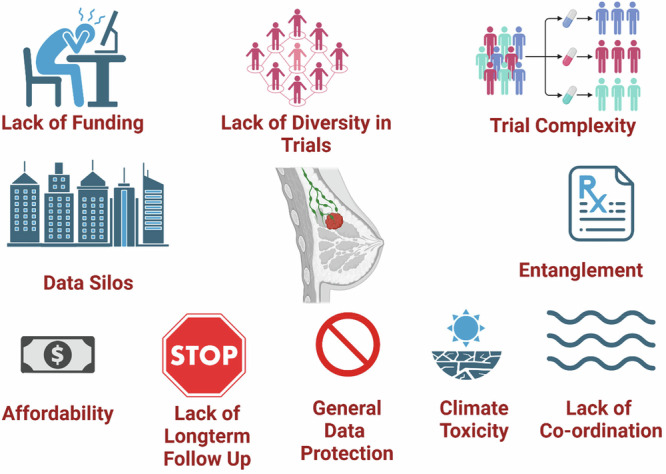
Barriers to clinical investigation in breast cancer therapeutics include lack of co-ordination and lack of data sharing between trials, climate toxicity associated with research, entanglement between industry and investigators213 and growing trial complexity compounded by lack of funding.
What would a trial addressing the concerns raised in this commentary look like? In Table 2 we have outlined many of the suggestions integrated in this paper which would increas access for patients and integrate them as partners in trial design and conduct. In our group The Optima Young /Path4Young Trial is an exemplar of a digital approach to the challenges we face. As demonstrated in Fig. 2 many activities across the trial pathway can be digitised. Such digital technology can encourage a more global and equitable reach of clinical trials and also empower patients to participate in co-creation of clinical research protocols. Artificial intelligence algorithms and natural language processing models can be activated to facilitate the screening and recruitment phase of a clinical trial to determine patient eligibility with relative accuracy173–175 and use of matching algorithms to reduce potential provider bias176. Patients can provide consent through digital platforms (eConsent)177,178 which reduces geographical constraints179,180. Patient data can be collected remotely at different time points during the clinical trial in several ways: electronic capture of active and passive patient-generated health data (PGHD) through the deployment of electronic patient-reported outcomes and biosensors; automated data collection via the patient’s electronic medical record and personal health record; and through telemedicine visits181–184. Other trial activities that can be digitised include the research intervention itself, the digital transfer of imaging and lab results, adverse event AE monitoring, data analysis, and the eventual sharing of results with participants185–192. Many oral, subcutaneous, and intramuscular therapies with established safety profiles and some infusions have been adaptable to successful remote administration185–187. Other advantages included real time feedback for patients and staff193,194 and patient empowerment195–198. Challenges to implementation include digital literacy199,200, cybersecurity and privacy concerns among others201,202. Oncology trials are often characterised by multi-site participation and manual data collection, digitisation of data collection can greatly ease the clinical burden associated with many trials. Such studies are also more environmentally sustainable with up to 90% less carbon emissions203. The aim is to realise many of the hallmarks of equitable trials which optimise the benefits of both academic and industry trials (Table 3).
Table 2.
Strategies to increase access to clinical trials for patients
| Factors Affecting Patient Access | Facilitators to Access |
|---|---|
| Awareness and Education | Patient friendly information, Provider engagement, Digital outreach |
| Geographical and Logistical Barriers | Decentralised and hybrid trials, Community based sites, Transport provision, Dependant support |
| Improved Diversity and Equity | Culturally competent recruitment, Language accessibility, Flexible eligibility criteria, Community and healthcare champions |
| Reduced Financial Burdens | Compensation and trial cost coverage, Advocacy to healthcare insurance providers |
| Build Trust and Transparency | Patient centered trial design, Clear communication, Ethical oversight |
| Streamline Enrolment and Participation | Simplified consent processes, Artificial intelligence and data tools for matching patients to trials |
Fig. 2. The use of digital tools in the path for young research pathway (EU funded international chemotherapy de-escalation trial in pre-menopausal women with breast cancer (BC)) – Figure adapted ref. 199.

The trial includes digital information resources for patients, family members and the general population to improve trial understanding and real-time communication; workshops with patients representatives regarding study procedures, recruitment, results, and monitoring of inclusion metrics with automated alerts relating to the risk of under-representation of patient groups, an equity toolbox to boost and support diverse participation hosted in WeShare, and implicit bias training programs for investigators.
Table 3.
Hallmarks of Equitable Trials
| Aim | Improve patient outcomes with right-sized therapies |
|---|---|
| Time Frame | Flexible and contingent on study endpoint |
| Design | Pragmatic, decentralized and hybrid (integrated real world data component) |
| Patient Partner Role | Active and early participation in design, conduct and analysis |
| Infrastructure | Physical and digital |
| Trial Staff | Supports, mentors and encourages new and existing staff |
| Data Access | Collaborative Data Sharing |
| Translational Studies | Collaborative Biobank Access |
Building on Charles Dickens’ acute social observations, as a healthcare community, we have a role in determining if the outlook for our patients represents “Great Expectations” as illustrated in Fig. 3, rather than “Bleak House”204. In 2022 the US NIH funding for clinical research was $18 billion205, a figure exceeding that of all other government funded research combined206. However it is only a fraction of the $100 billion expenditure of the US pharmaceutical industry205. This expenditure had doubled in a decade, a trend that will be reflected in a growing industry-funded clinical trials arena in the future. In this regard, a “Bleak House” ending that Dickens could have written might look like the following: The total control of clinical trials sits with commercial bodies which only test therapeutic approaches that will reap financial rewards for their shareholders, with no regard for the broader community in which they and their employees live. Regulators are emaciated into bodies that just review submitted data and can only reject studies that do not meet the endpoint chosen by the sponsor, which may have little or NO relevance to patients, hospitals, health care providers, or clinicians. Then, in the face of severe financial pressures, such new interventions are only accessible to the rich, further exacerbating the inequalities in the world until mass migration driven by famine, climate change, and lack of access to good medicine overwhelms even those rich health care systems. That nightmare scenario is perhaps unimaginable; but it is surely in no one’s interest to inch in that direction.
Fig. 3.

Opportunities to Optimise Patient Benefit and Integration in Clinical Trials in Breast Cancer.
We need to recognise and manage the hazards posed by prioritisation of shareholder returns over patient welfare and value for money in healthcare207. To realise the “Great Expectations” outlook that our patients and communities need, we would ask that the power balance shifts back to genuine partnership between all the parties involved: patients and the public, academics, health care providers, funders, innovators, commercial enterprises, and regulators, with the right clinical questions asked over the relevant timescale for everyone’s benefit208,209. The COVID-19 pandemic outlined where such a partnership was transformative for our societies. While the pandemic was an acute pivot point that facilitated rapid transformational change, our current reality in oncology research doesn’t. George Bernard Shaw, a Nobel Laureate for Literature, wrote “Progress is not possible without change”210. To harvest the current crop of discovery210–212 for ALL patients, we ALL need to change. We hope this manuscript will catalyse the necessary conversations required to enable such globally relevant re-democratisation of drug discovery and medical innovation.
Acknowledgements
The Breast International Group receives grant funding from the European Union. Cancer Trials Ireland receives grant funding from the Health Research Board (Ireland). WeShare (ANR-21-ESRE-0017) has been selected for the 2020 Equipex call for projects by the ANR (French National Research Agency) under the “Investissements d’avenir intégré à France 2030” programme and has been awarded €11 M in funding. Path for Young is funded by the European Union under the Grant Agreement N°101156800. Views and opinions expressed are however those of the author(s) only and do not necessarily reflect those of the European Union and Digital Executive Agency. Neither the European Union nor the granting authority can be held responsible for them. No funding was received for any source to specifically support this manuscript.
Author contributions
Conceptualisation: D.A.C., S.O.R., I.V.L., S.S.; Data Curation: D.A.C., S.O.R., I.V.L., S.S., E.C., E.R., A.U., P.L.B., B.C., V.A., Formal Analysis: D.A.C., S.O.R., I.V.L., S.S., E.C., E.R., A.U., P.L.B., B.C., V.A.; Funding Acquisition: D.A.C., V.A., C.S., T.G., A.A. Investigation: D.A.C., S.O.R., I.V.L., S.S., Methodology: D.A.C., S.O.R. Project admin: S.O.R., D.A.C., I.V.L., S.S. Resources: V.A., C.S., T.G., A.A. Software: S.O.R. supervision: D.A.C., I.V.L., S.O.R., S.S. validation: D.A.C., S.O.R., S.S., I.V.L. Visualisation: S.O.R., D.A.C., I.V.L. Writing - original: D.A.C., S.O.R., S.S., I.V.L. Writing - review and editing: all authors. Graphics – S.O.R. using Biorender under licence to S.O.R. All authors have read and agreed to the published version of the manuscript Artificial intelligence programs were not used in the writing of this manuscript.
Data availability
No datasets were generated or analysed during the current study.
Competing interests
Conflict of Interest Travel: Servier (ER), Gilead (ER, EB) Astra Zeneca (ER, EB, GC) Integris (ER), Pfizer (ER, EB), Genesis Pharma (ER), Bristol Myers Squibb (ER), Roche (ER, GC), Daichi Sankyo (EB, GC, SOR), Exact Sciences (EB), Novartis (EB,IVL, SOR), Merck (SOR), Nordic Pharma (SOR)Stocks: Eli Lilly (EC)Honoraria/Lecture Fees: Chugai (SS), Kyowa Kirin (SS), Merck Sharp Dohme (SS, GW), Takeda (SS, EB), Novartis (SS, GW, ER, EB, GC), Daichi Sankyo (SS, GW, EB,GC,BL), Eisai (SS), Eli Lilly (SS, EB, GC), Astra Zeneca (SS, GW, ER, EB, GC), Pfizer (EB, GC, GW,SS), Taiho (SS), Oho (SS), Nippon Kayaku (SS), Gilead (SS, ER), Exact Sciences (SS, GC,EB), Myriad Genetics (SS), Roche (GW,GC), Ser-vier (ER), Foundation Medicine (GC), Samsung (GC), Incyte (EB), Seagen (GC), Menarini (GC), Gilead Sciences (GC), Ellipses Pharma (GC).Consultancy/Advisory RolesGlaxo Smith Kline (GC), Zymeworks (PB), Astra Zeneca (GW,GC, BL, SL), Roche (SL, GC), Janssen (PB), Repare (PB), Eli Lilly (GC, SL, BL,PB), Exact Sciences (SL,EB), Gilead Sciences (GC, SL, BL), Amgen (PB), Foundation Medicine (GC), Bristol Myers Squibb (GC,SL), Samsung (GC), Boehringer Ingelheim (GC), Merck (GC, PB), Blueprint Medicines (GC), Sandoz (EB), Pfizer (EB, GC, BL), Menarini (EB, GC, BL), Exnet Science (GC), Daichi Sankyo (GW, EB, BL), Novartis (GW, GC,SL), Merck Sharp Dohme (GW), Seagen (GC,PB), Guardant Health (GC), Celulicity (GC), Hengrini Therapeutics (GC), Amaroq Therpeutics (SL), Mersana Therpeutics (SL), Domain Therpeutics (SL), BioNTech (SL), Menarini Asia Pacific (SL), Bicycle Therpeutics (SL), Saga Diagnostics (SL), Adanate (SL), Research Funding to InstitutionAmgen (PB, IVL), Signal Chem (PB) Seagen (PB), Servier (PB), Sanofi Aventis (SS, PB, AA, VA, TG, CS), Janssen (JB, GW), Clovis (JB), Bristol Myers Squibb (SL, PB), Lilly Loxo (PB), Medice-na (PB), PTC Thereputics (PB), Life Sciences (PB), Zymeworks (PB), Veracyte (BC, PB), Taiho (SS), Eisai (SS), Chugai (SS), Medimmune (GW), Novartis (IVL, SL, DC, GW, EC, AA, VA, TG, CS, JB, PB), Pfizer (DC, SL, GW, EC, AA, VA, CS, TG, JB), Merck Sharp Doehm (SL,JB,SS), Takeda (SS, GW), Astra Zeneca (SL, DC, SS, PB, GW, EC, BL, IVL), Daichi Sankyo (DC,SS), Roche (SL, DC, GW, EC, AA, VA, CS, TG), Merck (GW, GC,PB), Bayer (GW), Astellas (GW), PUMA biotech (JB), Gilead (SL, SS, GC, PB), Eli Lilly (SS, SL, EC, PB), Glaxo Smith Kline (GW, PB, AA, VA, TG, CS), Libos (GW), Boehringer Ingelheim (PB), Greenwich Lifesciences (EC), Nektar (PB), Exact Sciences (DC), Ely Lilly (DC), Menarini (DC), Resilience Care (IVL), Pfizer Edimark (IVL), Sandoz (IVL), Chugai (IVL), Servier Monde (IVL),Doctaform Medical Market-ing (IVL), Nektar Therapeutics (SL),No Conflicts to DeclareAU.
Footnotes
Publisher’s note Springer Nature remains neutral with regard to jurisdictional claims in published maps and institutional affiliations.
Change history
12/16/2025
A Correction to this paper has been published: 10.1038/s41523-025-00871-3
References
- 1.Piccart-Gebhart M. J., Goulioti T., Straehle C., Cameron D. Overcoming barriers to clinical trials cooperation: the Breast International Group example. 2021 ASCO Educational Handbook. 231-239 10.1200/EDBK_321475. [DOI] [PubMed]
- 2.Piccart, M. et al. Keeping faith with trial volunteers. Nature446, 137–138 (2007). [DOI] [PubMed] [Google Scholar]
- 3.Unger, J. M. et al. Population, clinical, and scientific impact of National Cancer Institute’s National Clinical Trials Network Treatment Studies. J. Clin. Oncol.10.1200/JCO.22.01826 (2022). [DOI] [PMC free article] [PubMed]
- 4.Duma, N. et al. Representation of minorities and women in oncology clinical trials: review of the past 14 years. JCO Oncol. Pr.14, e1–e10 (2018). [DOI] [PubMed] [Google Scholar]
- 5.DeSantis, C. E. et al. Cancer statistics for African Americans. CA Cancer J. Clin.69, 211–233 (2019). [DOI] [PubMed] [Google Scholar]
- 6.Tapara, K. et al. Race and ethnicity representation in Phase 2/3 oncology clinical trial publications a systemic review. JAMA Health Forum (2024). %: e241388. 10.1001/jamahealthforum.2024.1388. [DOI] [PMC free article] [PubMed]
- 7.Garcia-Cardenas, J. M. et al. Toward equitable precision oncology: monitoring racial and ethnic inclusion in genomics and clinical trials. JCO Precis Oncol.8, e2300398 (2024). [DOI] [PubMed] [Google Scholar]
- 8.Vidal, L. et al. Equitable inclusion of diverse populations in oncology clinical trials: deterrents and drivers. ESMO Open9, 103373 (2024). [DOI] [PMC free article] [PubMed] [Google Scholar]
- 9.Candelario, N. M. et al. Diversity in clinical trials in Europe and the USA: a review of a pharmaceutical company’s data collection, reporting and interpretation of race and ethnicity. Ann. Oncol.34, 1194–1197 (2023). [DOI] [PubMed] [Google Scholar]
- 10.Wallace, N., O’Keeffe, S., Gardner, H. & Shiely, F. Under-recording and underreporting of participant ethnicity in clinical trials is persistent and is a threat to inclusivity and generalisability. J. Clin. Epidemil162, 81–89 (2023). [DOI] [PubMed] [Google Scholar]
- 11.Lee Aiyegbusi, O. et al. Recommendations to promote equity, diversity and inclusion in decentralized clinical trials. Nat. Med.30, 3075–3084 (2024). [DOI] [PubMed] [Google Scholar]
- 12.Bania, A., Adamou, A. & Saloustros, E. Racial and ethnic disparities in European breast cancer clinical trials. Cancers16, 1726 (2024). [DOI] [PMC free article] [PubMed] [Google Scholar]
- 13.Cortes, J. et al. Enhancing global access to cancer medicines. CA Cancer J. Clin.70, 105–124 (2020). [DOI] [PubMed] [Google Scholar]
- 14.Barrios, C. deLima Lopez G, Yusof MM, et al. Barriers in access to oncology drugs a global crisis. Nat. Rev. Clin. Oncol.20, 7–15 (2023). [DOI] [PMC free article] [PubMed] [Google Scholar]
- 15.Mousaki, I., Olivier, T. & Prasad, V. Cost per event averted in clinical trials in adjuvant setting from 2018-2022. JAMA Netw. Open (2022). E2216058 10.1001/jamanetworkopen.2022.16058. [DOI] [PMC free article] [PubMed]
- 16.Shanahan, K. Debt or dying: the high costs of cancer care in America, one patient’s perspective. JCO Oncol. Pr.21, 20–22 (2025). [DOI] [PubMed] [Google Scholar]
- 17.Patel, M., Riley, A., Newcomer, L. & Schulman, K. the price is NOT right: payers roles in addressing financial toxicity. JCO Oncol. Pr.21, 100–102 (2025). [DOI] [PubMed] [Google Scholar]
- 18.Berwick, D. M. Salve Lucrum: The existential threat of greed in US healthcare. JAMAhttps://doi.org/jama.2023.0846 (2023). [DOI] [PubMed]
- 19.Chao, B., Whalen, R., Kesselheim, A. S. & Tu, S. S. Clearing Dense Drug Patent Thickets. New Eng. J. Med.https://doi.org/NEJMp2412999 (2024). [DOI] [PubMed]
- 20.Feldman, R. May your drug price be evergreen. J. Law Biosci. 590–647 10.1093/jlb/lsy022 (2018). [DOI] [PMC free article] [PubMed]
- 21.McIntosh, S. A. et al. Global funding for cancer research between 2016 and 2020: a content analysis of public and philanthropic investments. Lancet Oncol.24, 636–645 (2023). [DOI] [PubMed] [Google Scholar]
- 22.Del Paggio, J. C. et al. Evolution of randomised clinical trial in the era of precision oncology. JAMA Oncol.7, 728–734 (2021). [DOI] [PMC free article] [PubMed] [Google Scholar]
- 23.Abdou, Y. & Sharpless, N. E. Bridging the gap in cancer clinical trial funding. J. Clin. Oncol.42, 3887–3890 (2024). [DOI] [PubMed] [Google Scholar]
- 24.Unger, J. M., Xiao, H., Vaidya, R. & LeBlanc, M. Patient enrolment to industry sponsored versus federally sponsored cancer clinical trials. J. Clin. Oncol.42, 3917–3925 (2024). [DOI] [PMC free article] [PubMed] [Google Scholar]
- 25.Udesky, L. Is political interference causing faculty brain drain in the southern United States. Nature.10.1038/d41586-024-04070-1 (2024). [DOI] [PubMed]
- 26.Mallapaty S. Trump team ‘survey’ sent to overseas researchers prompts foreign interference fears. Nature 2025. 10.1038/d41586-025-00850-5. [DOI] [PubMed]
- 27.Waldman A., Song L. National Cancer Institute employees can’t publish information on these topics without special approval. Propublica March 2025. https://www.propublica.org/article/national-cancer-institute-flagged-topics-vaccines-autism-rfk-jr accessed 22/03/2025.
- 28.Leary A., Besse B., Andre F. The need for pragmatic, affordable, and practice-changing real-life clinical trials in oncology. Lancet 2023. 10.1016/S0140-6736(23)02199-2. [DOI] [PubMed]
- 29.Yamamoto, N. et al. Real world safety of nivolumab in patients with non-small cell lung cancer in japan: post marketing surveillance. Cancer Sci.112, 4492–4701 (2021). [DOI] [PMC free article] [PubMed] [Google Scholar]
- 30.Wilson, B. E. et al. Differential treatment effect between younger and older adults for new cancer therapies in solid tumors supporting US Food and Drug Administration approval between 2010 and 2021. Cancer129, 3318–3325 (2023). [DOI] [PubMed] [Google Scholar]
- 31.Fashoyin-Aje, L. A. et al. Driving diversity and inclusion in cancer drug development – Industry and regulatory perspectives, current practices, opportunities and challenges. Clin. Cancer Res29, 3566–3572 (2023). [DOI] [PMC free article] [PubMed] [Google Scholar]
- 32.Wildiers, H. & de Glas, N. A. Anti-cancer drugs are not well tolerated in all older patients with cancer. Lancet Healthy Longev.1, e43–e47 (2020). [DOI] [PubMed] [Google Scholar]
- 33.Chua, A. V. et al. Under-representation and under-reporting of minoritized racial and ethnic groups in clinical trials on immune checkpoint inhibitors. JCO Oncol. Pr.21, 408–417 (2024). [DOI] [PMC free article] [PubMed] [Google Scholar]
- 34.Hsu, M. L. et al. Clinical features, survival, and burden of toxicities in survivors more than one year after lung cancer immunotherapy. Oncologist27, 971–981 (2022). [DOI] [PMC free article] [PubMed] [Google Scholar]
- 35.Wakao, R. et al. Data-driven identification of adverse event reporting patterns for Japan in VigBase, the WHO global database of individual case safety reports. Drug Saf.42, 1487–1498 (2019). [DOI] [PMC free article] [PubMed] [Google Scholar]
- 36.Wong, A. K. et al. Pivotal trial demographic representation and clinical development times for oncology therapeutics. JAMA330, 2392–2394 (2023). [DOI] [PMC free article] [PubMed] [Google Scholar]
- 37.Chin, M. H. et al. Guiding principals to address the impact of algorithm bias on racial and ethnic disparities in health and health care. JAMA Netw. Open6, e2345050 (2023). [DOI] [PMC free article] [PubMed] [Google Scholar]
- 38.Vyas, D. A., Eisenstein, L. G. & Jones, D. S. Hiding in plain sight – reconsidering the use of race correction in clinical algorithms. N. Engl. J. Med383, 874–882 (2020). [DOI] [PubMed] [Google Scholar]
- 39.Luo, M. et al. Ancestral differences in anticancer treatment efficacy and their underlying genomic and molecular alterations. Cancer Discov.15, 511–529 (2025). [DOI] [PMC free article] [PubMed] [Google Scholar]
- 40.Rubagumya, F. et al. An analysis of the African cancer research ecosystem: tackling disparities. BMJ Glob. Health8, e011338 (2023). [DOI] [PMC free article] [PubMed] [Google Scholar]
- 41.Ramaswami, R. et al. Disparities in breast, lung and cervical cancer trials worldwide. JCO Global. Oncology4, 1–11 (2018). [DOI] [PMC free article] [PubMed] [Google Scholar]
- 42.Miller, J. E. et al. Evaluation of drug trials in high-, middle-, and low –income countries and loca commercial availability of newly approved drugs. JAMA Netw. Open4, e217075 (2021). [DOI] [PMC free article] [PubMed] [Google Scholar]
- 43.Rubagumya, F. et al. Participation of lower and upper middle income countries in oncology clinical trials led by high-income countries. JAMA Netw. Open5, e22227252 (2022). [DOI] [PMC free article] [PubMed] [Google Scholar]
- 44.Global Cancer Observatory. www.gco.iarc.fr. accessed 3rd February 2023
- 45.Sarwar, M. R., Iftikhar, S. & Saquib, A. Availability of anticancer medicines in public and private sectors, and their affordability by low, middle and high income class patients in Pakistan. BMC Cancer18, 14 (2018). [DOI] [PMC free article] [PubMed] [Google Scholar]
- 46.World Health Organisation 2023. The Global Breast Initiative Implementation Framework. Assessing strengthening and scaling up services for the early detection and management of breast cancer. https://www.who.int/initiatives/global-breast-cancer-initiative
- 47.Chen, S. et al. Estimates and projections of the Global economic cost of 29 cancers in 204 countries and territories from 2020-2050. JAMA Oncol.9, 465–472 (2023). [DOI] [PMC free article] [PubMed] [Google Scholar]
- 48.Well, J. C. et al. An analysis of contemporary oncology randomised clinical trials for low/middle income versus high income countries. JAMA Oncol.7, 379–385 (2021). [DOI] [PMC free article] [PubMed] [Google Scholar]
- 49.Guida, F. et al. Global and regional estimates of orphans attributed to maternal cancer mortality in 2020. Nat. Med28, 2563–2572 (2022). [DOI] [PMC free article] [PubMed] [Google Scholar]
- 50.World Bank Group. World development report 2022. Finance for an equitable recovery. www.worldbank.org accessed October 1st 2023.
- 51.Maringe, C. et al. The impact of the COVID-19 pandemic on cancer deaths due to delays in diagnosis in England, UK: a national, population-based, modelling study. Lancet Oncol.21, 1023–1034 (2020). [DOI] [PMC free article] [PubMed] [Google Scholar]
- 52.Gruber, K. Cancer research in the midst of COVID-19. Nat. Cancer3, 1409–1411 (2022). [DOI] [PubMed] [Google Scholar]
- 53.Li, B. T. et al. Reimagining patient-centric cancer clinical trials: a multistakeholder international coalition. Nat. Med28, 622–628 (2022). [DOI] [PubMed] [Google Scholar]
- 54.O’Reilly, S. et al. The SARS-CoV-2 Pandemic and Cancer Trials Ireland: Impact, Resolution and Legacy. Cancers14, 2447 (2022). [DOI] [PMC free article] [PubMed] [Google Scholar]
- 55.Burke, S. et al. Building health system resilience through policy development in response to COVID-19 in Ireland: From shock to reform. Lancet Reg. Health – Eur.9, 100223 (2021). [DOI] [PMC free article] [PubMed] [Google Scholar]
- 56.O’Reilly, S. et al. Climate therapy: sustainability solutions for breast cancer care in the Anthopocene era. Clin. Breast Cancer21, S1526–S8209 (2024). [DOI] [PubMed] [Google Scholar]
- 57.Lynch E. et al. Why we should, and how we can, reduce the climate toxicity of cancer care. JCO Oncol Pract 2024. OP24000680. 10.1200/OP-24-00680 [DOI] [PubMed]
- 58.Dickens, C. A Christmas Carol. Chapman and Hall: London, 1843. [Google Scholar]
- 59.Bray, F. et al. Global cancer statistics 2022: GLOBOCAN estimates of incidence and mortality worldwide for 36 cancers in 185 countries. CA Cancer J. Clin.74, 229–263 (2024). [DOI] [PubMed] [Google Scholar]
- 60.Kim J. et al. Global patterns and trends in breast cancer incidence and mortality across 185 countries. Nat Med 2025. 10.1038/s41591-025-03502-3 [DOI] [PubMed]
- 61.Jordan, V. C. 50th anniversary of the first clinical trial ICI 46,474 9tamoxifen) then what happened. Endocr. Relat. Cancer28, R11–R30 (2021). [DOI] [PMC free article] [PubMed] [Google Scholar]
- 62.Cole, M. P., Jones, C. T. A. & Todd, I. D. H. A new anti-oestrogenic agents in late breast cancer: an early clinical appraisal of ICI 46474. Br. J. Cancer35, 270–274 (1971). [DOI] [PMC free article] [PubMed] [Google Scholar]
- 63.Fossati, R. et al. Cytotoxic and hormonal treatment for metastatic breast cancer: a systematic review of published randomized trials involving 31,510 women. J. Clin. Oncol.16, 3439–3460 (1998). [DOI] [PubMed] [Google Scholar]
- 64.Ribeiro G., Swindell R. The Christie hospital adjuvant tamoxifen trial. J Natl Cancer Inst Monogr 1992. 121-125. [PubMed]
- 65.Controlled trial of tamoxifen as a single adjuvant agent in the management of early breast Nolvadex Adjuvant Trial Organisation. Br. J. Cancer57, 608–611 (1988). [DOI] [PMC free article] [PubMed] [Google Scholar]
- 66.Report from the Breast Cancer Trials Committee, Scottish Cancer Trials Office (MRC) Edinburgh. Lancet2, 171–175 (1987). [PubMed] [Google Scholar]
- 67.Stewart, H. J., Prescott, R. J. & Forrest, A. P. Scottish adjuvant tamoxifen trial: a randomized study updated to 15 years. J. Natl Cancer Inst.93, 456–462 (2001). [DOI] [PubMed] [Google Scholar]
- 68.Tormey, D. C., Gray, R. & Falkson, H. C. Postchemotherapy adjuvant tamoxifen therapy beyond five years in patients with lymph node-positive breast cancer. East. Cooperative Oncol. Group. J. Natl Cancer Inst.88, 1828–1833 (1996). [DOI] [PubMed] [Google Scholar]
- 69.Davies, C. et al. Long-term effects of continuing adjuvant tamoxifen to 10 years versus stopping at 5 years after diagnosis of oestrogen receptor-positive breast cancer: ATLAS, a randomised trial. Lancet381, 805–816 (2013). [DOI] [PMC free article] [PubMed] [Google Scholar]
- 70.Hackshaw, A. et al. Long term benefits of 5 years of tamoxifen: 10 year follow up of a large randomised trial in women at least 50 years of age with early stage breast cancer. J. Clin. Oncol.29, 1657–1663 (2011). [DOI] [PubMed] [Google Scholar]
- 71.Decensi, A. et al. A randomised trial of low-dose tamoxifen on breast cancer proliferation and blood estrogenic markers. J. Natl Cancer Inst.95, 779–790 (2003). [DOI] [PubMed] [Google Scholar]
- 72.Ludwig Breast Cancer Study Group. Randomised trial of chemo-endocrine therapy, endocrine therapy, and mastectomy alone in postmenopausal patients with operable breast cancer and axillary node metastasis. Lancet 323:1256-1260. [PubMed]
- 73.Early Breast Cancer Clinical Trials Group Effects of adjuvant tamoxifen and of cytotoxic therapy on mortality in early breast cancer. N. Engl. J. Med319, 1681–1692 (1988). [DOI] [PubMed] [Google Scholar]
- 74.“Essential Drugs for Cancer Chemotherapy: Memorandum from a WHO Meeting,” Bulletin of the World Health Organization 63, no. 6 (1985): 999–1002 [PMC free article] [PubMed]
- 75.Bazell R. Her-2: The Making of Herceptin, a Revolutionary Treatment for Breast Cancer. 1998 Random House.
- 76.Slamon, D. et al. Use of chemotherapy plus a monoclonal antibody against HER2 for metastatic breast cancer than overexpresses HER2. N. Engl. J. Med344, 783–792 (2001). [DOI] [PubMed] [Google Scholar]
- 77.Joensuu, H. et al. Fluorouracil, Epirubicin, and Cyclophosphamide with either docetaxel or vinorelbine, with or without Trastuzumab, as adjuvant treatments of Breast Cancer: Final Results of the FinHer Trial. J. Clin. Oncol.27, 5685–5692 (2009). [DOI] [PubMed] [Google Scholar]
- 78.Goldhirsch, A. et al. 2 years versus one year of adjuvant trastuzumab for HER2-positive breast cancer (HERA): an open label randomised controlled trial. Lancet382, 1021–1028 (2013). [DOI] [PubMed] [Google Scholar]
- 79.D’Hondt, V. et al. UCBG 2-04: Long-term results of the PACS 04 trial evaluating adjuvant epirubicin plus docetaxel in node-positive breast cancer and trastuzumab in the human epidermal growth factor receptor 2-positive subgroup. Eur. J. Cancer122, 91–100 (2019). [DOI] [PubMed] [Google Scholar]
- 80.Earl, H. M. et al. 6 versus 12 months of adjuvant trastuzumab for HER2-positive early breast cancer (PERSEPHONE): 4-year disease-free survival results of a randomised phase 3 non-inferiority trial. Lancet393, 2599–2612 (2019). [DOI] [PMC free article] [PubMed] [Google Scholar]
- 81.Pivot, X. et al. 6 months versus 12 months of adjuvant trastuzumab in early breast cancer (PHARE): final analysis of a multicentre, open-label, phase 3 randomised trial. Lancet393, 2591–2598 (2019). [DOI] [PubMed] [Google Scholar]
- 82.Taylor, C. et al. Breast cancer mortality in 500000 women with early invasive breast cancer diagnosed in England, 1993-2015: population based observational cohort study. BMJ381, e074684 (2023). [DOI] [PMC free article] [PubMed] [Google Scholar]
- 83.Giaquinto, A. N. et al. Breast cancer statistics 2024. CA Cancer JClin74, 477–495 (2024). [DOI] [PubMed] [Google Scholar]
- 84.Caswell-Jin, J. L. et al. Analysis of breast cancer mortality in the US- 1975-2019. JAMA331, 233–241 (2024). [DOI] [PMC free article] [PubMed] [Google Scholar]
- 85.Huang, P. W. & Chang, J. W. C. Immune checkpoint inhibitors win the 2018 Nobel Prize. Biomed. J.42, 299–306 (2019). [DOI] [PMC free article] [PubMed] [Google Scholar]
- 86.Jenei, K. et al. Cancer medicines on the WHO model list of essential medicines: processes, challenges, and a way forward. Lancet Glob. Health10, e1860–e1888 (2022). [DOI] [PubMed] [Google Scholar]
- 87.WHO model list of essential medicines -22nd list 2021. World Health Organisation Sept 30th 2021 https://www.who.int/publications/i/item/WHO-MHP-HPS-EML-2021.02
- 88.Topalian, S. L. et al. Safety, activity and immune correlates of anti-PD-1 antibody in cancer. N Eng. J. Med366, 2443–2454 (2012). [DOI] [PMC free article] [PubMed] [Google Scholar]
- 89.Weber, J. S. et al. Phase I/II study of ipilumimab for patients with metastatic melanoma. J. Clin. Oncol.26, 5950–5956 (2008). [DOI] [PubMed] [Google Scholar]
- 90.Franzoi, M. A., Romano, E. & Piccart, M. Immunotherapy for early breast cancer: too soon, too superficial, or just right. Ann. Oncol.32, 323–336 (2021). [DOI] [PubMed] [Google Scholar]
- 91.Rizzo, A. et al. KEYNOTE-522, Impassion31 and GeparNUEVO: changing the paradigm of neoadjuvant immune checkpoint inhibitors in early triple negative breast cancer. Future Oncol.18, 2301–2309 (2022). [DOI] [PubMed] [Google Scholar]
- 92.Thorsson, V. et al. The immune landscape of cancer. Immunity48, 812–830.e14 (2018). [DOI] [PMC free article] [PubMed] [Google Scholar]
- 93.Gatti-Mays, M. E. et al. If we build it they will come: targeting the immune response to breast cancer. NPJ Breast cancer5, 37 (2019). [DOI] [PMC free article] [PubMed] [Google Scholar]
- 94.Beaver, J. A. & Pazdur, R. The wild west of checkpoint inhibitor development. N. Engl. J. Med386, 1297–1301 (2022). [DOI] [PubMed] [Google Scholar]
- 95.Talbot, A. et al. The impact of the 2022 Ukraine /Russian conflict on cancer clinical trials. J. Int Med Res50, 1–10 (2022). [DOI] [PMC free article] [PubMed] [Google Scholar]
- 96.Mullard, A. 2023 FDA approvals. Nat. Rev. Drug Discov.23, 88–95 (2024). [DOI] [PubMed] [Google Scholar]
- 97.Mullard, A. 2024 FDA approvals. Nat. Drug Discov.24, 75–82 (2025). [DOI] [PubMed] [Google Scholar]
- 98.Oliner, K. S. et al. Challenges to innovation arising from current companion diagnostic regulations and suggestions for improvrments. Clin. Cancer Res31, 795–800 (2025). [DOI] [PMC free article] [PubMed] [Google Scholar]
- 99.Zietse, M. et al. Interchangeability of immune checkpoint inhibitors: an urgent need for action. Lancet Oncol.25, e611–e616 (2024). [DOI] [PubMed] [Google Scholar]
- 100.Editorial Calling time on the immunotherapy gold rush. Lancet Oncol.18, 981 (2017). [DOI] [PubMed] [Google Scholar]
- 101.Kaplon, H. et al. Antibodies to watch in 2023. mAbs15, 215340 (2023). [DOI] [PMC free article] [PubMed] [Google Scholar]
- 102.Jacob S. L., Huppert L. A., Rugo H. S. Role of Immunotherapy in Breast Cancer. JCO Oncol Prac epub Jan 3rd 2023. 10.1200/OP.22.00483. [DOI] [PubMed]
- 103.Santa-Maria C. A. Optimising and refining immunotherapy in breast cancer. JCO Oncol Prac epub Jan 6th 2023. 10.1200/OP.22.00722. [DOI] [PubMed]
- 104.Abdou, Y. et al. Immunotherapy in triple negative breast cancer: beyond checkpoint inhibitors. NPJ Breast Cancer8, 121 (2022). [DOI] [PMC free article] [PubMed] [Google Scholar]
- 105.Tapia-Galisteo, A., Compte, M., Alvarez-Valina, L. & Sanz, L. When three is not a crowd: trispecific antiboidies for enhanced cancer immunotherapy. Theranostics13, 1028–1041 (2023). [DOI] [PMC free article] [PubMed] [Google Scholar]
- 106.Klein, C., Brinkman, U., Reichert, J. M. & Kontermann, R. E. The present and future of bispecific antibodies for cancer therapy. Nat. Drug Discov.23, 301–319 (2024). [DOI] [PubMed] [Google Scholar]
- 107.Chen, E. Y., Haslam, A. & Prasad, V. FDA acceptance of surrogate endpoints for cancer drug approval :1992-2019. JAMA Intern Med180, 912–914 (2020). [DOI] [PMC free article] [PubMed] [Google Scholar]
- 108.Sarac, S. B., Ainsworth, M. A., Hovgaard, D. & Bjerrum, O. W. Progression-free survival in oncology: caveat emptor!. Basic Clin. Pharm. Toxicol.124, 237–238 (2019). [DOI] [PubMed] [Google Scholar]
- 109.Booth, C. M., Eisenhauer, E. A., Gyawali, B. & Tannock, I. F. Progression-free survival should not be used as a primary endpoint for registration of anticancer drugs. J. Clin. Oncol.41, 4968–4972 (2023). [DOI] [PubMed] [Google Scholar]
- 110.Schmid, P. et al. Overall survival with pembrolizumab in early stage triple negative breast cancer. N. Engl. J. Med391, 1981–1991 (2024). [DOI] [PubMed] [Google Scholar]
- 111.Schmid, P. et al. Atezolizumab and nab-paclitaxel in advanced triple negative breast cancer. N. Engl. J. Med379, 2108–2121 (2018). [DOI] [PubMed] [Google Scholar]
- 112.Cortes, J. et al. Pembrolizumab plus chemotherapy in advanced triple-negative breast cancer. N. Engl. J. Med387, 217–226 (2022). [DOI] [PubMed] [Google Scholar]
- 113.Food and Drug Administration. April 27-29, 2021: Meeting of the Oncologic Drugs Advisory Committee meeting announcement. https://www.fda.gov/advisory-committees/advisory-committee-calender/april-27-29-2021-meeting-oncologic-drugs-advisory-committee-meeting-announcement-04272021-04292021.
- 114.O’Rourke, H., Hart, C. & De Boer, R. H. Current usage of pembrolizumab in triple negative breast cancer. Expert Rev. Anticancer Ther.24, 253–261 (2024). [DOI] [PubMed] [Google Scholar]
- 115.Colombo Bonadio, R. et al. Management of patients with early stage triple negative breast cancer following pembrolizumab based neoadjuvant therapy; what are the evidences ?. Cancer treat. Rev.110, 102459 (2022). [DOI] [PubMed] [Google Scholar]
- 116.Tarantino, P., Hortobagyi, G., Tolaney, S. M. & Mittendorf, E. A. Heterogeneity of residual disease after neoadjuvant systemic therapy in breast cancer: a review. JAMA Oncol.10, 1578–1584 (2024). [DOI] [PubMed] [Google Scholar]
- 117.Krishnan, J. et al. Detrimental impact of chemotherapy dose reduction or discontinuation in early stage triple negative breast cancer treated with pembrolizumab and neoadjuvant chemotherapy: a multicentre experience. Clin. Breast Cancer24, e701–e711 (2024). [DOI] [PMC free article] [PubMed] [Google Scholar]
- 118.Rosner, S. et al. Five year clinical outcomes after neoadjuvant nivolumab in resectable non-small cell lung cancer. Clin. Cancer res29, 705–710 (2023). [DOI] [PMC free article] [PubMed] [Google Scholar]
- 119.Van Akkooi, A. C. J., Blank, C. & Eggermont, A. M. M. NeoadjuANT immunotherapy emerges as best medical practice, and will be the new standard of care for macroscopic stage III melanoma. Eur. J. Cancer182, 38–42 (2023). [DOI] [PubMed] [Google Scholar]
- 120.Burton, E. M. et al. Neoadjuvant immunotherapy across cancers: meeting report form the Immunotherapy Bridge- December 1st-2nd, 2021. J. Transl. Med20, 271 (2022). [DOI] [PMC free article] [PubMed] [Google Scholar]
- 121.Menzies, A. M. et al. Pathological response and survival with neoadjuvant therapy in melanoma: a pooled analysis form the International Neoadjuvant Melanoma Consortium (INMC). Nat. Med27, 301–309 (2021). [DOI] [PubMed] [Google Scholar]
- 122.Jayan, A. et al. Real-world immune-related adverse events in patients with early triple-negative breast cancer who received pembrolizumab. JCO Oncol. Pr.10, OP2400371 (2024). [DOI] [PMC free article] [PubMed] [Google Scholar]
- 123.Cronin C., O’Sullivan A., Naidoo J. Long-term toxicity of immune checkpoint inhibitors – time to widen the lens. JAMA Oncol 2025. Feb 27th. 10.1001/jamaoncol.2024-6809 [DOI] [PubMed]
- 124.Guven D. C., Sy Thong M., Arndt V. Survivorship outcomes in patients treated with immune checkpoint inhibitors: a scoping review. J Cancer Surviv 2024. Jan 4th. 10.1007/s11764-023-01507-w [DOI] [PMC free article] [PubMed]
- 125.Williams, J. W. & Lutgens, E. Untrained cancer immunity ignites atherosclerosis. Nat. Cardiovasc Res3, 1380–1382 (2024). [DOI] [PubMed] [Google Scholar]
- 126.Drobni, Z. D. et al. Association between immune checkpoint inhibitors with cardiovascular events and atherosclerotic plaque. Circulation142, 2299–2311 (2020). [DOI] [PMC free article] [PubMed] [Google Scholar]
- 127.Kandapalli, L., Bittinor, W. & Lenneman, C. By releasing the brakes with immunotherapy are we accelerating atherosclerosis. Circulation142, 2312 (2020). [DOI] [PubMed] [Google Scholar]
- 128.Winship, A. L. et al. Checkpint inhibitor immunotherapy diminishes oocyte number and quality in mice. Nat. Cancer3, 1–13 (2022). [DOI] [PubMed] [Google Scholar]
- 129.O’Reilly D. et al. Cost and public reimbursement of cancer medicines in the UK and the Republic of Ireland. Ir J Med Sci 2022. Apr 21. 10.1007/s11845-022-02990-3. [DOI] [PubMed]
- 130.Ramagopalan, S. V. et al. Is the price right? Paying for value today to get more value tomorrow. BMC Med22, 45 (2024). [DOI] [PMC free article] [PubMed] [Google Scholar]
- 131.Paulus V. H., Ravi A. “ Deal with the Devil”: Harvard Medical School Faculty grapple with increasing industry research funding. Harvard Crimson April 24th 2024. www.thecrimson.com
- 132.Iqbal, S. & Collins, D. C. Crowdfunding for anticancer therapies: an analysis of non-US GoFundMe pages. Ir. J. Med Sci.190, 1355–1361 (2021). [DOI] [PubMed] [Google Scholar]
- 133.Polite, B. N., Ratain, M. J. & Lichter, A. S. Oncology’s “Hockey Stick” moment for the cost of cancer drugs- the climate is about to change. JAMA Oncol.7, 25–26 (2021). [DOI] [PubMed] [Google Scholar]
- 134.Turkie R. AbbVie overcharged the Dutch healthcare system by as much as 1.2 billion euros for Humira Feb 21st 2023. www.pharmaceuticalaccountability.org accessed 1/3/2023
- 135.Barber, M. J., Gotham, D., Bygrave, H. & Cepuch, C. Estimated sustainable cost-based prices for diabetes medicines. JAMA Netw. Open7, e243474 (2024). [DOI] [PMC free article] [PubMed] [Google Scholar]
- 136.Jenei, K., Prasad, V., Lythgoe, M. E. & High, U. S. drug process have global implications. BMJ376, o693 (2022). [DOI] [PubMed] [Google Scholar]
- 137.Serra-Burriel, M., Martin-Bassols, N., Perenyi, G. & Vokinger, K. N. Drug prices after patent expirations in high income countries and implications for cost effectiveness analyses. JAMA Health Forum5, e242530 (2024). [DOI] [PMC free article] [PubMed] [Google Scholar]
- 138.Conti R. M., Frank R. G., Cutler D. M. The myth of the free market for pharmaceuticals. N Engl J Med 390: 1448-1450. [DOI] [PubMed]
- 139.Moore, T. J., Heyward, J., Anderson, G. & Alexander, G. C. Variation in the estimated costs of pivotal clinical benefit trials supporting the approval of new therapeutic agents, 2015-2017: a cross sectional study. BMJ Open10, e038863 (2020). [DOI] [PMC free article] [PubMed] [Google Scholar]
- 140.Schuhmacher, A. et al. Analysis of pharma R&D productivity – new persepective needed. Drug Discov. Today28, 103726 (2023). [DOI] [PubMed] [Google Scholar]
- 141.Prasad, V. & Mailankody, S. Research and development spending to bring a single cancer drug to market and revenues after approval. JAMA Intern Med177, 1569–1575 (2017). [DOI] [PMC free article] [PubMed] [Google Scholar]
- 142.Goozner, M. A much needed corrective on drug development costs. JAMA Intern Med177, 1575–1576 (2017). [DOI] [PubMed] [Google Scholar]
- 143.Miljkovic, M. D., Tuia, J. E., Olivier, T., Haslam, A. & Prasad, V. Association between US drug price and measures of efficacy for oncology drugs approved by the United States Food and Drug Administration from 2015-2020. JAMA Int Med182, 1315–1320 (2022). [DOI] [PMC free article] [PubMed] [Google Scholar]
- 144.Hu, X. et al. Association of medical debt and cancer mortality in the US. J. Clin. Oncol.41, 6505 (2022). abstract. [Google Scholar]
- 145.Patel, A., Goldstein, D. A. & Tannock, I. F. Improving access to immunotherapy I low- and middle- income countries. Ann. Oncol.33, 360–361 (2022). [DOI] [PubMed] [Google Scholar]
- 146.Patil, V. M. et al. Low-dose immunotherapy in head and neck cancer: a randomized study. J. Clin. Oncol.41, 222–232 (2023). [DOI] [PubMed] [Google Scholar]
- 147.Cherny, N. I. et al. ESMO Global Consortium Study on the availability, out of pocket costs, and accessibility of cancer medicines: 2023 update. Ann. Oncol.36, 247–262 (2025). [DOI] [PubMed] [Google Scholar]
- 148.Jin S., Pazdur, Sridhara R. Re-evaluating eligibility criteria for oncology clinical trials: analysis of investigational new drug applications in 2015. J Clin Oncol 35:3745-3752 [DOI] [PMC free article] [PubMed]
- 149.Bloomberg New Economy International Cancer Coalition, McKinsey Cancer Center, Cure4Cancer Advancing global health equity in oncology clinical trial access. Cancer Discov.14, 2317–2323 (2024). [DOI] [PubMed] [Google Scholar]
- 150.Khular D. The Gilded Age of Medicine is Here. The New Yorker. December 12th 2024. www.newyorker.com/culture/2024-in-review/the-gilded-age-of-medicine-is-here accessed February 20th 2025
- 151.Grimes, D. R. The struggle against cancer misinformation. Cancer Discov.12, 26–30 (2022). [DOI] [PubMed] [Google Scholar]
- 152.Oliver, J. E. & Wood, T. Medical conspiracy theories and health behaviour in the United States. JAMA Intern Med174, 817–818 (2014). [DOI] [PubMed] [Google Scholar]
- 153.Omura, S. & Crump, A. The life and times of ivermectin – a success story. Nat. Rev. Micorbiol2, 984–989 (2004). [DOI] [PubMed] [Google Scholar]
- 154.Bell D. Volvo’s gift to the world, modern seat belts have saved millions of lives. Forbes. August 13th 2019. https://www.forbes.com/sites/douglasbell/2019/08/13/60-years-of-seatbelts-volvos-great-gift-to-the-world
- 155.Finnucane F. Ozempic changed the lives of obesity patients. And then we had to stop prescribing it. Irish Times April 27th 2024. https://www.theirishtimes.com/opinion/2024/04/27/osempic-changed-the-lives-of-obesity-patients-but-we-had-to-stop-prescribing-it/
- 156.World Medical Organisation. World Medical Organisation Declaration of Helsinki. Ethical Principles for Medical Research Involving Human Subjects. JAMA 2024. 10.1001/jama.2024.2972
- 157.Coleman, R. et al. Code of practice needed for samples donated by trial participants. Lancet Oncol.23, e 89–e 90 (2022). [DOI] [PubMed] [Google Scholar]
- 158.Ross, J. S., Waldstreicher, J. & Krumholz, H. M. Data sharing – a new era for research funded by the U.S. government. N. Engl. J. Med389, 2408–2410 (2023). [DOI] [PubMed] [Google Scholar]
- 159.Buyse, M. On enhancing clinical trial data sharing. JAMA Oncol.9, 1627–1628 (2023). [DOI] [PubMed] [Google Scholar]
- 160.Hopkins A. M., et al. Heterogeneity and utility of pharmaceutical company sharing of individual participant data packages. JAMA Oncol 2023. 10.1001/jamaoncol.2023.3996 [DOI] [PMC free article] [PubMed]
- 161.Chawia D. S. Japan’s push to make all research open access if taking shape. Nature 2024. 10.1038/d41586-024-01493-8 [DOI] [PubMed]
- 162.Tang, M., Pearson, S. A., Simes, R. J. & Chua, B. H. Harnessing real world evidence to advance cancer research. Curr. Oncol.30, 1844–1859 (2023). [DOI] [PMC free article] [PubMed] [Google Scholar]
- 163.Saesen, R., Lacombe, D. & Huys, I. Real-world data in oncology: a questionnaire based analysis of the academic research landscape examining the policies and experiences of the cancer cooperative groups. ESMO Open8, 100878 (2023). [DOI] [PMC free article] [PubMed] [Google Scholar]
- 164.Chodick, G. et al. The effectiveness of the two dose BNT162b2 vaccine: analysis of real-world data. Clin. Infect. Dise74, 472–478 (2022). [DOI] [PMC free article] [PubMed] [Google Scholar]
- 165.Ben-Tov, A. et al. BNT162b2 messanager RNA COVID-19 vaccine effectiveness in patients with inflammatory bowel disease: preliminary real-world data during mass vaccination campaign. Gastroenterol161, 1715–1717.e1 (2021). [DOI] [PMC free article] [PubMed] [Google Scholar]
- 166.RECOVERY (randomised evaluation of COVID-19 therapy. www.recoverytrial.net accessed 31st Jan 2023
- 167.Fusaroli, M. et al. Post marketing surveillance of CAR_T_Cell therapies: analysis of the FDA adverse event reporting system (FAERS) database. Drug Saf.45, 891–908 (2022). [DOI] [PMC free article] [PubMed] [Google Scholar]
- 168.Luyendijk, M., Blommestein, H., Uyl-do-Groot, C., Siesling, S. & Jager, A. Regulatory approval, reimbursement, and clinical use of cyclin-dependent kinase 4/6 inhibitors in metastatic breast cancer in the Netherlands. JAMA Netw. Open6, e2256170 (2023). [DOI] [PMC free article] [PubMed] [Google Scholar]
- 169.O’Reilly S. et al. Impact of the COVID-19 pandemic on cancer care in Ireland- perspectives from a COVID-19 and cancer working group. J Cancer Policy 2023 Feb 23;100414. 10.1016/j.jcpo.2023.100414 [DOI] [PMC free article] [PubMed]
- 170.Johnson, P. C., Gainor, J. F., Sullivan, R. J. & Longo, D. L. Immune checkpoint inhibitors the need for innovation. N. Engl. J. Med388, 1529–1532 (2023). [DOI] [PubMed] [Google Scholar]
- 171.The RECOVERY Collaborative Group Dexamethasone in hospitalised patients with COVID-19. N. Engl. J. Med384, 693–704 (2021). [DOI] [PMC free article] [PubMed] [Google Scholar]
- 172.Coles, C. E. et al. The Lancet Breast Cancer Commission. Lancet403, 10439 (2024). [DOI] [PubMed] [Google Scholar]
- 173.Inan, O. T. et al. Digitizing clinical trials. NPJ Digit Med3, 1–7 (2020). [DOI] [PMC free article] [PubMed] [Google Scholar]
- 174.Haddad, T. C. et al. Impact of a cognitive computing clinical trial matching system in an ambulatory oncology practice. J. Clin. Oncol.36, 6550–6550 (2018). [Google Scholar]
- 175.Klein, H. et al. Matchminer: an open-source platform for cancer precision medicine. NPJJ Precis. Onc6, 1–9 (2022). [DOI] [PMC free article] [PubMed] [Google Scholar]
- 176.Barrett, N. J. et al. An Assessment of the Feasibility and Utility of an ACCC-ASCO Implicit Bias Training Program to Enhance Racial and Ethnic Diversity in Cancer Clinical Trials. JCO Oncol. Pract.19, e570–e580 (2023). [DOI] [PubMed] [Google Scholar]
- 177.Jain, N. M., Culley, A., Micheel, C. M., Osterman, T. J. & Levy, M. A. Learnings from Precision Clinical Trial Matching for Oncology Patients who received NGS Testing. JCO Clinical Cancer Informatics 231-238 (2021) 10.1200/CCI.20.00142. [DOI] [PMC free article] [PubMed]
- 178.Medidata eConsent in Clinical Trials. Medidata solutionshttps://www.medidata.com/en/clinical-trial-products/patient-centric-clinicaltrials/econsent/
- 179.Goodson, N. et al. Opportunities and counterintuitive challenges for decentralizes clinical trials to broaden participant inclusion. Npi Digit. Med5, 1–6 (2022). [DOI] [PMC free article] [PubMed] [Google Scholar]
- 180.Adesoye, T., Katz, M. H. G. & Offodile, A. C. Meeting Trial Participants Where They Are: Decentralized Clinical Trials as a Patient-Centered Paradigm for Enhancing Accrual and Diversity in Surgical and Multidisciplinary Trials in Oncology. JCO Oncol. Pr.19, 317–321 (2023). [DOI] [PubMed] [Google Scholar]
- 181.Kadakia, K. T. et al. Virtual Clinical Trials in Oncology – Overview, Challenges, Policy considerations and Future Directions. JCO Clinical Cancer Informatics 421-425 (2021) 10.1200/CCI.20.00169 [DOI] [PubMed]
- 182.Patt, D. et al. Implementation of Electronic Patient-Reported Outcomes for Symptom Monitoring in a Large Multisite Community Oncology Practice: Dancing the Texas Two-Step through a pandemic. JCO Clinical Cancer informatics 615-621 (2021) 10.1200/CCI.21.00063. [DOI] [PubMed]
- 183.M. D. Anderson Cancer Center. Potential Impact of the COVID-19 Pandemic on Financial Toxicity in Breast Cancer Surgical Patients: The Impact on Out of Pocket costs, Lost Wages and Economic Strain. https://clinicaltrials.gov/study/NCT04169542 (2023).
- 184.Kim, Y. N., Shin, D. G., Park, S. & Lee, C. H. Randomized clinical trial to assess the effectiveness of remote patient monitoring and physician care in reducing office blood pressure. Hypertens. Res38, 491–497 (2015). [DOI] [PubMed] [Google Scholar]
- 185.Meghiref, Y. et al. The Use of Telemedicine in Cancer Clinical Trials: Connect-Patient-to-Doctor Prospective Study. JMIR Cancer8, e31255 (2022). [DOI] [PMC free article] [PubMed] [Google Scholar]
- 186.Mir, O. et al. Digital remote monitoring plus usual care versus usual care in patients treated with oral anticancer agents: the randomized phase 3 CAPRI trial. Nat. Med28, 1224–1231 (2022). [DOI] [PubMed] [Google Scholar]
- 187.Jiang, C. Y. et al. Telehealth for Cancer Care in Vererans: Opportunities and Challenges Revealed by COVID. JCO Oncol. Pract.17, 22–29 (2021). [DOI] [PubMed] [Google Scholar]
- 188.Evans, J. M. et al. A multi-method review of home-based chemotherapy. Eur. J. Cancer Care25, 883–902 (2016). [DOI] [PubMed] [Google Scholar]
- 189.Basch, E. et al. Effect of Electronic Symptom Monitoring on Patient – Reported Outcomes Among Patients with Metastatic Cancer. JAMA327, 2413–2422 (2022). [DOI] [PMC free article] [PubMed] [Google Scholar]
- 190.Lee, B. et al. Centralized Clinical Trial Imaging Data Management: Practical Guidance from a Comprehensive Cancer Center’s Experience. J. Digit Imaging32, 849–854 (2019). [DOI] [PMC free article] [PubMed] [Google Scholar]
- 191.Akechi, T. et al. Smartphone Psychotherapy Reduces Fear of Cancer Recurrence Among Breast Cancer Survivors: A Fully Decentralized Randomized Controlled Clinical Trial (J-SUPPORT 1703 Study). JClin Oncol.41, 1069–1078 (2023). [DOI] [PMC free article] [PubMed] [Google Scholar]
- 192.Hummel, S. B. et al. Internet-based cognitive behavioral therapy or sexual dysfunctions in women treated for breast cancer: design of a multicenter, randomized controlled trial. BMC Cancer15, 321 (2015). [DOI] [PMC free article] [PubMed] [Google Scholar]
- 193.Schwartz, A. L., Alsan, M., Morris, A. A. & Halpern, S. D. Why Diverse Clinical Trial Participation Matters. N. Engl. J. Med388, 1252–1254 (2023). [DOI] [PubMed] [Google Scholar]
- 194.Tan, R. K. J. et al. Digital Approaches to enhancing community engagement in clinical trials. Npi Digit. Med5, 1–8 (2022). [DOI] [PMC free article] [PubMed] [Google Scholar]
- 195.Goodday, S. M. et al. Better Understanding of the Metamorphosis of Pregnancy (BUMP): protocol for a digital feasibility study in women from preconception to postpartum. NPJ Digit Med5, 40 (2022). [DOI] [PMC free article] [PubMed] [Google Scholar]
- 196.Franzoi, M. A. et al. PROACT: Implementing a PROACTive care pathway to empower and support survivors of breast cancer. JCO Oncol Pract 19:353-361 [DOI] [PMC free article] [PubMed]
- 197.Howell, D. et al. Management of Cancer and Heatlh After the Clinic Visit: A Call to Action for Self-Management in Cancer Care. J. Natl Cancer Inst.113, 523–531 (2021). [DOI] [PMC free article] [PubMed] [Google Scholar]
- 198.Aapro, M. et al. Digital health for optimal supportive care in oncology: benefits, limits, and future perspectives. Support Care Cancer28, 4589–4612 (2020). [DOI] [PMC free article] [PubMed] [Google Scholar]
- 199.Franzoi, M. A., Gillanders, E. & Vaz-Luis, I. Unlocking digitially enabled research in oncology: the time is now. ESMO Open8, 101633 (2023). [DOI] [PMC free article] [PubMed] [Google Scholar]
- 200.The Lancet Health Longevity Tackling the Digital Divide. Lancet Healthy Longev.2, e601 (2021). [DOI] [PubMed] [Google Scholar]
- 201.Abernathy A. et al. The Promise of Digital Health: Then, Now, and the Future. NAM Perspect 2022. 10.31478/202206e [DOI] [PMC free article] [PubMed]
- 202.Verkerk, K. & Voest, E. E. Generating and using real world data: a worthwhile uphill battle. Cell187, 1636–1650 (2024). [DOI] [PubMed] [Google Scholar]
- 203.Kohl, S. H. & Schmidt-Lucke, C. Clinical trials to go green- a sustainable argument for decentralised digital trials. PLOS Digit Health2, e0000366 (2023). [DOI] [PMC free article] [PubMed] [Google Scholar]
- 204.Kirkby, N. S., Hadoke, P. W. F., Bagnall, A. J. & Webb, D. J. The endothelin system as a therapeutic target in cardiovascular disease: great expectations or bleak house?. Br. J. Pharm.153, 1105–1119 (2008). [DOI] [PMC free article] [PubMed] [Google Scholar]
- 205.www.statista.com accessed June 6th 2024.
- 206.Gaind, N. How the NIH dominates the world’s health research – in charts. Nature639, 554–555 (2025). [DOI] [PubMed] [Google Scholar]
- 207.Conti, R. M., Frank, R. G. & Cutler, D. M. The myth of the free market for pharmaceuticals. N. Engl. J. Med390, 1448–1450 (2024). [DOI] [PubMed] [Google Scholar]
- 208.Lacombe, D. & Cardosa Borges, F. Do regulations and policies undermine the social value of independent academic research?. Eur. J. Cancer10.1016/j.ejca.2024.115076 (2024). [DOI] [PubMed] [Google Scholar]
- 209.Schild, S. E. Optimising endpoints for phase III cancer trials. JCO Clin. Cancer Inf.8, e2400210 (2024). [DOI] [PubMed] [Google Scholar]
- 210.Mittal, A. et al. What is ailing oncology clinical trials ? Can we fix them?. Curr. Oncol.31, 1736–1751 (2024). [DOI] [PMC free article] [PubMed] [Google Scholar]
- 211.Swanton, C. et al. Embracing cancer complexity: hallmarks of systemic disease. Cell187, 1589–1616 (2024). [DOI] [PMC free article] [PubMed] [Google Scholar]
- 212.Pessaro, A. et al. Cancer biomarkers: emerging trends and clinical implications for personalised treatment. Cell187, 1617–1635 (2024). [DOI] [PMC free article] [PubMed] [Google Scholar]
- 213.Moynihan, R. et al. Financial ties between leaders of influential US professional medical associations and industry: cross sectional study. BMJ369, m1505 (2020). [DOI] [PMC free article] [PubMed] [Google Scholar]
Associated Data
This section collects any data citations, data availability statements, or supplementary materials included in this article.
Data Availability Statement
No datasets were generated or analysed during the current study.