



ABSTRACT
Introduction
Paroxysmal nocturnal hemoglobinuria (PNH) is an ultra‐rare, life‐threatening disease associated with chronic intravascular hemolysis due to uncontrolled complement activation. PNH results in anemia with an increased risk of thrombosis, and often causes severe fatigue, and decreased physical function and health‐related quality of life (QoL). We investigated the efficacy, safety, and patient‐reported outcomes data of the combination of pozelimab (a fully human monoclonal antibody) and cemdisiran (an N‐acetylgalactosamine‐conjugated small interfering ribonucleic acid) from a Phase 2 trial (NCT04811716) in patients with PNH who transitioned from pozelimab monotherapy.
Methods
In this randomized, open‐label, Phase 2 study, patients were randomized (1:1) to one of two treatment arms; both arms received subcutaneous cemdisiran 200 mg every 4 weeks (Q4W) plus subcutaneous pozelimab 400 mg either Q4W (Arm 1) or every 2 weeks (Arm 2).
Results
Twenty‐four patients were treated with combination dosing. During the 28‐week open‐label treatment period (OLTP), 20 patients (83.3%) maintained control of lactate dehydrogenase (≤ 1.5 × upper limit of normal) at all timepoints. The majority of patients (92%) did not require a blood transfusion. While most patients (66.7%) experienced treatment‐emergent adverse events, the majority of these events were mild to moderate in severity. No meningococcal infections, thrombotic events, or deaths were reported. The combination therapy maintained improvements in patient‐reported fatigue, physical functioning, and QoL throughout the OLTP.
Conclusion
Combination treatment maintained adequate hemolysis control and was generally well tolerated. Administration of pozelimab Q2W did not improve disease control as compared to pozelimab Q4W.
Trial Registration
ClinicalTrials.gov/NCT04811716
Keywords: complement, hemolysis, quality of life
1. Introduction
Paroxysmal nocturnal hemoglobinuria (PNH) is an ultra‐rare, acquired, life‐threatening hematological disease characterized by chronic intravascular hemolysis caused by uncontrolled complement activation, with an estimated global incidence of 1.3 million cases and a prevalence of 15.9 million [1, 2, 3, 4]. In PNH, pluripotent hematopoietic stem cells have an acquired somatic mutation in the phosphatidylinositol glycan anchor biosynthesis class A gene (PIGA), which is required for synthesis of the glycosyl phosphatidylinositol (GPI) anchor. The absence of a GPI anchor leads to a reduced or absent expression of decay‐accelerating factor (CD55) and membrane inhibitor of reactive lysis (CD59) on the surface of impacted cells, making these red blood cells vulnerable to the action of terminal complement, resulting in intravascular hemolysis [5, 6]. Patients with PNH can experience severe fatigue, headache, shortness of breath, hemoglobinuria, abdominal pain, dysphagia, renal failure, erectile dysfunction, and thrombosis, as well as a negative impact on their physical function and health‐related quality of life (QoL) [7, 8, 9, 10].
Diagnosis of PNH requires the detection of circulating PNH granulocytes, erythrocytes, and monocyte clones in peripheral blood via flow cytometry [11, 12, 13]. Lactate dehydrogenase (LDH), an enzyme that is present in red blood cells, has been shown to be an excellent biomarker of intravascular hemolysis and is used to assess treatment response [14]. LDH levels of ≤ 1.5 × the upper limit of normal (ULN) are considered to demonstrate a good treatment response [15].
Despite the availability of treatments for PNH, there is still a need for improved treatment modalities for patients with this disease. Complement pathway inhibitors are the standard of care for patients with PNH. Eculizumab and ravulizumab are humanized monoclonal antibodies directed against the terminal complement protein C5, and are approved for the treatment of PNH in key markets such as the United States, Japan, and Europe. While most patients achieve adequate control of intravascular hemolysis (defined as a decrease in LDH levels to ≤ 1.5 × ULN) upon treatment with C5 inhibitors [16], 11%–27% of patients still experience breakthrough hemolysis. Some patients may also experience persistent anemia, as well as a high treatment burden due to factors such as the need for frequent dosing or office visits for treatment administration, which can negatively impact their QoL [17, 18, 19]. For example, eculizumab requires intravenous (IV) infusions every 2 weeks (Q2W), which may be burdensome for patients as well as the healthcare system given that it requires administration by a trained healthcare professional [17]. Breakthrough hemolysis may lead to a recurrence of the patient's signs and symptoms (including the potential for a thrombotic event), and may require increases in either dose or frequency of anti‐complement therapy [20, 21]. Furthermore, a subset of patients (25%–27%) continue to require blood transfusions due to a myriad of issues that may include the coexistence of aplastic anemia or bone marrow insufficiency, C3‐mediated extravascular hemolysis, or incomplete inhibition of terminal complement activity [22, 23]. The approval of additional therapies targeting different complement pathways has resulted in more treatment options for patients with PNH, but no treatment has led to a resolution of disease manifestations in all patients, and therefore an unmet need remains [24, 25, 26].
Pozelimab (a fully human monoclonal antibody) and cemdisiran (an N‐acetylgalactosamine‐conjugated small interfering ribonucleic acid) are investigational treatments, both directed at C5, that together suppress terminal complement activity by preventing the activation of C5 in circulation and reducing production of the C5 protein in the liver [27, 28]. In a preceding Phase 2 study (NCT03946748), patients with active symptomatic PNH who were naïve to complement inhibitor therapy, or who had received prior treatment with a complement inhibitor (> 6 months prior to the start of the study) were treated with pozelimab monotherapy that resulted in a rapid and sustained reduction in LDH through Week 26 [29]. In a Phase 1 study (NCT02352493) of cemdisiran in patients with PNH, dose‐dependent C5 suppression was achieved, accompanied by low immunogenicity and an acceptable safety profile. However, cemdisiran monotherapy was shown to be insufficient in preventing hemolysis in patients with PNH [30]. By combining pozelimab with cemdisiran, the desired C5 suppression may be prolonged with markedly lower doses of both agents and a longer dosing interval with the potential for self‐administration. The combination could potentially address current unmet clinical needs by achieving complete CH50 suppression with a lower risk of pharmacokinetic breakthrough.
Here, we present the efficacy, safety, and patient‐reported outcomes (PROs) data of pozelimab and cemdisiran combination treatment from a Phase 2 trial (NCT04811716) in patients with PNH who transitioned from pozelimab monotherapy.
2. Materials and Methods
2.1. Study Design
This randomized, open‐label, two‐arm, multicenter, 28‐week Phase 2 study was conducted across six countries and regions (Hong Kong, Hungary, South Korea, Malaysia, Taiwan, and the United Kingdom).
2.2. Study Treatment
All eligible patients were randomized (1:1) into one of two treatment arms. Both arms received a 1 mL dose of subcutaneous (SC) cemdisiran 200 mg every 4 weeks (Q4W) plus a 2 mL SC dose of pozelimab 400 mg at a frequency of either Q4W (Arm 1) or Q2W (Arm 2; Figure 1).
FIGURE 1.
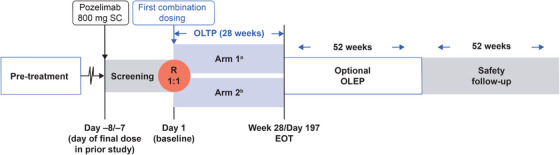
Study design. (a) Arm 1: pozelimab 400 mg SC Q4W + cemdisiran 200 mg SC Q4W. (b) Arm 2: pozelimab 400 mg SC Q2W + cemdisiran 200 mg SC Q4W. Patients completed the FACIT‐Fatigue scale (score range 0–52), the EORTC‐QLQ‐C30 physical function (score range 0–100) assessment, and the EORTC‐QLQ‐C30 GHS/QoL assessment at baseline and intermittently throughout the OLTP. All baseline values and assessments were collected prior to patients receiving their first treatment dose. EORTC, European Organisation for Research and Treatment of Cancer; EOT, end of treatment; FACIT‐Fatigue, Functional Assessment of Chronic Illness Therapy‐Fatigue; GHS, global health status; OLEP, open‐label extension period; OLTP, open‐label treatment period; Q2W, every 2 weeks; Q4W, every 4 weeks; QLQ‐C30, Quality‐of‐Life Questionnaire Core 30; R, randomization; SC, subcutaneous.
The study consisted of four periods: a 7–8‐day screening period; a 28‐week open‐label treatment period (OLTP); an optional 52‐week open‐label extension period (OLEP); and a 52‐week posttreatment safety follow‐up period. The safety follow‐up period began when a patient completed or permanently discontinued study treatment (e.g., at the time of premature study drug discontinuation, at the completion of study treatment in the OLTP for patients who declined the optional OLEP, or at the completion of study treatment in the optional OLEP for patients who did not continue study treatment in an expanded access program immediately following the study).
Patients were monitored for at least 30 min after the first cemdisiran injection, while no monitoring was required after the pozelimab injection. Patients received sufficient training on the combination dose administration, followed by observation by clinical site personnel either in person or via telemedicine. Once deemed satisfactory, patients or designated persons could continue administering the treatment for the remainder of the study. The administration of the treatment could be performed by the patient, a designated person, or a healthcare professional at the patient's preferred location or by site personnel during study visits, depending on the investigator's and patient's preference, local regulations, and healthcare professional availability. A patient diary was provided to record each study drug administration. The study drug kit was dispensed at clinical site visits, through a direct‐to‐patient service provider, or transported by a healthcare professional.
2.3. Eligibility Criteria
Patients with PNH who received pozelimab monotherapy as part of an open‐label extension trial (NCT04162470), who were willing to switch to the combination therapy and were able to comply with clinic or remote visits and study‐related procedures, were eligible. As a part of the risk mitigation for this study, patients were required to remain up to date with meningococcal vaccinations. Additional details of inclusion and exclusion criteria are provided in Text S1.
2.4. Study Objectives and Endpoints
2.4.1. Primary Objective
The primary objective was to assess the safety and tolerability of two dosing regimens of pozelimab and cemdisiran combination therapy during the OLTP, as assessed by the incidence and severity of treatment‐emergent adverse events (TEAEs) through Week 28 of the OLTP.
2.4.2. Secondary Objectives
Secondary objectives included an evaluation of intravascular hemolysis. Control of intravascular hemolysis was assessed by the following secondary endpoints: percent change of LDH from pretreatment (defined as mean of LDH values at Days –7 and 1 [prior to combination dosing]) to the end of the treatment period (defined as mean of LDH values at Week 24 through Week 28); adequate control and normalization of LDH at each visit (defined as LDH ≤ 1.5 and ≤ 1.0 × ULN, respectively from Day 1 through Week 28); breakthrough hemolysis (defined as LDH ≥ 2 × ULN concomitant with associated signs or symptoms of intravascular hemolysis at any time subsequent to an initial achievement of disease control [i.e., LDH ≤ 1.5 × ULN]); hemoglobin stabilization (defined as not receiving a blood transfusion and having no decrease in hemoglobin ≥ 2 g/dL); and inhibition of total complement hemolysis activity using the CH50 assay an ex vivo measure of complement lytic activity, conducted under physiological conditions (measured by change in CH50 from baseline to Week 28).
Further secondary objectives included evaluating the effect of combination therapy on hemoglobin levels (measured as change from baseline to Week 28), transfusion avoidance (defined as not requiring a red blood cell transfusion as per protocol algorithm from baseline to Week 28), immunogenicity (determined by the incidence of treatment‐emergent anti‐drug antibody responses), and PRO measures. Psychometrically validated electronic PRO instruments, including the Functional Assessment of Chronic Illness Therapy‐Fatigue (FACIT‐Fatigue) scale (score range 0–52) [31, 32], and global health status (GHS)/QoL (range 0–100) and physical functioning (range 0–100) scores of the European Organisation for Research and Treatment of Cancer Quality‐of‐Life Questionnaire Core 30 items, captured changes from baseline to Week 28 [32, 33]. Higher scores indicate a better level of functioning or GHS/QoL, or less fatigue; a FACIT‐Fatigue total score difference of ≥ 5 points and a score difference of ≥ 10 points in physical functioning and GHS/QoL are considered clinically meaningful [33, 34].
2.5. CH50 Assay
CH50 was centrally measured using a hemolytic assay validated at National Jewish Health Advanced Diagnostic Laboratories, Denver, CO. Briefly, serum was diluted in a physiological gelatin veronal buffer (GVB) containing Ca2+ and Mg2+ (pH 7.35 ± 0.05). Serial dilutions of serum were mixed with equal amounts of sheep red blood cells (sRBC) sensitized with optimal amounts of anti‐sRBC antibodies. The mixture was incubated at 37°C for 30 min. The reaction was stopped with an equal volume of cold saline and then centrifuged to remove unlysed sRBCs. The degree of hemolysis was quantitated by measuring the absorbance (OD) at 414 nm of hemoglobin released into the supernatant when the target cells were lysed by the action of complement. Percent lysis = (Sample OD − Buffer OD)/ H20 (100% lysis) OD − Buffer (0% lysis) OD) × 100, and CH50 U/mL is defined as the reciprocal of the serum dilution that yields 50% lysis.
2.6. Statistical Analyses
No statistical hypothesis testing was conducted. For continuous variables, descriptive statistics were used and presented as mean, standard deviation, quartile (Q)1, median, Q3, minimum, and maximum. For categorical or ordinal data, frequencies and percentages are displayed for each category. Demographic and baseline characteristics were summarized descriptively by treatment group and by all patients combined. All treated patients were analyzed for the binary secondary endpoints, and the proportions of patients meeting the criteria and 95% confidence intervals by an exact method for the endpoints were reported for both treatment arms. Control of multiplicity was not applicable and was therefore not conducted in this study. Additional details are provided in Text S2.
3. Results
3.1. Baseline Demographics and Clinical Characteristics
A total of 24 eligible patients were treated with combination dosing (Arm 1, n = 12 and Arm 2, n = 12) as summarized in Figure S1.
At baseline, the mean age for the total group was 47.3 years; the majority of the participants were Asian (87.5%) and over half (54.2%) were male. For the current trial, baseline values were representative of the effect of the pozelimab monotherapy that the patients had received prior to transitioning to combination therapy. A summary of key baseline demographics and clinical characteristics is presented in Table 1.
TABLE 1.
Baseline demographics and patient clinical characteristics.
| Characteristic | Arm 1 (n = 12) | Arm 2 (n = 12) | Total (N = 24) |
|---|---|---|---|
| Age, years, mean (SD) | 53.2 (16.4) | 41.4 (16.9) | 47.3 (17.3) |
| Age group, years, n (%) | |||
| 18–64 | 8 (66.7) | 11 (91.7) | 19 (79.2) |
| 65–84 | 4 (33.3) | 1 (8.3) | 5 (20.8) |
| ≥ 85 | 0 | 0 | 0 |
| Sex, male, n (%) | 6 (50.0) | 7 (58.3) | 13 (54.2) |
| Ethnicity, not Hispanic or Latino, n (%) | 12 (100) | 12 (100) | 24 (100) |
| Race, n (%) | |||
| Asian | 11 (91.7) | 10 (83.3) | 21 (87.5) |
| White | 1 (8.3) | 1 (8.3) | 2 (8.3) |
| Other | 0 | 1 (8.3) | 1 (4.2) |
| PNH diagnosis age, years, median (Q1:Q3) | 45.0 (32:50) | 30.0 (23:49) | 36.5 (29:50) |
| LDH, U/L, mean (SD) | 237.9 (41.1) | 237.0 (44.4) | 237.5 (41.9) |
| LDH × ULN, mean (SD) | 0.79 (0.2) | 0.79 (0.2) | 0.79 (0.2) |
| Hemoglobin, g/L, mean (SD) | 115.4 (17.2) | 108.3 (21.4) a | 112.0 (19.2) |
| eGFR, mL/min/1.73 m2, mean (SD) | 104.1 (21.9) | 117.8 (18.2) | 111.0 (20.9) |
| Creatinine, µmol/L, mean (SD) | 61.2 (18.9) | 57.5 (12.4) | 59.3 (15.7) |
| Total bilirubin, µmol/L, mean (SD) | 22.8 (12.3) | 31.5 (15.6) | 27.1 (14.5) |
| Haptoglobin, g/L, mean (SD) | 0.1 (0.1) | 0.1 (0.1) | 0.1 (0.1) |
| Complement CH50, U/mL, mean (SD) | 0.1 (0.3) | 0.0 (0.0) | 0.0 (0.2) |
| FACIT‐Fatigue score, mean (SD) | 45.4 (5.6) b | 45.6 (3.6) c | 45.5 (4.6) d |
| Physical functioning score, mean (SD) | 93.3 (8.8) b | 94.2 (9.0) c | 93.7 (8.7) d |
| GHS/QoL scores, mean (SD) | 77.8 (14.4) b | 80.2 (20.9) c | 78.9 (17.2) d |
Note: Arm 1: pozelimab 400 mg SC Q4W + cemdisiran 200 mg SC Q4W; Arm 2: pozelimab 400 mg SC Q2W + cemdisiran 200 mg SC Q4W.
Abbreviations: CH50, total complement hemolysis assay; eGFR, estimated glomerular filtration rate; FACIT‐Fatigue, Functional Assessment of Chronic Illness Therapy‐Fatigue; GHS, global health status; LDH, lactate dehydrogenase; PNH, paroxysmal nocturnal hemoglobinuria; Q, quartile; Q2W, every 2 weeks; Q4W, every 4 weeks; QoL, quality of life; SC, subcutaneous; SD, standard deviation; ULN, upper limit of normal.
n = 11.
b n = 9.
c n = 8.
d n = 17.
3.2. Safety Outcomes
Of the 24 patients, a total of 16 (66.7%) experienced a TEAE: seven from Arm 1 (n = 12; 58%) and nine from Arm 2 (n = 12; 75%). The most common TEAEs were COVID‐19 infection (16.7%), injection‐site reaction (16.7%), upper respiratory tract infection (8.3%), myalgia (8.3%), and breakthrough hemolysis (8.3%) (Table 2).
TABLE 2.
Safety outcomes (safety analysis set).
| Patients, n (%) | Arm 1 (n = 12) | Arm 2 (n = 12) | Total (N = 24) |
|---|---|---|---|
| Summary of TEAEs | |||
| Any TEAE | 7 (58.3) | 9 (75.0) | 16 (66.7) |
| Any serious TEAE | 0 | 3 (25.0) | 3 (12.5) |
| Any related TEAE | 4 (33.3) | 3 (25.0) | 7 (29.2) |
| Any severe TEAE | 0 | 2 (16.7) | 2 (8.3) |
| Any TEAE leading to discontinuation of any study drug | 0 | 0 | 0 |
| Any TEAE leading to death | 0 | 0 | 0 |
| AESIs | |||
| At least one TEAE of special interest | 3 (25.0) | 2 (16.7) | 5 (20.8) |
| Suspected Neisseria infection | 0 | 0 | 0 |
| Moderate or severe infusion reaction | 0 | 0 | 0 |
| Any thrombotic event | 0 | 0 | 0 |
| Moderate or severe hypersensitivity reactions | 0 | 0 | 0 |
| Liver transaminase elevations | 0 | 0 | 0 |
| Other AESIs | 3 (25.0) | 2 (16.7) | 5 (20.8) |
| Infusion reaction | 0 | 0 | 0 |
| Injection‐site event | 3 (25.0) | 2 (16.7) | 5 (20.8) |
| TEAEs by preferred term (in ≥ 5% of patients overall) | |||
| COVID‐19 | 1 (8.3) | 3 (25.0) | 4 (16.7) |
| Injection‐site reaction | 2 (16.7) | 2 (16.7) | 4 (16.7) |
| Breakthrough hemolysis | 0 | 2 (16.7) | 2 (8.3) |
| Myalgia | 1 (8.3) | 1 (8.3) | 2 (8.3) |
| Upper respiratory tract infection | 0 | 2 (16.7) | 2 (8.3) |
Note: Arm 1: pozelimab 400 mg SC Q4W + cemdisiran 200 mg SC Q4W. Arm 2: pozelimab 400 mg SC Q2W + cemdisiran 200 mg SC Q4W.
Abbreviations: AESI, adverse event of special interest; Q2W, every 2 weeks; Q4W, every 4 weeks; SC, subcutaneous; TEAE, treatment‐emergent adverse event.
Overall, the majority of TEAEs were mild to moderate in severity; seven (29.2%) patients experienced a mild TEAE, seven (29.2%) a moderate TEAE, and two (8.3%) a severe TEAE. No serious or severe adverse events were reported in Arm 1. Three patients in Arm 2 had serious adverse events: COVID‐19 infection (n = 1; 8.3%), upper respiratory tract infection (n = 1; 8.3%), and gastroenteritis (n = 1; 8.3%). In addition, two patients in Arm 2 experienced severe TEAEs: one patient experienced a severe event of anemia and another patient had severe events of gastroenteritis (corresponding to the aforementioned serious adverse event) and breakthrough hemolysis. Of these, the first patient experienced anemia beginning on Day 25, with a hemoglobin value that was significantly lower than baseline (8.8 g/dL on Day 29), headache, and new onset or worsening fatigue. Increased LDH values of 620 and 631 U/L were observed on Days 29 and 35, respectively, signifying a breakthrough hemolysis event, which was treated with one IV on Day 32 and a blood transfusion on Day 33. On Day 35, the patient was diagnosed as having a Chlamydia infection, treated with 100 mg oral doxycycline (Days 43–49). On Day 35, the patient received an unscheduled IV bolus of 30 mg/kg pozelimab per protocol. The breakthrough hemolysis resolved with sequelae on Day 57; the same day, LDH was 279 U/L, and the patient experienced a non‐serious TEAE of moderate anemia. The second patient experienced breakthrough hemolysis during the OLEP, related to gastroenteritis, which was treated with one blood transfusion on Day 199 and resolved on Day 201. At the time of the transfusion, the patient's LDH values were > 1.5 × ULN and reticulocytes were > ULN. No serious or severe TEAEs were considered related to the study treatment, and all resolved with ongoing treatment. Importantly, there were no meningococcal infections, thrombotic events, or deaths. No patient discontinued treatment due to an adverse event. No patient who received pozelimab experienced a treatment‐emergent antidrug antibody response.
3.3. Clinical Efficacy Outcomes
At the time of analysis, all patients had completed the OLTP. During the 28‐week OLTP, maintenance of adequate control of hemolysis (LDH ≤ 1.5 × ULN at all scheduled timepoints) was achieved in 20 patients (83.3%): 11 (91.7%) in Arm 1 and nine (75.0%) in Arm 2. The majority of patients maintained LDH < 1.0 × ULN throughout the study (Figure 2). Two patients in Arm 2 experienced an episode of non‐serious breakthrough hemolysis, both of which were associated with complement‐activating conditions. There were no breakthrough hemolysis events experienced by any patient in Arm 1. Transfusion avoidance was achieved by 100% of patients in Arm 1 and 92% of patients in Arm 2. Most patients (75%, n = 18) met the criteria for hemoglobin stabilization (defined as not receiving a blood transfusion and having no decrease in hemoglobin ≥ 2 g/dL): 10 (83.3%) patients in Arm 1 and eight (66.7%) patients in Arm 2. From baseline to Week 28, mean hemoglobin levels increased from 115.4 to 125.8 g/L in Arm 1 and decreased from 108.3 to 103.8 g/L in Arm 2 (Figure 3). CH50 remained fully suppressed in all patients, regardless of treatment arm, at all post‐baseline timepoints measured (Figure S2).
FIGURE 2.
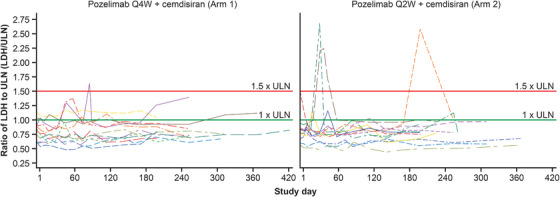
Change from baseline in LDH over time in patients with PNH (full analysis set). LDH, lactate dehydrogenase; PNH, paroxysmal nocturnal hemoglobinuria; Q2W, every 2 weeks; Q4W, every 4 weeks, ULN, upper limit of normal.
FIGURE 3.
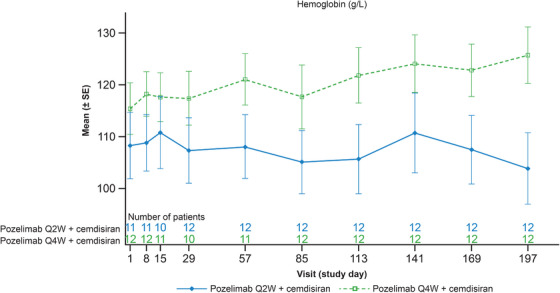
Mean hemoglobin from baseline through Week 28 in patients with PNH (full analysis set). PNH, paroxysmal nocturnal hemoglobinuria; Q2W, every 2 weeks; Q4W, every 4 weeks; SE, standard error.
3.4. Patient‐Reported Efficacy Outcomes
Before transitioning to combination therapy, the mean FACIT‐Fatigue scores were 45.4 and 45.6 in Arm 1 and Arm 2, respectively, reflecting control while on pozelimab monotherapy (Table 1). At Week 28, the mean change from baseline in FACIT‐Fatigue scores was 2 (a decrease of 4.7%) and 5.5 (a decrease of 12.4%) in Arm 1 and Arm 2, respectively (Figure 4), with the change in Arm 2 considered clinically meaningful. The mean change from baseline in physical functioning scores was 0.7 for Arm 1 (a 1.5% increase) and −6.7 for Arm 2 (a decrease of 6.6%) (Figure 5) at Week 28. The mean change from baseline in GHS/QoL scores was −1.9 (a decrease of 2.2%) for Arm 1 and −9.4 (a decrease of 8.5%) for Arm 2 (Figure 6) at Week 28.
FIGURE 4.
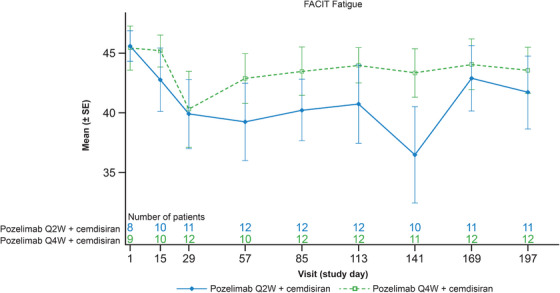
Mean FACIT‐Fatigue scores from baseline to Week 28 in patients with PNH (full analysis set). FACIT‐Fatigue, Functional Assessment of Chronic Illness Therapy‐Fatigue; PNH, paroxysmal nocturnal hemoglobinuria; Q2W, every 2 weeks; Q4W, every 4 weeks; SE, standard error.Mean FACIT‐Fatigue scores from baseline to Week 28 in patients with PNH (full analysis set). FACIT‐Fatigue, Functional Assessment of Chronic Illness Therapy‐Fatigue; PNH, paroxysmal nocturnal hemoglobinuria; Q2W, every 2 weeks; Q4W, every 4 weeks; SE, standard error.
FIGURE 5.
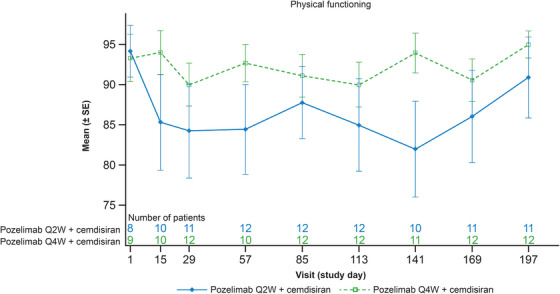
Mean physical functioning scores from baseline to Week 28 in patients with PNH (full analysis set). PNH, paroxysmal nocturnal hemoglobinuria; Q2W, every 2 weeks; Q4W, every 4 weeks; SE, standard error.Mean physical functioning scores from baseline to Week 28 in patients with PNH (full analysis set). PNH, paroxysmal nocturnal hemoglobinuria; Q2W, every 2 weeks; Q4W, every 4 weeks; SE, standard error.
FIGURE 6.
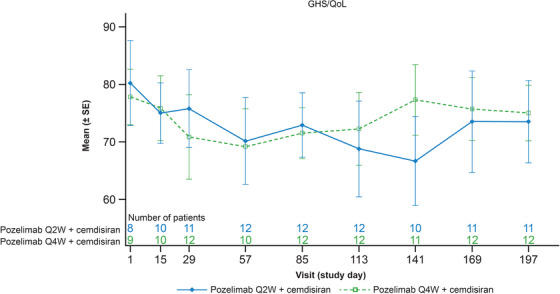
Mean GHS/QoL scores from baseline to Week 28 in patients with PNH (full analysis set). GHS, global health status; PNH, paroxysmal nocturnal hemoglobinuria; Q2W, every 2 weeks; Q4W, every 4 weeks; QoL, quality of life; SE, standard error.Mean GHS/QoL scores from baseline to Week 28 in patients with PNH (full analysis set). GHS, global health status; PNH, paroxysmal nocturnal hemoglobinuria; Q2W, every 2 weeks; Q4W, every 4 weeks; QoL, quality of life; SE, standard error.
4. Discussion
In this study, pozelimab plus cemdisiran was generally well tolerated and provided adequate control of intravascular hemolysis in patients with PNH. The majority of patients achieved normalization of LDH at all scheduled timepoints throughout the 28‐week study. When combined with cemdisiran, administration of pozelimab Q2W (Arm 2) did not result in improved disease control as compared to pozelimab Q4W (Arm 1). All patients treated in Arm 1 (pozelimab plus cemdisiran SC Q4W) achieved transfusion avoidance with complete CH50 suppression, demonstrating uninterrupted inhibition of terminal complement throughout the dosing interval. In these patients, the FACIT‐Fatigue, physical functioning, and GHS/QoL scores were comparable from baseline to Week 28.
Existing evidence suggests that patients generally prefer SC dosing over IV methods as this can be administered at home, reducing time taken off from work, travel time to and from the hospital, out‐of‐pocket costs, and issues with accessing veins for IV infusions [35]. Patients indicated that the pain and discomfort associated with cannulation is a major deterrent to IV infusions, and 41% reported less pain and discomfort with SC dosing. Therefore, there is a need to consider patient preference regarding drug administration when developing new treatment modalities for patients with PNH.
In this Phase 2 study, pozelimab and cemdisiran combination treatment was shown to maintain control of intravascular hemolysis, with a need for infrequent SC injections, regardless of the treatment arm. The combination demonstrated an acceptable safety profile, with most TEAEs being of mild‐to‐moderate intensity and none leading to treatment discontinuation. Furthermore, there was no observable benefit in either the efficacy or the safety of administering the combination treatment Q2W compared to Q4W, supporting the Q4W dosing regimen in the ongoing Phase 3 studies.
Some limitations of this study include the small sample size, the open‐label nature of the study design, and the fact that patients transitioned to the combination therapy after pozelimab monotherapy treatment. While the demographics of the study population are reflective of where the trial was conducted, they may not be representative of the worldwide population of patients with PNH.
5. Conclusion
Overall, this study provides promising results for the potential use of pozelimab and cemdisiran combination therapy in the treatment of PNH, and supports the dose utilized in the ongoing Phase 3 clinical development program.
Ethics Statement
This trial was conducted in agreement with the protocol and the ethical principles of the Declaration of Helsinki and the Council for International Organizations of Medical Sciences (CIOMS) International Ethical Guidelines, and was consistent with the International Conference on Harmonization Guidelines for Good Clinical Practice. The study protocols were reviewed and approved by the relevant health authorities or ethics committees. The trial also complied with any additional local safety reporting requirements deemed necessary.
Consent
All participants provided informed written consent before participation in the study.
Conflicts of Interest
Jun‐Ho Jang has received research funding from Alexion, Novartis, Regeneron Pharmaceuticals, Inc., AbbVie, Allovir, Janssen, Bristol Myers Squibb, Sanofi, Samsung Bioepis, and Roche Pharmaceuticals; and honoraria from Bristol Myers Squibb, Sanofi, Alexion, Janssen, Samsung Bioepis, Novartis, Astella, and Vifor Pharma. Raymond Siu Ming Wong has received research funding from Amgen, Apellis, Gilead, Novartis, Regeneron Pharmaceuticals, Inc., AbbVie, Acerta, Bayer, Roche, UCB, and Daiichi Sankyo; and honoraria from Bristol Myers Squibb, Sanofi, Apellis, Alexion, Pfizer, Spark Therapeutics, and Astella. Christopher Hartford, Rodrigo Pavani, Lisa Aurand, Quang Nguyen, Karoline Meagher, Steven Sherman, Diana Rofail, Lorah Perlee, and Amal Souttou are employees of and stockholders in Regeneron Pharmaceuticals, Inc. Kosalai Mohan was an employee of Regeneron Pharmaceuticals, Inc. at the time the study was conducted. Richard J. Kelly has received consultancy fees/honoraria/speaker's bureau fees from Alexion, AstraZeneca Rare Disease, Astellas, F. Hoffmann‐La Roche Ltd, Florio, Jazz Pharmaceuticals, Novartis, Otsuka, and Sobi.
Supporting information
FIGURE S1. Patient disposition
FIGURE S2. Mean CH50 (U/mL) levels from baseline over time
Acknowledgments
The authors would like to thank the patients, their families, and all investigators involved in this study; Yi Zhang for her support with this study; and Richa Attre, PhD, for her review. Medical writing support under the direction of the authors was provided by Alpha (a division of Prime, Knutsford, UK) funded by Regeneron Pharmaceuticals Inc., according to Good Publication Practice guidelines (https://www.acpjournals.org/doi/10.7326/M22‐1460). The sponsor was involved in the study design and collection, analysis, and interpretation of data, as well as data checking of information provided in the manuscript. The authors were responsible for all content and editorial decisions, and received no honoraria related to the development of this publication.
Funding: This study was funded by Regeneron Pharmaceuticals Inc.
Data Availability Statement
Qualified researchers may request access to study documents (including the clinical study report, study protocol with any amendments, blank case report form, and statistical analysis plan) that support the methods and findings reported in this manuscript. Individual anonymized participant data will be considered for sharing once the product and indication has been approved by major health authorities (e.g., FDA, EMA, PMDA), if there is legal authority to share the data and there is not a reasonable likelihood of participant re‐identification. Submit requests to https://vivli.org/.
References
- 1. Sahin F., Akay O. M., Ayer M., et al., “Pesg PNH Diagnosis, Follow‐Up and Treatment Guidelines,” American Journal of Blood Research 6 (2016): 19–27. [PMC free article] [PubMed] [Google Scholar]
- 2. Parker C., Omine M., Richards S., et al., “Diagnosis and Management of Paroxysmal Nocturnal Hemoglobinuria,” Blood 106 (2005): 3699–3709. [DOI] [PMC free article] [PubMed] [Google Scholar]
- 3. Brodsky R. A., “Paroxysmal Nocturnal Hemoglobinuria,” Blood 124 (2014): 2804–2811. [DOI] [PMC free article] [PubMed] [Google Scholar]
- 4. Hill A., Kelly R. J., and Hillmen P., “Thrombosis in Paroxysmal Nocturnal Hemoglobinuria,” Blood 121 (2013): 4985–4996. [DOI] [PubMed] [Google Scholar]
- 5. Cançado R. D., Araújo A. S., Sandes A. F., et al., “Consensus Statement for Diagnosis and Treatment of Paroxysmal Nocturnal Haemoglobinuria,” Hematology, Transfusion and Cell Therapy 43 (2021): 341–348. [DOI] [PMC free article] [PubMed] [Google Scholar]
- 6. Hillmen P., Hall C., Marsh J. C. W., et al., “Effect of Eculizumab on Hemolysis and Transfusion Requirements in Patients With Paroxysmal Nocturnal Hemoglobinuria,” New England Journal of Medicine 350 (2004): 552–559. [DOI] [PubMed] [Google Scholar]
- 7. Kelly R. J., Hill A., Arnold L. M., et al., “Long‐Term Treatment With Eculizumab in Paroxysmal Nocturnal Hemoglobinuria: Sustained Efficacy and Improved Survival,” Blood 117 (2011): 6786–6792. [DOI] [PubMed] [Google Scholar]
- 8. Escalante C. P., Chisolm S., Song J., et al., “Fatigue, Symptom Burden, and Health‐Related Quality of Life in Patients With Myelodysplastic Syndrome, Aplastic Anemia, and Paroxysmal Nocturnal Hemoglobinuria,” Cancer Medicine 8 (2019): 543–553. [DOI] [PMC free article] [PubMed] [Google Scholar]
- 9. Schrezenmeier H., Röth A., Araten D., et al., “Baseline Clinical Characteristics and Disease Burden in Patients With Paroxysmal Nocturnal Hemoglobinuria (PNH): Updated Analysis From the International PNH Registry,” Annal of Hematology 99 (2020): 1505–1514. [DOI] [PMC free article] [PubMed] [Google Scholar]
- 10. Versino F. and Fattizzo B., “Complement Inhibition in Paroxysmal Nocturnal Hemoglobinuria: From Biology to Therapy,” International Journal of Laboratory Hematology 46 Suppl 1 (2024): 43–54. [DOI] [PubMed] [Google Scholar]
- 11. Brando B., Gatti A., and Preijers F., “Flow Cytometric Diagnosis of Paroxysmal Nocturnal Hemoglobinuria: Pearls and Pitfalls—A Critical Review Article,” eJIFCC 30 (2019): 355–370. [PMC free article] [PubMed] [Google Scholar]
- 12. Parker C. J., “Update on the Diagnosis and Management of Paroxysmal Nocturnal Hemoglobinuria,” Hematology, the Education Program of the American Society of Hematology 2016 (2016): 208–216. [DOI] [PMC free article] [PubMed] [Google Scholar]
- 13. Bektas M., Copley‐Merriman C., Khan S., Sarda S. P., and Shammo J. M., “Paroxysmal Nocturnal Hemoglobinuria: Current Treatments and Unmet Needs,” Journal of Managed Care and Specialty Pharmacy 26 (2020): S14–S20. [DOI] [PMC free article] [PubMed] [Google Scholar]
- 14. Jang J.‐H., Kim J. S., Yoon S.‐S., et al., “Predictive Factors of Mortality in Population of Patients With Paroxysmal Nocturnal Hemoglobinuria (PNH): Results From a Korean PNH Registry,” Journal of Korean Medical Science 31 (2016): 214. [DOI] [PMC free article] [PubMed] [Google Scholar]
- 15. Kulasekararaj A. G., Kuter D. J., Griffin M., Weitz I. C., and Roth A., “Biomarkers and Laboratory Assessments for Monitoring the Treatment of Patients With Paroxysmal Nocturnal Hemoglobinuria: Differences Between Terminal and Proximal Complement Inhibition,” Blood Reviews 59 (2023): 101041. [DOI] [PubMed] [Google Scholar]
- 16. Kulasekararaj A. G., Griffin M., Langemeijer S., et al., “Long‐Term Safety and Efficacy of Ravulizumab in Patients With Paroxysmal Nocturnal Hemoglobinuria: 2‐Year Results From Two Pivotal Phase 3 Studies,” European Journal of Haematology 109 (2022): 205–214. [DOI] [PMC free article] [PubMed] [Google Scholar]
- 17. Peipert J., Kulasekararaj A. G., Gaya A., et al., “Patient Preferences and Quality of Life Implications of Ravulizumab (Every 8 Weeks) and Eculizumab (Every 2 Weeks) for the Treatment of Paroxysmal Nocturnal Hemoglobinuria,” PLoS One 15 (2020): e0237497. [DOI] [PMC free article] [PubMed] [Google Scholar]
- 18. Brodsky R. A., de Latour R. P., Rottinghaus S. T., et al., “Characterization of Breakthrough Hemolysis Events Observed in the Phase 3 Randomized Studies of Ravulizumab Versus Eculizumab in Adults With Paroxysmal Nocturnal Hemoglobinuria,” Haematologica 106 (2021): 230–237. [DOI] [PMC free article] [PubMed] [Google Scholar]
- 19. Kulasekararaj A. G., Hill A., Rottinghaus S. T., et al., “Ravulizumab (ALXN1210) vs Eculizumab in C5‐Inhibitor–Experienced Adult Patients With PNH: The 302 Study,” Blood 133 (2019): 540–549. [DOI] [PMC free article] [PubMed] [Google Scholar]
- 20. de Latour R. P., Fremeaux‐Bacchi V., Porcher R., et al., “Assessing Complement Blockade in Patients With Paroxysmal Nocturnal Hemoglobinuria Receiving Eculizumab,” Blood 125 (2015): 775–783. [DOI] [PubMed] [Google Scholar]
- 21. Dingli D., Matos J. E., Lehrhaupt K., et al., “The Burden of Illness in Patients With Paroxysmal Nocturnal Hemoglobinuria Receiving Treatment With the C5‐Inhibitors Eculizumab or Ravulizumab: Results From a US Patient Survey,” Annal of Hematology 101 (2022): 251–263. [DOI] [PMC free article] [PubMed] [Google Scholar]
- 22. Al‐Ani F., Chin‐Yee I., and Lazo‐Langner A., “Eculizumab in the Management of Paroxysmal Nocturnal Hemoglobinuria: Patient Selection and Special Considerations,” Therapeutics and Clinical Risk Management 12 (2016): 1161–1170. [DOI] [PMC free article] [PubMed] [Google Scholar]
- 23. Kelly R. J., Holt M., Vidler J., et al., “Treatment Outcomes of Complement Protein C5 Inhibition in 509 UK Patients With Paroxysmal Nocturnal Hemoglobinuria,” Blood 143 (2024): 1157–1166. [DOI] [PubMed] [Google Scholar]
- 24. Kulasekararaj A. G., Risitano A. M., Maciejewski J. P., et al., “Phase 2 Study of Danicopan in Patients With Paroxysmal Nocturnal Hemoglobinuria With an Inadequate Response to Eculizumab,” Blood 138 (2021): 1928–1938. [DOI] [PMC free article] [PubMed] [Google Scholar]
- 25. Hillmen P., Szer J., Weitz I., et al., “Pegcetacoplan Versus Eculizumab in Paroxysmal Nocturnal Hemoglobinuria,” New England Journal of Medicine 384 (2021): 1028–1037. [DOI] [PubMed] [Google Scholar]
- 26. de Latour R. P., Röth A., Kulasekararaj A. G., et al., “Oral Iptacopan Monotherapy in Paroxysmal Nocturnal Hemoglobinuria,” New England Journal of Medicine 390 (2024): 994–1008. [DOI] [PubMed] [Google Scholar]
- 27. Badri P., Jiang X., Borodovsky A., et al., “Pharmacokinetic and Pharmacodynamic Properties of Cemdisiran, an RNAi Therapeutic Targeting Complement Component 5, in Healthy Subjects and Patients With Paroxysmal Nocturnal Hemoglobinuria,” Clinical Pharmacokinetics 60 (2021): 365–378. [DOI] [PMC free article] [PubMed] [Google Scholar]
- 28. Latuszek A., Liu Y., Olsen O., et al., “Inhibition of Complement Pathway Activation With Pozelimab, a Fully Human Antibody to Complement Component C5,” PLoS One 15 (2020): e0231892. [DOI] [PMC free article] [PubMed] [Google Scholar]
- 29. Jang J. H., Wong R., Weyne J., et al., “Long‐Term Efficacy and Safety of Pozelimab Monotherapy in Patients With Paroxysmal Nocturnal Hemoglobinuria,” Blood 140 (2022): 5309–5310. [Google Scholar]
- 30. Gaya A., Munir T., Urbano‐Ispizua A., et al., “Results of a Phase 1/2 Study of Cemdisiran in Healthy Subjects and Patients With Paroxysmal Nocturnal Hemoglobinuria,” eJHaem 4 (2023): 612–624. [DOI] [PMC free article] [PubMed] [Google Scholar]
- 31. Cella D., Johansson P., Ueda Y., et al., “Clinically Important Change for the FACIT‐Fatigue Scale in Paroxysmal Nocturnal Hemoglobinuria: A Derivation From International PNH Registry Patient Data,” Journal of Patient‐Reported Outcomes 7 (2023): 63. [DOI] [PMC free article] [PubMed] [Google Scholar]
- 32. Weitz I., Meyers G., Lamy T., et al., “Cross‐Sectional Validation Study of Patient‐Reported Outcomes in Patients With Paroxysmal Nocturnal Haemoglobinuria,” Internal Medicine Journal 43 (2013): 298–307. [DOI] [PubMed] [Google Scholar]
- 33. Osoba D., Rodrigues G., Myles J., Zee B., and Pater J., “Interpreting the Significance of Changes in Health‐Related Quality‐of‐Life Scores,” Journal of Clinical Oncology 16 (1998): 139–144. [DOI] [PubMed] [Google Scholar]
- 34. Cella D., Johansson P., Ueda Y., et al., “Clinically Important Difference for the FACIT‐Fatigue Scale in Paroxysmal Nocturnal Hemoglobinuria: A Derivation From International PNH Registry Patient Data,” Blood 130 (2021): 1952. [DOI] [PMC free article] [PubMed] [Google Scholar]
- 35. Stoner K. L., Harder H., Fallowfield L. J., et al., “Intravenous Versus Subcutaneous Drug Administration. Which Do Patients Prefer? A Systematic Review,” Patient 8 (2014): 145–153. [DOI] [PubMed] [Google Scholar]
Associated Data
This section collects any data citations, data availability statements, or supplementary materials included in this article.
Supplementary Materials
FIGURE S1. Patient disposition
FIGURE S2. Mean CH50 (U/mL) levels from baseline over time
Data Availability Statement
Qualified researchers may request access to study documents (including the clinical study report, study protocol with any amendments, blank case report form, and statistical analysis plan) that support the methods and findings reported in this manuscript. Individual anonymized participant data will be considered for sharing once the product and indication has been approved by major health authorities (e.g., FDA, EMA, PMDA), if there is legal authority to share the data and there is not a reasonable likelihood of participant re‐identification. Submit requests to https://vivli.org/.