



Abstract
PURPOSE
Azacitidine and venetoclax is a standard frontline treatment regimen for newly diagnosed older adults with AML; however, long-term outcomes remain poor. Revumenib is an oral menin inhibitor with clinical activity in AML patients with nucleophosmin-1 mutation (NPM1m) or lysine methyltransferase 2A rearrangements (KMT2Ar).
METHODS
We conducted a phase I dose-escalation and expansion study of azacitidine, venetoclax, and revumenib at two dose levels (113 mg or 163 mg orally every 12 hours in combination with strong cytochrome P450 inhibitor azoles) in patients aged 60 years and older newly diagnosed with AML with NPM1m or KMT2Ar (ClinicalTrials.gov identifier: NCT03013998).
RESULTS
Overall, 43 patients were enrolled and treated. There was no maximal tolerated dose identified. Differentiation syndrome was present in eight (19%) patients and QTc Fridericia prolongation was present in 19 (44%) patients, and neither required permanent discontinuation of revumenib. The overall response rate with an intention-to-treat population was 88.4% (95% CI, 74.9 to 96.1; NPM1m: 85.3%; KMT2Ar: 100%), the rate of composite complete remission (complete remission [CR] + CR with partial or incomplete hematologic recovery) was 81.4% (95% CI, 66.6 to 91.6; NPM1m: 79.4%; KMT2Ar: 88.9%), and the rate of CR was 67.4% (95% CI, 51.5 to 80.9; NPM1m: 65%; KMT2Ar: 78%). No patient had refractory disease after 1-2 cycles of treatment. The median time to first response was 28 days, and 84% of responders achieved remission within the first cycle. All 37 patients evaluated had no evidence of measurable residual disease by a centralized flow cytometry assay.
CONCLUSION
In older adults newly diagnosed with NPM1m or KMT2Ar AML, the combination of azacitidine, venetoclax, and revumenib was able to be safely administered with high rates of CR and clinical activity.
INTRODUCTION
AML is an aggressive myeloid malignancy that predominantly affects older adults with a median age of 68-70 years. Historically, AML outcomes have been poor, particularly in older adults, with 5-year overall survival (OS) rates <10% in patients aged 65 years and older.1 Owing to older age and/or comorbidities, a large proportion of patients with AML are unfit and ineligible to receive intensive chemotherapy. The combination of azacitidine and the B-cell lymphoma 2 antagonist venetoclax was shown to significantly improve complete remission (CR) rates (36.7% v 17.9%) and median OS (14.7 v 9.6 months) compared with azacitidine and placebo in patients with newly diagnosed AML unfit for intensive chemotherapy and/or aged 75 years and older, leading to a new standard of care for this patient population.2 However, long-term outcomes remain poor with 2-year OS rates <40%.3
CONTEXT
Key Objective
To determine the safety and clinical activity of azacitidine, venetoclax, and revumenib—an oral menin inhibitor—in newly diagnosed older (≥60 years) AML patients with nucleophosmin-1 mutations or lysine methyltransferase 2A rearrangements.
Knowledge Generated
Revumenib was able to be safely added to azacitidine-venetoclax without dose-limiting toxicities at the highest dose level (163 mg every 12 hours with strong CYP3A4 inhibitor azoles). The addition of revumenib to azacitidine-venetoclax led to high rates of composite complete remission (81.4%) with all evaluable patients negative for measurable residual disease by a centralized flow cytometry assay.
Relevance (C. Craddock)
An azacitidine/venetoclax/revumenib triplet is well tolerated and clinically active in newly diagnosed AML. Randomized trials of this novel triplet are now indicated.*
*Relevance section written by JCO Associate Editor Charles Craddock, MD.
Nucleophosmin-1 mutations (NPM1m) and lysine methyltransferase 2A rearrangements (KMT2Ar) are AML-defining genetic abnormalities seen in approximately 30% and 5% of all patients with AML, respectively, and share similar gene expression profiles with aberrant menin-dependent transcription of homeobox genes leading to differentiation arrest and leukemogenesis.4 Menin inhibitors are a new class of oral targeted agents with clinical activity in relapsed/refractory (R/R) NPM1m or KMT2Ar acute leukemia. Revumenib is a first-in-class menin inhibitor approved for R/R KMT2Ar acute leukemia with overall response rates (ORRs), CR, and median OS of 63.2%, 17.5%, and 8.0 months, respectively.5
The Beat AML Master Trial (BAMT) is an ongoing precision medicine–based clinical trial investigating novel combinations for older adults newly diagnosed with AML.6 We designed a Beat AML substudy evaluating the safety and activity of revumenib in combination with azacitidine-venetoclax for the first time in older adults (≥60 years) newly diagnosed with NPM1m or KMT2Ar AML.
METHODS
Study Design and Participants
This phase I study was conducted to evaluate the safety and activity of revumenib in combination with azacitidine-venetoclax in newly diagnosed NPM1m or KMT2Ar AML. The study was designed as a 3 + 3 dose-escalation study of revumenib on days 1-28 of each cycle (see Procedures). After determination of the recommended dose (RD), an expansion phase was planned (see Statistical Analysis). Key eligibility criteria included age 60 years or older with untreated AML according to standard guidelines7 who were either not candidates for or declined to pursue intensive induction therapy. All patients underwent central genomic screening as part of BAMT before enrollment as previously published.6 Central detection of NPM1m was performed by the NPM1 Mutation Assay (Invivoscribe) or local detection of KMT2Ar by cytogenetics and/or fluorescent in situ hybridization was required for eligibility. Concomitant mutations in fms-like tyrosine kinase 3 (FLT3) were eligible, whereas previous treatment of AML or prior hypomethylating agents was exclusionary. Full eligibility criteria are listed in Appendix 1 (online only).
The trial was designed by the Beat AML investigators and approved by a central institutional review board. All patients provided written informed consent before participation. The trial was conducted according to the International Council for Harmonisation Good Clinical Practice Guidelines and the principles of the Declaration of Helsinki. Revumenib was supplied by Syndax. Data were collected and stored centrally by the investigators and research staff from each institution. The details of the study design are provided in the study protocol (Appendix 1).
Procedures
Revumenib was administered in a dose-escalation manner at two dose levels: Dose Level 1 (DL1): 113 mg orally (PO) every 12 hours on days 1-28, and Dose Level 2 (DL2): 163 mg PO every 12 hours on days 1-28 (Fig 1A). Strong CYP3A4 inhibitor azoles (posaconazole, voriconazole, or ketoconazole) were required during the induction phase in dose escalation and were optional during the expansion phase. Revumenib was dose adjusted without strong CYP3A4 inhibitor azoles (DL1: 226 mg PO every 12 hours, and DL2: 276 mg PO every 12 hours). Azacitidine was administered at 75 mg/m2 subcutaneously or intravenously once daily on days 1-7 every 28 days and venetoclax was administered as dose ramp-up on days 1-4 followed by dosing per label with dose modifications based on azoles (Appendix 1).
FIG 1.

Study schema and CONSORT diagram. (A) Patients are allowed up to three induction cycles to achieve a marrow remission before going onto continuation-phase cycles. Continuation-phase cycles can only be started after achieving hematologic recovery. (B) Forty-three patients were treated in this study between DL1 and DL2 across multiple dose expansions. DL1, Dose Level 1; DL2, Dose Level 2; PO, orally.
The treatment plan was divided into an induction phase and a continuation phase (Fig 1A). The induction phase consisted of 1-3 cycles until bone marrow blasts were <5%. A bone marrow aspirate/biopsy was performed on day 28 (−4 days) of each induction-phase cycle. If blasts were ≥5% after a cycle of induction, then an additional cycle of induction was administered without delay up to two additional cycles. If blasts were <5% after 1-3 cycles of the induction phase, then continuation-phase cycles were initiated once the absolute neutrophil count was ≥0.5 × 10⁹/L and platelets were ≥50 × 109/L and continued every 28 days. Dose modifications occurred in the setting of Grade ≥4 neutropenia or thrombocytopenia lasting >14 days before the start of any continuation cycle. Full details of dose modifications are listed in Appendix 1. At each bone marrow assessment, central testing was performed for measurable residual disease (MRD) by flow cytometry with a sensitivity of 0.02%.8 Patients with NPM1m were also serially assessed for MRD by the AML-NPM1 MRD NGS Assay (Invivoscribe) at a sensitivity of 0.005%.9 Bone marrow assessments were performed after cycle 1, cycle 2 (if MRD was still present after cycle 1), cycle 3, cycle 6, every six cycles thereafter, and at suspicion of relapse.
End Points and Assessments
The primary end point was the determination of the RD of revumenib in combination with azacitidine-venetoclax for newly diagnosed NPM1m or KMT2Ar AML. All adverse events (AEs) were classified by Common Terminology of Common Adverse Events version 5.0. Full details of dose-limiting toxicity (DLT) assessments are in Appendix 1.
Secondary end points included ORRs (ORR:CR, CR with incomplete recovery [CRi], CR with partial hematologic recovery [CRh], or morphologic leukemia-free state), CR rates, duration of response (DOR), event-free survival (EFS), and OS. Response assessments were consistent with 2017 European Leukemia Net (ELN) Guidelines10 and also included CRh as defined by ELN-2022 (see Appendix 1 for response definitions).11 Composite CR (CRc) was defined as CR, CRi, or CRh. EFS was defined for all patients on study as time from day 1 of treatment to date of treatment failure (no ORR), relapse after achieving ORR, or death from any cause, whichever occurs first. OS was defined for all patients on study from day 1 of treatment until death from any cause. Patients were censored at the time of last known follow-up date.
Statistical Analysis
The data were collected and analyzed on February 17, 2025. The intention-to-treat population included all patients who enrolled on study and received at least 1 dose of revumenib. The RD was defined as the highest dose where at most 1 patient out of six experienced a DLT (see Trial Design). After the RD was established to be DL2, an expansion cohort consisted of an additional 13 patients at DL2. A second dose expansion was then performed randomly assigning patients between DL1 and DL2 to obtain an equal number of patients for safety and clinical activity comparison of DL1 and DL2 (Fig 1B; Data Suppl.).
RESULTS
Patients
From March 31, 2022, through September 24, 2024, 43 patients were enrolled and started treatment with azacitidine-venetoclax and revumenib (Fig 1B). In the dose-escalation phase, seven patients were treated at DL1 and six at DL2. In the dose-expansion phase, 13 patients were enrolled on DL2. Subsequently, a randomized dose-expansion cohort enrolled 14 patients in DL1 and three patients in DL2 to obtain an equal number of patients treated with DL1 and DL2. Between the two phases, 21 patients were treated on DL1 and 22 on DL2. The median age was 70 years (range, 60-92 years) and 17 (40%) patients were aged 75 years and older. Overall, 34 (79%) patients had NPM1m and nine (21%) patients had KMT2Ar. Baseline characteristics are summarized in Table 1.
TABLE 1.
Baseline Characteristics
| Characteristic | DL1 | DL2 | All | ||||||
|---|---|---|---|---|---|---|---|---|---|
| KMT2Ar (n = 3) | NPM1m (n = 18) | DL1 (n = 21) | KMT2Ar (n = 6) | NPM1m (n = 16) | DL2 (n = 22) | KMT2Ar (n = 9) | NPM1m (n = 34) | All (N = 43) | |
| Age, years, median (range) | 67 (62-81) | 74.5 (61-92) | 74 (61-92) | 67 (60-70) | 72.5 (61-84) | 69.5 (60-84) | 67 (60-81) | 73.5 (61-92) | 70 (60-92) |
| Age ≥75 years, No. (%) | 1 (33.3) | 9 (50.0) | 10 (47.6) | 0 (0.0) | 7 (43.8) | 7 (31.8) | 1 (11.1) | 16 (47.1) | 17 (39.5) |
| Sex, No. (%) | |||||||||
| Female | 3 (100.0) | 12 (66.7) | 15 (71.4) | 1 (16.7) | 7 (43.8) | 8 (36.4) | 4 (44.4) | 19 (55.9) | 23 (53.5) |
| Race, No. (%) | |||||||||
| Black | 1 (33.3) | 0 (0.0) | 1 (4.8) | 0 (0.0) | 0 (0.0) | 0 (0.0) | 1 (11.1) | 0 (0.0) | 1 (2.3) |
| Other | 0 (0.0) | 1 (5.6) | 1 (4.8) | 1 (16.7) | 1 (6.3) | 2 (9.1) | 1 (11.1) | 2 (5.9) | 3 (7.0) |
| Unknown | 0 (0.0) | 2 (11.1) | 2 (9.5) | 0 (0.0) | 2 (12.5) | 2 (9.1) | 0 (0.0) | 4 (11.8) | 4 (9.3) |
| White | 2 (66.7) | 15 (83.3) | 17 (81.0) | 5 (83.3) | 13 (81.3) | 18 (81.8) | 7 (77.8) | 28 (82.4) | 35 (81.4) |
| Ethnicity, No. (%) | |||||||||
| Not Hispanic | 3 (100.0) | 18 (100.0) | 21 (100.0) | 5 (83.3) | 15 (93.8) | 20 (90.9) | 8 (88.9) | 33 (97.1) | 41 (95.4) |
| Unknown | 0 (0.0) | 0 (0.0) | 0 (0.0) | 1 (16.7) | 1 (6.3) | 2 (9.1) | 1 (11.1) | 1 (2.9) | 2 (4.7) |
| ECOG performance status, No. (%) | |||||||||
| 0 | 0 (0.0) | 2 (11.1) | 2 (9.5) | 2 (33.3) | 1 (6.3) | 3 (13.6) | 2 (22.2) | 3 (8.8) | 5 (11.6) |
| 1 | 3 (100.0) | 10 (55.6) | 13 (61.9) | 3 (50.0) | 9 (56.3) | 12 (54.6) | 6 (66.7) | 19 (55.9) | 25 (58.1) |
| 2 | 0 (0.0) | 6 (33.3) | 6 (28.6) | 1 (16.7) | 6 (37.5) | 7 (31.8) | 1 (11.1) | 12 (35.3) | 13 (30.2) |
| WBC, 10^9/L, median (range) | 5.0 (1.5-13.3) | 4.8 (0.7-18.8) | 5.0 (0.7-18.8) | 4.4 (1.2-14.3) | 2.4 (1.0-13.7) | 2.4 (1.0-14.3) | 5.0 (1.2-14.3) | 3.2 (0.7-18.8) | 3.2 (0.7-18.8) |
| Platelets, 10^9/L, median (range) | 25 (13-37) | 94 (11-345) | 60 (11-345) | 75.5 (12.0-124.0) | 49.5 (7-874) | 50 (7-874) | 37 (12-124) | 59 (7-874) | 54 (7-874) |
| Bone marrow blast (%), median (range) | 71 (67-84) | 54 (15-94) | 63 (15-94) | 79 (55-82) | 54 (16-95) | 60 (16-95) | 78 (55-84) | 54 (15-95) | 60 (15-95) |
| Albumin, g/L, median (range) | 30 (28-42) | 33 (3-40) | 32 (3-42) | 38 (30-42) | 30 (21-37) | 31 (21-42) | 36 (28-42) | 31 (3-40) | 32 (3-42) |
| LDH, U/L, median (range) | 199 (195-247) | 326 (179-1,130) | 295 (179-1,130) | 251 (144-434) | 246 (141-678) | 246 (141-678) | 210 (144-434) | 283 (141-1,130) | 272 (141-1,130) |
| ELN 2017 risk, No. (%) | |||||||||
| Favorable | 0 (0.0) | 12 (66.7) | 12 (57.1) | 0 (0.0) | 11 (68.8) | 11 (50.0) | 0 (0.0) | 23 (67.7) | 23 (53.5) |
| Intermediate | 0 (0.0) | 5 (27.8) | 5 (23.8) | 0 (0.0) | 5 (31.3) | 5 (22.7) | 0 (0.0) | 10 (29.4) | 10 (23.3) |
| Adverse | 3 (100.0) | 1 (5.6) | 4 (19.1) | 6 (100.0) | 0 (0.0) | 6 (27.3) | 9 (100.0) | 1 (2.9) | 10 (23.3) |
| ELN 2024 risk, No. (%) | |||||||||
| Favorable | 1 (33.3) | 8 (44.4) | 9 (42.9) | 4 (66.7) | 9 (56.3) | 13 (59.1) | 5 (55.6) | 17 (50.0) | 22 (51.2) |
| Intermediate | 1 (33.3) | 10 (55.6) | 11 (52.4) | 2 (33.3) | 7 (43.8) | 9 (40.9) | 3 (33.3) | 17 (50.0) | 20 (46.5) |
| Adverse | 1 (33.3) | 0 (0.0) | 1 (4.8) | 0 (0.0) | 0 (0.0) | 0 (0.0) | 1 (11.1) | 0 (0.0) | 1 (2.3) |
| NRAS mutation, No. (%)a | |||||||||
| Present | 1 (33.3) | 4 (22.2) | 5 (23.8) | 2 (33.3) | 2 (13.3) | 4 (19.0) | 3 (33.3) | 6 (18.2) | 9 (21.4) |
| KRAS mutation, No. (%)a | |||||||||
| Present | 1 (33.3) | 2 (11.1) | 3 (14.3) | 1 (16.7) | 1 (6.6) | 2 (9.5) | 2 (22.2) | 3 (9.1) | 5 (11.9) |
| FLT3-ITD mutation, No. (%) | |||||||||
| Present | 0 (0.0) | 6 (33.3) | 6 (28.6) | 0 (0.0) | 5 (31.3) | 5 (22.7) | 0 (0.0) | 11 (32.4) | 11 (25.6) |
Abbreviations: DL1, Dose Level 1; DL32, Dose Level 2; ECOG, Eastern Cooperative Oncology Group; ELN, European Leukemia Net; FLT3, fms-like tyrosine kinase 3; ITD, internal tandem duplication; LDH, lactate dehydrogenase.
One NPM1mut patient was not tested for NRAS or KRAS, but did not affect their ELN 2024 risk classifications.
Safety
In the dose-escalation phase, 1 patient developed a hematologic DLT on DL1: G4 thrombocytopenia lasting >14 days after completion of cycle 1. Therefore, three additional patients were treated on DL1 before escalating to DL2. There were no additional DLTs seen in DL1 or DL2. The most common overall nonhematologic treatment-emergent adverse events of any grade were nausea (60%), constipation (53%), QTc Fridericia (QTcF) prolongation (44%), hypokalemia (44%), and vomiting (42%; Data Supplement, Table S1, online only). Overall Grade ≥3 nonhematologic AEs were rare and similar between DL1 and DL2 (Table 2). Differentiation syndrome (DS) was present in eight (19%) patients (DL1: n = 6; DL2: n = 2) including 2 with Grade 3 DS at DL1. Overall DS rates seemed similar between KMT2Ar (2/9: 22%) and NPM1m (6/34: 18%; Data Supplement, Table S2). Median time to DS was 4.5 days (range, 0-20 days). QTcF prolongation was seen in 19 (44%) patients (DL1: n = 7; DL2: n = 12), five (12%) of whom had G3 QTcF prolongation (DL1: n = 2, DL2: n = 3; Data Supplement, Table S3). There were no discontinuations because of DS or QTcF prolongation, and only 1 patient required a dose reduction for QTcF prolongation.
TABLE 2.
Grade ≥3 Nonhematologic Treatment-Emergent Adverse Events
| Adverse Event | DL1 (n = 21), No. (%) | DL2 (n = 22), No. (%) | All (n = 43), No. (%) |
|---|---|---|---|
| Febrile neutropenia | 5 (24) | 6 (27) | 11 (26) |
| Acute kidney injury | 4 (19) | 4 (18) | 8 (19) |
| Dyspnea | 4 (19) | 2 (9) | 6 (14) |
| Electrocardiogram QT prolonged | 2 (10) | 3 (14) | 5 (12) |
| Hypokalemia | 1 (5) | 4 (18) | 5 (12) |
| Muscular weakness | 2 (10) | 3 (14) | 5 (12) |
| Decreased appetite | 3 (14) | 1 (5) | 4 (9) |
| Hypoalbuminaemia | 2 (10) | 2 (9) | 4 (9) |
| Hypotension | 2 (10) | 2 (9) | 4 (9) |
| Pneumonia | 1 (5) | 3 (14) | 4 (9) |
| Atrial fibrillation | 2 (10) | 1 (5) | 3 (7) |
| Hypoxia | 2 (10) | 1 (5) | 3 (7) |
| Nausea | 1 (5) | 2 (9) | 3 (7) |
| Sepsis | 1 (5) | 2 (9) | 3 (7) |
| Septic shock | 3 (14) | 0 (0) | 3 (7) |
| Acute respiratory failure | 1 (5) | 1 (5) | 2 (5) |
| Aspartate aminotransferase increased | 1 (5) | 1 (5) | 2 (5) |
| Blood bilirubin increased | 1 (5) | 1 (5) | 2 (5) |
| COVID-19 | 1 (5) | 1 (5) | 2 (5) |
| Diarrhea | 2 (10) | 0 (0) | 2 (5) |
| Differentiation syndrome | 2 (10) | 0 (0) | 2 (5) |
| Fall | 1 (5) | 1 (5) | 2 (5) |
| Pulmonary sepsis | 0 (0) | 2 (9) | 2 (5) |
| Respiratory failure | 0 (0) | 2 (9) | 2 (5) |
| Syncope | 1 (5) | 1 (5) | 2 (5) |
| Urinary tract infection | 1 (5) | 1 (5) | 2 (5) |
Overall, 30-day and 60-day mortality was 7% (3/43) due to sepsis/infection. The median duration of the induction-phase cycle before initiation of continuation-phase cycles was 38.5 days (range, 28-55 days; Data Supplement, Table S4). The median duration of each completed continuation-phase cycle was 42 days and was similar between DL1 and DL2; 87% of continuation-phase cycles required a delay and 46% of continuation-phase cycles required >2-week delay because of cytopenias (Data Supplement, Table S5). Revumenib dose reductions occurred in 10 patients, mainly because of Grade 4 thrombocytopenia and/or neutropenia, and only seven patients had a dose reduction in venetoclax to ≤21 days per cycle (Data Supplement, Table S6).
Clinical Efficacy
The ORR, CRc, and CR rates were 88.4% (95% CI, 74.9 to 96.1), 81.4% (95% CI, 66.6 to 91.6), and 67.4% (95% CI, 51.5% to 80.9%), respectively (Table 3). The ORR, CRc, and CR rates were 85%, 79%, and 65% in NPM1m and 100%, 89%, and 78% in KMT2Ar, respectively. Five patients had early death prior to disease assessment (n = 3) or withdrawal from study to pursue hospice (n = 2) but were included in the overall intention-to-treat clinical efficacy population. No patient had evidence of refractory disease after 1-2 cycles. Among the 38 patients who had a bone marrow assessment after treatment, ORR, CRc, and CR rates were 100%, 92%, and 76%, respectively. The median time to first response was 28 days (Data Supplement, Table S7), and 84% (32/38) of those who received a marrow assessment achieved a marrow remission during the first cycle of treatment. Among patients with intermediate or adverse risk based on the 2024 ELN risk classification,12 the ORR, CRc, and CR rates were 86%, 76% and 62%, respectively (Fig 2, Data Supplement, Table S14).
TABLE 3.
Clinical Outcomes
| Clinical Outcome | DL1 | DL2 | All | ||||||
|---|---|---|---|---|---|---|---|---|---|
| KMT2Ar (n = 3) | NPM1m (n = 18) | DL1 (n = 21) | KMT2Ar (n = 6) | NPM1m (n = 16) | DL2 (n = 22) | KMT2Ar (n = 9) | NPM1m (n = 34) | All (N = 43) | |
| Best response, No. (%) | |||||||||
| CR | 2 (66.7) | 11 (61.1) | 13 (61.9) | 5 (83.3) | 11 (68.8) | 16 (72.7) | 7 (77.8) | 22 (64.7) | 29 (67.4) |
| CRh | 0 (0.0) | 0 (0.0) | 0 (0.0) | 0 (0.0) | 1 (6.3) | 1 (4.6) | 0 (0.0) | 1 (2.9) | 1 (2.3) |
| CRi | 1 (33.3) | 3 (16.7) | 4 (19.1) | 0 (0.0) | 1 (6.3) | 1 (4.6) | 1 (11.1) | 4 (11.8) | 5 (11.6) |
| MLFS | 0 (0.0) | 2 (11.1) | 2 (9.5) | 1 (16.7) | 0 (0.0) | 1 (4.6) | 1 (11.1) | 2 (5.9) | 3 (7.0) |
| Not evaluable | 0 (0.0) | 2 (11.1) | 2 (9.5) | 0 (0.0) | 3 (18.8) | 3 (13.6) | 0 (0.0) | 5 (14.7) | 5 (11.6) |
| ORR, % (95% CI) | |||||||||
| CR/CRh/CRi/MLFS | 100 (29.2 to 100) | 88.9 (65.3 to 98.6) | 90.5 (69.6 to 98.8) | 100 (54.1 to 100) | 81.3 (54.5 to 96.0) | 86.4 (65.1 to 97.1) | 100 (66.4 to 100) | 85.3 (68.9 to 95.1) | 88.4 (74.9 to 96.1) |
| CRc rate, % (95% CI) | |||||||||
| CR/CRh/CRi | 100 (29.2 to 100) | 77.8 (52.4 to 93.6) | 81.0 (58.1 to 94.6) | 83.3 (35.9 to 99.6) | 81.3 (54.4 to 96.0) | 81.8 (59.7 to 94.8) | 88.9 (51.8 to 99.7) | 79.4 (62.1 to 91.3) | 81.4 (66.6 to 91.6) |
| Response-evaluable CRc rate,a % (95% CI) | |||||||||
| CR/CRh/CRi | 100 (29.2 to 100) | 87.5 (61.7 to 98.5) | 89.5 (66.9 to 98.7) | 83.3 (35.9 to 99.6) | 100 (75.3 to 100) | 94.7 (74.0 to 99.9) | 88.9 (51.8 to 99.7) | 93.1 (77.2 to 99.2) | 92.1 (78.6 to 98.3) |
| Flow MRD negative, No. (% of tested) | 3 (100.0) | 15 (100.0) | 18 (100.0) | 6 (100.0) | 13 (100.0) | 19 (100.0) | 9 (100.0) | 28 (100.0) | 37 (100.0) |
| NPM1m MRD negative, No. (% of tested) | NA | 4 (28.6) | 4 (28.6) | NA | 4 (33.3) | 4 (33.3) | NA | 8 (30.7) | 8 (30.7) |
| Allo stem-cell transplant, No. (%) | 0 (0) | 3 (16.7) | 3 (14.2) | 3 (50.0) | 4 (25.0) | 7 (31.8) | 3 (33.3) | 7 (20.6) | 10 (23.2) |
Abbreviations: CR, complete remission; CRc, composite CR; CRh, CR with partial hematologic recovery; CRi, CR with incomplete recovery; DL1, Dose Level 1; DL2, Dose Level 2; MLFS, morphologic leukemia-free state; MRD, measurable residual disease; NA, not applicable; NPM1m, nucleophosmin-1 mutations; ORR, overall response rate.
Patients included in response-evaluable CRc rates were only those who received a bone marrow assessment after initiating treatment.
FIG 2.

Clinical response rates by patient subgroups' clinical response rates by categories including dose levels, age, mutation group, and ELN 2024 risk. Only 1 patient was ELN2024 adverse risk and is included with the intermediate-risk group. CRc rate includes CR/CRh/CRi. CR, complete remission; CRc, composite CR; CRh, CR with partial hematologic recovery; CRi, CR with incomplete recovery; DL1, Dose Level 1; DL2, Dose Level 2; ELN, European Leukemia Net; KMT2Ar, lysine methyltransferase 2A rearrangements; MLFS, morphologic leukemia-free state; NPM1m, nucleophosmin-1 mutations.
Among 37 patients with an MRD response assessment, 100% achieved flow MRD–negative disease, including 76% (28/37) after cycle 1 and 89% (33/37) after cycle 2. In NPM1m patients evaluable for NPM1 NGS MRD, 31% (8/26) were NPM1m MRD negative (Data Supplement, Tables S8-S10).
The median DOR was 12.0 months (95% CI, 7.8 to not reached; Appendix Fig A1, Data Supplement, Table S11). Four (11%) patients relapsed (KMT2Ar: n = 3; NPM1m: n = 1) including 1 NPM1m patient with extramedullary relapse in the central nervous system. The median time to relapse from remission was 10.1 months (range, 5.5 to 12.0 months). Ten (23%) patients received an allogeneic stem-cell transplant (alloSCT). A swimmer plot of all patients on study is shown in Figure 3C.
FIG 3.
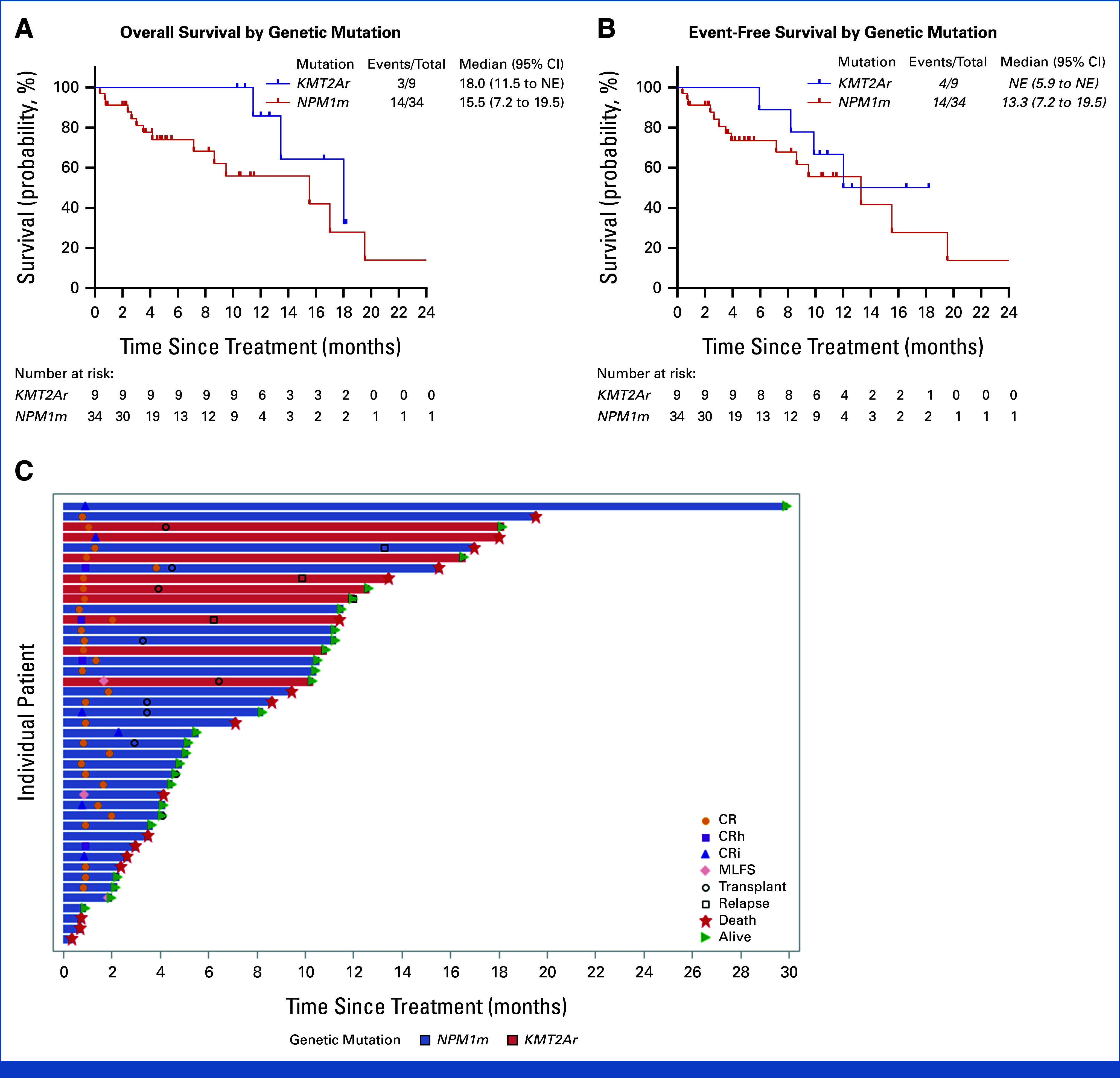
Overall and event-free survival. (A) Median overall survival in KMT2Ar was 18.0 months (95% CI, 11.5 to not reached) and that in NPM1m was 15.5 months (95% CI, 7.2 to 19.5). (B) Median event-free survival in KMT2Ar was not reached and that in NPM1m was 13.3 months (95% CI, 7.2 to 19.5). (C) Swimmer plot describing response, relapse, transplant, and death. CR, complete remission; CRh, CR with partial hematologic recovery; CRi, CR with incomplete recovery; KMT2Ar, lysine methyltransferase 2A rearrangements; MLFS, morphologic leukemia-free state; KMT2Ar, lysine methyltransferase 2A rearrangements; NE, not reached; NPM1m, nucleophosmin-1 mutations.
Survival
With a median follow-up of 6.9 months (range, 0.9-29.9 months), median EFS, median OS, and 1-year OS were 13.3 months (95% CI, 8.6 to 19.5), 15.5 months (95% CI, 9.5 to 19.5), and 62.9% (95% CI, 42.2 to 78.0), respectively (Figs 3A and 3B, Data Supplement, Tables S12 and S13). Median OS was 15.5 months versus 18.0 months in NPM1m versus KMT2Ar AML, respectively, and 17.0 versus not reached in DL1 versus DL2, respectively. Additionally, median OS was 17.0 versus 15.5 months in ELN-2024 favorable versus intermediate/adverse risk, respectively (Data Supplement, Table S14). Overall, 17 (40%) patients died of infection (n = 6), AML (n = 4), pursuit of hospice (n = 3), alloSCT complications (n = 2), respiratory failure (n = 1), and stroke (n = 1; Data Supplement, Table S15).
DISCUSSION
We designed and implemented the first clinical study, to our knowledge, investigating the addition of a menin inhibitor, revumenib, to azacitidine-venetoclax in older newly diagnosed AML patients with NPM1m or KMT2Ar. We demonstrated that revumenib is able to be safely added to azacitidine-venetoclax at both dose levels tested without a maximum tolerated dose and with no increase in hematologic toxicity or early mortality compared with historical controls treated with azacitidine-venetoclax.2 Overall AEs were similar between DL1 and DL2, except that DS was more common in DL1 and QTcF prolongation was more common in DL2. The combination of azacitidine-venetoclax-revumenib was clinically active with an overall full CR rate of 67% and CRc rate of 81%. Responses were rapidly achieved (84% within 1 cycle), and all patients achieved an MRD-negative remission by a centralized flow cytometry assay validating the efficacy of this regimen. Notably, no patient had refractory disease with this regimen.
Azacitidine-venetoclax has improved the frontline management of older patients with AML. However, approximately 33% of patients are refractory to treatment with azacitidine-venetoclax and only 37% of patients achieve CR.2 In this study, 67% of patients achieved CR with azacitidine-venetoclax-revumenib suggesting that CR rates may be improved by the addition of revumenib to azacitidine-venetoclax in NPM1m and KMT2Ar AML. Additionally, 23% of patients received an alloSCT, which is an important curative therapeutic goal for patients with AML. This is noteworthy as <1% of patients treated with azacitidine-venetoclax received an alloSCT on the VIALE-A study, although this may be reflective of the relatively younger patient population enrolled in this study (median age = 70 years).2
Achievement of an MRD-negative CR is a critical milestone in AML that has been associated with improved OS.13,14 In the VIALE-A study, 42% of patients with a CRc after azacitidine-venetoclax were MRD negative with a centralized flow cytometry assay with a sensitivity of 0.1%, and these patients had a longer median OS than those with MRD-positive CRc.3 All 37 patients tested achieved MRD-negative remissions at a lower threshold than that used in VIALE-A (0.02%) suggesting that the addition of revumenib may lead to deeper remissions than those seen with azacitidine-venetoclax alone.
The primary end point of this phase Ib trial was to establish a RD of revumenib in combination with azacitidine-venetoclax. Given the lack of MTD, both dose levels of revumenib were deemed to be safe and effective for future studies. Although median follow-up was short (6.9 months with 17 [40%] patients enrolling on this study within 9 months of this analysis), subset analysis revealed a CRc rate of 76% and median OS of 15.5 months in patients with intermediate/adverse risk by ELN-2024, which has been validated to accurately discriminate outcomes in patients treated with azacitidine-venetoclax.12 These results compare favorably with NPM1m patients with intermediate risk treated with Aza/Ven (CRc of 56.5% and median OS of 9.9 months).15 These findings are notable given that approximately half of the patients with NPM1m AML have intermediate-risk disease by ELN-2024 and seem to have the most benefit from azacitidine-venetoclax-revumenib. Although KMT2Ar are not specifically included in the ELN-2024 risk classification, in a retrospective analysis of 400 patients with newly diagnosed AML treated with azacitidine-venetoclax at the Mayo Clinic, KMT2Ar were significantly associated with worse clinical outcomes with a CRc rate of 43% and median OS of 2.5 months.16 In our study, patients with KMT2Ar AML had a CRc rate of 89% and median OS of 18.0 months. Thus, our findings represent a promising targeted treatment combination for newly diagnosed NPM1-mutated or KMT2Ar AML, especially for those with higher risk disease. However, a randomized comparison with azacitidine-venetoclax is necessary to determine whether azacitidine-venetoclax-revumenib can improve clinical outcomes in this setting.
Although this study was designed on the basis of the recommended and standard dosing guidelines for azacitidine-venetoclax, revumenib was the first agent to be dose-reduced for cytopenias. In the VIALE-A study, 78% of patients who achieved CRc required a delay in continuation-phase cycles with a median duration of 34 days for each cycle of treatment. Furthermore, in the VIALE-A study, 69% of those on continuation phase had a reduction in the duration of venetoclax to ≤21 days per cycle without an apparent impact on clinical outcomes, whereas only 22% of patients in our study had a dose reduction of venetoclax in continuation-phase.3,17 The protocol of azacitidine-venetoclax-revumenib was amended in September 2024 to allow 14 days of venetoclax for each 28-day continuation-phase cycle to mitigate cytopenias and treatment delays. Further follow-up is necessary to compare duration of continuation cycles, rates of Grade ≥3 cytopenias, and overall infectious toxicity in patients treated with preemptive dose modifications of venetoclax in the continuation phase.
In conclusion, the addition of revumenib to azacitidine-venetoclax leads to high rates of flow MRD–negative remission rates in older patients newly diagnosed AML with NPM1m or KMT2Ar without an appreciable increase in toxicity or mortality. On the basis of these findings, a randomized phase III study is in development comparing azacitidine, venetoclax, and revumenib with azacitidine, venetoclax, and placebo in older/unfit patients newly diagnosed NPM1-mutated AML to determine whether the addition of revumenib improves OS in this patient population (ClinicalTrials.gov identifier: NCT06652438).
APPENDIX 1
Inclusion and Exclusion Criteria
Patients must meet all inclusion and exclusion criteria of the Beat AML Master Trial. In addition, they must meet the criteria below specific for this study.
Inclusion Criteria
Patients, aged 60 years or older at the time of diagnosis with untreated AML according to the International Consensus Classification 2022 guidelines, who have NPM1-mutated or MLL-rearranged disease and who are not candidates for or do not wish to pursue intensive induction chemotherapy.
Patients must be able to understand and provide written informed consent.
Eastern Cooperative Oncology Group performance status 0, 1, or 2.
AST <5 × upper limit of normal (ULN), ALT <5 × ULN, and total bilirubin <2 × ULN (except for patients with known or suspected Gilbert syndrome and with direct bilirubin within normal range) for the local laboratory.
Adequate renal function as defined by calculated creatinine clearance ≥60 mL/min for the local laboratory.
Female patients of childbearing potential must agree to use two forms of contraception from the screening visit until 120 days after the last dose of study treatment. Male patients of childbearing potential having intercourse with women of childbearing potential must agree to abstain from heterosexual intercourse or have their partner use two forms of contraception from the screening visit until 120 days until the last dose of study treatment. They must also refrain from sperm donation from the time of the screening visit until 120 days after the last dose of study treatment.
Patients must have previously untreated AML with no prior treatment other than hydroxyurea. No chemotherapy for AML outside of hydroxyurea for treatment of leukostasis or all-trans-retinoic acid for initially suspected acute promyelocytic leukemia (ie, ruled out) is allowed as well as 1 dose of intrathecal chemotherapy for suspected CNS involvement (ie, ruled out) is allowed. Prior therapy for myelodysplastic syndrome is allowed except for hypomethylating agents.
If the patient has comorbid illness or malignancy, life expectancy attributed to this must be > 2 years.
Exclusion Criteria
Isolated myeloid sarcoma (meaning patients must have blood or marrow involvement with AML to enter the study).
Acute promyelocytic leukemia (FAB M3).
Favorable risk cytogenetics (core binding factor AML).
Active CNS involvement by AML.
Signs of leukostasis requiring urgent therapy.
Patients with WBC ≥25,000/μL (patients must have WBC <25,000/μL to begin therapy and hydroxyurea may be used to obtain this level).
Patients willing and able to receive intensive induction chemotherapy.
Disseminated intravascular coagulopathy with active bleeding or signs of thrombosis.
Patients with psychologic, familial, social, or geographic factors that otherwise preclude them from giving informed consent, following the protocol, or potentially hamper compliance with study treatment and follow-up.
Any other significant medical condition, including psychiatric illness or laboratory abnormality, that would preclude the patient from participating in the trial or would confound the interpretation of the results of the trial.
Known active HIV, active hepatitis B, or active hepatitis C infection.
Patients with the following will be excluded: uncontrolled intercurrent illness including, but not limited to, symptomatic congestive heart failure, unstable angina pectoris, serious cardiac arrhythmia, myocardial infarction as presentation of AML, New York Heart Association Class III or IV heart failure, severe uncontrolled ventricular arrhythmias, or electrocardiographic evidence of acute ischemia or active conduction system abnormalities. Patients with medical comorbidities that will preclude safety evaluation of the combination should not be enrolled.
As infection is a common feature of AML, patients with active infection are permitted to enroll provided that the infection is under control. Patients with uncontrolled infection shall not be enrolled until infection is treated and brought under control.
Patients who have received an investigational agent (for any indication) within five half-lives of the agent and until toxicity from this has resolved to grade 1 or less; if the half-life of the agent is unknown, patients must wait 4 weeks before the first dose of study treatment. An investigational agent is one for which there is no approved indication by the US Food and Drug Administration (FDA).
Patients with QTcF (Fridericia) >450 ms for male patients and >468 for female patients and patients with right, left, or partial bundle branch blocks or pacemaker that may confound interpretation of this reading are excluded from this provided they lack history of primary arrhythmic events and are cleared by cardiology for enrollment in the trial. Any factors that increase the risk of QTc prolongation or risk of arrhythmic event such as congenital long QT syndrome or family history of long QT syndrome will also result in exclusion.
Dose Escalation Schema and Dose-Limiting Toxicities
Starting at Dose Level 1 (DL1), patients were enrolled in cohorts of 3. If 0 of 3 patients experienced a dose-limiting toxicity (DLT), then the dose level would be escalated to Dose Level 2 (DL2). If 1 of 3 patients experience a DLT, an additional cohort of three patients would be enrolled on DL1, and if <2 of 6 patients experienced a DLT, then the dose level would be escalated to DL2. At DL2, six patients would be enrolled to assess safety at the maximum dose. If >2 patients experienced a DLT at DL2, then DL1 would be determined the recommended dose (RD), whereas if 0 or 1 patient experienced a DLT at DL2, then DL2 would be determined the RD. After determination of the RD, an expansion cohort was planned (see Statistical Design). During the expansion phase, strong CYP3A4 inhibitor azoles were optional. Without concomitant use of strong CYP3A4 inhibitor azoles, DL1 and DL2 of revumenib were 226 mg PO every 12 hours and 276 mg PO every 12 hours, respectively.
Hematologic DLT was defined as Grade ≥4 absolute neutrophil count (ANC) and/or platelet count ≥42 days from the start of cycle 1 in the absence of morphologic AML (bone marrow blasts <5%). A patient was considered nonevaluable for dose escalation and DLT assessment if more than 25% of the planned revumenib doses were missed during cycle 1 or if more than 25% of the doses of azacitidine and venetoclax were missed for reasons other than drug-related toxicity.
Response and Response Rate Definitions
Overall response rate (ORR) was defined as marrow remission (<5% blasts) without respect to hematologic recovery. CR was defined as blasts <5% in the bone marrow with absence of circulating blasts or extramedullary disease and ANC ≥1.0 × 10⁹/L and platelets ≥100 × 109/L within 14 days of bone marrow assessment; CR with incomplete blood count recovery (CRi) was defined according to CR definition but with ANC <1.0 × 10⁹/L or platelets <100 × 109/L within 14 days of bone marrow assessment; CR with partial hematologic recovery (CRh) was defined according to CR definition but with ANC ≥0.5 × 10⁹/L and platelets ≥50 × 109/L within 14 days of bone marrow assessment. A morphologic leukemia-free state was considered an ORR and defined as <5% blasts in bone marrow, absence of circulating blasts, or extramedullary disease with no hematologic recovery meeting CR, CRi, or CRh.
Trial Design and Statistical Considerations
After the first 13 patients were enrolled in the expansion cohort and treated at DL2, the FDA/sponsor requested that the study team randomly assign the remaining patients between dose levels 1 and 2. Therefore, the rest of the expansion cohort patients were randomly assigned 4:1 between dose levels 1 and 2 using permuted block randomization, stratified by age (≥75 years or <75 years) and genotype (NPM1-mutated v KMT2A-rearranged).
Continuous and categorical variables were summarized using medians and ranges or frequencies and percentages, respectively. Binomial test was applied to compare response rates between groups. Duration of response, event-free survival, and overall survival were estimated with the Kaplan-Meier method and compared using log-rank test.
FIG A1.

Duration of response. Median duration of response in KMT2Ar was 11.2 months (95% CI, 5.2 to not reached) and that in NPM1m was 12.0 months (95% CI, 7.7 to not reached). KMT2Ar, lysine methyltransferase 2A rearrangements; NE, not reached; NPM1m, nucleophosmin-1 mutations.
Joshua F. Zeidner
Consulting or Advisory Role: AbbVie, Shattuck Labs, SERVIER, Gilead Sciences, Foghorn Therapeutics, Syndax, Novartis, Sellas Life Sciences, Daiichi Sankyo/UCB Japan, AstraZeneca, Sumitomo Pharma Oncology, NeoGenomics Laboratories, Genmab, Ipsen
Research Funding: Merck (Inst), Gilead Sciences (Inst), Arog (Inst), Astex Pharmaceuticals (Inst), Sumitomo Dainippon Pharma Oncology (Inst), AbbVie (Inst), Stemline Therapeutics (Inst), Shattuck Labs (Inst), Jazz Pharmaceuticals (Inst), Zentalis (Inst), Sellas Life Sciences (Inst), Newave Pharmaceutical (Inst), Loxo (Inst), AstraZeneca (Inst), Faron Pharmaceuticals (Inst), Akeso Biopharma (Inst), Novartis (Inst)
Tara L. Lin
Consulting or Advisory Role: SERVIER, Jazz Pharmaceuticals, Daiichi Sankyo, Syndax
Research Funding: Bio-Path Holdings, Inc (Inst), Astellas Pharma (Inst), Celyad (Inst), Aptevo Therapeutics (Inst), Cleave Biosciences (Inst), CicloMed (Inst), Jazz Pharmaceuticals (Inst), Cardiff Oncology (Inst), Kura Oncology (Inst)
Emily Curran
Honoraria: Pfizer, SERVIER, University of Chicago, Duke University, CE Synergy, Jazz Pharmaceuticals, Clinical Care Options
Consulting or Advisory Role: Kite/Gilead, Jazz Pharmaceuticals, Kite, a Gilead Company, Incyte
Speakers' Bureau: Clinical Care Options
Travel, Accommodations, Expenses: Dava Oncology, Creative Educational Concepts, American Society of Hematology, Kite/Gilead, Society of Hematologic Oncology, Duke University, University of Chicago, CE Synergy
Kristin Koenig
Consulting or Advisory Role: Rigel
Other Relationship: Medical Mutual of Ohio (I)
Wendy Stock
Honoraria: Newave Pharmaceutical, SERVIER, Adaptive Biotechnologies
Consulting or Advisory Role: Jazz Pharmaceuticals, Kura Oncology, Pfizer, SERVIER, Newave Pharmaceutical, AstraZeneca
Research Funding: Kura Oncology
Patents, Royalties, Other Intellectual Property: Royalties for a chapter in Up to Date
Travel, Accommodations, Expenses: Pfizer
Yazan F. Madanat
Honoraria: Blueprint Medicines, OncLive/MJH Life Sciences, Stemline Therapeutics, Taiho Oncology, Bristol Myers Squibb, Kura Oncology, GERON, SOBI, Rigel, SERVIER, Curio Science, Cogent Biosciences, AbbVie
Consulting or Advisory Role: Geron, Kura Oncology
Travel, Accommodations, Expenses: Blueprint Medicines, MorphoSys
Maria R. Baer
Research Funding: AbbVie (Inst), FORMA Therapeutics (Inst), Kite, a Gilead Company (Inst), Takeda (Inst), Kura Oncology (Inst), Ascentage Pharma (Inst), Curadev (Inst)
William Blum
Consulting or Advisory Role: AbbVie
Research Funding: Celgene/Bristol Myers Squibb (Inst), Meryx Pharmaceuticals (Inst), Nkarta (Inst)
Expert Testimony: Bristol Myers Squibb/Celgene
Travel, Accommodations, Expenses: AbbVie
Open Payments Link: https://openpaymentsdata.cms.gov/physician/273427
Eytan M. Stein
Stock and Other Ownership Interests: Auron Therapeutics
Consulting or Advisory Role: Novartis, Janssen, Bristol Myers Squibb/Celgene, Agios, Menarini, Genentech, Genesis Pharma, AbbVie, Neoleukin Therapeutics, Gilead Sciences, Syndax, OnCusp Therapeutics, Immunogen, CTI BioPharma Corp, Foghorn Therapeutics, SERVIER, Calithera Biosciences, Daiichi Sankyo, Aptose Biosciences, Ono Pharmaceutical, Blueprint Medicines, GEMoaB, Jnana Therapeutics, Debiopharm Group
Research Funding: Eisai (Inst), Bristol Myers Squibb/Celgene (Inst), Bayer (Inst), Agios (Inst), BioTheryX (Inst), Syros Pharmaceuticals (Inst), SERVIER (Inst), Foghorn Therapeutics (Inst), Syndax (Inst), Gilead Sciences (Inst), Cleave Biosciences (Inst), Prelude Therapeutics (Inst), Loxo/Lilly (Inst)
Rebecca L. Olin
Honoraria: Aptitude Health (I), Axiom Healthcare Strategies (I), Clarion Healthcare (I), Equinox Group (I)
Consulting or Advisory Role: SERVIER, Rigel, Janssen Oncology (I), Gilead Sciences (I), Bayer (I), Bristol Myers Squibb/Pfizer (I)
Research Funding: Novartis (Inst), Mirati Therapeutics (Inst), Roche (Inst), AstraZeneca (Inst), Spectrum Pharmaceuticals (Inst), Takeda (Inst), Cellectis (Inst), Puma Biotechnology (Inst), Pfizer (Inst), Verastem (Inst)
Gary Schiller
Stock and Other Ownership Interests: Bristol Myers Squibb, Amgen, Johnson & Johnson
Honoraria: Rigel, Menarini Group, Bristol Myers Squibb
Consulting or Advisory Role: Ono Pharmaceutical, Agios, Celgene, Incyte, Jazz Pharmaceuticals, Novartis, AbbVie, Astellas Pharma, Autolus Therapeutics, Rigel, Bristol Myers Squibb/Celgene
Speakers' Bureau: Astellas Pharma, Kite, a Gilead Company, Jazz Pharmaceuticals, Stemline Therapeutics, Bristol Myers Squibb, Sanofi, Karyopharm Therapeutics, Incyte, AbbVie, Rigel, Blueprint Medicines, Agios, Seattle Genetics/Astellas, Amgen
Research Funding: AbbVie, Actinium Pharmaceuticals, Actuate Therapeutics, Arog, Astellas Pharma, Bristol Myers Squibb/Celgene, Celator, Constellation Pharmaceuticals, Daiichi Sankyo, Deciphera, Delta-Fly Pharma, FORMA Therapeutics, Fujifilm, Gamida Cell, Genentech/Roche, Geron, Incyte, Karyopharm Therapeutics, Kite, a Gilead Company, Mateon Therapeutics, Onconova Therapeutics, Pfizer, PrECOG, REGiMMUNE, Samus Therapeutics, Sangamo Bioscience, Sellas Life Sciences, Stemline Therapeutics, Takeda, Tolero Pharmaceuticals, Trovagene, Agios, Amgen, Jazz Pharmaceuticals, ElevateBio, Ono Pharmaceutical, Novartis, Sanofi, AVM Biotechnology, Syros Pharmaceuticals, GlycoMimetics, Aptevo Therapeutics, Biomea Fusion, Bio-Path Holdings, Biosight, Cellectis, Celularity, Cogent Biosciences, Cullinan Oncology, Fate Therapeutics, Immune-Onc Therapeutics, Kronos Bio, Kura Oncology, Loxo, Marker Therapeutics, REGiMMUNE, Syros Pharmaceuticals
Angela Nichols
Employment: UNC Healthcare
Travel, Accommodations, Expenses: UNC Healthcare
Olatoyosi Odenike
Consulting or Advisory Role: AbbVie, Celgene, Treadwell Therapeutics, SERVIER, Rigel
Research Funding: Incyte (Inst), Astex Pharmaceuticals (Inst), AbbVie (Inst), Agios (Inst), AstraZeneca (Inst), Kartos Therapeutics (Inst), Loxo (Inst), Servier (Inst)
Elie Traer
Consulting or Advisory Role: Astellas Pharma, AbbVie, Daiichi Sankyo/UCB Japan, Rigel, SERVIER, Syndax, Incyte
Research Funding: AstraZeneca, Prelude Therapeutics, Schrodinger, Incyte
Patents, Royalties, Other Intellectual Property: Patent for human marrow organoid model held by myself OHSU. Also on patient for ex vivo drug prediction assay with OHSU
Curtis Lachowiez
Consulting or Advisory Role: SERVIER, Rigel, AbbVie/Genentech, Cota Healthcare, Syndax, Astellas Pharma
Research Funding: AbbVie
Travel, Accommodations, Expenses: SERVIER, AbbVie
Michael J. Hochman
Stock and Other Ownership Interests: Doximity
Honoraria: OncLive, MJH Life Sciences
Consulting or Advisory Role: Rigel, Blueprint Medicines
Travel, Accommodations, Expenses: Doximity, Rigel
Sheng F. Cai
Honoraria: DAVA Oncology
Consulting or Advisory Role: Daiichi Sankyo/UCB Japan, Ursamin
Research Funding: Syndax, Trio Pharmaceuticals, Actinium Pharmaceuticals
Catherine Smith
Consulting or Advisory Role: Astellas Pharma, AbbVie/Genentech
Research Funding: AbbVie, Revolution Medicines, Fujifilm (Inst), Celgene/Bristol Myers Squibb (Inst), Biomea Fusion (Inst), Zentalis (Inst), Erasca, Inc
Mona Stefanos
Consulting or Advisory Role: Eilean Therapeutics
Ying Huang
Research Funding: AstraZeneca (Inst)
Timothy L. Chen
Consulting or Advisory Role: The Leukemia & Lymphoma Society
Brian J. Druker
Employment: Oregon Health & Science University (OHSU)
Leadership: Amgen, Vincerx Pharma, Burroughs Wellcome Fund
Stock and Other Ownership Interests: Blueprint Medicines, GRAIL, Amgen, Enliven Therapeutics, Blueprint Medicines, Recludix Pharma, Vincerx Pharma, Adela, Aptose Biosciences, Iterion Therapeutics
Consulting or Advisory Role: Blueprint Medicines, Aptose Biosciences, GRAIL, Vivid Biosciences, RUNX1 Research Program, Patient True Talk, Enliven Therapeutics, VBL Therapeutics, Therapy Architects, Iterion Therapeutics, Novartis, Nemucore Medical Innovations, Recludix Pharma, Vincerx Pharma, Adela, Cepheid
Research Funding: Novartis (Inst), Enliven Therapeutics (Inst), Recludix Pharma (Inst), AstraZeneca (Inst), AbbVie (Inst), Astellas Pharma (Inst), Bristol Myers Squibb (Inst), Celgene (Inst), Gilead Sciences (Inst), Incyte (Inst), Syndax (Inst), Tolero Pharmaceuticals (Inst), DELiver Therapeutics (Inst), Immunoforge (Inst), Terns Pharmaceuticals (Inst)
Patents, Royalties, Other Intellectual Property: OHSU Invention #0843—Issue payment from Sun Pharma in 2021, Patent #4326534; Detection of gleevec resistant mutations, US Patent #7416873, Detection of gleevec resistant mutations, US Patent #6958335, Treatment of gastrointestinal stromal tumors, US Patent # 7592142, Detection of gleevec resistance, US Patent # 10473667, Methods Apparatuses and Sustems for Detecting and Quantifying Phosphoproteins, US Patent #10664967, Methods, Systems, and Apparatuses for Quantitative Analysis of Heterogeneous Biomarker Distribution, US Patent # 11049247, Methods, Systems, and Apparatuses for Quantitative Analysis of Heterogeneous Biomarker Distribution, Dana Farber Inventions #2063 and #2524
Travel, Accommodations, Expenses: Amgen, Burroughs Wellcome Fund
Uncompensated Relationships: Burroughs Wellcome Fund, Beat AML, Multicancer Early Detection Consortium, Malta North American Business Council
Ross L. Levine
Employment: Memorial Sloan-Kettering Cancer Center, Memorial Sloan-Kettering Cancer Center (I)
Leadership: Qiagen
Stock and Other Ownership Interests: Loxo, Qiagen, Imago Pharma, C4 Therapeutics, IsoPlexis, Epiphanes, BAKX Therapeutics, Anovia, Syndax, Prelude Therapeutics, Zentalis, Mana Therapeutics, Auron Therapeutics, Ajax, Kurome Therapeutics, Mission Bio, Scorpion Therapeutics
Honoraria: Lilly, Amgen, Genome Canada, The Mark Foundation For Cancer Research, Celgene, Janssen, Incyte, Gilead Sciences
Consulting or Advisory Role: Loxo, Imago Pharma, C4 Therapeutics, IsoPlexis, Celgene, Roche, Prelude Therapeutics, MorphoSys, Daiichi, Bridge Medicines, BridgeBio, Vida Ventures, Stelexis Therapeutics, Jubilant Biosys, BMS, Bridge Therapeutics, Novartis
Speakers' Bureau: Lilly, Amgen
Research Funding: Roche, Celgene, Prelude Therapeutics, The Mark Foundation For Cancer Research, ECOG-ACRIN, Cure Breast Cancer Foundation
Travel, Accommodations, Expenses: C4 Therapeutics, Qiagen, Constellation Pharmaceuticals, Incyte, Auron Therapeutics, Genome Canada
Uma Borate
Honoraria: RUNX1 Research Program
Consulting or Advisory Role: Novartis, AbbVie, Genentech, Astellas Pharma, Kura Oncology, SERVIER, Bristol Myers Squibb/Celgene, BeiGene, Rigel
Research Funding: AbbVie, Incyte, Jazz Pharmaceuticals, Pfizer, Novartis
Travel, Accommodations, Expenses: Novartis
John C. Byrd
Stock and Other Ownership Interests: Vincerx Pharma, Eilean Pharma
Consulting or Advisory Role: Kartos Therapeutics, Vincerx Pharma, Orange Grove Bio, Eilean, Newave Pharmaceutical, OrbiMed, Ohio State Univ Drug Development Inst (Inst), AbbVie (Inst), AstraZeneca (Inst)
Research Funding: Eilean Pharma (Inst), Newave Pharmaceutical (Inst), OrbiMed, Orange Grove Bio (Inst)
Patents, Royalties, Other Intellectual Property: OSU Patents
Travel, Accommodations, Expenses: Gilead Sciences, Janssen, Novartis, Pharmacyclics, TG Therapeutics
Alice S. Mims
Consulting or Advisory Role: BMSi, Novartis, Treadwell Therapeutics, Foghorn Therapeutics, SERVIER, Daiichi Sankyo
No other potential conflicts of interest were reported.
PRIOR PRESENTATION
Presented in part at the 2024 European Hematology Association (EHA) Congress, Madrid, Spain, June 14, 2024 and the 2025 EHA Congress, Milan, Italy, June 12, 2025.
CLINICAL TRIAL INFORMATION
NCT03013998 (BAMT)
DATA SHARING STATEMENT
A data sharing statement provided by the authors is available with this article at DOI https://doi.org/10.1200/JCO-25-00914.
AUTHOR CONTRIBUTIONS
Conception and design: Joshua F. Zeidner, Kristin Koenig, Ronan Swords, William Blum, Eytan M. Stein, Gary Schiller, Mona Stefanos, Timothy L. Chen, Brian J. Druker, Ross L. Levine, Uma Borate, John C. Byrd, Alice S. Mims
Financial support: John C. Byrd
Administrative support: Molly Martycz, Len Rosenberg, Sonja Marcus, Timothy L. Chen, Ashley O. Yocum, John C. Byrd
Provision of study materials or patients: Tara L. Lin, Emily Curran, Wendy Stock, Ronan Swords, Maria R. Baer, Eytan M. Stein, Rebecca L. Olin, Gary Schiller, Olatoyosi Odenike, Elie Traer, Curtis Lachowiez, Michael J. Hochman, John C. Byrd
Collection and assembly of data: Joshua F. Zeidner, Tara L. Lin, Emily Curran, Wendy Stock, Ronan Swords, William Blum, Rebecca L. Olin, Gary Schiller, Angela Nichols, Olatoyosi Odenike, Elie Traer, Vu H. Duong, Catherine Smith, Mona Stefanos, Molly Martycz, Len Rosenberg, Sonja Marcus, Timothy L. Chen, Ashley O. Yocum, Ross L. Levine, Uma Borate, Alice S. Mims
Data analysis and interpretation: Joshua F. Zeidner, Tara L. Lin, Rina Li Welkie, Emily Curran, Yazan F. Madanat, Ronan Swords, Maria R. Baer, William Blum, Eytan M. Stein, Rebecca L. Olin, Gary Schiller, Olatoyosi Odenike, Elie Traer, Curtis Lachowiez, Michael J. Hochman, Sheng F. Cai, Catherine Smith, Mona Stefanos, Ying Huang, Timothy L. Chen, Ross L. Levine, Uma Borate, Alice S. Mims
Manuscript writing: All authors
Final approval of manuscript: All authors
Accountable for all aspects of the work: All authors
AUTHORS' DISCLOSURES OF POTENTIAL CONFLICTS OF INTEREST
Azacitidine, Venetoclax and Revumenib for Newly Diagnosed NPM1-Mutated or KMT2A-Rearranged AML
The following represents disclosure information provided by authors of this manuscript. All relationships are considered compensated unless otherwise noted. Relationships are self-held unless noted. I = Immediate Family Member, Inst = My Institution. Relationships may not relate to the subject matter of this manuscript. For more information about ASCO's conflict of interest policy, please refer to www.asco.org/rwc or ascopubs.org/jco/authors/author-center.
Open Payments is a public database containing information reported by companies about payments made to US-licensed physicians (Open Payments).
Joshua F. Zeidner
Consulting or Advisory Role: AbbVie, Shattuck Labs, SERVIER, Gilead Sciences, Foghorn Therapeutics, Syndax, Novartis, Sellas Life Sciences, Daiichi Sankyo/UCB Japan, AstraZeneca, Sumitomo Pharma Oncology, NeoGenomics Laboratories, Genmab, Ipsen
Research Funding: Merck (Inst), Gilead Sciences (Inst), Arog (Inst), Astex Pharmaceuticals (Inst), Sumitomo Dainippon Pharma Oncology (Inst), AbbVie (Inst), Stemline Therapeutics (Inst), Shattuck Labs (Inst), Jazz Pharmaceuticals (Inst), Zentalis (Inst), Sellas Life Sciences (Inst), Newave Pharmaceutical (Inst), Loxo (Inst), AstraZeneca (Inst), Faron Pharmaceuticals (Inst), Akeso Biopharma (Inst), Novartis (Inst)
Tara L. Lin
Consulting or Advisory Role: SERVIER, Jazz Pharmaceuticals, Daiichi Sankyo, Syndax
Research Funding: Bio-Path Holdings, Inc (Inst), Astellas Pharma (Inst), Celyad (Inst), Aptevo Therapeutics (Inst), Cleave Biosciences (Inst), CicloMed (Inst), Jazz Pharmaceuticals (Inst), Cardiff Oncology (Inst), Kura Oncology (Inst)
Emily Curran
Honoraria: Pfizer, SERVIER, University of Chicago, Duke University, CE Synergy, Jazz Pharmaceuticals, Clinical Care Options
Consulting or Advisory Role: Kite/Gilead, Jazz Pharmaceuticals, Kite, a Gilead Company, Incyte
Speakers' Bureau: Clinical Care Options
Travel, Accommodations, Expenses: Dava Oncology, Creative Educational Concepts, American Society of Hematology, Kite/Gilead, Society of Hematologic Oncology, Duke University, University of Chicago, CE Synergy
Kristin Koenig
Consulting or Advisory Role: Rigel
Other Relationship: Medical Mutual of Ohio (I)
Wendy Stock
Honoraria: Newave Pharmaceutical, SERVIER, Adaptive Biotechnologies
Consulting or Advisory Role: Jazz Pharmaceuticals, Kura Oncology, Pfizer, SERVIER, Newave Pharmaceutical, AstraZeneca
Research Funding: Kura Oncology
Patents, Royalties, Other Intellectual Property: Royalties for a chapter in Up to Date
Travel, Accommodations, Expenses: Pfizer
Yazan F. Madanat
Honoraria: Blueprint Medicines, OncLive/MJH Life Sciences, Stemline Therapeutics, Taiho Oncology, Bristol Myers Squibb, Kura Oncology, GERON, SOBI, Rigel, SERVIER, Curio Science, Cogent Biosciences, AbbVie
Consulting or Advisory Role: Geron, Kura Oncology
Travel, Accommodations, Expenses: Blueprint Medicines, MorphoSys
Maria R. Baer
Research Funding: AbbVie (Inst), FORMA Therapeutics (Inst), Kite, a Gilead Company (Inst), Takeda (Inst), Kura Oncology (Inst), Ascentage Pharma (Inst), Curadev (Inst)
William Blum
Consulting or Advisory Role: AbbVie
Research Funding: Celgene/Bristol Myers Squibb (Inst), Meryx Pharmaceuticals (Inst), Nkarta (Inst)
Expert Testimony: Bristol Myers Squibb/Celgene
Travel, Accommodations, Expenses: AbbVie
Open Payments Link: https://openpaymentsdata.cms.gov/physician/273427
Eytan M. Stein
Stock and Other Ownership Interests: Auron Therapeutics
Consulting or Advisory Role: Novartis, Janssen, Bristol Myers Squibb/Celgene, Agios, Menarini, Genentech, Genesis Pharma, AbbVie, Neoleukin Therapeutics, Gilead Sciences, Syndax, OnCusp Therapeutics, Immunogen, CTI BioPharma Corp, Foghorn Therapeutics, SERVIER, Calithera Biosciences, Daiichi Sankyo, Aptose Biosciences, Ono Pharmaceutical, Blueprint Medicines, GEMoaB, Jnana Therapeutics, Debiopharm Group
Research Funding: Eisai (Inst), Bristol Myers Squibb/Celgene (Inst), Bayer (Inst), Agios (Inst), BioTheryX (Inst), Syros Pharmaceuticals (Inst), SERVIER (Inst), Foghorn Therapeutics (Inst), Syndax (Inst), Gilead Sciences (Inst), Cleave Biosciences (Inst), Prelude Therapeutics (Inst), Loxo/Lilly (Inst)
Rebecca L. Olin
Honoraria: Aptitude Health (I), Axiom Healthcare Strategies (I), Clarion Healthcare (I), Equinox Group (I)
Consulting or Advisory Role: SERVIER, Rigel, Janssen Oncology (I), Gilead Sciences (I), Bayer (I), Bristol Myers Squibb/Pfizer (I)
Research Funding: Novartis (Inst), Mirati Therapeutics (Inst), Roche (Inst), AstraZeneca (Inst), Spectrum Pharmaceuticals (Inst), Takeda (Inst), Cellectis (Inst), Puma Biotechnology (Inst), Pfizer (Inst), Verastem (Inst)
Gary Schiller
Stock and Other Ownership Interests: Bristol Myers Squibb, Amgen, Johnson & Johnson
Honoraria: Rigel, Menarini Group, Bristol Myers Squibb
Consulting or Advisory Role: Ono Pharmaceutical, Agios, Celgene, Incyte, Jazz Pharmaceuticals, Novartis, AbbVie, Astellas Pharma, Autolus Therapeutics, Rigel, Bristol Myers Squibb/Celgene
Speakers' Bureau: Astellas Pharma, Kite, a Gilead Company, Jazz Pharmaceuticals, Stemline Therapeutics, Bristol Myers Squibb, Sanofi, Karyopharm Therapeutics, Incyte, AbbVie, Rigel, Blueprint Medicines, Agios, Seattle Genetics/Astellas, Amgen
Research Funding: AbbVie, Actinium Pharmaceuticals, Actuate Therapeutics, Arog, Astellas Pharma, Bristol Myers Squibb/Celgene, Celator, Constellation Pharmaceuticals, Daiichi Sankyo, Deciphera, Delta-Fly Pharma, FORMA Therapeutics, Fujifilm, Gamida Cell, Genentech/Roche, Geron, Incyte, Karyopharm Therapeutics, Kite, a Gilead Company, Mateon Therapeutics, Onconova Therapeutics, Pfizer, PrECOG, REGiMMUNE, Samus Therapeutics, Sangamo Bioscience, Sellas Life Sciences, Stemline Therapeutics, Takeda, Tolero Pharmaceuticals, Trovagene, Agios, Amgen, Jazz Pharmaceuticals, ElevateBio, Ono Pharmaceutical, Novartis, Sanofi, AVM Biotechnology, Syros Pharmaceuticals, GlycoMimetics, Aptevo Therapeutics, Biomea Fusion, Bio-Path Holdings, Biosight, Cellectis, Celularity, Cogent Biosciences, Cullinan Oncology, Fate Therapeutics, Immune-Onc Therapeutics, Kronos Bio, Kura Oncology, Loxo, Marker Therapeutics, REGiMMUNE, Syros Pharmaceuticals
Angela Nichols
Employment: UNC Healthcare
Travel, Accommodations, Expenses: UNC Healthcare
Olatoyosi Odenike
Consulting or Advisory Role: AbbVie, Celgene, Treadwell Therapeutics, SERVIER, Rigel
Research Funding: Incyte (Inst), Astex Pharmaceuticals (Inst), AbbVie (Inst), Agios (Inst), AstraZeneca (Inst), Kartos Therapeutics (Inst), Loxo (Inst), Servier (Inst)
Elie Traer
Consulting or Advisory Role: Astellas Pharma, AbbVie, Daiichi Sankyo/UCB Japan, Rigel, SERVIER, Syndax, Incyte
Research Funding: AstraZeneca, Prelude Therapeutics, Schrodinger, Incyte
Patents, Royalties, Other Intellectual Property: Patent for human marrow organoid model held by myself OHSU. Also on patient for ex vivo drug prediction assay with OHSU
Curtis Lachowiez
Consulting or Advisory Role: SERVIER, Rigel, AbbVie/Genentech, Cota Healthcare, Syndax, Astellas Pharma
Research Funding: AbbVie
Travel, Accommodations, Expenses: SERVIER, AbbVie
Michael J. Hochman
Stock and Other Ownership Interests: Doximity
Honoraria: OncLive, MJH Life Sciences
Consulting or Advisory Role: Rigel, Blueprint Medicines
Travel, Accommodations, Expenses: Doximity, Rigel
Sheng F. Cai
Honoraria: DAVA Oncology
Consulting or Advisory Role: Daiichi Sankyo/UCB Japan, Ursamin
Research Funding: Syndax, Trio Pharmaceuticals, Actinium Pharmaceuticals
Catherine Smith
Consulting or Advisory Role: Astellas Pharma, AbbVie/Genentech
Research Funding: AbbVie, Revolution Medicines, Fujifilm (Inst), Celgene/Bristol Myers Squibb (Inst), Biomea Fusion (Inst), Zentalis (Inst), Erasca, Inc
Mona Stefanos
Consulting or Advisory Role: Eilean Therapeutics
Ying Huang
Research Funding: AstraZeneca (Inst)
Timothy L. Chen
Consulting or Advisory Role: The Leukemia & Lymphoma Society
Brian J. Druker
Employment: Oregon Health & Science University (OHSU)
Leadership: Amgen, Vincerx Pharma, Burroughs Wellcome Fund
Stock and Other Ownership Interests: Blueprint Medicines, GRAIL, Amgen, Enliven Therapeutics, Blueprint Medicines, Recludix Pharma, Vincerx Pharma, Adela, Aptose Biosciences, Iterion Therapeutics
Consulting or Advisory Role: Blueprint Medicines, Aptose Biosciences, GRAIL, Vivid Biosciences, RUNX1 Research Program, Patient True Talk, Enliven Therapeutics, VBL Therapeutics, Therapy Architects, Iterion Therapeutics, Novartis, Nemucore Medical Innovations, Recludix Pharma, Vincerx Pharma, Adela, Cepheid
Research Funding: Novartis (Inst), Enliven Therapeutics (Inst), Recludix Pharma (Inst), AstraZeneca (Inst), AbbVie (Inst), Astellas Pharma (Inst), Bristol Myers Squibb (Inst), Celgene (Inst), Gilead Sciences (Inst), Incyte (Inst), Syndax (Inst), Tolero Pharmaceuticals (Inst), DELiver Therapeutics (Inst), Immunoforge (Inst), Terns Pharmaceuticals (Inst)
Patents, Royalties, Other Intellectual Property: OHSU Invention #0843—Issue payment from Sun Pharma in 2021, Patent #4326534; Detection of gleevec resistant mutations, US Patent #7416873, Detection of gleevec resistant mutations, US Patent #6958335, Treatment of gastrointestinal stromal tumors, US Patent # 7592142, Detection of gleevec resistance, US Patent # 10473667, Methods Apparatuses and Sustems for Detecting and Quantifying Phosphoproteins, US Patent #10664967, Methods, Systems, and Apparatuses for Quantitative Analysis of Heterogeneous Biomarker Distribution, US Patent # 11049247, Methods, Systems, and Apparatuses for Quantitative Analysis of Heterogeneous Biomarker Distribution, Dana Farber Inventions #2063 and #2524
Travel, Accommodations, Expenses: Amgen, Burroughs Wellcome Fund
Uncompensated Relationships: Burroughs Wellcome Fund, Beat AML, Multicancer Early Detection Consortium, Malta North American Business Council
Ross L. Levine
Employment: Memorial Sloan-Kettering Cancer Center, Memorial Sloan-Kettering Cancer Center (I)
Leadership: Qiagen
Stock and Other Ownership Interests: Loxo, Qiagen, Imago Pharma, C4 Therapeutics, IsoPlexis, Epiphanes, BAKX Therapeutics, Anovia, Syndax, Prelude Therapeutics, Zentalis, Mana Therapeutics, Auron Therapeutics, Ajax, Kurome Therapeutics, Mission Bio, Scorpion Therapeutics
Honoraria: Lilly, Amgen, Genome Canada, The Mark Foundation For Cancer Research, Celgene, Janssen, Incyte, Gilead Sciences
Consulting or Advisory Role: Loxo, Imago Pharma, C4 Therapeutics, IsoPlexis, Celgene, Roche, Prelude Therapeutics, MorphoSys, Daiichi, Bridge Medicines, BridgeBio, Vida Ventures, Stelexis Therapeutics, Jubilant Biosys, BMS, Bridge Therapeutics, Novartis
Speakers' Bureau: Lilly, Amgen
Research Funding: Roche, Celgene, Prelude Therapeutics, The Mark Foundation For Cancer Research, ECOG-ACRIN, Cure Breast Cancer Foundation
Travel, Accommodations, Expenses: C4 Therapeutics, Qiagen, Constellation Pharmaceuticals, Incyte, Auron Therapeutics, Genome Canada
Uma Borate
Honoraria: RUNX1 Research Program
Consulting or Advisory Role: Novartis, AbbVie, Genentech, Astellas Pharma, Kura Oncology, SERVIER, Bristol Myers Squibb/Celgene, BeiGene, Rigel
Research Funding: AbbVie, Incyte, Jazz Pharmaceuticals, Pfizer, Novartis
Travel, Accommodations, Expenses: Novartis
John C. Byrd
Stock and Other Ownership Interests: Vincerx Pharma, Eilean Pharma
Consulting or Advisory Role: Kartos Therapeutics, Vincerx Pharma, Orange Grove Bio, Eilean, Newave Pharmaceutical, OrbiMed, Ohio State Univ Drug Development Inst (Inst), AbbVie (Inst), AstraZeneca (Inst)
Research Funding: Eilean Pharma (Inst), Newave Pharmaceutical (Inst), OrbiMed, Orange Grove Bio (Inst)
Patents, Royalties, Other Intellectual Property: OSU Patents
Travel, Accommodations, Expenses: Gilead Sciences, Janssen, Novartis, Pharmacyclics, TG Therapeutics
Alice S. Mims
Consulting or Advisory Role: BMSi, Novartis, Treadwell Therapeutics, Foghorn Therapeutics, SERVIER, Daiichi Sankyo
No other potential conflicts of interest were reported.
REFERENCES
- 1. Walter RB, Estey EH. Management of older or unfit patients with acute myeloid leukemia. Leukemia. 2015;29:770–775. doi: 10.1038/leu.2014.216. [DOI] [PMC free article] [PubMed] [Google Scholar]
- 2. DiNardo CD, Jonas BA, Pullarkat V, et al. Azacitidine and venetoclax in previously untreated acute myeloid leukemia. N Engl J Med. 2020;383:617–629. doi: 10.1056/NEJMoa2012971. [DOI] [PubMed] [Google Scholar]
- 3. Pratz KW, Jonas BA, Pullarkat V, et al. Long-term follow-up of VIALE-A: Venetoclax and azacitidine in chemotherapy-ineligible untreated acute myeloid leukemia. Am J Hematol. 2024;99:615–624. doi: 10.1002/ajh.27246. [DOI] [PubMed] [Google Scholar]
- 4. Uckelmann HJ, Armstrong SA. Chromatin complexes maintain self-renewal of myeloid progenitors in AML: Opportunities for therapeutic intervention. Stem Cel Rep. 2020;15:6–12. doi: 10.1016/j.stemcr.2020.05.013. [DOI] [PMC free article] [PubMed] [Google Scholar]
- 5. Issa GC, Aldoss I, Thirman MJ, et al. Menin inhibition with revumenib for KMT2A-rearranged relapsed or refractory acute leukemia (AUGMENT-101) J Clin Oncol. 2025;43:75–84. doi: 10.1200/JCO.24.00826. [DOI] [PMC free article] [PubMed] [Google Scholar]
- 6. Burd A, Levine RL, Ruppert AS, et al. Precision medicine treatment in acute myeloid leukemia using prospective genomic profiling: Feasibility and preliminary efficacy of the Beat AML master trial. Nat Med. 2020;26:1852–1858. doi: 10.1038/s41591-020-1089-8. [DOI] [PMC free article] [PubMed] [Google Scholar]
- 7. Arber DA, Orazi A, Hasserjian RP, et al. International Consensus Classification of myeloid neoplasms and acute leukemias: Integrating morphologic, clinical, and genomic data. Blood. 2022;140:1200–1228. doi: 10.1182/blood.2022015850. [DOI] [PMC free article] [PubMed] [Google Scholar]
- 8. Loken MR, Alonzo TA, Pardo L, et al. Residual disease detected by multidimensional flow cytometry signifies high relapse risk in patients with de novo acute myeloid leukemia: A report from Children's Oncology Group. Blood. 2012;120:1581–1588. doi: 10.1182/blood-2012-02-408336. [DOI] [PMC free article] [PubMed] [Google Scholar]
- 9. Krönke J, Schlenk RF, Jensen KO, et al. Monitoring of minimal residual disease in NPM1-mutated acute myeloid leukemia: A study from the German-Austrian acute myeloid leukemia study group. J Clin Oncol. 2011;29:2709–2716. doi: 10.1200/JCO.2011.35.0371. [DOI] [PubMed] [Google Scholar]
- 10. Döhner H, Estey E, Grimwade D, et al. Diagnosis and management of AML in adults: 2017 ELN recommendations from an international expert panel. Blood. 2017;129:424–447. doi: 10.1182/blood-2016-08-733196. [DOI] [PMC free article] [PubMed] [Google Scholar]
- 11. Döhner H, Wei AH, Appelbaum FR, et al. Diagnosis and management of AML in adults: 2022 recommendations from an international expert panel on behalf of the ELN. Blood. 2022;140:1345–1377. doi: 10.1182/blood.2022016867. [DOI] [PubMed] [Google Scholar]
- 12. Döhner H, DiNardo CD, Appelbaum FR, et al. Genetic risk classification for adults with AML receiving less-intensive therapies: The 2024 ELN recommendations. Blood. 2024;144:2169–2173. doi: 10.1182/blood.2024025409. [DOI] [PubMed] [Google Scholar]
- 13. Bazinet A, Kadia T, Short NJ, et al. Undetectable measurable residual disease is associated with improved outcomes in AML irrespective of treatment intensity. Blood Adv. 2023;7:3284–3296. doi: 10.1182/bloodadvances.2022009391. [DOI] [PMC free article] [PubMed] [Google Scholar]
- 14. Jen WY, Sasaki K, Ravandi F, et al. Impact of measurable residual disease clearance kinetics in patients with AML undergoing intensive chemotherapy. Blood Adv. 2025;9:783–792. doi: 10.1182/bloodadvances.2024013826. [DOI] [PMC free article] [PubMed] [Google Scholar]
- 15. Döhner H, Pratz KW, DiNardo CD, et al. Genetic risk stratification and outcomes among treatment-naive patients with AML treated with venetoclax and azacitidine. Blood. 2024;144:2211–2222. doi: 10.1182/blood.2024024944. [DOI] [PMC free article] [PubMed] [Google Scholar]
- 16. Gangat N, Elbeih A, Ghosoun N, et al. Mayo genetic risk models for newly diagnosed acute myeloid leukemia treated with venetoclax + hypomethylating agent. Am J Hematol. 2025;100:260–271. doi: 10.1002/ajh.27564. [DOI] [PMC free article] [PubMed] [Google Scholar]
- 17. Pratz KW, DiNardo CD, Selleslag D, et al. Postremission cytopenia management in patients with acute myeloid leukemia treated with venetoclax and azacitidine in VIALE-A. Am J Hematol. 2022;97:E416–E419. doi: 10.1002/ajh.26692. [DOI] [PubMed] [Google Scholar]
Associated Data
This section collects any data citations, data availability statements, or supplementary materials included in this article.
Data Availability Statement
A data sharing statement provided by the authors is available with this article at DOI https://doi.org/10.1200/JCO-25-00914.