



Abstract
Background
Accurate estimates of malaria burden are crucial for allocating resources and designing effective control strategies. However, global reports often underestimate the burden in low- and middle-income countries, especially beyond the African region. This study addresses this gap by providing a longitudinal time-series analysis of malaria burden and spatio-temporal distribution in Sindh province, Pakistan.
Methods
Monthly suspected malaria cases reported from 1088 primary healthcare facilities managed by the PPHI-Sindh across 23 districts of Sindh Province (excluding seven districts of Karachi), Pakistan, were analysed over a 13-year period (2012–2024). Malaria incidence was determined by dividing total malaria cases by each health facility's catchment area population. Population-weighted estimates of malaria cases were calculated to account for variations in population size across districts. Yearly time-trend (with 95% CI), seasonal variation by month (with 95% CI), and a treemap illustrating the distribution of malaria burden across districts in Sindh.
Results
An incidence of 92 per 1000 people per annum of suspected malaria cases was reported at primary public healthcare facilities. Pooled estimates of 16.7 million cases occurred during a 13-year period, about 1.28 million cases annually. Marked heterogeneity observed in malaria burden across districts. Malaria positivity rate was 12.3%. Six districts (Khairpur, Sanghar, Naushero Feroze, Badin, Mirpurkhas, and Larkana) carried over 53% burden of malaria in Sindh. A distinct seasonal pattern with peak coinciding with the wet season and post-monsoon period was observed. Since the 2022 floods in Sindh, the malaria incidence has doubled, and it is persisting in the province.
Conclusions
The study highlights the substantial malaria burden with wet seasons and post-monsoon peaks in Sindh and identified few high-burden districts. The impact of 2022 flood seems to have persisted to 2024 and onwards, which needs immediate attention. Identification of high-burden districts could help tailor malaria control strategies. Also, the underestimation by global reports emphasizes the need for country-level and subnational analyses for informed decision-making. By addressing these gaps and refining burden estimates, Pakistan can develop more targeted strategies towards malaria control.
Keywords: Malaria, High-burden, Spatio-temporal distribution, Time-series, Incidence, GIS, Seasonality
Background
Globally, in 2022, there were 249 million reported malaria cases across 85 endemic countries, with an incidence rate of 58 per 1000 people at risk. Africa withstands most of the disease, accounting for 94% (233 million) of cases [1]. However, Pakistan stands out with the largest case number increase from 2021 to 2022 (2.1 million—a fivefold rise), primarily due to devastating floods [1]. It is important to note that systematic estimates beyond the African region are rarely reported. Pakistan malaria estimates were weighted by modelled estimates based on parasite index from high-burden countries of African region [1]. However, this method has limitations due to weak surveillance systems in high-burden African countries [2]. Improved methods of malaria estimates would help the efficiency of malaria control programmes.
Pakistan's focus on provincial health governance since the 18th constitutional amendment (in 2010) [3] necessitates provincial-level information for effective malaria control programmes. The national malaria figures, although informative, offer limited practical value for programme implementation at provincial or district level [4, 5]. Pakistan lacks a comprehensive understanding of its malaria burden due to the absence of systematic prevalence estimates. A 2023 meta-analysis reported a national pooled prevalence of 23.3%, ranging from 1.68 to 99.79% [6], while other studies showed inconsistent estimates, highlighting the need for longitudinal data to improve accuracy and inform context-specific control strategies [7, 8].
The province of Sindh-Pakistan represents a critical region for malaria research due to its persistent disease burden, diverse ecological conditions, and gaps in surveillance and control efforts [9]. The province experiences significant malaria transmission contributing to the high disease burden [7]. Geographical and climatic factors, including the presence of riverine belts, coastal regions, and irrigation systems, create favourable conditions for vector breeding, while seasonal monsoons further exacerbate transmission. Despite ongoing malaria elimination initiatives, disparities in healthcare infrastructure, underreporting, and variations in district-level interventions hinder effective disease management. While previous studies have examined malaria epidemiology in Pakistan, there is limited research on the spatio-temporal distribution of malaria in Sindh at the district level. A detailed assessment of geographic and seasonal patterns is essential for designing targeted interventions, improving resource allocation, and strengthening malaria control efforts in the province.
To address this gap, the burden of malaria by district was determined, and the population-weighted malaria burden in the province of Sindh, Pakistan, was estimated using spatio-temporal data over a 13-year period (2012–2024). Yearly time trends, seasonal patterns by month, and malaria density regions were analysed using cumulative data for the entire study period.
Methods
Study site
The study site, Sindh province in southern Pakistan, borders the Arabian Sea and features diverse landscapes. Fertile plains along the Indus River, with stagnant water bodies, provide breeding grounds for malaria-transmitting mosquitoes. The riverine belt, with its high density of healthcare facilities, experiences a favourable climate for malaria transmission during the wet season (June–August). Conversely, arid regions face significant temperature fluctuations, impacting mosquito breeding patterns. The temperatures frequently rise above 46 °C (115°F) between May and August, and the minimum average temperature of 2 °C (36°F) occurs during December and January. The annual rainfall averages about 18 cm falling during July and August, which can influence mosquito breeding patterns and potentially affect malaria seasonality [10].
Study design
Monthly longitudinal suspected malaria cases reported to 1088 primary healthcare facilities across 23 districts in Sindh Province, Pakistan, between 2012 and 2024 were analysed. PPHI Sindh has been managing public sector primary healthcare facilities in Sindh province since 2007. This public–private partnership (PPP) with the Government of Sindh aims to improve healthcare access and quality across the province [11]. PPHI currently operates facilities in 26 districts, including 3 within Karachi.
Currently, PPHI manages 1469 healthcare facilities in the province. To focus on primary healthcare facilities with established malaria data since 2012 for the entire study period, 96 secondary healthcare facilities offering specialized services and an additional 285 facilities established after 2012 were excluded. Therefore, this analysis was focused on 1088 primary healthcare facilities including 681 basic health units (BHUs), 331 dispensaries, 36 maternal and child health centres (MCHs), and 40 others, including maternity homes, rural dispensaries, sub-health centres, civil dispensaries. These facilities offer essential maternal, newborn and child health (MNCH) services, such as antenatal care, childbirth support, postnatal care, family planning, and childhood immunizations (see Fig. 1). Of 1088, 76% work between 09.00 h and 14.00 h and provide outpatient services for 6 days, while 24% provide inpatient services and work 24/7 in addition to outpatient services [11].
Fig. 1.

Inclusion criteria for people’s primary healthcare initiative’s (PPHI) facilities in the province of Sindh, Pakistan
Participants’ data for suspected malaria cases
This study included suspected malaria cases reported at healthcare facilities in Sindh province, Pakistan. Data were gathered for all ages and genders. Data are collected daily from the outpatient register and compiled every month in the form of a report, which is sent to the District Office (DO). At the DO, the summary report is uploaded into District Health Information System (DHIS) software, a digital form of data, which can be accessed, extracted and analysed at any time. Monthly data from the DHIS of each of the 1088 health facilities were obtained.
The following case definition was used by healthcare providers working at the facility: any person presenting with fever (> 37.5 °C) or a history of fever in the previous 72 h with chills, headache, nausea, or vomiting without any obvious cause of fever in malaria endemic areas [12].
In the above cases, patients received antimalarial treatment with or without confirmatory testing. RDT malaria testing kits were not regularly available for the entire duration. The testing was done interruptedly at a few facilities to determine the malaria positivity ratio. Malaria RDT positivity data were available from 7153 facilities over a 13-year period, although reporting was inconsistent throughout the study duration. The malaria positivity ratio was calculated as the number of RDT-positive cases divided by the total number of RDTs conducted during the reporting period.
Statistical analysis
Monthly suspected malaria cases across Sindh were calculated according to health facility and districts with 95% CI to capture malaria incidence variations over 13 years (2012–2024) across 23 districts. Similarly, annual suspected malaria incidence was calculated with a 95% CI. Malaria incidence rates for each facility were calculated by dividing the total number of reported cases from 2012 to 2024 by the corresponding facility’s catchment population for the entire 13-year period. Then, district-level average incidence rates of malaria were obtained with corresponding 95% CIs, by averaging the facility-level rates within each district. Weighted averages for each facility were used. Finally, the district-level average malaria incidence rate with 95% CI was multiplied by the total yearly population of the district to estimate the overall malaria burden for that district. To account for population growth over time, population figures were interpolated using the 2017 and 2023 census data. Population estimates between 2012 and 2016 were calculated using the 2017 census backward interpolation. While population estimates between 2018 and 2022 were calculated using backward interpolation of 2023 census, for 2024 forward interpolation of 2023 census figures were used [13].
Mapping and visual analysis
To determine the spatial distribution of malaria burden, each healthcare facility was geolocated using GPS coordinates, and spatial data were processed using ArcMap 10.8 (Esri, Redlands, CA, USA) [14].
Yearly district-level malaria-burden maps were developed based on pooled averages from each health facility to generate population-weighted estimates for the districts. A point density map was created to illustrate the spatial distribution of the calculated malaria burden at the district level, with each point representing an estimated burden of 1000 suspected malaria cases per total population within a district over the study period (2012–2024). Denser clusters of points indicated areas with a higher malaria burden relative to population size. GPS coordinates were validated to ensure the accuracy of GIS mapping and spatial analysis through cross-validation with existing datasets and accuracy assessment using reference points. Data consistency was verified through georeferencing checks and spatial overlay analysis, using established spatial datasets (previously georeferenced) to ensure the reliability of spatial representations.
Results
District-wise distribution of health facilities in Sindh
The healthcare facilities are variably distributed across the province. The highest concentration of facilities was in the riverine zone, the Indus River basin. This strategic placement of health facility aligns well with the fact that population density is also highest in these riverine areas, to ensure greater accessibility to healthcare services. Furthermore, BHUs are uniformly distributed across the province. The BHUs are the basic level of healthcare facility, offering essential services such as vaccinations, primary care consultations, and basic diagnostics. Nonetheless, in the desert areas, particularly in districts such as Tharparkar and Dadu, have a sparse distribution of healthcare facilities (Fig. 2).
Fig. 2.
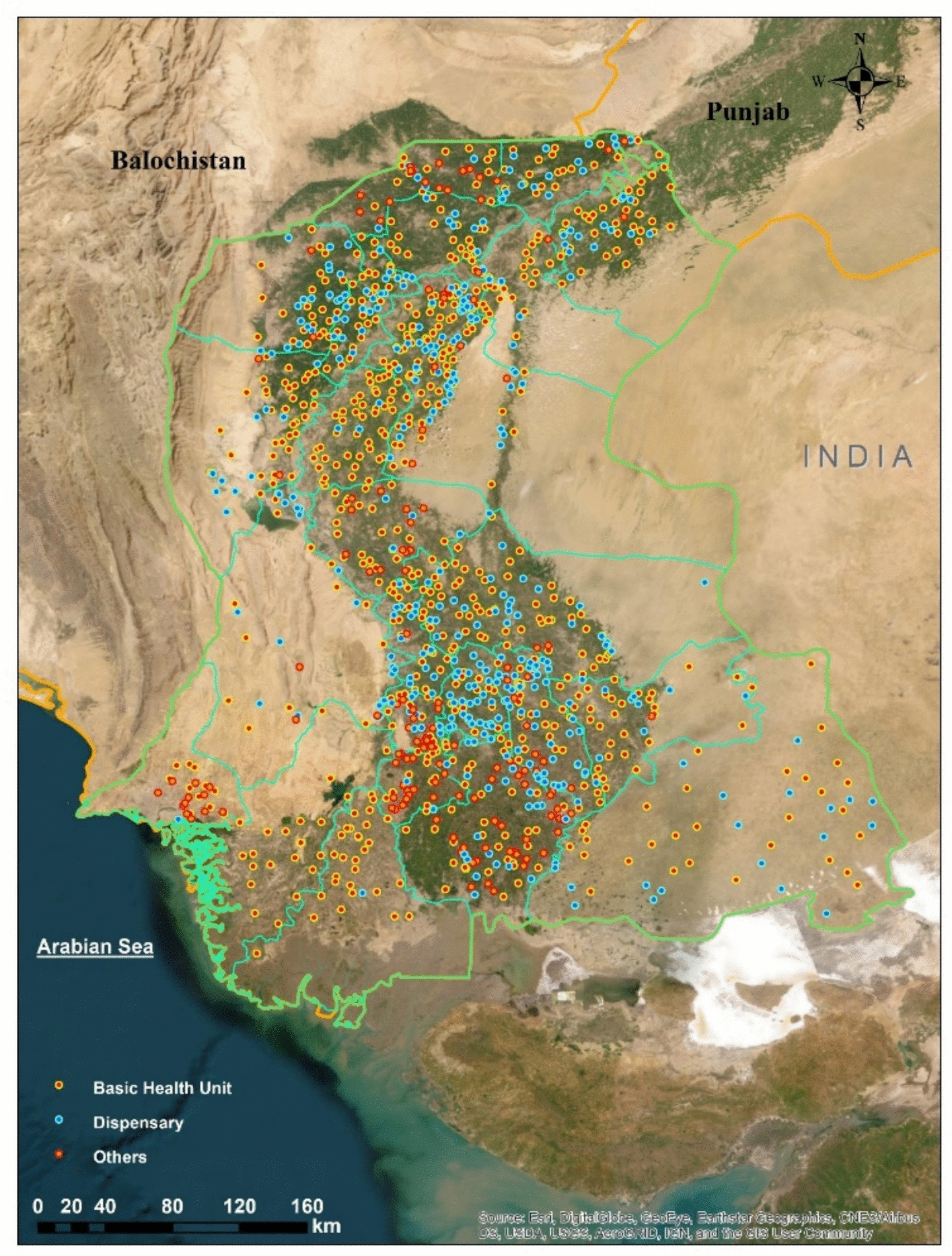
Distribution of primary healthcare facilities of public sector (PPHI) in Sindh, Pakistan
Burden of suspected malaria cases in the province
The overall annual incidence of suspected malaria was 92 cases per 1000 population. This ranged from 43 cases per 1000 in Jamshoro to 191 cases per 1000 in Thatta. A total of 1088 public sector healthcare facilities in 23 districts reported a total of 16.76 million suspected malaria (average of 1.28 million annual) cases during 2012–2024. On average, each healthcare facility observed approximately 1148 suspected cases every year (Table 1).
Table 1.
Total cases, annual incidence and population-weighted incidence of malaria according to districts in the province of Sindh, Pakistan (2012–2024)
| Districts | Health facilities | Total cases (2012–2024) | Average cases per annum | Average cases/year/Facility | Population covered by health facilities in the district | % of total population in the district | Average population covered per facility | Incidence/1000/year | Population weighted district-wise total incidence per year |
|---|---|---|---|---|---|---|---|---|---|
| Badin | 54 | 926,984 | 71,306 | 1320 | 837,135 | 46 | 15,503 | 85 | 165,851 |
| Dadu | 47 | 631,154 | 48,550 | 1033 | 562,960 | 36 | 11,978 | 86 | 150,260 |
| Ghotki | 40 | 458,440 | 35,265 | 882 | 712,332 | 43 | 17,808 | 50 | 87,755 |
| Hyderabad | 36 | 235,129 | 18,087 | 502 | 374,330 | 17 | 10,398 | 48 | 117,535 |
| Jacobabad | 27 | 469,174 | 39,098 | 1448 | 465,984 | 46 | 17,259 | 84 | 98,511 |
| Jamshoro | 37 | 285,288 | 21,945 | 593 | 507,921 | 51 | 13,728 | 43 | 48,274 |
| Kamber | 46 | 769,932 | 59,226 | 1288 | 679,229 | 51 | 14,766 | 87 | 132,089 |
| Kashmore | 38 | 541,813 | 41,678 | 1097 | 503,828 | 46 | 13,259 | 83 | 102,076 |
| Khairpur | 131 | 2,472,508 | 190,193 | 1452 | 1,905,125 | 79 | 14,543 | 100 | 259,318 |
| Larkana | 47 | 1,148,771 | 88,367 | 1880 | 635,738 | 42 | 13,526 | 139 | 248,037 |
| Matiari | 35 | 310,468 | 23,882 | 682 | 300,207 | 39 | 8577 | 80 | 67,570 |
| Mirpurkhas | 97 | 1,173,209 | 90,247 | 930 | 1,107,087 | 74 | 11,413 | 82 | 137,062 |
| Naushero Feroze | 48 | 1,137,526 | 87,502 | 1823 | 634,000 | 39 | 13,208 | 138 | 245,265 |
| Sanghar | 89 | 1,194,213 | 91,863 | 1032 | 1,400,373 | 68 | 15,735 | 66 | 151,432 |
| Shaheed Benazirabad | 38 | 398,740 | 36,249 | 954 | 318,296 | 20 | 8376 | 114 | 210,129 |
| Shikarpur | 26 | 438,087 | 33,699 | 1296 | 401,535 | 33 | 15,444 | 84 | 116,348 |
| Sujawal | 30 | 493,226 | 37,940 | 1265 | 262,995 | 34 | 8767 | 144 | 121,079 |
| Sukkur | 34 | 493,046 | 37,927 | 1115 | 610,158 | 41 | 17,946 | 62 | 101,934 |
| Tando Allahyar | 46 | 536,343 | 41,257 | 897 | 601,377 | 72 | 13,073 | 69 | 63,254 |
| Tando M. Khan | 34 | 444,045 | 34,157 | 1005 | 405,018 | 60 | 11,912 | 84 | 61,237 |
| Tharparkar | 49 | 511,584 | 39,353 | 803 | 478,901 | 29 | 9773 | 82 | 146,137 |
| Thatta | 21 | 742,343 | 57,103 | 2719 | 299,410 | 30 | 14,258 | 191 | 206,586 |
| Umerkot | 38 | 948,314 | 72,947 | 1920 | 642,559 | 60 | 16,909 | 114 | 131,671 |
| Total (‘*’ indicate average) | 1088 | 16,760,337 | 1,289,257 | 1148* | 14,646,498 | 46* | 13,462* | 92* | 3,244,793 |
Based on data available from limited facilities, a total of 1,354,943 RDTs were conducted over a 13-year period, of which 166,179 were positive, yielding an overall test positivity rate of 12.3%. The monthly positivity rate ranged between 7 and 18%, with higher values observed during the peak transmission season.
The number of healthcare facilities varied across districts, ranging from 21 in Thatta to 131 in Khairpur, with an average of 47.3 per district. The total number of suspected malaria cases also varied significantly by district, ranging from 48,274 to 259,318 annually. The percentage of the total population covered by healthcare facilities, based on catchment area estimates, in each district ranged from 17% in Hyderabad to 79% in Khairpur district, with an average coverage of 46% overall. Thus, average population served by each health facility was 13,462 individuals (Table 1).
There was a strong positive correlation between number of health facilities in the district and number of malaria cases reported (correlation coefficient: 0.85) and moderate positive correlation with total population (correlation coefficient: 0.68) in the district.
Time series and seasonality of malaria
The province of Sindh was affected by severe floods during 2010 and a ‘super’ flood during 2022. Yearly time series of malaria illustrates high incidence of suspected malaria in 2012, which gradually declines until 2021, and then a sharp increase was seen between 2022 and 2024 (about 2.5-fold increase). Notably, small increases in suspected cases also reported during 2015 and 2019, years coinciding with flooding events of lesser intensity. The 95% CI demonstrates high variations of incidence of suspected malaria across districts in the province (Fig. 3). These averages were calculated by aggregating reported suspected malaria cases at district level each year and dividing by the number of reporting districts, providing a province-level yearly mean. The 95% CIs were derived based on the standard deviation of district-level values for each year.
Fig. 3.

Yearly population-weighted average suspected malaria cases and 95% CI across 23 districts in Sindh province (2012-2024)
The monthly suspected cases of malaria show a clear trend of increased cases during the wet season, with a significant decline observed in drier months. The trend also reveals a small distinct peak in March, potentially coinciding with the tail end of the winter season and the start of pre-monsoon rains. The second peak occurs during the post-monsoon season and heavy rainfall, experiencing twofold higher average suspected malaria cases compared to the rest of the year (Fig. 4).
Fig. 4.

Monthly population-weighted suspected malaria cases and 95% CI across 23 districts in Sindh province (2012–2024)
Using the cumulative data for a 13-year period, the study identified 6 districts (of 23) with the highest burden of malaria, including Khairpur, Sanghar, Naushero Feroze, Badin, Mirpurkhas, and Larkana. These districts carried over 53% burden of malaria during this period (Fig. 5).
Fig. 5.

Total burden of malaria (with 95% CI) during 2012–2024 according to districts in the province of Sindh, Pakistan
Spatial distribution of malaria by district
Annual suspected malaria incidence per 1000 population was plotted by district using spatial maps (Fig. 6). Few districts consistently had a high burden of malaria during the study period (2012–2024). These districts with persistent malaria include Khairpur, Larkana, Sanghar, Thatta, Mirpur Khas, and Badin. This finding aligns with the identification of high-burden districts based on overall cumulative burden (Fig. 5).
Fig. 6.

District-wise burden of suspected malaria cases (incidence/1000) in Sindh, Pakistan (2012–2022)
The density map depicts the cumulative spatial distribution of suspected malaria burden in Sindh, Pakistan, over a period of 13 years. The spatial analysis revealed a concentration of suspected malaria cases along the Indus River corridor and basin, extending from the Jacobabad/Kashmore border (where the river enters Sindh from Punjab) to its discharge point at the Arabian Sea near Thatta. The districts bordering the river, including Larkana, Khairpur, Naushero Feroze, Thatta, and Hyderabad, exhibited the highest burden of malaria persistently during this period (Fig. 7).
Fig. 7.

Population-adjusted malaria suspected burden density map by district in Sindh, Pakistan (2012–2024)
Discussion
This study provided the most recent population-based estimates of the malaria burden in the second-most populated province of Pakistan. Malaria incidence of 92 per 1,000 people per annum was estimated at primary health care facilities. This is one of the highest beyond the African region. Cumulative estimates of 16.7 million suspected cases occurred during a 13-year period in the province of Sindh, about 1.28 million cases annually. Significant heterogeneity in malaria burden was observed across districts. Six districts, namely Khairpur, Sanghar, Naushero Feroze, Badin, Mirpurkhas, and Larkana accounted for over 53% of the malaria burden in Sindh. A distinct seasonal pattern was evident, with peaks aligning with the wet season and post-monsoon period. Since the 2022 floods in Sindh, malaria incidence has more than doubled and continues to persist in the province. The estimates are based on monthly reported suspected cases over 13 years from 1088 primary healthcare facilities. The large malaria datasets encompass 23 districts and 31.8 million population over 13 years. This study provided insight in subnational analysis of malaria for decision-making, in particular district-level estimates for strategic malaria control in the province.
Comparatively, the global report of malaria (2021) estimated 4.8 to 6.4 million annual cases, both suspected (presumed) and confirmed in Pakistan in the last decade (2010–2021) [2]. This study estimated the incidence of suspected malaria cases of 1.28 million annually in approximately 15% of the population of Pakistan, living in 23 districts of the province of Sindh. If extrapolated to entire Pakistan, approximately 8 million malaria cases (both presumed and confirmed) may be occurring annually in Pakistan. Furthermore, due to floods, the rates of malaria have doubled between 2022 and 2024, increasing the incidence.
The current study estimated the incidence of 92 suspected malaria cases per one 1000 population per year, and the range observed across districts between 43 and 144 cases per 1,000 people in primary public sector healthcare facilities alone (Table 1). It is important to note that in Pakistan about 60–70% of the population use the private health sector [15], therefore the above tally is an underestimate. Considering that at least three times the cases are seeking healthcare from private health sector, the incidence rate might go above 200 per 1000 per annum and the overall incidence may cross 20 million cases of malaria annually. Furthermore, the study did not include secondary and tertiary care hospitals in these districts which may further underestimate the overall burden. The global malaria report estimated the burden of malaria on the varied quality of data. In areas with limited surveillance data, sub-Saharan African and low-income countries, malaria case estimates are generated using modelled parasite prevalence and geographic information. In contrast, countries with robust surveillance systems can directly use reported case data, adjusted for factors such as healthcare-seeking behaviour and population coverage. Population-weighted estimates derived from actual data are considered more dependable than model-based estimates reliant on weaker surveillance systems. This study utilized data from over 1088 healthcare facilities collected over 13 years, representing a previously unprecedented dataset for Pakistan.
The slide positivity ratio was not obtained from DHIS data, as these records are not captured within the system. However, separate records of slide positivity ratio were consulted. Due to several factors, including non-availability and maldistribution of RDT kits, slide positivity data were not available from all health facilities. Therefore, the malaria positivity ratio was calculated from the limited available data, with an overall positivity of 12.3%, ranging from 7 to 18% across different seasons. Moreover, studies from Pakistan estimated that 15–25% of suspected malaria patients have confirmed malaria [16, 17]. Global malaria reported that the percentage of confirmed cases among suspected patients ranged between 18.1% and 49.7%. Therefore, based on the above estimates of 92 suspected cases, the incidence of confirmed malaria cases in Sindh Province was assumed to range between 11 and 18 cases per 1000 population per year, representing those reported to public healthcare facilities alone. When accounting for cases potentially reported to private sector health facilities, the estimated incidence increases to approximately 30–50 confirmed cases per 1000 population per year. It seems that 1 in 5 presumed cases are diagnosed as confirmed cases of malaria.
The study strength is to provide malaria estimates based on actual incidence from over 1088 health facilities for more than a decade. The method employed by the World Malaria Report relies on adjustments to reported malaria cases based on reporting completeness, test positivity rates, and health service utilization, incorporating household survey data to estimate overall malaria incidence [1]. While this approach allows for standardized cross-country comparisons, it has several limitations for subnational or regional estimation of malaria. It assumes that health service use among children under five represents all age groups, which may not always be valid. The health service utilization rates among children under five are higher than adults. Secondly, the health service utilization is not optimal for any age group because a substantial healthcare cost (direct or indirect) is borne out-of-pocket even if healthcare services are provided free of cost. This assumption may lead to under- or over-estimation of malaria burden in a given country or region. Additionally, the adjustments rely on estimated parameters rather than actual incidence data. In contrast, this approach utilizes direct, monthly malaria incidence data weighted with current population estimates. This method provides a more granular, time-resolved, and empirically driven assessment of malaria trends, minimizing reliance on assumptions about service utilization and test positivity.
This longitudinal analysis also sheds light on the relationship between climate change, malaria transmission, control efforts, and their effects on health services. The 2010 and 2022 floods had a major impact on the incidence of malaria. These events not only led to an immediate increase in malaria incidence during the same year, as reported in previous studies [18, 19], but the data also indicate that the impact persisted for a longer term (three years or more) following the flood events. This suggests that disasters such as floods can disrupt health services for extended periods and undermine years of malaria control efforts. With the increasing frequency of floods, this poses one of the greatest challenges for malaria control in endemic countries.
The study also revealed that the average coverage of the population by public sector healthcare facilities was 46% in the province of Sindh, ranging between 17 and 79% across 23 districts (Table 1). There was moderate correlation between the number of healthcare facilities and total population per district (correlation coefficient: 0.68) suggesting that the distribution of health facilities according to population size can be enhanced to improve coverage. However, given the meagre resources for the health sector, it provides a good population representation of health facilities for primary healthcare across districts in the province [20].
There is a large disparity in the malaria burden in the province. The study highlights six high-burden districts where targeted intervention can be organized to control malaria in the province of Sindh. This also highlights the high disparity between districts based on population-weighted estimates. Spatial distribution identifies the River Indus as a risk factor for malaria. The districts closer to the river have one of the highest burdens of malaria in the province targeted for intervention, as seen in previous studies [21, 22].
The study provided a trend of suspected malaria cases according to seasons (monthly) and spatial distribution across districts, identifying high-burden districts/hotspots. Malaria has a clear seasonal pattern, and two peaks were consistently visible: one in March and the other is a higher peak post-monsoon. The wet season witnessed a surge in cases, while drier months experienced a significant decline. This trend can be attributed to the ideal breeding conditions for mosquitoes, the primary vectors, transmitting malaria during periods of high rainfall and humidity. These peaks highlight the periods when factors such as rainfall and humidity create an environment conducive to amplified malaria transmission [23–25]. It is important to note that suspected cases were used to assess the seasonality trend of malaria. However, results are consistent with other studies and robust in indicating malaria seasonality. Two distinct peaks provide critical information for decision-makers to organize control strategies in advance of such surges, which may include targeted distribution of insecticide-treated bed nets and implementation of chemoprophylaxis. This strong seasonal pattern underscores the importance of incorporating seasonal malaria chemoprophylaxis campaigns as part of malaria control strategies in Sindh province. These campaigns involve the targeted administration of antimalarial medication during peak transmission periods, which can significantly reduce the malaria burden [26]. Additionally, the presence of water around the riverbanks during periods of overflow and its stagnancy in bordering areas contribute to the high burden of malaria in these areas. Addressing such factors could be crucial in implementing effective malaria control measures and reducing the disease burden in these regions. Although a significant contributing factor to the high caseload in these locations is stagnant water, the province's green belts also serve as breeding grounds for mosquitoes [27, 28].
Furthermore, one of the implications of this study is that it has identified high malaria burden districts with low health facility coverage for targeted interventions. Identified districts with targeted interventions would improve efficiency in the prevention, diagnosis and treatment of malaria. The population at risk of malaria in Pakistan is not well defined. The funding agencies, Global Fund to Fight AIDS, Tuberculosis and Malaria started to support the National Malaria Control Programme (NMCP) in 2007, and would find this information useful for allocation efficiency.
Limitations of the study
A key limitation of this study is the reliance on suspected rather than confirmed malaria cases. Suspected cases are based on clinical diagnosis without laboratory confirmation, which may introduce misclassification bias due to overlap with other febrile illnesses. Malaria testing was available interruptedly and in selected health facilities. Although a consistent positivity ratio was observed, corresponding with findings from other studies, more consistent testing data are required for improved malaria surveillance. This limitation could lead to either overestimation or underestimation of the malaria burden, potentially affecting the accuracy of the conclusions. While suspected case data provide a broader picture of malaria trends, the absence of confirmation limits the specificity of these estimates. Future studies incorporating laboratory-confirmed cases would improve the reliability of malaria burden assessments. Secondly, the main methods of malaria surveillance in Pakistan are passive case detection at healthcare facilities. This underestimates the malaria incidence, however, passive case detection of malaria for burden estimation is a uniform method globally, hence comparison was possible across studies [1]. Secondly, only public sector primary healthcare malaria data were utilized for estimation, as private sector healthcare facilities in Pakistan lack systematic data collection methods. Furthermore, secondary and tertiary hospital data were not included, which may further underestimate the overall burden of malaria in the studied districts. The study area did not include Karachi city. Since the PPHI services are mainly focused on rural districts, excluding Karachi, there were only a few health facilities established in Karachi (in peripheral areas). Also, health services in Karachi are provided by a large network of private small, medium and large hospitals, which do not implement control programmes.
Catchment area estimates for malaria density were not calculated; instead, district-level estimates were used. This approach was adopted for two reasons: first, the exact geographical boundaries of the catchment areas were not available, with only total population figures provided. Secondly, the district-level analysis was done to ensure that high-density districts are identified since the districts are the smallest administrative units for healthcare management in Pakistan (including Sindh) where one district health officer (DHO) manages all healthcare facilities and health initiatives. Therefore, it would be useful information for the district level manager to apply it in decision making.
Conclusion
This study provides a comprehensive longitudinal analysis of the malaria burden and distribution in Sindh province, Pakistan, utilizing a large dataset spanning 13 years (2012–2024) and encompassing 23 districts. By leveraging monthly suspected malaria cases reported from 1088 healthcare facilities, the district-wise burden was estimated using population-weighted methods. This approach, potentially the first of its kind in the region, provides a more accurate representation of the malaria situation in Sindh.
The findings reveal a substantial burden of suspected malaria cases across Sindh, with an average of 1.28 million cases reported annually. Importantly, the burden varies significantly between districts, highlighting the need for targeted interventions. Population-weighted estimates identified 6 high-burden districts for malaria bordering the Indus River corridor. Targeted interventions (particularly along the Indus River corridor) can be carried out, which can significantly improve the efficiency of malaria prevention, diagnosis, and treatment in Sindh, Pakistan.
The analysis also revealed a distinct seasonal pattern with two peaks: one in March and another during the post-monsoon period during August to October. This finding aligns with the known biology of malaria vectors and underscores the importance of incorporating seasonal malaria chemoprophylaxis campaigns as part of the control strategy in Sindh.
The findings highlight the critical need for strengthening surveillance systems. Implementing standardized data collection and reporting methods across healthcare facilities would enhance data quality and facilitate informed decision-making. There is a need to expand access to RDTs and integrate into DHIS. This would enable faster and more accurate diagnosis, leading to improved treatment outcomes and better disease management and allocation of resources.
Abbreviations
- BHU
Basic health units
- GIS
Geographic Information System
- MCH
Mother and Child Health
- MNCH
Maternal, Newborn, and Child Health
- NMCP
National Malaria Control Programme
- PPHI
People’s Primary Healthcare Initiative
- SMC
Seasonal malaria chemoprophylaxis
- SM
Suspected malaria
- SNT
Sub-National Tailoring
- WHO
World Health Organization
Author contributions
ZF, ZA, BAU conceptualized the study. NB, WZJ and ZA compiled the initial data. NB, ZA, RHR, JAJ provided insight into operational details and interpretation of information. SR, BAU and MA conducted analysis and developed maps for spatial distribution. ZF, BAU, WZJ, ZA wrote the draft manuscript. All authors critically reviewed and approved the final manuscript.
Funding
This was a non-funded research.
Availability of data and materials
District Health Information System (DHIS) data was analysed during the current study.
Declarations
Ethics approval and consent to participate
Not applicable. No human interaction occurred for collection of data.
Consent for publication
Not applicable.
Competing interests
The authors declare no competing interests.
Footnotes
Publisher's Note
Springer Nature remains neutral with regard to jurisdictional claims in published maps and institutional affiliations.
References
- 1.WHO. Global malaria report 2023. Geneva: World Health Organization; 2023. https://www.who.int/teams/global-malaria-programme/reports/world-malaria-report-2023
- 2.WHO. Global malaria report 2022. Geneva: World Health Organization; 2022. https://www.who.int/teams/global-malaria-programme/reports/world-malaria-report-2023
- 3.Pakistan. 18th Amendment to the Constitution of Pakistan. Islamabad: Government of Pakistan; 2010.
- 4.WHO. Global technical strategy for malaria 2016–2030 (2021 update). Geneva: World Health Organization; 2021.
- 5.Scott N, Hussain SA, Martin-Hughes R, Fowkes FJI, Kerr CC, Pearson R, et al. Maximizing the impact of malaria funding through allocative efficiency: using the right interventions in the right locations. Malar J. 2017;16:368. [DOI] [PMC free article] [PubMed] [Google Scholar]
- 6.Khan MI, Qureshi H, Bae SJ, Khattak AA, Anwar MS, Ahmad S, et al. Malaria prevalence in Pakistan: a systematic review and meta-analysis (2006–2021). Heliyon. 2023;9: e15373. [DOI] [PMC free article] [PubMed] [Google Scholar]
- 7.Umer MF, Zofeen S, Majeed A, Hu W, Qi X, Zhuang G. Spatiotemporal clustering analysis of malaria infection in Pakistan. Int J Environ Res Public Health. 2018;15:1202. [DOI] [PMC free article] [PubMed] [Google Scholar]
- 8.Qureshi H, Khan MI, Ahmad A, Awan UA, Khattak AA, Khan AA, et al. Passive surveillance of malaria in pregnant women, non-pregnant women and children under 5 years of age in Bannu district, Khyber Pakhtunkhwa Pakistan. Front Med. 2021;8: 751456. [DOI] [PMC free article] [PubMed] [Google Scholar]
- 9.Malik MA, Batool R, Ahmed M, Abbasi IN, Fatmi ZA, Saleem S, et al. Self-reported illnesses in Thatta: evidence from a rural and underdeveloped district in Sindh province, Pakistan. PLoS ONE. 2025;20: e0293790. [DOI] [PMC free article] [PubMed] [Google Scholar]
- 10.Sindh Weather Portal (SWP). Climate of Sindh. Karachi: WordPress.com; https://sindhweatherportal.wordpress.com/climate-of-sindh/. Accessed 24 Jul 2024.
- 11.People's Primary Healthcare Initiatives (PPHI). PPHI Sindh [Internet]. Karachi: PPHI; http://pphisindh.org/. Accessed 24 Jul 2024.
- 12.Directorate of Malaria Control Programme, MNHRC. Malaria case management chart. In: World Health Organization. WHO guidelines for malaria. Geneva: World Health Organization; 2022. p. 139.
- 13.Pakistan Bureau of Statistics. Government of Pakistan. Islamabad: Pakistan Bureau of Statistics; https://www.pbs.gov.pk/. Accessed 24 Jul 2024.
- 14.Esri. ArcGIS software. Redlands (CA): Esri; https://www.esri.com/. Accessed 24 Jul 2024.
- 15.National Institute of Population Studies (NIPS) [Pakistan] and ICF. Pakistan Demographic and Health Survey 2017–18. Islamabad (Pakistan) and Rockville (MD): NIPS and ICF; 2019. https://dhsprogram.com/pubs/pdf/FR354/FR354.pdf. Accessed 24 Jul 2024.
- 16.Qureshi H, Khan MI, Ambachew H, Pan HF, Ye DQ. Baseline survey for malaria prevalence in Khyber Pakhtunkhwa province, Pakistan. East Mediterr Health J. 2020;26:453–60. [DOI] [PubMed] [Google Scholar]
- 17.Khan W, Rahman AU, Khan W, Shafiq S, Ihsan H, Khan K. Malaria prevalence in Malakand district, the north western region of Pakistan. J Pak Med Assoc. 2019;69:946–9. [PubMed] [Google Scholar]
- 18.Coalson JE, Anderson EJ, Santos EM, Madera Garcia V, Romine JK, Dominguez B, et al. The complex epidemiological relationship between flooding events and human outbreaks of mosquito-borne diseases: a scoping review. Environ Health Perspect. 2021;129:96002. [DOI] [PMC free article] [PubMed] [Google Scholar]
- 19.Acosta-España JD, Romero-Alvarez D, Luna C, Rodriguez-Morales AJ. Infectious disease outbreaks in the wake of natural flood disasters: global patterns and local implications. Infez Med. 2024;32:451–62. [DOI] [PMC free article] [PubMed] [Google Scholar]
- 20.Health Department Sindh. Health Department Sindh. Karachi: Health Department Sindh; https://sindhhealth.gov.pk/. Accessed 24 Jul 2024.
- 21.Dieng S, Adebayo-Ojo TC, Kruger T, Riddin M, Trehard H, Tumelero S, et al. Geo-epidemiology of malaria incidence in the Vhembe District to guide targeted elimination strategies, South Africa, 2015–2018: a local resurgence. Sci Rep. 2023;13:11049. [DOI] [PMC free article] [PubMed] [Google Scholar]
- 22.Oesterholt MJ, Bousema JT, Mwerinde OK, Harris C, Lushino P, Masokoto A, et al. Spatial and temporal variation in malaria transmission in a low endemicity area in northern Tanzania. Malar J. 2006;5:98. [DOI] [PMC free article] [PubMed] [Google Scholar]
- 23.Stadler E, Cromer D, Ogunlade S, Ongoiba A, Doumbo S, Kayentao K, et al. Evidence for exposure dependent carriage of malaria parasites across the dry season: modelling analysis of longitudinal data. Malar J. 2023;22:42. [DOI] [PMC free article] [PubMed] [Google Scholar]
- 24.Liu Z, Wang S, Zhang Y, Xiang J, Tong MX, Gao Q, et al. Effect of temperature and its interactions with relative humidity and rainfall on malaria in a temperate city Suzhou, China. Environ Sci Pollut Res Int. 2021;28:16830–42. [DOI] [PubMed] [Google Scholar]
- 25.Matthew OJ. Investigating climate suitability conditions for malaria transmission and impacts of climate variability on mosquito survival in the humid tropical region: a case study of Obafemi Awolowo University campus, Ile-Ife, south-western Nigeria. Int J Biometeorol. 2020;64:355–65. [DOI] [PubMed] [Google Scholar]
- 26.ACCESS-SMC Partnership. Effectiveness of seasonal malaria chemoprevention at scale in west and central Africa: an observational study. Lancet. 2020;396:1829–40. [DOI] [PMC free article] [PubMed] [Google Scholar]
- 27.Ali SA, Ahmad A. Mapping of mosquito-borne diseases in Kolkata Municipal Corporation using GIS and AHP-based decision-making approach. Spat Inf Res. 2019;27:351–72. [Google Scholar]
- 28.Sowilem MM, El-Zeiny AM, Mohamed ES. Mosquito larval species and geographical information system (GIS) mapping of environmental vulnerable areas, Dakhla Oasis, Egypt. Int J Environ Climate Change. 2019;9:17–28. [Google Scholar]
Associated Data
This section collects any data citations, data availability statements, or supplementary materials included in this article.
Data Availability Statement
District Health Information System (DHIS) data was analysed during the current study.