



Abstract
Engineered bacteria have demonstrated great potential for treating a broad array of tumors. However, the precision and safety of controlling the performance of engineered bacteria in vivo remains a central challenge. Here, genetic circuit programming strategy is utilized to construct an engineered Escherichia coli Nissle 1917 with accurate targeted colonizing and on‐demand payloads releasing ability. The engineered probiotic survives only in the presence of more than 5 mM L‐lactate by employing an improved lactate‐sensing system, which leads to preventing the growth outside the permissive environments in mice. Meanwhile an expressing α‐hemolysin (SAH) circuit based on quorum‐sensing system is introduced to augment anti‐tumor effect. Furthermore, coagulase (Coa) induced by high‐level lactate creates the closure to deprive tumor of nutrients and oxygen and may help prevent the leakage of bacteria and SAH, which enhances the therapeutic effectiveness and biosafety. This self‐adjusting living biotherapeutics significantly inhibits tumor proliferation and prolongs the survival time of colorectal tumor‐bearing mice. Together, this work takes a step toward safer and more effective application of living bacteria for tumor treatment in practice.
Keywords: engineered probiotics, multiplexed, self‐adjusting, synthetic biology, tumors treatment
Zou et al. developed an engineered strain of Escherichia coli Nissle 1917 with precise targeting abilities for colonization and on‐demand payload release. The engineered probiotic survives and embolizes tumors only in the presence of more than 5 mM L‐lactate. Furthermore, the introduction of an α‐hemolysin circuit enhances its anti‐tumor effect. This approach significantly inhibits tumor growth and extends survival.

1. Introduction
The treatment of tumors has been a long‐standing challenge. Many strategies have been applied in cancer treatment or clinical testing phase, such as radiotherapy,[ 1 ] chemotherapy,[ 2 ] CAR‐T cell therapy[ 3 , 4 ] and living bacterial therapy.[ 5 , 6 , 7 ] Especially, due to the selective tumor colonization and high programmability,[ 8 ] living bacteria therapies are increasingly being sought after by researchers. Many live tumor‐targeting microorganisms, such as bacillus Calmette‐Guérin,[ 9 ] Salmonella typhimurium [ 10 , 11 ] and Escherichia coli Nissle 1917 (EcN)[ 12 ] can colonize in tumor tissues and inhibit tumor cell growth to a certain extent. To augment the antitumor efficacy of bacterial therapy, transport and expression of the therapeutic agents such as various cytotoxic agents,[ 13 , 14 ] angiogenesis inhibitors,[ 15 ] compounds,[ 16 ] short hairpin RNA[ 17 ] and chemokines[ 18 ] have been harnessed. Recently, it was reported that the ClyA and FlaB secreted by Salmonella typhimurium could remodel the tumor immune microenvironment to carry out the strong anti‐tumor effect.[ 19 ] Jean et al. engineered an arabinose‐induced E. coli strain to express toxic proteins Staphylococcus aureus α‐hemolysin (SAH), which could reduce 91% of the 4T1 tumor volume.[ 20 ] SAH is a naturally secreted pore‐forming protein that can induce mammalian cell lysis. When expressed in E. coli, SAH is released as a functional protein, requiring no additional modification to maintain its activity.[ 20 ] The signal peptide of SAH contains Sec‐like motifs, suggesting that E. coli may secrete SAH using its native Sec‐pathway machinery. Alternatively, SAH could be released following bacterial death and subsequent lysis, leading to the release of cellular contents. Tan et al. developed a S. typhimurium strain expressing cytolysin A to treat pancreatic cancer.[ 21 ] Bacteria also could be designed to express and release IFN‐γ, CTLA‐4 or PD‐L1 nanobodies, and achieve satisfactory effects on tumor treatment.[ 22 , 23 , 24 ] However, a critical consideration of using such engineered bacteria in vivo is how to keep them enriched and grow only in tumor. Enhancing the tropism of bacteria via synthetic biology‐based genetic circuits is an elegant approach to prevent off‐target tissue damage. Yu et al. coupled S. typhimurium growth with hypoxia to control the colonization in tumors.[ 25 ] Another work showed that the engineered S. typhimurium with both hypoxia and lactate biosensors via an AND gate improved tumor specificity,[ 26 ] but the lactate biosensor based on the E. coli LldR regulator and PlldPRD are inhibited partly by glucose and anaerobic[ 27 ] which are the two characteristic hallmarks in the tumor microenvironment (TME). In short, there are still existing several neck bottles needing to be addressed for clinical practice, such as the accuracy and efficiency of anti‐tumor drug release, the selective tumor colonization ability, and prevention of therapeutic protein leakage through blood vessels.
To meet these simultaneous demands, we developed an engineered EcN for selective colonization and on‐demand recombinant drug protein release in tumor, and this intelligent engineered bacterium prevented the toxic protein from leaking into the healthy tissue by inducing tumor thrombus. Notably, we developed a sensing system specifically responding to high concentrations (>5 mM) of lactate, and it was not restricted by glucose and hypoxia. This sensing system could regulate the expression of the growth essential gene asd (aspartate‐semialdehyde dehydrogenase gene)[ 25 ] and coagulase[ 28 ] gene simultaneously in an asd gene deleted EcN strain. The expression of coagulase causes thrombosis and infarction within the tumor, which results in blocking the nutrients and oxygen supply and preventing the therapeutic protein from leaking.
This self‐adjusting bacterial system preferentially colonizes in tumors, inhibits tumor proliferation, and prolongs the survival time of tumor‐bearing mice (Figure 1 ). Our study demonstrates that synthetic biology allows us to reprogram bacteria via integrating multiple genetic circuits to recognize a niche where they should grow and therapeutic proteins could be expressed and released in an effective and safe way. In summary, we established a paradigm for the practical application of living engineered bacteria in the treatment of tumors.
Figure 1.
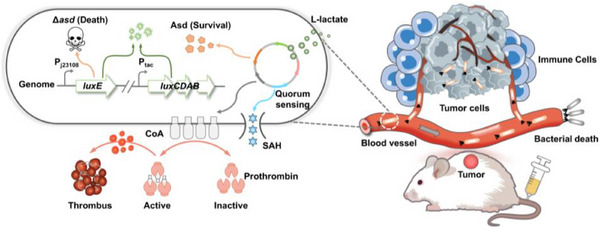
Schematic of self‐adjusting engineered EcN for selective tumor colonization and local therapeutics delivery. Left: schematic diagram of the engineered EcN. Right: engineered EcN selectively colonizes tumors and releases payloads via intravenous injection.
2. Results
2.1. Engineering Lactate‐Sensing System to Control Bacterial Growth
Tumor cells uptake glucose and produce lactate at levels typically exceeding 5 mM, in contrast to the normal lactate concentration of approximately 1.5 mM found in healthy organs and blood.[ 29 , 30 ] We also measured lactate concentrations in the colorectal cancer MC38 tumor, and the results indicated that the lactate content in tumor is indeed higher than that in normal tissues (Figure S1, Supporting Information). Therefore, it is feasible to construct an engineered bacterium that strictly relies on high concentration lactate to control tumor targeting and colonization.
We developed lactate sensor by using LldR from Corynebacterium glutamicum, because it is unaffected by glucose and anaerobic.[ 31 , 32 ] We first optimized the expression of the codon‐optimized lldR gene using L‐arabinose induction system, and use LldR to regulate the reporter sfGFP with various copy numbers and lldRO operator locations to obtain AL, ALO, and ALOO strains (Figure 2A). The fluorescence intensity decreased or increased with the rising amounts of L‐arabinose and lactate, respectively (Figure 2B), which indicated that LldR from C. glutamicum is a repressor regulated by lactate. Given that the sensor containing the ALOO‐type lactate‐inducible promoter exhibits the lowest level of basal expression, it was selected for further investigation. Subsequently, we constructed a variant library of biosensors by adjusting the transcription and translation levels of lldR. Most variants exhibited a significant response signal to 5 mM lactate (Figure 2C). These results indicated that this improved lactate‐sensing system could respond to 5 mM lactate and alleviate the inhibitory effect of glucose (Figure S2A,B, Supporting Information).
Figure 2.

Design and characterization of a lactate inducing system for the bacterial growth. A) Schematic diagram of tuning the intracellular LldR level by the arabinose inducible system, and the expression of sfGFP is controlled by three promoters, PAL, PALO, PALOO respectively. B) Fluorescence intensity (top) and the induction fold induced by 0–10 mM arabinose and 0–10 mM lactate after 12 h (bottom). The fluorescence intensity of the culture decreases with increasing arabinose concentration and increases with increasing lactate concentration, indicating that LldR is a repressor. C) Construction and optimization of a whole‐cell biosensor with lactate response. By controlling the transcription and translation levels of LldR, it is convenient to regulate the basal expression and maximum output of the biosensor (mean ± SEM, n = 3). D–F) Coupling a lactate biosensor with bacterial growth via the expression of an essential gene asd. The escape rate is defined as the ratio between colonies grown in different concentrations of lactate and DAP. All strains were cultured for 8 h, and the culture was appropriately diluted and plated on LB agar plates containing 100 µg mL−1 DAP to determine the bacterial count (mean ± SEM, n = 3). (G) EcNlA strain at serial dilutions under increasing Lactate levels was cultured for 12 h and observed for bacterial growth.
To effectively control the growth of engineered bacteria under specific conditions, dominating the essential gene expression is an effective strategy. We chose the essential gene asd, under the control of this lactate inducing system. We replaced asd in the genome of EcNl with the luxE gene to obtain a mutant EcNlE (Figure S3A,B, Supporting Information), and EcNl contained luxABCD gene in its genome (refer to our previous work).[ 33 ] EcNlE could grow (Figure S3C, Supporting Information) and produce bioluminescence (Figure S3D, Supporting Information) only when 2,6‐diaminopimelic acid (DAP) exceeded 50 µg mL−1. In order to utilize lactate to control bacterial growth (Figure S3E, Supporting Information), we tried to place the asd gene under the control of three different lactate sensing systems to generate L1029asd, L1032asd and L1035asd strains separately. They all showed approximately 100% “escape rate” regardless of lactate from 0 to 10 mM (Figure S4A, Supporting Information). In our study, the “escape rate” is defined as the ratio of the number of engineered bacteria grown under different concentrations of lactic acid to the number of engineered bacteria grown under permissive conditions (50 µg mL−1 DAP). To reduce the escape rate of engineered bacteria under the limited concentration of lactate, we further reduced the basal expression level of Asd protein by interlinking degradation tags Ssr (AAV or LAA). The results showed that only strain L1032asdLAA (EcNlEA) could grow when the concentration of lactate was more than 5 mM (Figure 2D–F; Figure S4B, Supporting Information), and the agar plate experiments also confirmed this result (Figure 2G).
We further characterized the “escapee rate” of L1032asdLAA. The “escapee rate” is defined as the ratio of bacterial growth in non‐permissive (0 mM lactate) environments to permissive conditions (10 mM lactate).[ 26 , 34 ] The results show that L1032asdLAA exhibited selective growth in the presence of 10 mM lactate with a 10−4 escapee rate (Figure S5, Supporting Information). Next, we studied the growth curve of the L1032asdLAA variant in a medium containing lactate, and the results showed that both the L1032asdLAA variant and EcNI reached the same OD600 after of 8 h, although L1032asdLAA grew slightly slower than EcNl (Figure S6, Supporting Information). This delay is likely due to the time required for L1032asdLAA to sense lactate and subsequently transcribe and translate the asd gene. Taken together, we successfully developed a lactate‐sensing system for precise control of bacterial growth when the lactate is over 5 mM.
2.2. Lactate‐Induced Display of Coa on EcN for Coagulation
Targeted delivery of coagulating proteins to tumor blood vessels can block the oxygen and nutrients for tumors and leads to their death. Some coagulation strategies have been used for specific induction of thrombosis within tumors.[ 35 , 36 ] We chose Coa (NCBI Reference Sequence: WP_000744074.1) from Staphylococcus to achieve coagulation, because it is convenient to be expressed in prokaryotes and will not promote angiogenesis in vivo.[ 28 , 37 ] We chose to study the truncated form of Coa because previous studies have shown that the truncated version retains its functional activity.[ 28 ] Additionally, the truncated Coa requires a smaller plasmid size, making it more suitable for genetic manipulation. We first tested the coagulating ability of purified Coa (Figure S7, Supporting Information), and it could coagulate blood within 30 min in vitro (Figure 3A). Then, we integrated the coa gene with lactate inducing system and conducted a series of optimizations, ultimately obtaining the L1035coa strain (Figure 3B). L1035coa was induced with different lactate concentrations for 6 h (OD600 ≈ 0.4), and only the cultures induced by lactate with 5 and 10 mM could cause blood coagulation in 3 h (Figure 3C).
Figure 3.
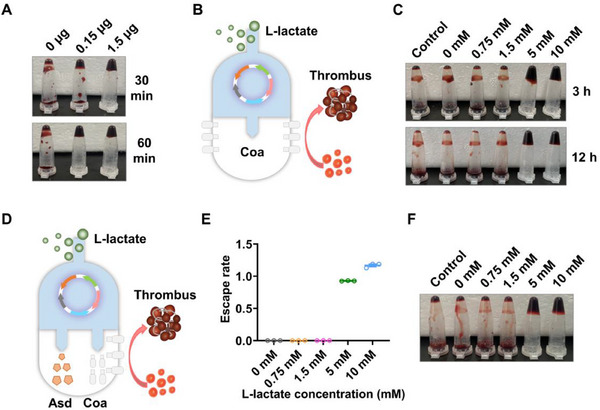
Simultaneous control of bacterial growth and coagulase expression through lactate biosensor. A) Images of the coagulation formation at 30 and 60 min after being treated by different concentrations of Coa. B) Construction of an engineered EcN strain with lactate induced coagulase expression. C) lactate responsive engineered EcN L1035coa induced blood coagulation. Pre‐culture L1035coa strain (with 100 µg/mL DAP) to OD600 ≈ 0.4, then induce for 6 h with different concentrations of lactate. Mix 50 µL cultures with 50 µL blood and incubated at 37 °C for 3 and 12 h to test blood coagulation. D) Construction of an engineered EcN strain with lactate induced bacterial growth and coagulase expression. E) The growth of EcNlEAC strain is strictly regulated by lactate concentration. EcNlEAC strain can growth only in permissive lactate levels (more than 5 mM) (mean ± SEM, n = 3). F) The expression of coagulase in EcNlEAC strain also strictly regulated by lactate concentration.
In order to construct a strain capable of controlling growth and expressing coagulase induced by lactate simultaneously, we integrated lldR, asd‐laa gene and coa gene into one plasmid to generate an engineered bacterial library (Figure 3D). Ultimately, we obtained a strain named EcNlEAC that could selectively grow (Figure 3E) and coagulate blood (Figure 3F) under permissive conditions (lactate exceeds 5 mM). Please refer to Table S1 (Supporting Information) for the characteristics of EcNlEAC.
2.3. Cytotoxic Protein Enhances Anti‐Tumor Effect
To further improve the anti‐tumor effect, we integrated cytotoxic protein SAH with the quorum‐induced system into EcNlEAC. Quorum‐sensing (QS) bacteria have the ability to modulate specific gene expression in response to the population density.[ 38 ] This feature endows our engineered bacteria with ability to express and release payloads only in tumor. We first demonstrated the effectiveness of QS system LuxI/LuxR (from Vibrio fischeri)[ 39 ] through fluorescent proteins (Figure S8, Supporting Information). Then we constructed the expressing SAH[ 20 ] by QS system in EcNlEAC to obtain strain named EcNIEACS containing two systems: i) Lactate‐sensing system strictly controlling bacterial growth and coagulase expression, and ii) QS system inducing toxic protein SAH expression. (Figure 4A).
Figure 4.

Design and functional characterization of a multifunctional EcN. A) Genetic circuit diagram of EcNlEACS. B) Detection and quantification of the secretion level of SAH by ELISA. Detection of SAH levels in culture supernatant through ELISA during the cultivation process (mean ± SEM, n = 3). C) Cytotoxicity analysis through CCK‐8. Supernatant from EcNlEACS cultures decreased survival of MCF‐7 cells compared to LB control, EcNlEAC and 50 ng/mL SAH (mean ± SEM, n = 3). D) Quantification of EcNlEACS colonization in MC38 tumors at different time points after injection of 1.5 × 10⁷ CFU bacteria (mean ± SEM, n = 3). E) Escape rate of EcNlEACS strain at various lactate concentrations, EcNlEACS strain can growth only in more than 5 mM lactate levels (mean ± SEM, n = 3). F) Coagulation ability of EcNlEACS strain induced by various lactate concentrations.
Next, to analyze the secretion and quantitative determination of SAH, western blot (WB) and enzyme‐linked immunosorbent assay (ELISA) were carried out. As shown in Figure 4B, Figures S9 and Figure S10 (Supporting Information), only EcNlEACS displayed a specific band compared with other groups, and the secretion of SAH could reach at 75 ng/mL after 12 h cultivation. To test the ability of EcNlEACS killing cancer cells, the supernatants of EcNlEAC and EcNlEACS were co‐incubated with cancer cells. The supernatant of EcNlEACS reduced cell viability sharply (about 60%) after 6 h incubation (Figure 4C). The blood agar test also confirmed the functional SAH produced by EcNlEACS (Figure S11, Supporting Information). Finally, we evaluated the colonization ability of EcNlEACS in tumors. EcNlEACS (1.5 × 10⁷ CFU) was intravenously injected to female C57BL/6 mice bearing subcutaneous MC38 tumors, and sacrificed at 4, 6, 24, 48, 72, 96 h after injection. The tumor tissues were collected, homogenized, and plated on LB plates after serially diluted, there were still 1 × 10⁷ CFU EcNlEACS in tumors even after 96 h (Figure 4D). The engineered bacterial growth and the coagulase expression were also investigated at different lactate concentrations from 0 to 10 mM, and both of them were strictly controlled by high concentration lactate (Figure 4E,F).
2.4. Engineered Probiotic EcNlEACS Exhibits Biosafety
To evaluate the biocontainment and safety of our engineered bacteria, we intravenously injected 1.5 × 10⁷ CFU EcNllux, EcNlEA, EcNlEAC, EcNlEACS to healthy mice and sacrificed at 24 h and 48 h respectively. Wherein, EcNllux harbored a plasmid expressing the luxE gene to serve as a negative control. Liver, spleen and lung were collected, homogenized, and plated on LB plates after serially diluted to calculate the number of engineered bacteria. Comparatively, lactate‐dependent strains exhibited a 1–2 order decrease in CFU when recovered from the liver and spleen, and a 2–3 order decrease when recovered from the lung, as compared to the control strain EcNllux. The results showed that the recovered CFU of all lactate‐dependent strains were much lower than strain EcNllux in the organs (Figure 5A–C; Figure S12A–C, Supporting Information). Moreover, EcNlEACS group exhibited a slightly weight loss compared to EcNllux after intravenously injection (Figure 5D). It is worth noting that all engineered bacteria maintain plasmid stability over time (Figure S13, Supporting Information). This is attributed to the presence of the essential gene asd on the plasmid, which functions as a plasmid stabilization system.
Figure 5.
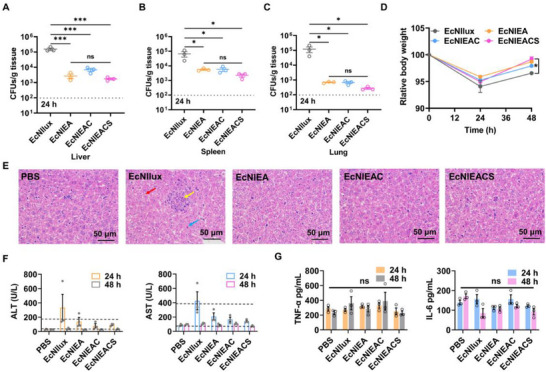
The biocontainment and safety of the engineered EcN. A–C) Quantification of bacterial colonization in different organs (liver, spleen, lung) harvested from healthy mice after inject bacterial for 24 h. LOD = 1 × 10² CFU/g (mean ± SEM, n = 3). Statistical significance was determined by a one‐way ANOVA, *p ≤ 0.05, ***p ≤ 0.001. D) Weight changes in healthy mice during different strains treatment (mean ± SEM, n = 3). Statistical significance was determined by a two‐way ANOVA, *p ≤ 0.05. E) Histological images of liver sections from each group stained with hematoxylin and eosin. Red arrow: mild edema of liver cells. Yellow arrow: hepatic sinus stenosis and small focal necrosis. Blue arrow: hepatocyte eosinophilic transformation. F) Serum transaminase levels in healthy mice. Detection of transaminase levels in mouse serum after 24 and 48 h of 1.5 × 10⁷ CFU bacterial injection (mean ± SEM, n = 3). G) Serum inflammatory factors levels in healthy mice. Detection of inflammatory factors levels in mouse serum after 24 and 48 h of 1.5 × 10⁷ CFU bacterial injection via ELISA (mean ± SEM, n = 3). Statistical significance was determined by a one‐way ANOVA, ns p > 0.05.
To evaluate the damage of liver, we observed the histopathological status by hematoxylin and eosin (H&E) histological staining after 24 h of intravenous injection of PBS, EcNllux, EcNlEA, EcNlEAC and EcNlEACS. The control group (EcNllux) showed a degree of pathological characteristics, such as mild edema of liver cells (red arrow), hepatic sinus stenosis and small focal necrosis (yellow arrow) and hepatocyte eosinophilic transformation (blue arrow), whereas less pathological characteristics were observed in all lactate‐dependent strains groups (Figure 5E). We also measured the levels of alanine transaminase (ALT), aspartate aminotransferase (AST) and cytokines in the serum. Serum transaminase levels of EcNIlux group reached the upper limit of healthy ones, while other groups were almost within normal range after 24 h administration (Figure 5F). There was no significant difference in cytokine levels among all groups after 24 h administration (Figure 5G). Collectively, these results demonstrated that EcNlEACS could reduce tissue off‐target and owned satisfied biosafety.
2.5. Distribution of Engineered Probiotic EcNlEACS in Vivo
To evaluate the colonization ability in tumor, EcNlEACS and control strains (1.5 × 10⁷ CFU) were intravenously injected to C57BL/6 mice bearing subcutaneous MC38 tumors. Organs and tumors were homogenized to evaluate bacterial colonization ability for 24 h. All strains colonized tumors at a comparable level (107‐108 CFU/g tissue), but the abundance of EcNIEACS in the liver and spleen is two orders of magnitude lower compared with EcNIlux (Figure 6A–C). We then computed a dose‐toxicity curve and demonstrated that lactate‐dependent strains have a higher maximum tolerated dose (MTD) than EcNllux in healthy mice (Figure 6D). Moreover, using imaging of bioluminescent bacterial populations, we could identify bacterial populations in tumors obviously (Figure 6E). Lactate responding strains at MTD showed rapid weight recovery within three days (Figure 6F). We next injected EcNllux, EcNlEA, EcNlEAC and EcNlEACS intravenously at the corresponding MTD of each strain (2.9 × 10⁷ CFU, 8.5 × 10⁷ CFU, 8.9 × 10⁷ CFU and 9.7 × 10⁷ CFU for EcNllux, EcNlEA, EcNlEAC and EcNlEACS, respectively) in MC38 tumor‐bearing mice, and the tumors were collected to measure the levels of cytokine by ELISA after 24 h injection. The results showed that all bacterial groups could significantly increase TNFα and IFNγ levels in tumors (Figure 6G,H), which indicated that EcN could effectively stimulate the immune system. We further evaluated various immune cell populations, including dendritic cells, neutrophils, and macrophages, which may be activated due to the presence of the bacteria and their intrinsic immune‐boosting properties, such as LPS and flagellin (Figure S14, Supporting Information). The results show that bacterial treatment significantly increased the infiltration of dendritic cells, neutrophils, and macrophages in the tumor tissue compared to the PBS‐treated group. However, no significant differences were observed between the EcNlEA and EcNlEACS groups. This lack of difference may be attributed to the non‐specific cell killing effects of SAH, which could have affected the immune cells infiltrating the tumor.
Figure 6.

Characterization of engineered EcN functions in tumors. A–C) Quantification of bacterial colonization in tumors and different organs harvested from mice bearing the MC38 tumor after inject bacterial for 24 h. LOD = 1.0 × 10² CFU/g (mean ± SEM, n = 3). Statistical significance was determined by a one‐way ANOVA, ns p > 0.05, *p ≤ 0.05, **p ≤ 0.01. D) Dose‐toxicity curve with MTD = 2.9 × 10⁷ CFU, 8.5 × 10⁷ CFU, 8.9 × 10⁷ CFU and 9.7 × 10⁷ CFU for EcNllux, EcNlEA, EcNlEAC and EcNlEACS, respectively. MTD was calculated based on TD50 (Toxic Dose for 50% of the population; >10% body weight drops; non‐linear regression with least squares fit; n ≥ 6). E) Visualization of bacterial colonization through bioluminescence imaging. I: PBS, II: EcNllux, III: EcNlEA, IV: EcNlEAC and V: EcNlEACS. F) Weight changes in MC38‐bearing mice during different strains treatment (mean ± SEM, n = 4). G,H) Changes in intracellular cytokine (TNFα and IFNγ) levels after 24 h of bacterial injection (mean ± SEM, n = 4). Statistical significance was determined by a one‐way ANOVA, *p ≤ 0.05, **p ≤ 0.01. I) Histological images of tumor sections from each group stained with hematoxylin and eosin. Yellow arrow: coagulation. Blue arrow: necrosis. Scale bars = 100 µm. J) Detection of intra‐tumoral SAH levels after intravenous injection of PBS, EcNlEAC and EcNlEACS for 24 h (mean ± SEM, n = 3). Statistical significance was determined by an unpaired two‐tailed t test, *p ≤ 0.05, **p ≤ 0.01. K) Fluorescence imaging of tumor slices. DAPI staining (blue), engineered bacteria (red), SAH (green). Scale bars = 200 µm.
As assessed by H&E staining, treatment with EcNlEAC and EcNlEACS triggered apparent coagulation (yellow arrow), while this phenomenon was not observed in residual groups (Figure 6I). Though EcNlEACS and EcNlEAC could cause tumor tissue damage, treatment with EcNlEACS exhibited a greater degree of necrosis (Figure 6I). This result was due to the production of a large amount of SAH by EcNllEACS (Figure 6J).
To observe the expression of SAH in tumors visually, we fused the sfGFP tag with SAH gene. In addition, a mCherry gene was also integrated to observe the localization of EcNlEACS in tumors. Fluorescence scanning images showed that the engineered EcN effectively colonize tumors and express SAH after 24 h injection, but the PBS group did not display any red or green fluorescence signals (Figure 6K). In summary, we demonstrated that EcNlEACS can perform the multiple functions in tumors: i) Specific and selective colonization in tumors. ii) Expression of coagulase to cause thrombus. iii) Self‐adjusting release of cytotoxic proteins. These results provided further motivation for utilizing engineered EcN to treat tumors.
2.6. Nutrient Deprivation Analysis
To assess the ability of EcNlEACS to induce intratumoral thrombosis and thereby cause dysfunction in substance exchange, we first performed an Evans blue staining experiment to evaluate thrombosis formation. The results clearly show that after EcNlEACS treatment, there is a significant blockage in the blood vessels of the tumor, indicating that thrombosis impairs the blood supply to the tumor tissue (Figure S15, Supporting Information). This blockage may lead to oxygen and nutrient deprivation, contributing to tumor cell death. Furthermore, we conducted nontargeted metabolomics analysis on MC38 tumor‐bearing mice treated with PBS or EcNlEACS for 24 h to evaluate tumor metabolism. As shown in Figure 7A, 506 metabolites were identified, of which 206 metabolites exhibited significant changes, with 83 metabolites upregulated and 123 downregulated. Principal Component Analysis (PCA) indicated a significant difference in the metabolites between the EcNlEACS‐treated mice and the PBS group (Figure 7B).
Figure 7.
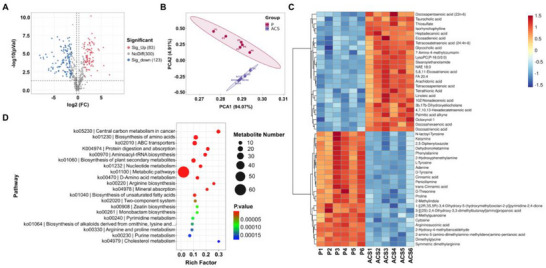
Nutrient deprivation analysis. A) Volcano plot comparing metabolites between PBS and EcNlEACS treated mice (P: PBS, ACS: EcNlEACS). B) PCA scores of the metabolites with significant differences between PBS and EcNlEACS treated mice. C) Heat map of the metabolites in MC38 tumor‐bearing mice after treatment with PBS and EcNlEACS. D) KEGG enrichment analysis of metabolites between PBS and EcNlEACS treatment groups. n = 6.
We further analyzed and displayed a heatmap of the top 50 differential metabolites (Figure 7C). The results showed that the EcNlEACS‐treated group exhibited downregulation of amino acids (such as D‐Tyrosine, Phenylalanine, Proline, etc.), nucleotides and their metabolites (such as Adenine, Cytosine, 2‐Methylguanosine, etc.), which are important components of cellular activity. Additionally, we observed the upregulation of some metabolites related to fatty acid metabolism, which may be closely linked to the metabolic reprogramming of tumor cells in response to adverse conditions such as hypoxia and nutrient deprivation. Moreover, we conducted a Kyoto Encyclopedia of Genes and Genomes (KEGG) database search to evaluate changes in metabolic pathways after EcNlEACS treatment. The results indicated that the differential metabolites were mainly associated with central carbon metabolism, amino acid biosynthesis, and nucleotide metabolism pathways in tumor cells (Figure 7D). These findings strongly suggest that EcNlEACS‐induced intratumoral thrombosis hinders the material exchange between tumor cells and their environment.
2.7. Therapeutic Effects in Vivo
To assess the therapeutic potential of this system in vivo, we administered MC38 tumor‐bearing mice with PBS, EcNllux, EcNlEA, EcNlEAC and EcNlEACS at the corresponding MTD of each strain (2.9 × 10⁷ CFU, 8.5 × 10⁷ CFU, 8.9 × 10⁷ CFU and 9.7 × 10⁷ CFU for EcNllux, EcNlEA, EcNlEAC and EcNlEACS, respectively) for three times over the course of 6 days and monitored for 10 days (Figure 8A). Although all bacterial administration groups resulted in a delay in tumor growth, EcNlEACS treatment showed the best anti‐tumor among all groups. Administration of EcNlEACS could significantly inhibit tumor growth (Figure 8B), and exhibited the lightest tumor weight (Figure 8C), the smallest tumor size (Figure 8D) and the lowest tumor cell proliferation activity (Figure S16, Supporting Information). The tumor growth inhibition value was about 90% in 10th day of EcNlEACS. Notably, all bacterial groups exhibited slight weight loss after 24 h of intravenous administration, and regained their weights at the end of 10 days (Figure S17, Supporting Information). Moreover, we administered MC38 tumor‐bearing mice with PBS, EcNllux, EcNlEA, EcNlEAC and EcNlEACS at the corresponding MTD of each strain for three times over the course of 6 days and monitored for 30 days and continuously monitored tumor size. The results showed that EcNlEACS treatment significantly prolonged the survival time of the MC38 tumor‐bearing mice to a median survival time of 26 days compared to PBS (13 days), EcNllux (14 days), EcNlEA (15 days) and EcNlEAC (16 days) (Figure 8E). Figure 8F–J show the growth curves of tumors from individual mice. All these results demonstrated the potential of our multifunctional live bacterial therapy to combat cancers.
Figure 8.

Evaluation of therapeutic efficacy of intravenous injection engineered EcN in a MC38 subcutaneous tumor model. A) Therapeutic schedule. B) Tumor growth of mice in different treatment groups within 10 days (mean ± SEM, n = 5). Statistical significance was determined by a two‐way ANOVA, *p ≤ 0.05, **p ≤ 0.01. C) Tumor weights of mice with different treatments on the 10th day (mean ± SEM, n = 5). Statistical significance was determined by a one‐way ANOVA, ****p ≤ 0.0001. D) Images of the excised tumor tissues. All tumor samples are sourced from Figure 8C. E) Survival curves for the mice receiving different treatments (mean ± SEM, n = 7). Statistical significance was determined by a Log‐rank (Mantel‐Cox) test, ***p ≤ 0.001. F‐J) Growth curves of tumors from individual mice.
3. Discussion
In recent years, EcN has gained considerable attention as a promising vector for the development of smart microbes in the treatment of solid tumors. Various studies have demonstrated the potential of EcN to deliver therapeutic agents, and modulate the tumor microenvironment.[ 40 ] Moreover, engineered EcN has been explored not only as an anti‐tumor vaccine platform[ 41 ] but also for its ability to guide CAR‐T cells in precision cell therapy, providing a novel approach for targeted cancer treatment.[ 42 ] Here, we used synthetic biology strategies to design and create an intelligent genetic engineered EcN strain EcNlEACS capable of selective tumor colonization, causing coagulation and self‐adjusting drug delivery without additional inducers to fight tumors. The targeted colonization and self‐seclusion in tumor sites were rationally designed by developing a lactate‐sensing system to control the expression of growth essential gene asd and coagulase simultaneously. Subsequently, the QS system guaranteed to release therapeutic protein only in tumor and kill cancer cells.
As known, there is a significant difference in the content of lactate between normal tissues and tumor, which requires the sensing system to function at tumor concentrations strictly to avoid activation in other normal organs. One critical design of this gene circuit is optimizing a lactate sensing system based on LldR from C. glutamicum that is not inhibited by glucose. This system can respond to tumor only when the lactate concentration is above 5 mM, which is crucial for application in tumor treatment. We then coupled the optimized lactate biosensor with bacterial growth through the expression of an essential gene asd to address the limitation of targeted colonization in tumor. Moreover, the fusion of the asd gene with strong degradation label can further reduce the risk of bacterial escape. Induction of thrombosis in tumor vasculature is a promising avenue for the treatment of tumors. Unlike tumor embolism induced by pure thrombin, coagulase, or pathogenic bacteria, we used a tumor biomarker to regulate the expression of coagulase in a probiotic strain resulting in more targeted coagulation. The resultant enclosed environment not only helps to deprive tumor cells of oxygen and nutrients, which leads to tumor cell death, but also reduces the risk of EcNlEACS and therapeutic protein leakage. The other critical design of this gene circuit is exploiting quorum‐sensing system for evoking the expression of therapeutic protein. Only when the engineered bacteria colonize the tumor and grow to a specific density, the expression of toxic proteins can be activated. Collectively, compared to other tumor treatment strategies that utilize bacteria as carriers, our multifunctional collaborative strategy enhanced treatment efficacy and improved biosafety.
A various bacterial based therapies have previously been investigated for the treatment of cancer, and attenuated pathogens such as Salmonella typhimurium, Clostridium novyi, and Listeria monocytogenes were widely used.[ 5 , 6 , 7 ] However, these pathogens have dose‐limiting toxicities and are prone to causing infection once colonized in normal organs. In this study, we used a probiotic strain EcN as chassis for its advantageous safety and convenience of genetic manipulation. In addition, increasing the dosage without increasing side effects endows EcN with stronger therapeutic potential. Nonetheless, there are still some issues needing to be further resolved, such as how to reduce the immunogenicity of EcN during delivery to improve efficiency. Using biomaterial strategy is a reasonable option to improve the delivery of therapeutic bacteria, such as wrapping with cell membranes and programmable encapsulation system.[ 43 , 44 , 45 ] In short, we provided a strategy for effectively targeting and colonizing tumors which laying the foundation for enhancing maximum drug administration, and developed a treatment model with the “closed door” (tumor embolism) and the “released dogs” (therapeutic drugs) to achieve the goal of efficiently and safely killing cancer cells.
4. Experimental Section
Ethics
Female C57BL/6 mice (5‐6 weeks) were obtained from Shanghai Model Organisms Center, Inc. All animal procedures were performed in accordance with the Guidelines for Care and Use of Laboratory Animals of East China University of Science and Technology and the experiments were approved by the Animal Ethics Committee of East China University of Science and Technology (ECUST‐21038). All animals were euthanized when tumor burden reached 2000 mm3.
Materials
Anti‐α‐hemolysin antibodies (ab190467) were purchased from Abcam. HRP conjugated anti‐mouse IgG (HS201) and the cell counting kit‐8 assay (CCK‐8) reagent were purchased from TransGen Biotech. Mouse TNF‐α ELISA kit (EMC102aQT), mouse IFN‐γ ELISA kit (EMC101gQT) and mouse IL‐6 ELISA kit (EMC004QT) were purchased from Neobioscience. HE dye solution set (G1003) was purchased from Servicebio. DNA polymerase (P505) was purchased from Vazyme. Blood agar plates (CP0230) were purchased from HuanKai Biology. Roswell Park Memorial Institute (RPMI) 1640 medium and Dulbecco's modified Eagle's medium (DMEM) were purchased from Gibco. DAP (BCCH0213) was purchased from Sigma‐Aldrich. Human blood was obtained from Shanghai Tenth People's Hospital. MC38 (National Collection of Authenticated Cell Cultures, Shanghai, China. Serial: TCM46, Identifier: CSTR:19375.09.3101MOUTCM46). MCF‐7 (National Collection of Authenticated Cell Cultures, Shanghai, China. Serial: SCSP‐531, Identifier: CSTR:19375.09.3101HUMSCSP531). All the cell lines used were confirmed to be free of mycoplasma contamination.
Bacteria and Cell Culture
All bacterial strains and cell lines were listed in Table S1 (Supporting Information). Bacterial strains were spread on the LB solid plate (with appropriate antibiotics) and then incubated at 37 °C for 12 h. Colonies were picked out and transferred to 700 µL LB liquid medium (with appropriate antibiotics) in a microplate shaker (37 °C, 1000 rpm) for overnight. Afterward, the activated cultures were diluted 200‐fold into fresh medium and further cultured to the logarithmic growth stage (OD600 ≈ 0.4).
Cancer cells were maintained at 37 °C in a 5% CO2 humidified atmosphere. MC38 cells were cultured in cell culture flasks containing 5 mL of 1640 medium, respectively, supplemented with 10% fetal bovine serum (FBS) and 100 U mL−1 penicillin‐streptomycin. MCF‐7 cells were cultured in DMEM medium with 10% fetal bovine serum (FBS) and 100 U mL−1 penicillin‐streptomycin.
Construction of plasmids
The construction of all plasmids was performed in E. coli strain DH5α (TransGen Biotech) in accordance with standard procedures. Plasmids were constructed by an origin replication of pSC101. To construct and optimize lactate‐responsive gene circuits, the codon‐optimized lldR gene (Sangon Biotech) from C. glutamicum was placed downstream of a series of different combinations of promoters and RBSs and the expression of the sfGFP gene was regulated by a synthetic promoter, which contains two LldR repressor binding sites. To construct biocontainment circuits, the essential gene asd or its variants (asdaav and asdlaa) was added downstream of the synthesis promoter regulated by L‐lactate. The asd gene was obtained by colony polymerase chain reaction (PCR) from E. coli Nissle 1917, and the protein‐degradation tag of AAV or LAA was added to the C‐terminus of the asd gene through PCR. Codon‐optimized SAH (from S. aureus) and truncated coa (from S. aureus) gene were integrated into engineered plasmid through homologous recombination. Standard strength promoter (BBa_J231XX) sequences were obtained from http://parts.igem.org. All sequences were shown in Table S2 (Supporting Information). The engineered plasmids were introduced into EcN via electroporation (3 kV, 4 ms). The electroporation protocol was adapted from this previous report.[ 46 ]
asd Gene Deletion and luxE Gene Integration in EcNl Strain
The deletion of the asd gene and the integration of the luxE gene were carried out through the λ‐Red recombination system. Details of chromosomal gene deletion and integration were previously reported.[ 46 , 47 ] In brief, linear DNA containing a Pj23108‐luxE, an aminoglycoside phosphotransferase‐gene (kanR) gene and two homology arms (50 bp) was amplified by PCR, and electroporated into EcNl strain carrying pKD46 plasmid. Bacteria were spread on a LB solid plate with 100 µg mL−1 DAP and cultured for overnight. Chromosomal deletions and integration were verified by colony PCR and sequencing.
Determination of Fluorescence Intensity
Each activated bacterial strain was diluted 200‐fold into fresh LB liquid medium containing different concentrations of L‐lactate in a microplate shaker (1000 rpm, 37 °C). After 12 h, the fluorescence values and OD600 were measured. The Fluo/OD600 showed the reporter sfGFP expression intensity. It was noted that before fluorescence detection, the cultures were needed to be washed twice and resuspended in PBS. OD600 and fluorescence values were measured by a microplate reader (BioTek Instruments, Winooski, VT, USA).
Bacterial Escape Analysis
Activated bacteria were washed twice by PBS and diluted 1000‐fold into 200 µL fresh LB liquid medium containing different concentrations of L‐lactate or 100 µg mL−1 DAP. After 8 h cultivation at 37 °C, 1000 rpm, all cultures were serially diluted and spread on the LB solid plate with 100 µg mL−1 DAP, after which colonies were counted after 12 h culture. The escape rate was defined as the ratio between colonies grown in and different concentrations of L‐lactate and DAP.
Expression and Purification of Truncated Coa and SAH Protein
The coa or SAH gene containing the 6 × His tag was inserted into a pET‐28a expression vector respectively. The protein was expressed and purified according to standard protocols in E. coli BL21 strain. First, the bacteria were inoculated into LB medium and cultured overnight at 37 °C in a shaker. The following day, the bacterial solution was transferred into fresh LB medium and cultured until reaching the logarithmic growth phase. IPTG was then added to the culture to a final concentration of 1 mM to induce protein expression for 16 h at 18 °C. The bacteria were then collected and washed with PBS by centrifugation (8000 rpm, 10 min) before being disrupted using an ultrasonic cell disruptor. The supernatant containing the soluble protein was collected by centrifugation (10000 rpm, 10 min). The soluble protein was loaded onto a nickel column equilibrated with 10 mM imidazole. The column was washed with 20 mM imidazole to remove impurities, and the target protein was eluted with 250 mM imidazole, which was collected into a centrifuge tube. The ultrafiltration tube was washed with PBS (4500 rpm, 10 min), and the whole protein solution was added into the ultrafiltration tube to concentrate.
Blood Clotting in Vitro
For pure enzymes assay, 0, 0.15 µg and 1.5 µg coagulase (Coa) were incubated with 50 µL human blood at 37 °C, respectively. Photos were taken at 30 min and 60 min. For engineered EcN assay, bacterial strains were cultured to OD600 ≈ 0.4, then induced by different concentrations of L‐lactate for 6 h. Afterward, these bacteria were incubated with human blood at 37 °C, respectively. Photos were taken at 3 h and 12 h.
Western Blot Analysis for SAH
Activated EcNlEAC and EcNlEACS strains were diluted 200‐fold into fresh LB liquid medium with 100 µg mL−1 streptomycin and DAP, and grown in a 37 °C shaker for 12h. Cultures were collected and centrifuged at 12000 rcf for 5 min at 4 °C. The supernatant was used for Western blot (WB) analysis. Supernatant and LB control were loaded per well for SDS‐PAGE, followed by transferring to nitrocellulose membranes and WB test was then performed according to a standard protocol, with an appropriate concentration of SAH antibody (1:2000) and an HRP conjugated goat anti‐mouse IgG (1:5000).
ELISA Analysis for SAH
Activated EcNlEACS strain was diluted 200‐fold into fresh LB liquid medium with 100 µg mL−1 streptomycin and DAP, and grown in a 37 °C shaker for 12 h. Cultures were collected at 6 h, 8 h, 10 h, 12 h, and then centrifuged at 12000 rcf for 5 min at 4 °C. The supernatant was used for ELISA analysis. The standard curve was obtained through purified SAH protein. The SAH protein was diluted to 100, 50, 10, 5, 1 and 0 ng mL−1. 100 µL diluted SAH was added to per well of ELISA plate and incubated overnight at 4 °C, then the well plate was washed three times with 250 µL TBST buffer. After blocking with 5% bovine serum albumin (200 µL) for 1 h at 37 °C and subsequent washing step, 100 µL of SAH antibody (1:2000) was added to each well, incubated for 1 h at 37 °C and subjected to subsequent washing step. HRP conjugated goat anti‐mouse IgG (1:3000) was added to each well, incubated for 1 h at 37 °C and subsequently washed. After the washing step, 200 µL of TMB was added to each well, and the plate was incubated for 15 min at 37 °C. 2 M sulfuric acid was added to each well to stop the reaction, and the OD450 was then measured.
Cytotoxicity in Vitro
For CCK‐8 assay, MCF‐7 cells (1 × 10⁴ cells/100 µL) were seeded into a 96‐well plate and for 12 h, then 10 µL PBS, 50 ng/mL SAH protein, 10 µL 10% 10 × LB medium and 10 µL 10% 10 × concentrated, sterile supernatant from EcNlEAC and EcNlEACS were added to culture medium for 6 h. After that, samples were washed two times with 100 µL of PBS, followed by the addition of 100 µL of RPMI‐1640 medium with 10% CCK‐8 reagent. After 20 min incubation at 37 °C, the OD450 values of all samples were recorded. Cell viability (%) = (ODSample – ODBlank) / (ODPBS – ODBlank) × 100. ODBlank: The OD450 of 1640 medium without CCK8 reagent.
Quantification of Bacterial Colonization
Overnight cultures of all strains were grown in LB liquid medium with 100 µg mL−1 streptomycin and 100 µg mL−1 DAP. A 1/200 dilution was made by fresh LB with 100 µg mL−1 streptomycin and 100 µg mL−1 DAP on the following day and grown in a 37 °C shaker until OD600 ≈ 0.4. Each sample was washed two times with cold PBS, and then diluted to 1.5 × 10⁸ CFU/mL in PBS. Mice were injected intravenously with 100 µL diluted bacteria and sacrificed at a preset time (24 h or 48 h). Tumors and organs were immerged in 500 µL of PBS and homogenized using a tissue homogenizer. The homogenized samples were diluted and spread on the LB agar plate, containing 100 µg mL−1 DAP, after which colonies were counted after 12 h. The bacterial titer (CFU/g tissue) was calculated according to colony counts, dilution ratio and the tissue weight.
H&E and Immunohistochemistry
Sample sections were fixed on slides (5 µm) and stained with hematoxylin and eosin. The immunohistochemistry was completed by Servicebio. Photos were taken by an inverted microscope.
Detection of Serum Transaminases and Cytokines
Each bacterial strain or PBS was intravenously injected to female C57BL/6 mice. After 24 or 48 h, the blood samples were collected and centrifuged at 2000 rcf for 10 min at 4 °C. The serum was collected and stored at −80 °C for analysis. Biochemical indicators were detected through a biochemical analyzer. Cytokines were measured using a ELISA kit according to the manufacturer's protocol.
Intra‐Tumoral Cytokine Analysis
Each bacterial strain or PBS was intravenously injected to MC38‐bearing female C57BL/6 mice. After 24 h, tumors were collected and homogenized in 500 µL of PBS. The samples were centrifuged at 12000 rcf for 10 min at 4 °C. The supernatant was collected for the detection of cytokine by ELISA.
Intra‐Tumoral SAH Analysis
Each bacterial strain (5.0 × 10⁷ CFU) or PBS was intravenously injected to MC38‐bearing female C57BL/6 mice. After 24 h, tumors were collected and homogenized in RIPA Lysis Buffer (1 g of tumor tissue: 2 mL of lysis buffer).The samples were centrifuged at 12000 rcf for 10 min at 4 °C. The supernatant was collected for the detection of SAH by ELISA. ELISA procedure follows the “ELISA analysis for SAH” section.
Nutrient Deprivation Analysis
Nutrient deprivation in tumor tissues was assessed through untargeted metabolomic analysis. After treatment with PBS or EcNlEACS (5 × 10⁷ CFU) for 24 h, the tumor tissues were collected and stored at −80 °C. The tumor tissue samples were then processed and analyzed using LC‐MS (LC Bio Technology CO.,Ltd).
Animal Model and Treatment Assays
After a week of adaptive feeding, female C57BL/6 mice were subcutaneously injected with 5 × 10⁵ MC38 cells, 100 µL. For tumor treatment, tumors were grown to a volume was of 50–100 mm3 before bacteria or PBS injection, and bacteria and PBS were intravenously injected three times over the course of 6 days (on 0th, 3th, and 6th day). Tumor volume (mm3) was measured with the caliper and calculated using the following formula: (length × width 2 )/2.
Statistical Analysis
Statistical analyses and graphical output of the data were performed with the computer program Prism (GraphPad Prism 8). The data were reported as the means ± SEMs, n ≥ 3; statistical significance was determined by a one‐way ANOVA with Tukey's multiple comparisons post‐test or two‐way ANOVA; statistical significance was determined by a Log‐rank (Mantel‐Cox) test for survival curves. n.s. p>0.05, *p < 0.05, **p < 0.01, ***p < 0.001, and ****p < 0.0001.
Conflict of Interest
The authors declare no conflict of interest.
Author Contributions
Z.‐P.Z., Y.Z., and B.‐C.Y. designed the experiments, wrote the paper and provided funding support. Z.‐P.Z., X.‐R S., J.M., and X.‐P.Z. performed in vitro experiments. Z.‐P.Z., X.‐G.W., X.‐R S., and S.‐T.S. performed in vivo experiments. B.‐C.Y. helped with manuscript revision.
Supporting information
Supporting Information
Acknowledgements
This work was sponsored by the National Natural Science Foundation of China (22134003), the National Key Research and Development Program of China (2020YFA0908800 and 2023YFF1204500) and China Postdoctoral Science Foundation (2023M741176, 2024T170274). The authors were grateful to LC Bio Technology CO., Ltd. for assisting in Mass spectrometry detection and bioinformatics analysis.
Zou Z.‐P., Wang X.‐G., Shi X.‐R., Sun S.‐T., Mi J., Zhang X.‐P., Yin B.‐C., Zhou Y., Ye B.‐C., Self‐Adjusting Engineered Probiotic for Targeted Tumor Colonization and Local Therapeutics Delivery. Adv. Sci. 2025, 12, e06486. 10.1002/advs.202406486
Contributor Information
Ying Zhou, Email: zhouying@ecust.edu.cn.
Bang‐Ce Ye, Email: bcye@ecust.edu.cn.
Data Availability Statement
The data that support the findings of this study are available from the corresponding author upon reasonable request.
References
- 1. Petroni G., Cantley L. C., Santambrogio L., Formenti S. C., Galluzzi L., Nat. Rev. Clin. Oncol. 2022, 19, 114. [DOI] [PMC free article] [PubMed] [Google Scholar]
- 2. Galluzzi L., Bravo‐San Pedro J. M., Demaria S., Formenti S. C., Kroemer G., Nat. Rev. Clin. Oncol. 2017, 14, 247. [DOI] [PubMed] [Google Scholar]
- 3. Waldman A. D., Fritz J. M., Lenardo M. J., Nat. Rev. Immunol. 2020, 20, 651. [DOI] [PMC free article] [PubMed] [Google Scholar]
- 4. Flugel C. L., Majzner R. G., Krenciute G., Dotti G., Riddell S. R., Wagner D. L., Abou‐el‐Enein M., Nat. Rev. Clin. Oncol. 2023, 20, 49. [DOI] [PMC free article] [PubMed] [Google Scholar]
- 5. Zhou S., Gravekamp C., Bermudes D., Liu K., Nat. Rev. Cancer 2018, 18, 727. [DOI] [PMC free article] [PubMed] [Google Scholar]
- 6. Sieow B. F.‐L., Wun K. S., Yong W. P., Hwang I. Y., Chang M. W., Trends Cancer 2021, 7, 447. [DOI] [PubMed] [Google Scholar]
- 7. Gurbatri C. R., Arpaia N., Danino T., Science 2022, 378, 858. [DOI] [PMC free article] [PubMed] [Google Scholar]
- 8. Manole S., Nguyen D.‐H., Min J.‐J., Zhou S., Forbes N., Med 2025, 6, 100549. [DOI] [PubMed] [Google Scholar]
- 9. O'Donnell M. A., Urol. Oncol.‐Semin. Orig. Invest. 2009, 27, 325. [DOI] [PubMed] [Google Scholar]
- 10. Lin Q., Rong L., Jia X., Li R., Yu B., Hu J., Luo X., Badea S. R., Xu C., Fu G., Lai K., Lee M.‐c., Zhang B., Gong H., Zhou N., Chen X. L., Lin S.‐H., Fu G., Huang J.‐D., Nat. Commun. 2021, 12, 2537. [DOI] [PMC free article] [PubMed] [Google Scholar]
- 11. Zheng J. H., Nguyen V. H., Jiang S.‐N., Park S.‐H., Tan W., Hong S. H., Shin M. G., Chung I.‐J., Hong Y., Bom H.‐S., Choy H. E., Lee S. E., Rhee J. H., Min J.‐J., Sci. Transl. Med. 2017, 9, aak9537. [DOI] [PubMed] [Google Scholar]
- 12. Lynch J. P., Goers L., Lesser C. F., Trends Pharmacol. Sci. 2022, 43, 772. [DOI] [PMC free article] [PubMed] [Google Scholar]
- 13. Jiang S.‐N., Park S.‐H., Lee H. J., Zheng J. H., Kim H.‐S., Bom H.‐S., Hong Y., Szardenings M., Shin M. G., Kim S.‐C., Ntziachristos V., Choy H. E., Min J.‐J., Mol. Ther. 2013, 21, 1985. [DOI] [PMC free article] [PubMed] [Google Scholar]
- 14. Ryan R. M., Green J., Williams P. J., Tazzyman S., Hunt S., Harmey J. H., Kehoe S. C., Lewis C. E., Gene Ther. 2009, 16, 329. [DOI] [PubMed] [Google Scholar]
- 15. Wei C., Xun A. Y., Wei X. X., Yao J., Wang J. Y., Shi R. Y., Yang G. H., Li Y. X., Xu Z. L., Lai M. G., Zhang R., Wang L. S., Zeng W. S., Technol. Cancer Res. Treat. 2015, 15, 498. [DOI] [PubMed] [Google Scholar]
- 16. Chiang C.‐J., Hong Y.‐H., Sci. Rep. 2021, 11, 18172. [DOI] [PMC free article] [PubMed] [Google Scholar]
- 17. Gu J., Li Y., Zeng J., Wang B., Ji K., Tang Y., Sun Q., Sci. Rep. 2017, 7, 7546. [DOI] [PMC free article] [PubMed] [Google Scholar]
- 18. Savage T. M., Vincent R. L., Rae S. S., Huang L. H., Ahn A., Pu K., Li F., de los Santos‐Alexis K., Coker C., Danino T., Arpaia N., Sci. Adv. 2023, 9, adc9436. [DOI] [PMC free article] [PubMed] [Google Scholar]
- 19. Nguyen D.‐H., You S.‐H., Ngo H. T.‐T., Van Nguyen K., Tran K. V., Chu T.‐H., Kim S.‐Y., Ha S.‐J., Hong Y., Min J.‐J., Nat. Commun. 2024, 15, 6680. [DOI] [PMC free article] [PubMed] [Google Scholar]
- 20. St Jean A. T., Swofford C. A., Panteli J. T., Brentzel Z. J., Forbes N. S., Mol. Ther. 2014, 22, 1266. [DOI] [PMC free article] [PubMed] [Google Scholar]
- 21. Tan W., Duong M. T.‐Q., Zuo C., Qin Y., Zhang Y., Guo Y., Hong Y., Zheng J. H., Min J.‐J., Mol. Ther. 2022, 30, 662. [DOI] [PMC free article] [PubMed] [Google Scholar]
- 22. Chen Y., Du M., Yuan Z., Chen Z., Yan F., Nat. Commun. 2022, 13, 4468. [DOI] [PMC free article] [PubMed] [Google Scholar]
- 23. Gurbatri C. R., Lia I., Vincent R., Coker C., Castro S., Treuting P. M., Hinchliffe T. E., Arpaia N., Danino T., Sci. Transl. Med. 2020, 12, aax0876. [DOI] [PMC free article] [PubMed] [Google Scholar]
- 24. Abedi M. H., Yao M. S., Mittelstein D. R., Bar‐Zion A., Swift M. B., Lee‐Gosselin A., Barturen‐Larrea P., Buss M. T., Shapiro M. G., Nat. Commun. 2022, 13, 1585. [DOI] [PMC free article] [PubMed] [Google Scholar]
- 25. Yu B., Yang M., Shi L., Yao Y., Jiang Q., Li X., Tang L.‐H., Zheng B.‐J., Yuen K.‐Y., Smith D. K., Song E., Huang J.‐D., Sci. Rep. 2012, 2, 436. [DOI] [PMC free article] [PubMed] [Google Scholar]
- 26. Chien T., Harimoto T., Kepecs B., Gray K., Coker C., Hou N., Pu K., Azad T., Nolasco A., Pavlicova M., Danino T., Nat. Biomed. Eng 2022, 6, 94. [DOI] [PMC free article] [PubMed] [Google Scholar]
- 27. Zúñiga A., Camacho M., Chang H.‐J., Fristot E., Mayonove P., Hani E.‐H., Bonnet J., ACS Synth. Biol. 2021, 10, 3527. [DOI] [PMC free article] [PubMed] [Google Scholar]
- 28. Seidi K., Jahanban‐Esfahlan R., Monhemi H., Zare P., Minofar B., Daei Farshchi Adli A., Farajzadeh D., Behzadi R., Mesgari Abbasi M., Neubauer H. A., Moriggl R., Zarghami N., Javaheri T., Oncogene 2018, 37, 3967. [DOI] [PMC free article] [PubMed] [Google Scholar]
- 29. de la Cruz‐López K. G., Castro‐Muñoz L. J., Reyes‐Hernández D. O., García‐Carrancá A., Manzo‐Merino J., Front. Oncol. 2019, 9, 1143. [DOI] [PMC free article] [PubMed] [Google Scholar]
- 30. Ho J. M. L., Miller C. A., Parks S. E., Mattia J. R., Bennett M R., Nucleic Acids Res. 2021, 49, 25. [DOI] [PMC free article] [PubMed] [Google Scholar]
- 31. Gao Y.‐G., Suzuki H., Itou H., Zhou Y., Tanaka Y., Wachi M., Watanabe N., Tanaka I., Yao M., Nucleic Acids Res. 2008, 36, 7110. [DOI] [PMC free article] [PubMed] [Google Scholar]
- 32. Georgi T., Engels V., Volker F. W, J. Bacteriol. 2008, 190, 963. [DOI] [PMC free article] [PubMed] [Google Scholar]
- 33. Zou Z.‐P., Yang Y., Wang J., Zhou Y., Ye B.‐C., Biosens. Bioelectron. 2022, 214, 114520. [DOI] [PubMed] [Google Scholar]
- 34. Chan C. T. Y., Lee J. W., Cameron D. E., Bashor C. J., Collins J. J., Nat. Chem. Biol. 2016, 12, 82. [DOI] [PMC free article] [PubMed] [Google Scholar]
- 35. Wang Y., Li W., Li Z., Mo F., Chen Y., Iida M., Wheeler D. L., Hu Q., Sci. Adv. 2023, 9, adf6854. [DOI] [PMC free article] [PubMed] [Google Scholar]
- 36. Li S., Jiang Q., Liu S., Zhang Y., Tian Y., Song C., Wang J., Zou Y., Anderson G. J., Han J.‐Y., Chang Y., Liu Y., Zhang C., Chen L., Zhou G., Nie G., Yan H., Ding B., Zhao Y., Nat. Biotechnol. 2018, 36, 258. [DOI] [PubMed] [Google Scholar]
- 37. Panizzi P., Friedrich R., Fuentes‐Prior P., Richter K., Bock P. E., Bode W., J. Biol. Chem. 2006, 281, 1179. [DOI] [PMC free article] [PubMed] [Google Scholar]
- 38. Dang Z., Gao M., Wang L., Wu J., Guo Y., Zhu Z., Huang H., Kang G., Biotechnol. Adv. 2023, 65, 108142. [DOI] [PubMed] [Google Scholar]
- 39. Swofford C. A., Van Dessel N., Forbes N. S., Proc. Natl. Acad. Sci. USA 2015, 112, 3457. [DOI] [PMC free article] [PubMed] [Google Scholar]
- 40. Kwon S.‐Y., Thi‐Thu Ngo H., Son J., Hong Y., Min J.‐J., Nat. Rev. Clin. Oncol. 2024, 21, 569. [DOI] [PubMed] [Google Scholar]
- 41. Redenti A., Im J., Redenti B., Li F., Rouanne M., Sheng Z., Sun W., Gurbatri C. R., Huang S., Komaranchath M., Jang Y., Hahn J., Ballister E. R., Vincent R. L., Vardoshivilli A., Danino T., Arpaia N., Nature 2024, 635, 453. [DOI] [PMC free article] [PubMed] [Google Scholar]
- 42. Vincent R. L., Gurbatri C. R., Li F., Vardoshvili A., Coker C., Im J., Ballister E. R., Rouanne M., Savage T., de los Santos‐Alexis K., Redenti A., Brockmann L., Komaranchath M., Arpaia N., Danino T., Science 2023, 382, 211. [DOI] [PMC free article] [PubMed] [Google Scholar]
- 43. Cao Z., Cheng S., Wang X., Pang Y., Liu J., Nat. Commun. 2019, 10, 3452. [DOI] [PMC free article] [PubMed] [Google Scholar]
- 44. Harimoto T., Hahn J., Chen Y.‐Y., Im J., Zhang J., Hou N., Li F., Coker C., Gray K., Harr N., Chowdhury S., Pu K., Nimura C., Arpaia N., Leong K. W., Danino T., Nat. Biotechnol. 2022, 40, 1259. [DOI] [PMC free article] [PubMed] [Google Scholar]
- 45. Wang X., Cao Z., Zhang M., Meng L., Ming Z., Liu J., Sci. Adv. 2020, 6, abb1952. [DOI] [PMC free article] [PubMed] [Google Scholar]
- 46. Zou Z.‐P., Fan Y.‐H., Du Y., Fang T.‐T., Du W., Zhou Y., Ye B.‐C., STAR Protoc. 2023, 4, 102254. [DOI] [PMC free article] [PubMed] [Google Scholar]
- 47. Zou Z.‐P., Du Y., Fang T.‐T., Zhou Y., Ye B.‐C., Cell Host Microbe 2023, 31, 199. [DOI] [PubMed] [Google Scholar]
Associated Data
This section collects any data citations, data availability statements, or supplementary materials included in this article.
Supplementary Materials
Supporting Information
Data Availability Statement
The data that support the findings of this study are available from the corresponding author upon reasonable request.