



Abstract
Glioblastoma (GBM) is a lethal brain cancer with no effective treatment; understanding how GBM cells respond to tumor microenvironment remains challenging as conventional cell cultures lack proper cytoarchitecture while in vivo animal models present complexity all at once. Developing a culture system to bridge the gap is thus crucial. Here, a multicellular approach is employed using human glia and vascular cells to optimize a 3D brain vascular niche model that enabled not only long‐term culture of patient derived GBM cells but also recapitulation of key features of GBM heterogeneity, in particular invasion behavior and vascular association. Comparative transcriptomics of identical patient derived GBM cells in 3D and in vivo xenotransplants models revealed that glia‐vascular contact induced genes concerning neural/glia development, synaptic regulation, as well as immune suppression. This gene signature displayed region specific enrichment in the leading edge and microvascular proliferation zones in human GBM and predicted poor prognosis. Gene variance analysis also uncovered histone demethylation and xylosyltransferase activity as main themes for gene adaption of GBM cells in vivo. Furthermore, the 3D model also demonstrated the capacity to provide a quiescence and a protective niche against chemotherapy.
Keywords: 3D vascular model, brain vascular niche, glia‐vascular unit, glioblastoma, human brain microvasculature, tumor quiescence
This study developed a 3D brain vascular niche model that capture the key features of glioblastoma including perivascular infiltration, gene signature, dormancy and chemo resistance, by comparing 3D model with in vivo condition using identical glioma stem cells. The advanced 3D brain vascular model has the potential for brain tumor research and drug development.

1. Introduction
Glioblastoma (GBM) is the most aggressive and lethal form of brain cancer, with a median survival of only 15–18 months despite multimodal treatment.[ 1 ] A major challenge for GBM research and therapy development has been the inability of traditional 2D cell culture systems to recapitulate the complex tumor microenvironment (TME) and GBM heterogeneity observed in vivo.[ 2 ] The lack of proper 3D cytoarchitecture thus represents a major limitation to understand tumor biology and drug response.[ 3 ]
Traditionally, GBM research has relied on animal models, such as patient derived xenografts (PDX) and genetically engineered mouse glioma models.[ 4 ] While these in vivo models have provided valuable insights, they present the complexity of TME all at once, making it challenging to stepwise dissect the intricate interactions between tumor cells and stromal cells and with the surrounding neuronal and glial networks. The GBM microenvironment is highly complex and dynamic, characterized by unique extracellular matrix (ECM), dense but dysfunctional tumor vasculature, and abundant non‐neoplastic stromal cell types such as glia and immune cells.[ 5 , 6 , 7 ] These components affect tumor progression, invasion, immune suppression, and therapy resistance.[ 8 , 9 , 10 ] Recreating the intricate TME in the laboratory setting faces major hurdles, as it requires the integration of multiple cell types, the establishment of appropriate cell‐cell and cell‐matrix interactions, and the incorporation of physiologically relevant mechanical and biochemical cues. Emulating these brain‐specific characteristics is essential for teasing out the unique tumor biology and heterogeneity of GBM regarding invasion behavior, vascular association, transcriptional adaptations, proliferative versus quiescent state, and therapy resistance. A better understanding of many reveals novel molecular targets to disrupt the malignant GBM‐neural network and counter immunosuppression.
To address the limitations of current GBM models, there is a growing need for biomimetic 3D culture systems with tissue‐level complexity mimicking the brain microenvironment. Brain organoids and organ‐on‐a‐chip platforms have emerged as promising tools, as they provide a more realistic representation of the tumor‐host interactions to study angiogenesis, drug delivery, and therapy resistance.[ 11 , 12 , 13 ] However, current brain organoids lack a functional vasculature, thus limiting their ability to fully mimic the complex vascular network of the brain.[ 14 ] The organ‐on‐a‐chip platforms have the limitations of inadequate ECM volume and constrained size for accurate reproduction of tumor growth dynamics, including the formation of hypoxic, necrotic zones, and the heterogeneity and invasiveness of tumor cells.[ 15 , 16 , 17 ] Furthermore, many existing 3D GBM models rely on simplified co‐culture systems or lack direct comparisons to in vivo data using identical patient‐derived cells. For example, while recent studies have explored micro‐vessel‐like 3D scaffolds for studying GBM‐endothelial cell interactions,[ 18 ] these models often use established cell lines (e.g., U251), which may not fully capture the patient‐specific heterogeneity of GBM. Similarly, although other 3D models incorporate brain‐relevant vascular cells,[ 19 ] they frequently do not include direct comparisons to in vivo gene expression profiles using the same patient‐derived GBM cells.
In this study, we developed an improved 3D brain vascular model by incorporating human sourced brain‐specific endothelial cells, pericytes, astrocytes and patient derived GBM cells. A key strength of our approach is the direct comparisons of tumor cell behavior, including invasion pattern and vascular association, as well as transcriptomic profiles across traditional 2D culture, various 3D models, and an in vivo orthotopic PDX intracranial transplant model using the same patient derived GBM stem cells (GSC). This unique multi‐platform analysis allows us to directly correlate in vitro and in vivo findings, providing a more robust and clinically relevant platform for GBM research. Our results demonstrate that the advanced 3D brain vascular niche model can recapitulate key features of GBM heterogeneity and gene signatures concordant with invasion patterns and GBM survival. Together, these findings highlight the value of advanced 3D models as an effective bridge between 2D culture and in vivo transplants for GBM modeling and identification of new molecular targets to combat this devastating disease.
2. Results
2.1. Optimization of 3D Human Brain Vascular Niche Model Using a Multicellular Approach
To build a biomimetic brain vascular niche model, we seeded in 3D fibrin matrix various combinations of human brain endothelial cells (bECs), human astrocytes (AC), brain pericytes (PC), and monitored vascular network formation (Figure 1a). The Young's modulus of the 3D fibrin matrix is 17.19 ± 3.53 kPa (mean ± SD; n = 3), within the same order of magnitude as human GBM cores (101 kPa range)[ 20 , 21 ] (Figure S1, Supporting Information). When co‐cultured with astrocytes alone, bECs tend to form broad vacuoles with few interconnections; when seeded with brain pericytes, bECs formed elongated vessels, but these vessels appeared thin and lacked hollow lumen formation. By contrast, the presence of both astrocytes and pericytes greatly enhanced vascular network connectivity, vessel width, hollow tube formation, and vascular area (Figure 1a,b; Figure S2, Supporting Information). This demonstrates the advantage of a multicellular approach for building a 3D brain vascular model.
Figure 1.
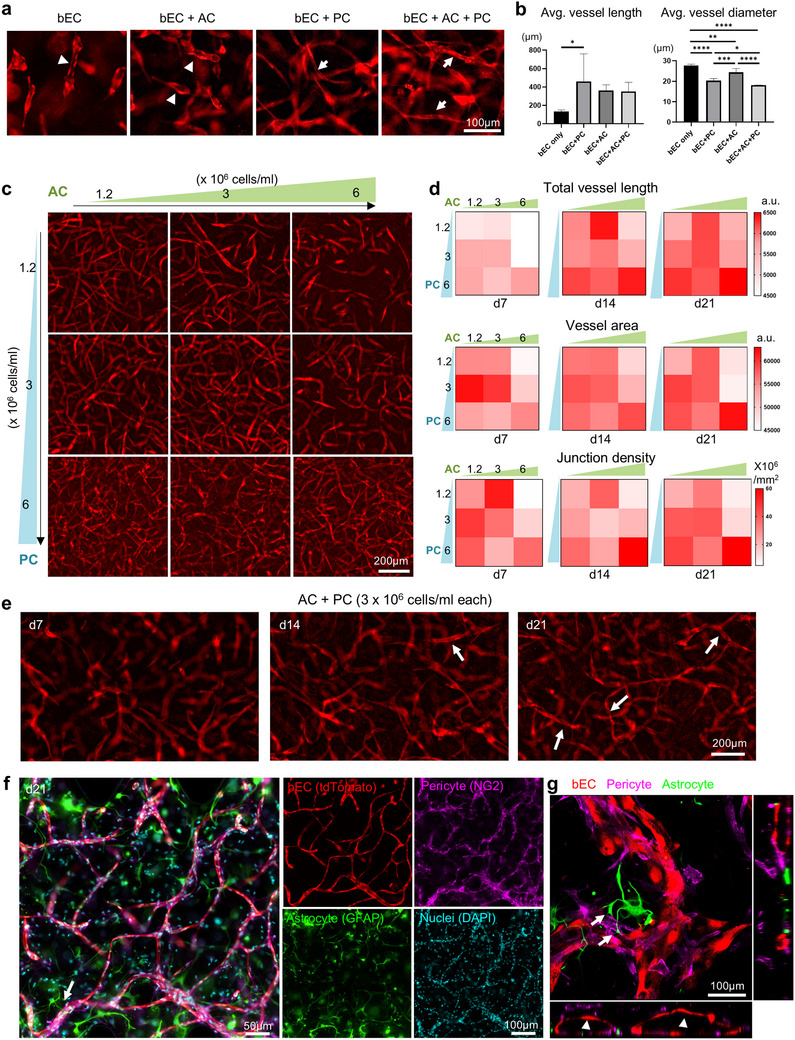
Optimization of a 3D brain vascular niche model. a) Fluorescence live cell imaging of brain endothelial cells (bEC, tdTomato+), cultured alone in 3D gel or together with astrocytes (AC), pericytes (PC), or both at 14 days of culture. The bEC were seeded at a density of 6 × 10⁶ cells/ml and AC and PC at 3 × 10⁶ /ml. Note that bEC cultured alone or with AC only tended to form vacuoles that were not interconnected (arrowheads), while co‐culture with PC, and more so with both AC and PC, led to the formation of interconnected vessels (arrows). b) Average vessel length and average vessel diameter quantified in 3D cultures across different seeding concentrations of pericytes (PC) and astrocytes (AC). Data represent mean ± SD. n = 4–6 per condition. Statistical analysis was performed using one‐way ANOVA with Tukey's post hoc test. * P ≤ 0.05, ** P ≤ 0.01, *** P ≤ 0.001, **** P ≤ 0.0001. c) Representative images of vascular development of bEC (tdTomato+) in 3D gel when cultured with increasing seeding densities of AC and PC. d) Quantifications of total vessel length and vascular area in cultures with different seeding densities of AC and PC. n = 4–12 for each condition. e) Time course of formation of interconnected vascular development of bECs (arrows) from culture day 7 to day 21, with AC and PC seeded at 3 × 10⁶ cells/ml each. f) Co‐immunofluorescence imaging of day 21 culture shows juxtaposition of PC (NG2+) with bEC (tdTomato+). Note AC (GFAP+) extending endfeet (arrow) toward vasculature. DAPI for nuclei staining. g) Orthogonal view from different planes (x/y, x/z or y/z) of the confocal microscope images of the 3D vascular niche showing lumen formation (arrowhead) and astrocyte endfeet (arrows) contacting the vasculature. Pericytes (PC, NG2⁺), brain endothelial cells (bEC, tdTomato⁺), and astrocytes (AC, GFAP⁺) are shown.
We next fine‐tuned the seeding densities of astrocytes and pericytes, testing different combinations of density for each cell type to further optimize vascular network formation (Figure 1c,d). We found that high seeding density of astrocytes (6 × 10⁶ cells/ml, referred to as AC6) led to considerable gel degradation and collapse of the 3D structure over time, suggesting their active role in extracellular matrix remodeling. This rapid degradation led endothelial cells to prioritize proliferation and migration over vascular structure formation. However, co‐seeding with a high density of pericytes mitigated this effect, highlighting a complex interplay between cell types in regulating matrix remodeling and maintaining structural integrity. The optimal balance of cell densities enabled sufficient matrix degradation to support cell migration and network formation while preserving the 3D structure essential for robust vascularization over a 21‐day culture period. Increasing the seeding density of pericytes resulted in progressively longer vessel lengths, but a mid‐range concentration (3 × 10⁶ pericytes/mL, denoted as PC3) achieved a larger total vascular area on Day 7. The highest astrocyte concentration (6 × 10⁶ astrocytes/mL, AC6) led to poor vessel length, area, and junction density early on (Day 7), unless balanced with an equal ratio of pericytes (PC6). The highest total vessel length, vascular area, and junction density were observed with the greatest number of supporting cells (PC6‐AC6). Five different combinations of seeding density combinations (PC1.2‐AC3, PC3‐AC1.2, PC3‐AC3, PC6‐AC1.2, PC6‐AC3) produced similarly high levels of vessel length, vascular area, and junction density, comparable to the PC6‐AC6 condition at day 21 (Figure 1d; Tables S1‐S3, Supporting Information), each with distinct vessel density and uniformity (Figure 1c). For subsequent studies, we selected PC3‐AC3 (3 × 10⁶ cells/mL for both pericytes and astrocytes) as the optimal seeding density, as it consistently yielded well‐branched, interconnected hollow tube structures after 14–21 days of culture (Figure 1e). This condition balanced vascular robustness with cell efficiency, minimizing cell usage per experiment while maintaining a well‐structured vascular network. Immunofluorescence staining further demonstrated perivascular localization of pericytes, with astrocytic endfeet extending to contact lumenized blood vessels (Figure 1f,g; Video S1, Supporting Information), resembling the 3D cytoarchitecture of human brain microvascular network.
2.2. 3D Brain Vascular Niche Model Enables Long‐Term Culture of Patient Derived GBM Stem Cells with Distinct Invasion Patterns
To model GBM invasion, we compared 2D and 3D culture systems for long‐term sustainability and capability to capture distinct infiltrative behavior of GBM cells (Figure 2a). For the 3D models, we further compared seeding GBM cells as dispersed cells or as spheroid aggregates, either in 3D fibrin hydrogel alone (3D G) or in the optimized 3D human brain vascular niche model containing also astrocytes, pericytes, and bECs (3D GAPE) (Figure 2b). Two patient‐derived GBM stem cell (GSC) lines were tested (SD2 and SD3), characterized as proneural and mesenchymal GBM transcriptional subtypes, respectively.[ 22 , 23 ]
Figure 2.

3D GAPE model recapitulates GBM invasion patterns as observed in vivo. a) Schematics of 3D GBM model fabrication with GBM cells seeded either in dispersed or spheroid fashion, together with astrocytes, and brain‐derived pericytes and endothelial cells (EC). Formation of a brain vascular network within the 3D structure with close interaction with GBM cells occurred over 3 weeks of culture. b) Examples of SD2‐patient derived GBM stem cells (expressing GFP) in various 2D or 3D cultures or in intracranial in vivo transplant in SCID mice. For the 3D gel model, an increased amount of matrix was used to sustain 3D gel model for over 2 weeks of culture. c) Immunofluorescence images of patient derived GBM stem cells (GFP+) seeded in different 3D culture conditions in dispersed or spheroid fashion, as compared to in vivo intracranial transplants (human nuclear antigen+ in tumor edge, or GFP+ in bulk+edge). Both SD2 and SD3 exhibited similar growth patterns in the 3D G condition, but distinctive invasion patterns in the 3D GAPE model, with SD3 showing stronger vascular association, resembling in vivo invasion at tumor margin. Vasculature was visualized by tdTomato+ ECs in 3D GAPE model or by staining for PECAM1 for in vivo model. d) Quantification shows a higher fraction of SD3 GSCs associated with vasculature in the dispersed 3D GAPE model (day 21) compared to SD2 GSC. Unpaired two‐tailed Student's t test, n = 4 independent cultures for each condition. Data represent mean ± SD. e) Quantifications show higher total vessel length and vessel area for dispersed 3D GAPE model with SD3 GSCs compared to 3D GAPE with SD2 GSC (day 21). Unpaired two‐tailed Student's t test, n = 16 independent cultures for each condition. Bar graphs represent mean ± SD. f) Quantifications show differences in sizes of aggregates of SD2 and SD3 GSC in dispersed 3D GAPE model, but not in dispersed 3D G model. One way ANOVA with Tukey's post hoc test. n = 2 independent cultures for 3D G, n = 4 independent cultures for 3D GAPE. Bar graphs represent mean ± SD. g) Fluorescence images show growth pattern of human GBM cell line U87MG (GFP+) seeded as dispersed or spheroid cells in different 3D models or in in vivo intracranial transplant. Note that U87MG expanded as bulk mass without invasive pattern both in 3D and in vivo models. h) Orthogonal views from different planes (x/y, x/z, or y/z) of confocal images of the 3D GAPE model showing lumen formation (arrowhead) and SD3 GSCs (arrows) positioned near the vasculature.
In the dispersed 3D G model without vasculature, both SD2 and SD3 GSCs formed small tumor clusters with limited individual cell migration or morphological differences between the two (Figure 2c; Dispersed). However, when cultured in the dispersed 3D GAPE model, we detected morphological variations, with SD3 displaying a stronger vascular association than SD2 (Figure 2c,d). This recapitulated in vivo migratory behaviors in intracranial transplants wherein both GSC lines displayed aggressive invasion but SD3 showed a preference for vascular association (Figure 2c). Another noticeable difference between the two GSC lines in the 3D GAPE model was an enhanced vessel development for SD3 as compared to SD2, measurable by both longer total vessel length and larger vascular area (Figure 2e). To further visualize the vascular interaction of SD3, we performed confocal imaging, which confirmed the formation of lumenized vasculature in close proximity to infiltrating SD3 cells (Figure 2h; Video S2, Supporting Information), illustrating direct spatial association between the tumor cells and vascular structures within the 3D niche. Aside from differences in vascular association and development, SD3 also showed a propensity for individual cell invasion in the dispersed 3D GAPE model, in contrast to the collective migration favored by SD2 (Figure 2c,f). Quantification of the size of GBM cell clusters confirmed a significant difference between SD2 and SD3 in collective versus individual cell invasion in the 3D GAPE model, a phenotypic difference not captured in the 3D G model (Figure 2f).
When cultured as GBM spheroids in the 3D G model, both SD2 and SD3 exhibited aggressive invasive migration from the spheroid edge, thus offering a clearer readout of invasiveness than the dispersed model with GBM cells scattered throughout the 3D cultures (Figure 2c; Spheroid). However, by day 21, most of the gel structures of the spheroid 3D G model had been degraded by the GBM cells (Figure 2c), and more volume of fibrin matrix was needed to maintain a 3‐week culture. In contrast, in the spheroid 3D GAPE brain vascular niche model, matrix degradation was minimal and individual GBM cell invasion from the spheroid edge was clearly detected. Similar to the dispersed 3D GAPE model, in the spheroid 3D GAPE model we also observed a more robust vascular association of SD3 than SD2, again recapitulating the in vivo perivascular migratory behavior of SD3 (Figure 2c). Together, these data support the advantage of the 3D GAPE over the 3D G system to model GBM invasion, for both dispersed and spheroid models, with the capacity to reveal morphological differences between different patient GSC lines, including association with brain vasculature and collective versus individual cell migration.
To further confirm the capability of our 3D GAPE model to capture in vivo GBM invasion behavior, we also compared GSC with U87MG cells, a widely used human GBM cell line that expands as a bulk mass tumor rather than by infiltrative growth.[ 24 ] Indeed, mirroring the in vivo bulk growth mode in intracranial transplants, when seeded in 3D GAPE, U87MG cells expanded as a spheroid mass without infiltration along vasculature (Figure 2g). Of note, in the 3D GAPE model, U87MG cells markedly suppressed vascular formation surrounding the GBM spheroid (Figure 2g).
2.3. GBM Cells in 3D Vascular Model and In Vivo Transplants Share Gene Signatures Featuring Neural/Glial Interactions
Interactions with the TME can induce profound transcriptional changes in GBM cells. We therefore investigated next how GBM cells adjust gene expression in response to different culture conditions as compared to the in vivo transplant paradigm. To this end, we isolated SD2 and SD3 cells from 2D and 3D culture models and from in vivo intracranial transplants and conducted RNA‐sequencing with three independent samples for each condition (Figure 3a; Figure S3a, Supporting Information). For the 3D GAPE model, GBM cells were isolated from other cells by FACS for GFP fluorescence, and for in vivo transplants, GBM cells were separated from stromal cells by FACS using an antibody against human leukocyte antigen (HLA) (Figure S3b, Supporting Information). Quantitative qRT‐PCR analysis for CDH5 (VE‐Cadherin), an EC marker, confirmed absence of its expression in all the GBM cell samples (Figure S3c, Supporting Information).
Figure 3.

Comparative transcriptomics reveal shared differentially expressed genes in 3D GAPE and in vivo featuring neural/synaptic regulation and immunosuppression. a) Schematic of RNA sequencing analyses of GBM cells grown in different in vitro conditions (2D, 3D G, 3D GAPE) or in vivo intracranial transplants. GBM cells from 3D GAPE or in vivo transplants were isolated by FACS for GFP+ cells or HLA+ cells, respectively. in vivo model schematics created with BioRender. b) Venn diagram illustrating overlap of differentially expressed genes (DEGs, cutoff: P<0.05 and |log2fold change| >2) in GBM cells from different conditions relative to 2D. c) Heatmap of expression of genes in top GOs enriched in upregulated DEGs shared by 3D GAPE and in vivo relative to 2D, across all four conditions (2D, 3D G, 3D GAPE, in vivo). d) Network plot of enriched GO of shared upregulated DEGs of 3D GAPE and in vivo conditions relative to 2D. Circular nodes depict GO Biological Process, while hexagonal nodes indicate GO Cellular Component. e) GO Enrichment Analysis of shared DEGs of 3D GAPE and in vivo relative to 2D, separated into up‐ and down‐regulated DEGs. f) Enrichr analysis of shared DEGs, separated into up and downregulated genes in 3D GAPE and in vivo relative to 2D. g) Summary depiction of gene adaptation of GBM cells in 3D GAPE and in vivo featuring neural/synaptic regulation and immunosuppression.
We first identified differentially expressed genes (DEGs) of combined SD2 and SD3 GSCs in different 3D and in vivo models versus 2D condition (Figure S4a, Supporting Information). This revealed that GBM cells in vivo harbored the highest number of DEGs relative to 2D, with more down‐regulated than up‐regulated genes (Figure 3b). This was followed by 3D GAPE and 3D G as a distant third. Intersection analysis revealed far more common DEGs shared between in vivo and 3D GAPE than between in vivo and 3D G (Figure 3b). Hence, the numbers of DEGs and a large overlap between 3D GAPE and in vivo support a better biomimetic environment conferred by 3D GAPE than the simpler 3D G model in recapitulating GBM transcriptomic adaptations.
Remarkably, the DEGs shared between 3D GAPE and in vivo relative to 2D were mainly associated with central nervous system (CNS) functions (e.g., Neurogenesis, Nervous system process, Gliogenesis) and Response to hormone (Figure 3c). Core network analysis of these common DEGs further highlighted Neuron projection, Dendritic tree, Ensheathment of neurons, Regulation of system process, and Regulation of ion transport as the main themes (Figure 3d). The comparative transcriptomic data thus illustrate an instructive role of the brain glia‐vascular unit (containing astrocytes, brain pericytes, and brain ECs) in inducing gene programs in GBM cells for neural interactions and synaptic regulation, despite the absence of neurons in the 3D GAPE model.
We next analyzed the up‐ and down‐regulated common DEGs separately. Enrichr gene ontology (GO) enrichment analysis revealed that, as compared to 2D condition, the environments in 3D GAPE or in vivo induced genes related to neuronal development (i.e., axon development, neuron cell‐cell adhesion, peripheral nervous system development), glial cell differentiation and myelination (i.e., ensheathment of neurons, axon ensheathment, myelination), and regulation of synapse structure or activity (Figure 3e; Figure S4b, Supporting Information). In echo, Enrichr analyses further showed that the shared up‐regulated DEGs between 3D GAPE and in vivo were highly enriched for pathways concerning neuronal interactions and nervous system development (Figure 3f). By contrast, the shared down‐regulated DEGs largely concerned immune signaling (e.g., regulation of B cell receptor signaling pathway, regulation of antigen receptor‐mediated signaling pathway, regulation of neutrophil migration), in accordance with the well‐known immunosuppressive status of GBM (Figure 3e,f). Together, these initial comparative transcriptomics data showcase the biomimetic nature of our 3D GAPE microenvironment in inducing gene programs featuring neural/glial interaction as well as immunosuppression (Figure 3g).
2.4. Shared Gene Signatures of GBM Cells in 3D Vascular Culture and In Vivo Predict Poor Outcome for GBM Patients
We further analyzed the upregulated DEGs shared by GBM cells in 3D GAPE and in vivo, which were associated with 5 top enriched GO categories (ranked by gene ratio) related to axon development, axon ensheathment, glial cell differentiation, ensheathment of neurons, and regulation of nervous system process (Figure 4a,b). For instance, the shared DEGs included UNC5A, MGARP, MT3, KIAA1755, NCAM2, CSPG5, EGR2, NR4A2, S100B, DOBL, ARK2C, genes that are linked to axon development. The shared DEGs also included NTRK3, LAMC3, SOX8, ERBB3, OLIG1, LGI4, TLR2, OLIG2, KCNJ10, CSCR4, ADGRG6, CLDN11, MPZ, GAL3ST1, genes related to ensheathment of neurons, glial cell differentiation and/or axon ensheathment. Genes linked to the regulation of nervous system process such as CACNG4, GRIN2D, AVPR1A, NOS3, IGSF11, OPRD1, DLGAP1, CACNG5, EDNRB were also included in the shared DEGs. CSPG5, MT3, PLP1, PTPRZ1, MBP, EGR2, IL33, LGI4, TLR2, OLIG2, CXCR4, CLDN11, MPZ, GAL3ST1, NLGN3, NRXN1 were genes concurrently associated with more than two categories mentioned above (Figure 4a,b; Table S4, Supporting Information). Altogether, GBM cells adapted gene expression for neural/glial interactions in response to the biomimetic glia‐vascular niche environment provided by our 3D GAPE model.
Figure 4.

Shared GBM gene signatures of 3D GAPE and in vivo are expressed at distinct zones of human GBM and predict poor survival. a,b) Gene‐concept network depiction of 5 top enriched GOs (ranked by p‐value) of the upregulated DEGs in 3D GAPE and in vivo relative to 2D (n = 409). The layout displays the relationships between significantly enriched GO terms (colored nodes with predicted biological functions) and their associated genes. c,d) Heatmap and quantification of the expression of 43 (of 50) top upregulated DEGs shared by 3D GAPE and in vivo relative to 2D in different zones of human GBM patient samples (Ivy GAP database). Note significantly higher expression of the shared DEGs in leading edge and infiltrating tumor zones, as well as microvascular proliferation zone. Mean expression scores for the 43 top shared DEGs across GBM tumor zones, normalized to the Cellular tumor (CT) zone. One‐way ANOVA, followed by Tukey's post hoc test. n = 270 specimens (n = 19‐111 for each zone) in the Ivy GAP database. Data represent mean ± SD. Note that only 43 of the top 50 genes were represented in Ivy GAP database. e) Top 50 shared upregulated DEGs of 3D GAPE and in vivo were applied for cluster analysis of the TCGA GBM Biodiscovery portal. f) Prognostic index based on expression of 50 upregulated shared DEGs from 3D GAPE and in vivo in human GBM patients, shown for GBM in total and for individual transcriptional subtypes.
To assess the clinical significance of the shared DEG signature common to 3D GAPE and in vivo, we selected the top 50 upregulated genes ranked by P values and examined their expression pattern in human GBM by surveying the Ivy Glioblastoma Atlas Project, which contains region‐specific gene expression data of human glioblastoma[ 25 ] (Figure 4c). Strikingly, we found that the top 50 shared upregulated DEGs were significantly enriched in the tumor zones “leading edge”, “infiltrating tumor”, and “microvascular proliferation”, as compared to regions of GBM interior (“cellular tumor”, “perinecrotic zone”, “pseudopalisading cells”) (Figure 4c,d).
We next surveyed the TCGA GBM Biodiscovery Portal[ 26 ] for patient survival data, and found that the shared gene signature of 3D GAPE and in vivo was associated with poor prognosis for GBM patients, which was applicable to all three transcriptional GBM subtypes (Figure 4e,f). These data underscore the clinical importance of the gene programs induced by glia‐vascular contact to support neural/glial interactions and malignant potency of GBM.
2.5. Variable Genes Across GBM Models Involve Histone Demethylation in Response to 3D Glia‐Vascular Culture and In Vivo Environment
We next studied the variance of gene signatures of GBM cells in different conditions. Principal component analysis (PCA) revealed a clear distinction between SD2 and SD3 samples, consistent with the marked intertumoral heterogeneity of GBM (Figure 5a). For both SD2 and SD3, the in vivo samples were distinctly separated from all three in vitro conditions, but distance to in vivo condition was closer for samples from 3D GAPE than from 2D and 3D G conditions (Figure 5b).
Figure 5.

Variable genes highlight histone demethylation for epigenetic adaptation as a main theme shared by GBM cells in 3D brain vascular niche model and in vivo. a) Principal component analysis (PCA) of RNA‐seq samples show separation of in vivo samples from in vitro samples for both SD2 and SD3, but 3D GAPE samples being closest to in vivo samples on PC1 axis than other culture conditions. b) Spearman correlation distances of cluster gene expression profiles between different in vitro conditions and in vivo samples (SD2 and SD3 combined), based on the top 1000 most variable genes. Distances were calculated using hierarchical clustering. Violin plots show median, quartiles, and minimum and maximum values. One‐way ANOVA, followed by Tukey's post hoc test. c) Left, unsupervised clustering of expression of top 1000 most variable genes across SD2 and SD3 combined samples in different conditions. Right, enriched GOs of top 1000 variable genes, separated into up and downregulated genes. d) Gene ontology enrichment analysis of top 50 most closely correlated genes of GBM cells in 3D GAPE and in vivo conditions highlight epigenetic adaptations by histone demethylation as the main biological theme. e) Top variable GO ontology terms across samples, based on geneset databases of brain regions and neural stem cells, as well as genesets associated with tumor propagation and GBM stemness.
The transcriptional distinction between in vivo and in vitro conditions was further illustrated by a heatmap of relative expression of the top 1000 variable genes across samples (Figure 5c). Notably, as compared to 2D or 3D G, the gene profile of 3D GAPE GBM cells appeared more similar to in vivo. Intriguingly, among the top variable genes, upregulated genes prominently concerned histone demethylation (for both H3‐K27 and H3‐K9) (Figure 5c). Another top enriched GO term for the top upregulated variable genes was xylosyltranferase activity (Figure 5c), which is linked to post‐translational modification of proteoglycans such as CSPG with a major role in modulation of tumor biology.[ 27 ] The top downregulated variable genes in vivo concerned cytoskeletal dynamics (e.g., Arp2/3 complex‐mediated actin nucleation, integrin‐mediated signaling pathway, actin nucleation), autophagy and endosome processes (Figure 5c).
As another sign of a biomimetic microenvironment provided by our vascular niche model for GBM cells, the top 50 closest genes between 3D GAPE and in vivo paradigm were enriched for GO categories of histone demethylation and protein localization to endosome (Figure 5d). We next further analyzed top variable GO terms across conditions, which revealed that the in vivo TME strongly induced genes linked to the nervous system (Brain regions, Jensen TISSUES database), in particular, frontal lobe, cerebral cortex, ganglion, and notably cerebral white matter, with 3D GAPE environment again most closely following this trend as compared to 2D or 3D G (Figure 5e). The in vivo condition also strongly induced genes related to neural stem cell biology, tumor‐propagation, and GBM stemness, including SOX2, OLIG2, CD133, GFAP, MAP2, NESTIN, FUT4, KLF4, LICAM, CD44, as well as tyrosine kinase receptors (EGFR, PDGFRA), all of which were not induced in 3D GAPE condition, highlighting a remaining gap between in vivo and in vitro paradigms (Figure 5e). This also signifies a potential important impact of neuronal interactions on gene adaption for GBM stemness. Despite the absence of neurons in the 3D GAPE model, several neural stem cell markers such as NES and MYC, as well TUBG1 (encoding tubulin gamma 1, involved in neuroprogenitor migration[ 28 ]) were similarly induced in 3D GAPE and in in vivo. Likewise, as in in vivo, GBM cells in 3D GAPE also induced HEY2, a transcription factor of the Notch pathway, and chemokine receptor CXCR4, both linked to malignant potency of GBM[ 29 , 30 ] (Figure 5e).
2.6. The 3D Vascular Model Maintains a Quiescent Niche with Protective Role Against Chemotherapy
The vascular niche has been suggested as a key regulator of glioblastoma stem cells, with potential impact on GBM stem cell quiescence.[ 31 , 32 ] To assess the capacity of our model to maintain a quiescent niche for GBM cells, we leveraged a doxycycline (Dox) inducible histone 2B (H2B)‐GFP quiescence reporter that we had previously developed,[ 23 ] with quiescent or slow dividing cells retaining nuclear GFP signals while fast dividing cells lose the H2B‐GFP signals over time (Figure 6a). We induced H2B‐GFP expression in GSC by Dox pulse from 7 days prior to seeding until 3 days after, and GFP signals were tracked during the following ‐Dox chase period until day 23 (Figure 6b). While the initial GFP label retention patterns appeared similar across culture conditions at day 7, by days 15 and 23, the GFP signals had largely disappeared in 2D G and 3D G condition; by contrast, we detected a significant amount of H2B‐GFPhigh signal (≈6–15% of GBM cells) in the 3D GAPE condition (Figure 6c,d). These numbers are comparable with the relative abundance of quiescent GBM stem cells in in vivo orthotopic PDX GBM samples, as determined by single cell sequencing.[ 33 ] Notably, quiescent GBM cells appeared to cluster together in perivascular niches (Figure 6e).
Figure 6.

The 3D brain vascular model supports GBM quiescence niche. a) Schematic of doxycycline (Dox)‐induced expression of histone 2B(H2B)‐GFP and progressive dilution of H2B‐GFP label in proliferative cells during ‐Dox chase phase, while quiescent cells retain H2B‐GFP label. b) Experimental timeline of H2B‐GFP induction (+Dox) and subsequent ‐Dox chase of GBM cell culture. c) Fluorescence images of GBM cells in different culture conditions on day 3 and day 23. Note that day 3 was the last day of Dox pulse and day 23 was after 21 days of ‐Dox chase. d) Quantification of GFPhigh fluorescent areas across culture conditions and culture periods. Note that GBM cells in 3D GAPE maintained a significantly higher amount GFPhigh quiescent cells than other culture conditions. One‐way ANOVA, followed by Tukey's post hoc test. n = 3 independent cultures for each condition. Bar graphs represent mean ± SD. e) Two representative immunofluorescence images show aggregation of H2B‐GFPhigh quiescent GBM cells in close proximity to vasculature at day 14. f) Top left, timeline of H2B‐GFP induction (+Dox) and treatment with chemodrug temozolomide (±TMZ) of 3D cultures from day 7 to day 21. Fluorescent images and quantification show significantly more H2B‐GFP label‐retaining GBM cells in 3D GAPE than in 3D G cultures at day 21, which survived even after TMZ treatment. One‐way ANOVA, followed by Tukey's post hoc test. n = 4 independent cultures for each condition. Bar graphs represent mean ± SD.
Quiescent GBM cells carry higher resistance to chemotherapy, which targets mostly proliferative cells.[ 34 ] For drug resistance studies, we administered from day 7 to day 21 during the Dox chase period temozolomide (TMZ), an alkylating chemo drug used as standard care for GBM patients (Figure 6f). We observed that 3D GAPE maintained a similarly high number of H2B‐GFPhigh quiescent cells after two‐week TMZ treatment as in vehicle‐treated condition, demonstrating the chemodrug resistance of quiescent GBM cells (Figure 6f). Hence the 3D GAPE microenvironment maintains a quiescent and also protective niche to resist chemotherapy.
3. Discussion
In this study, we optimized a biomimetic 3D brain vascular niche model for studying GBM, a highly aggressive brain cancer. The model incorporates key components of glia‐vascular units with human‐sourced brain mural cells and endothelial cells. Direct comparison of patient derived GSC lines across 2D and 3D models with the in vivo intracranial transplant paradigm demonstrated capability of our model to capture key features of GBM heterogeneity such as invasion behavior and vascular association, gene reprogramming, as well as capacity to maintain a quiescent niche for GBM cells and protection against chemotherapy.
Creating a reproducible and sizable 3D environment for GBM modeling faces major challenges, particularly in maintaining long‐term matrix integrity. Our studies reveal that traditional 3D GBM spheroid cultures degrade the matrix rapidly, necessitating a large volume of matrix to sustain the culture.[ 35 ] By reducing the seeding density of GBM cells and employing a dispersed model, we mitigated matrix degradation issues. By contrast, the 3D GAPE model allowed long term culture of patient derived GSCs without significant matrix degradation, thus providing a stable and biomimetic microenvironment for long‐term study of tumor cell behavior, gene adaptation, and drug response. For instance, SD3 displayed a predilection for vascular association than SD2, detectable in both 3D GAPE and in orthotopic PDX in vivo models, but not in 3D G condition.
Despite the importance of cellular composition in the brain vascular niche, there is currently no consensus on the optimal seeding density or ratio of astrocytes, pericytes, and endothelial cells, both in vivo and in vitro. Single‐cell transcriptomic studies have identified varying proportions of these cell types, with pericytes comprising ≈32%, endothelial cells 44%, and astrocytes 7% of brain vasculature.[ 36 , 37 ] Additionally, pericyte‐to‐brain microvascular endothelial cells (BMEC) ratios have been reported in the range of 1:1 to 1:3, while astrocytes are known to cover 99% of the brain basement membrane.[ 38 , 39 ] Similarly, in vitro blood‐brain barrier (BBB) models have employed diverse ratios, ranging from 1:1:1 to 1:1:10 (astrocytes:pericytes:endothelial cells),[ 40 , 41 , 42 , 43 , 44 ] reflecting the variability in experimental approaches. While our model does not strictly replicate in vivo cellular distributions, it prioritizes functional vascularization over exact ratios, making it a valuable tool for studying glioblastoma‐endothelial interactions. The gene expression results obtained from our model remain translationally relevant, as they provide insights into tumor‐endothelial and tumor‐glial interactions in an environment that supports stable vascular structures. Future refinements could explore optimizing cell ratios to further enhance in vivo relevance while preserving the functional integrity of the vascular niche.
We compared three different human GBM cells: patient‐derived SD2 and SD3 cells with stemness characteristics, representing proneural and mesenchymal GBM subtypes, respectively,[ 23 ] and the U87MG cell line. This provided compelling results on the capability of our 3D brain vascular niche model to recapitulate key features of GBM intertumoral heterogeneity, including invasion behavior (collective migration vs single cell infiltration vs no invasion), vascular association, and transcriptional changes in response to TME. The ability to directly compare our 3D model with both 2D culture and in vivo PDX model using identical GBM cells is particularly valuable, as it showcased the strengths and limitations of each system and allows us to rigorously validate our in vitro findings against in vivo data. This is a significant advantage over models that rely solely on in vitro characterization.
Remarkably, comparative transcriptomics across culture conditions versus in vivo unveiled a previously unappreciated influence of brain glia‐vascular unit (consisting of astrocytes, brain pericytes and brain EC) in gene adaptation of GBM cells that featured neurogenesis, glial differentiation, and nervous system processes. Intriguingly, despite the absence of neurons or immune cells in the 3D vascular model (inclusion of neuron and immune cells will be a future research direction), the GBM gene signature shared by 3D GAPE and in vivo conditions highlighted synaptic regulation and immunosuppression. This insight may provide a new therapeutic angle by way of targeting tumor vasculature to disrupt the malignant connection between GBM cells and neuronal network. This is particularly relevant given recent findings that neuronal activity promotes GBM proliferation and progression.[ 45 ] It may also provide an alternative strategy to counter the immunosuppressive state that is notorious for GBM, based on our findings that contact of GBM cells with glia‐vascular units triggered downregulation of immune signaling genes. Indeed, the gene signatures shared between 3D GAPE and in vivo showed a regional enrichment in specific zones of human GBMs, in particular leading edge, infiltrating tumor, and microvascular proliferation zones, and predicted poor survival for GBM patients, thus further supporting clinical relevance of our model for understanding malignant potency of GBM.
Various biomaterial hydrogels have been developed to mimic the brain microenvironment for GBM cell culture. Previous studies with collagen‐hyaluronic acid hydrogels highlighted the roles of cell‐cell interactions and ECM components in tumor progression.[ 46 , 47 ] Recent advancements have further demonstrated how ECM signals influence drug response,[ 48 ] perivascular cues regulate gene expression and chemotherapy resistance,[ 49 , 50 ] microenvironmental stiffness drives metabolic reprogramming,[ 51 ] and hyaluronic acid‐CD44 interactions mediate GBM invasion.[ 52 ] Among these factors, the mechanical properties of hydrogels, particularly matrix stiffness, are known to influence GBM cell behavior and gene expression.[ 51 , 53 ] Building on these findings, we characterized the mechanical properties of our fibrin‐based hydrogel system. The Young's modulus of our fibrin hydrogel (10 mg mL−1 fibrinogen) was measured at 17.19 ± 3.53 kPa, aligning with the reported stiffness of GBM tumor cores (5–12 kPa)[ 20 , 21 , 51 ] but exceeding that of normal brain tissue (1–2 kPa).[ 54 ] While this stiffness and the presence of fibrinogen contribute to some of the cellular behaviors observed, our results showed that hydrogel alone (3D G) was insufficient to recapitulate a representative tumor microenvironment. The 3D G model failed to reproduce key in vivo GBM gene signatures and cellular phenotypes, suggesting that factors beyond matrix mechanics are critical in shaping GBM behavior. Although fibrin is primarily associated with the vasculature, they are also present in the GBM microenvironment. Fibrinogen is enriched in GBM tissues and has been linked to tumor cell adhesion, motility, and matrix remodeling.[ 55 ] Moreover, the increased vascular permeability characteristic of GBM allows fibrinogen and thrombin to extravasate into the tumor microenvironment, where they may contribute to tumor progression and angiogenesis.[ 56 ] Including fibrin in our model may help capture some of these microenvironmental features, which could enhance its relevance for studying GBM invasion and vascular interactions.
Our results underscore the importance of a cellular microenvironment in dictating GBM phenotypes. The incorporation of brain‐specific cells in our 3D GAPE model likely plays a crucial role in providing a more physiologically relevant microenvironment, influencing cellular behavior and gene expression in ways that cannot be attributed to matrix properties alone. Future studies could explore gradient hydrogels or multi‐material systems to better mimic the heterogeneous stiffness of GBM tumors and further refine in vitro models. To address the cellular components, earlier studies predominantly relied on human umbilical vein endothelial cells (HUVECs) and endothelial cells from other sources.[ 57 , 58 , 59 ] Recently, brain relevant vascular cells have been introduced to construct GBM models.[ 49 , 50 , 60 , 61 , 62 ] However, most prior studies focused on in vitro characterization but did not compare gene signatures induced in the in vivo condition using the same patient‐derived cells. While some studies utilize brain‐specific cells,[ 63 , 64 , 65 , 66 , 67 ] they often lack the comprehensive in vivo validation that is a hallmark of our approach. We employed here brain‐specific cells to construct a 3D vascular niche model, as brain ECs display unique functional features.[ 68 , 69 ] The use of all brain‐sourced human cells may be crucial to induce gene reprogramming concerning nervous system processes, which we observed in our transcriptomic analysis. This is a key distinction from other models that utilize non‐brain‐specific endothelial cells. Our transcriptomics studies comparing GBM cells across different in vitro and in vivo conditions is powerful in unveiling previously unrecognized gene pathways that prominently featured histone demethylation and xylosyltransferase activity. Future studies are needed to understand the functional significant of the epigenetic changes and post‐translational modification of proteoglycans such as chondroitin sulfate proteoglycan (CSPG) in GBM cells in response to TME.
Finally, utilizing GSCs engineered with a quiescence reporter, we demonstrated the capability of the 3D GAPE culture model to maintain a quiescent and a protective niche against chemotherapy, which was not observed in 2D G and 3D G models. TMZ treatment in 3D GAPE resulted in an almost intact GFPhigh area, suggesting that the quiescent cells may be the predominant population that display chemo‐resistance. Further isolating and characterizing this cell population may reveal important molecular mechanism of dormancy and therapeutic resistance. Our 3D GAPE in vitro model not only offers a platform for investigating GBM pathophysiology but can also serve as a customizable tool for drug discovery and studying vascular interactions, such as blood‐brain barrier (BBB) function.[ 70 ] Future directions would also incorporate neurons and immune cells in our models, which will be valuable to understand the network between malignant GBM cells and neuronal synaptic connectivity and immunosuppression mechanisms.
In summary, our study highlights the potential of an advanced 3D brain vascular niche model to serve as a bridge between traditional culture systems and animal‐based in vivo approaches in capturing GBM heterogeneity and providing a versatile and a more physiologically relevant platform to study GBM biology and advance drug discovery.
4. Experimental Section
Cell Culture
Fibrinogen and thrombin (Millipore Sigma) were dissolved in culture media or Dulbecco's phosphate‐buffered saline (DPBS) for 3D matrix fabrication. Temozolomide and doxycycline hyclate were purchased from Millipore Sigma. Human brain microvascular endothelial cells (Sciencell) were transduced with a lentivirus to express tdTomato fluorescent protein (Vectorbuilder) and were cultured in EGM‐2 media (Promocell or Lonza). Human astrocytes (Sciencell) and human brain vascular pericytes (Sciencell) were expanded and cultured in astrocyte medium (Sciencell) and pericyte medium (Sciencell), respectively.
De‐identified human GBM stem cell lines SD2 and SD3 had been established previously from glioblastoma patients at University of California, San Diego (UCSD).[ 23 ] Human tissue samples had been obtained from newly diagnosed glioblastoma patients under a UCSD Institutional Review Board approved study. All patients signed a written consent form approved by the Institutional Review Board. Patient‐derived glioblastoma stem cell lines SD2 and SD3 were transduced with GFP‐expressing lentivirus or were genetically engineered with a doxycycline‐inducible H2B‐GFP reporter[ 23 ] and cultured in laminin‐coated tissue culture flasks in complete NeuroCult NS‐A proliferation medium for human cells (Stemcell Technologies). U87MG cells (ATCC) were transduced with a GFP expressing lentivirus and cultured in Dulbecco's modified Eagle's medium (DMEM; Gibco) supplemented with 10% fetal bovine serum and penicillin/streptomycin. To create GBM cell spheroids, 1000 to 5000 GBM cells were plated into a Corning spheroid microplate and cultured for 5 to 10 days until spheroids reached the desired diameter of >400 µm.
Modelling of Brain Vascular Niche in 3D Culture
3D fibrin matrices containing varying numbers of brain endothelial cells (bEC), astrocytes (AC), and pericytes (PC) were prepared by the following method. Fibrinogen solution containing cells was prepared at a concentration of 20 mg mL−1 in warm EGM‐2 media. Thrombin solution was prepared in DPBS at a concentration of 6 IU/mL. The fibrinogen solution containing cells (20 µL) and thrombin solution (20 µL) were mixed through gentle pipetting and deposited on culture plates. The final seeding density of bEC‐tdTomato was 6 × 10⁶ cells/ml for all samples. The final seeding density of AC and PC were 1.2, 3, or 6 × 10⁶ cells/mL. The 3D samples were cultured in EGM‐2 media for 21 days. Live imaging was performed every 3–4 days using Nikon Eclipse Ti2 microscope to observe vessel growth over time. Quantification of vessel area and total vessel length were performed using ImageJ software. One way ANOVA was performed, followed by Tukey's post hoc test, for statistical analysis.
To establish a brain vascular niche incorporating GBM cells in dispersion, GBM cells were mixed into fibrinogen solution containing bEC, AC, and PC at a density of 25000 cells/mL. This mixture was then combined with the thrombin solution to facilitate crosslinking. For the GBM spheroid model, a GBM spheroid was placed into a culture plate well using a wide‐bore pipette tip, followed by the removal of excess liquid. The fibrinogen solution containing bEC, AC, and PC was mixed with the thrombin solution, and the resulting blend was injected beneath the GBM spheroid to elevate it slightly. As the fibrin crosslinked, the GBM spheroid sank and became positioned at the center of the 3D hydrogel structure. All 3D GBM‐vascular niche samples were cultured in EGM‐2 media for up to 21 days, with media changes occurring every 2–3 days. Live imaging was performed every 3–4 days using Nikon Eclipse Ti2 microscope to observe GBM cell growth/invasion within the vascular niche. Quantification of vessel area, total vessel length, junction density, and vascular association was performed using ImageJ and the AngioTool plug‐in. Built‐in ImageJ measurement functions were used to subtract background, set thresholding, and measure total vessel length, vessel area, and junction density to ensure consistent quantification across samples. No additional plugins beyond AngioTool and ImageJ's native tools were used. One way ANOVA was performed, followed by Tukey's post hoc test, for statistical analysis.
Measurement of Hydrogel Young's Modulus
The mechanical properties of the fibrin hydrogels were characterized using oscillatory rheology (TA Instruments Discovery HR‐3 rheometer) with a cone plate geometry fitted with 150‐grit sandpaper to prevent slippage. An amplitude sweep (0.01–200% strain) was first performed to identify the linear viscoelastic region (LVR), which was determined to be between 0.1% and 1% strain (Figure S1, Supporting Information). All subsequent measurements were conducted within this LVR at a constant angular frequency of 1 rad/s. For each hydrogel batch (n = 3), the storage modulus (G′) was recorded across the 0.1–1% strain range. The average storage modulus for each sample was calculated and used to estimate the Young's modulus (E) using the following relation:
| (1) |
where ν is the Poisson's ratio, assumed to be 0.5 for incompressible hydrogels.
In Vivo GBM Intracranial Transplant Model
All animal procedures were approved by the Institutional Animal Care Use Committee (IACUC; protocol no. IACUC‐2014‐0183) of Icahn School of Medicine at Mount Sinai. Adult 8‐week‐old ICR‐SCID mice (Taconic) were anesthetized with isoflurane (5% initial, then 1% continuous), and 2–3 × 10⁵ GBM cells (SD2 or SD3 GSCs) were injected into each the right and the left striatum of recipient mice with a microsyringe (Hamilton) attached to a stereotactic instrument (Stoelting) (coordinates: 2 mm right/left and 0.5 mm anterior of Bregma, 2 mm deep). Mice bearing SD2 transplant were euthanized after 18–19 weeks, and mice bearing SD3 transplants after 5–7 weeks, and brains were removed for further analysis.
FACS Sorting
For 3D G and 3D GAPE in vitro cultures, GFP‐expressing GBM cells were isolated by degrading the 3D matrix by a brief trypsin‐EDTA treatment and dissociation in accutase, followed by live sorting for GFP fluorescence using a BD FACSAria device (BD Biosciences) for subsequent RNA‐seq. After extracting total RNA from sorted cells, expression of CDH5 (VE‐cadherin) was determined via PCR to confirm absence of ECs in the sorted population. Human GSCs transplanted into mouse brain were isolated by dissociation of forebrain tissues with the Neural Tissue Dissociation kit (Papain; Milltenyi 130‐092‐628) and resuspended in FACS buffer (Hibernate‐E low fluorescence (BrainBits) with 0.2% BSA and 20 µg mL−1 DNase I (Worthington)) and passed through a 40 µm mesh filter into round‐bottom tubes (Falcon). To separate human GBM cells from mouse host cells, cell suspension was incubated with the human‐specific anti‐human leukocyte (HLA) antibody (abcam #ab70328), and HLA+ cells were collected with a FACSAria IIu device (BD Biosciences) for subsequent RNA‐seq (Figure S3b, Supporting Information).
RNA‐Seq and Bioinformatic Analyses of Transcriptomes
Total RNA was extracted using RNeasy mini kit (Qiagen) and cDNA libraries for sequencing were prepared using NEBNext Ultra II Directional RNA Library Prep Kit for Illumina (NEB #E7760; ≈50‐150 ng RNA input per replicate sample). RNA‐seq was performed at John Wayne Cancer Institute using Illumina HiSeq2500 (1 × 75 bp, 30 × 106 reads per sample).
Raw sequence reads from samples were mapped to the human genome (hg38) using HISAT2.[ 71 ] Counts of reads mapping to genes were obtained using HTSeq‐count software against Ensembl v90 annotation.[ 72 ] Differential gene expression analysis was performed with the DESeq2 package.[ 73 ]
Gene set enrichment analysis (GSEA) was performed using a pre‐ranked list of gene expression fold change (FDR‐corrected P<0.05) (http://software.broadinstitute.org/gsea/index.jsp). For the analysis of genes correlated with TCGA GBM data, the top 50 upregulated genes (ranked by p‐value) were analyzed using the TCGA GBM Biodiscovery Portal (glioma‐biodp.nci.nih.gov). Enriched GO analysis was conducted for each gene set using the enrichGO function from the clusterProfiler package, complemented by Enrichr GO for the same gene sets. Network plots were generated using Cytoscape, including those derived from the stringApp following enrichment analysis. Gene‐Concept Network plots showcasing the top categories from the enrichGO analysis were created using the enrichplot package. Expression z‐scores were calculated across sample conditions based on read counts for highly‐ranked GO terms from the upregulated gene set, as well as for tumor‐propagating[ 74 ] and stemness markers[ 75 , 76 , 77 , 78 ] identified from the literature. Principal component analysis (PCA) was performed utilizing the plotPCA function from the DESeq2 package. This was corroborated by Glimma MDS Plot and rlog‐transformed gene expression data. A heatmap of the most variable genes across samples was generated using complete linkage hierarchical clustering based on correlation distances, which were employed to create a violin plot showing distance to in vivo.
GSC Dormancy and Drug Treatment Resistance Assays
SD2 and SD3 H2B‐GFP GSCs cells were expanded in the presence of 1 µg mL−1 doxycycline for 14 days until for full expression of nuclear H2B‐GFP, then harvested for 3D sample fabrication. GSC cells were mixed in a fibrinogen solution containing cells at 25000 cells/ml. The fibrinogen solution was mixed with thrombin solution in 1:1 ratio, then deposited to culture plate before the crosslinking was completed. The fibrin crosslinking was achieved by mixing fibrinogen and thrombin solutions. Each sample was given EGM‐2 with 1 µg mL−1 doxycycline for Days 0–3. Doxycycline was removed for Days 4–21 to allow for dilution of H2B‐GFP signal by cell division (Figure 6a,b).
For the treatment resistance assay, control and treatment group samples were cultured in EGM‐2 media with doxycycline until Day 3, and afterwards without doxycycline. At Day 7, EGM‐2 media was supplemented with 1.25 mM temozolomide chemotherapeutic in treatment groups. The temozolomide treatment continued through Day 21. Live imaging was performed every 2–3 days using Nikon ECLIPSE Ti2 microscope. The quantifications of GFP signal were performed using ImageJ software. One way ANOVA was performed, followed by Tukey's post hoc test, for statistical analysis.
Immunofluorescence Staining
Immunofluorescence techniques were used to stain specific proteins at the conclusion of cell culture. Briefly, all samples were washed three times with PBS and fixed with 4% paraformaldehyde (Alfa Aesa) for 1 h at room temperature. Next, samples were washed three times with PBS and incubated with a blocking/permeabilizing (B/P) solution comprised of 10% normal goat serum (MP Biomedicals), 0.2% Triton X‐100 (Fisher Scientific), and 0.1 M glycine (Fisher Scientific) in PBS overnight at 4 °C. Samples were then incubated with primary antibodies in B/P solution overnight at 4 °C. PCs and ACs were stained with anti‐neural/glial antigen 2 (NG‐2) antibody (eBioscience, 14‐6504‐80, 1:100) and anti‐glial fibrillary acidic protein (GFAP) antibody (Invitrogen, PA1‐10019, 1:1000), respectively. After primary antibody incubation, samples were washed three times with PBS and then incubated with secondary antibodies and Hoechst 33342 (1:1000, Invitrogen) in B/P solution overnight at 4 °C. Afterwards, samples were washed three times with PBS and stored at 4 °C until needed.
Statistical Analysis
The analysis for each plot was outlined in the figure legends and/or the corresponding methods mentioned above. All grouped data were presented as mean ± standard deviation (SD), unless otherwise specified. P values were calculated using unpaired two‐tailed Student's t‐test or one‐way ANOVA, followed by Tukey's post hoc test. An alpha level of 0.05 was used to determine statistical significance. P values were reported numerically and/or denoted as follows: * P ≤ 0.05, ** P ≤ 0.01, *** P ≤ 0.001, **** P ≤ 0.0001. Kaplan‐Meier survival curves were generated, and log‐rank (Mantel‐Cox) analysis was conducted to produce P values. GraphPad Prism software was employed for statistical analysis and data visualization. Sample sizes for each experiment were specified in the corresponding figures and/or methods. For RNA‐seq analyses, expression values were z‐score normalized where applicable.
Data and Software Availability
All raw and selected processed data files were available on the NCBI Gene Expression Omnibus repository (GEO; accession number GSE270481). Reviewer access token: efmvoegqrfgfvyh
Conflict of Interest
The authors declare no conflict of interest.
Supporting information
Supporting Information
Supplemental Video 1
Supplemental Video 2
Acknowledgements
This work was supported by National Institutes of Health grants R01NS107462 (to H.Z., R.H.F., and G.D.), R21NS125700 (to H.Z. and R.H.F.), R01NS134159 (to H.Z.), R01NS092735 (to R.H.F.), and NASA 21–3DTMPS_2‐0037 (to G.D., H.Z., R.H.F.). Research reported in this publication was also supported by the National Cancer Institute Tisch Cancer Institute Cancer Center Support Grant (P30 CA196521).
Lee V. K., Tejero R., Silvia N., et al. “3D Brain Vascular Niche Model Captures Glioblastoma Infiltration, Dormancy, and Gene Signatures.” Adv. Sci. 12, no. 33 (2025): 12, e00689. 10.1002/advs.202500689
Contributor Information
Roland H. Friedel, Email: roland.friedel@mssm.edu.
Hongyan Zou, Email: hongyan.zou@mssm.edu.
Guohao Dai, Email: g.dai@northeastern.edu.
Data Availability Statement
The data that support the findings of this study are openly available in NCBI Gene Expression Omnibus at https://www.ncbi.nlm.nih.gov/geo/query/acc.cgi?acc=GSE270481, reference number 270481.
References
- 1. Huse J. T., Holland E. C., Nat. Rev. Cancer 2010, 10, 319. [DOI] [PubMed] [Google Scholar]
- 2. Lathia J. D., Gallagher J., Myers J. T., Li M., Vasanji A., McLendon R. E., Hjelmeland A. B., Huang A. Y., Rich J. N., PLoS One 2011, 6, 24807. [DOI] [PMC free article] [PubMed] [Google Scholar]
- 3. Gomez‐Roman N., Stevenson K., Gilmour L., Hamilton G., Chalmers A. J., Neuro Oncol 2017, 19, 229. [DOI] [PMC free article] [PubMed] [Google Scholar]
- 4. Ledur P. F., Onzi G. R., Zong H., Lenz G., Oncotarget 2017, 8, 69185. [DOI] [PMC free article] [PubMed] [Google Scholar]
- 5. Virtuoso A., De Luca C., Cirillo G., Riva M., Romano G., Bentivegna A., Lavitrano M., Papa M., Giovannoni R., Mol. Neurobiol. 2022, 59, 6857. [DOI] [PMC free article] [PubMed] [Google Scholar]
- 6. Erices J. I., Bizama C., Niechi I., Uribe D., Rosales A., Fabres K., Navarro‐Martinez G., Torres A., San Martin R., Roa J. C., Quezada‐Monras C., Int. J. Mol. Sci. 2023, 24, 7047. [DOI] [PMC free article] [PubMed] [Google Scholar]
- 7. Tripathy D. K., Panda L. P., Biswal S., Barhwal K., Front. Pharmacol. 2024, 15, 1355242. [DOI] [PMC free article] [PubMed] [Google Scholar]
- 8. Di Nunno V., Franceschi E., Tosoni A., Gatto L., Bartolini S., Brandes A. A., Front. Oncol. 2022, 12, 852950. [DOI] [PMC free article] [PubMed] [Google Scholar]
- 9. Sharma P., Aaroe A., Liang J., Puduvalli V. K., Neurooncol Adv 2023, 5, vdad009. [DOI] [PMC free article] [PubMed] [Google Scholar]
- 10. Erices J. I., Bizama C., Niechi I., Uribe D., Rosales A., Fabres K., Navarro‐Martínez G., Torres Á., San Martín R., Roa J. C., Quezada‐Monrás C., Int. J. Mol. Sci. 2023, 24, 7047. [DOI] [PMC free article] [PubMed] [Google Scholar]
- 11. Ahmed T., Cancer Pathog Ther 2023, 1, 177. [DOI] [PMC free article] [PubMed] [Google Scholar]
- 12. Boccellato C., Rehm M., Cell Oncol (Dordr) 2022, 45, 527. [DOI] [PMC free article] [PubMed] [Google Scholar]
- 13. Paolillo M., Comincini S., Schinelli S., Cancers (Basel) 2021, 13, 2449. [DOI] [PMC free article] [PubMed] [Google Scholar]
- 14. Tan S. Y., Feng X., Cheng L. K. W., Wu A. R., Lab Chip 2023, 23, 2693. [DOI] [PubMed] [Google Scholar]
- 15. Colwell N., Larion M., Giles A. J., Seldomridge A. N., Sizdahkhani S., Gilbert M. R., Park D. M., Neuro Oncol 2017, 19, 887. [DOI] [PMC free article] [PubMed] [Google Scholar]
- 16. Monteiro A. R., Hill R., Pilkington G. J., Madureira P. A., Cells 2017, 6, 45. [DOI] [PMC free article] [PubMed] [Google Scholar]
- 17. Domènech M., Hernández A., Plaja A., Martínez‐Balibrea E., Balañà C., Int. J. Mol. Sci. 2021, 22, 12608. [DOI] [PMC free article] [PubMed] [Google Scholar]
- 18. Akolawala Q., Keuning F., Rovituso M., van Burik W., van der Wal E., Versteeg H. H., Rondon A. M., Accardo A., Adv. Healthcare Mater. 2024, 13, 2302988. [DOI] [PMC free article] [PubMed] [Google Scholar]
- 19. Yi H.‐G., Jeong Y. H., Kim Y., Choi Y.‐J., Moon H. E., Park S. H., Kang K. S., Bae M., Jang J., Youn H., Nat. Biomed. Eng. 2019, 3, 509. [DOI] [PubMed] [Google Scholar]
- 20. Bhargav A. G., Domino J. S., Chamoun R., Thomas S. M., Front. Oncol. 2022, 11, 805628. [DOI] [PMC free article] [PubMed] [Google Scholar]
- 21. Kondapaneni R. V., Gurung S. K., Nakod P. S., Goodarzi K., Yakati V., Lenart N. A., Rao S. S., Biomaterials Advances 2024, 160, 213860. [DOI] [PubMed] [Google Scholar]
- 22. Huang Y., Tejero R., Lee V. K., Brusco C., Hannah T., Bertucci T. B., Alves C. J., Katsyv I., Kluge M., Foty R., Zhang B., Friedel C. C., Dai G., Zou H., Friedel R. H., Commun. Biol. 2021, 4, 145. [DOI] [PMC free article] [PubMed] [Google Scholar]
- 23. Tejero R., Huang Y., Katsyv I., Kluge M., Lin J. Y., Tome‐Garcia J., Daviaud N., Wang Y., Zhang B., Tsankova N. M., Friedel C. C., Zou H., Friedel R. H., EBioMedicine 2019, 42, 252. [DOI] [PMC free article] [PubMed] [Google Scholar]
- 24. Galli R., Binda E., Orfanelli U., Cipelletti B., Gritti A., De Vitis S., Fiocco R., Foroni C., Dimeco F., Vescovi A., Cancer Res. 2004, 64, 7011. [DOI] [PubMed] [Google Scholar]
- 25. Puchalski R. B., Shah N., Miller J., Dalley R., Nomura S. R., Yoon J. G., Smith K. A., Lankerovich M., Bertagnolli D., Bickley K., Boe A. F., Brouner K., Butler S., Caldejon S., Chapin M., Datta S., Dee N., Desta T., Dolbeare T., Dotson N., Ebbert A., Feng D., Feng X., Fisher M., Gee G., Goldy J., Gourley L., Gregor B. W., Gu G., Hejazinia N., et al., Science 2018, 360, 660. [DOI] [PMC free article] [PubMed] [Google Scholar]
- 26. Celiku O., Johnson S., Zhao S., Camphausen K., Shankavaram U., PLoS One 2014, 9, 101239. [DOI] [PMC free article] [PubMed] [Google Scholar]
- 27. Sasisekharan R., Shriver Z., Venkataraman G., Narayanasami U., Nat. Rev. Cancer 2002, 2, 521. [DOI] [PubMed] [Google Scholar]
- 28. Ivanova E. L., Gilet J. G., Sulimenko V., Duchon A., Rudolf G., Runge K., Collins S. C., Asselin L., Broix L., Drouot N., Tilly P., Nusbaum P., Vincent A., Magnant W., Skory V., Birling M. C., Pavlovic G., Godin J. D., Yalcin B., Hérault Y., Dráber P., Chelly J., Hinckelmann M. V., Nat. Commun. 2019, 10, 2129. [DOI] [PMC free article] [PubMed] [Google Scholar]
- 29. Yadav V. N., Zamler D., Baker G. J., Kadiyala P., Erdreich‐Epstein A., DeCarvalho A. C., Mikkelsen T., Castro M. G., Lowenstein P. R., Oncotarget 2016, 7, 83701. [DOI] [PMC free article] [PubMed] [Google Scholar]
- 30. Wang S., Gu S., Chen J., Yuan Z., Liang P., Cui H., Biomolecules 2024, 14, 480. [DOI] [PMC free article] [PubMed] [Google Scholar]
- 31. Calabrese C., Poppleton H., Kocak M., Hogg T. L., Fuller C., Hamner B., Oh E. Y., Gaber M. W., Finklestein D., Allen M., Frank A., Bayazitov I. T., Zakharenko S. S., Gajjar A., Davidoff A., Gilbertson R. J., Cancer Cell 2007, 11, 69. [DOI] [PubMed] [Google Scholar]
- 32. Hambardzumyan D., Bergers G., Trends Cancer 2015, 1, 252. [DOI] [PMC free article] [PubMed] [Google Scholar]
- 33. Xie X. P., Ganbold M., Li J., Lien M., Chipman M. E., Wang T., Jayewickreme C. D., Pedraza A. M., Bale T., Tabar V., Neuron 2024, 112, 4017. [DOI] [PMC free article] [PubMed] [Google Scholar]
- 34. Atkins R. J., Stylli S. S., Kurganovs N., Mangiola S., Nowell C. J., Ware T. M., Corcoran N. M., Brown D. V., Kaye A. H., Morokoff A., Luwor R. B., Hovens C. M., Mantamadiotis T., Exp. Cell Res. 2019, 374, 353. [DOI] [PubMed] [Google Scholar]
- 35. Ozturk M. S., Lee V. K., Zhao L., Dai G., Intes X., J. Biomed. Opt. 2013, 18, 100501. [DOI] [PMC free article] [PubMed] [Google Scholar]
- 36. Vanlandewijck M., He L., Mäe M. A., Andrae J., Ando K., Del Gaudio F., Nahar K., Lebouvier T., Laviña B., Gouveia L., Nature 2018, 554, 475. [DOI] [PubMed] [Google Scholar]
- 37. He L., Vanlandewijck M., Mäe M. A., Andrae J., Ando K., Del Gaudio F., Nahar K., Lebouvier T., Laviña B., Gouveia L., Scientific data 2018, 5, 180160. [DOI] [PMC free article] [PubMed] [Google Scholar]
- 38. Armulik A., Genové G., Mäe M., Nisancioglu M. H., Wallgard E., Niaudet C., He L., Norlin J., Lindblom P., Strittmatter K., Nature 2010, 468, 557. [DOI] [PubMed] [Google Scholar]
- 39. Pardridge W. M., Mol. Biotechnol. 2005, 30, 057. [DOI] [PubMed] [Google Scholar]
- 40. Nakagawa S., Deli M. A., Kawaguchi H., Shimizudani T., Shimono T., Kittel A., Tanaka K., Niwa M., Neurochem. Int. 2009, 54, 253. [DOI] [PubMed] [Google Scholar]
- 41. Stone N. L., England T. J., O'Sullivan S. E., Frontiers in cellular neuroscience 2019, 13, 230. [DOI] [PMC free article] [PubMed] [Google Scholar]
- 42. Harding I. C., O'Hare N. R., Vigliotti M., Caraballo A., Lee C. I., Millican K., Herman I. M., Ebong E. E., Lab Chip 2022, 22, 4603. [DOI] [PMC free article] [PubMed] [Google Scholar]
- 43. Ahmad A. A., Taboada C. B., Gassmann M., Ogunshola O. O., Journal of Cerebral Blood Flow & Metabolism 2011, 31, 693. [DOI] [PMC free article] [PubMed] [Google Scholar]
- 44. Koh I., Hagiwara M., Commun. Biol. 2024, 7, 177. [DOI] [PMC free article] [PubMed] [Google Scholar]
- 45. Winkler F., Venkatesh H. S., Amit M., Batchelor T., Demir I. E., Deneen B., Gutmann D. H., Hervey‐Jumper S., Kuner T., Mabbott D., Platten M., Rolls A., Sloan E. K., Wang T. C., Wick W., Venkataramani V., Monje M., Cell 2023, 186, 1689. [DOI] [PMC free article] [PubMed] [Google Scholar]
- 46. Rao S. S., DeJesus J., Short A. R., Otero J. J., Sarkar A., Winter J. O., ACS Appl. Mater. Interfaces 2013, 5, 9276. [DOI] [PMC free article] [PubMed] [Google Scholar]
- 47. Cui Y., Lee P., Reardon J. J., Wang A., Lynch S., Otero J. J., Sizemore G., Winter J. O., J. Mater. Chem. B 2023, 11, 5442. [DOI] [PMC free article] [PubMed] [Google Scholar]
- 48. Pedron S., Wolter G. L., Chen J. E., Laken S. E., Sarkaria J. N., Harley B. A. C., Biomaterials 2019, 219, 119371. [DOI] [PMC free article] [PubMed] [Google Scholar]
- 49. Ngo M. T., Harley B. A. C., Biomaterials 2019, 122, 198. [DOI] [PMC free article] [PubMed] [Google Scholar]
- 50. Ngo M. T., Sarkaria J. N., Harley B. A. C., Adv. Sci. (Weinh) 2022, 9, 2201888. [DOI] [PMC free article] [PubMed] [Google Scholar]
- 51. Sohrabi A., Lefebvre A., Harrison M. J., Condro M. C., Sanazzaro T. M., Safarians G., Solomon I., Bastola S., Kordbacheh S., Toh N., Kornblum H. I., Digman M. A., Seidlits S. K., Cell Rep. 2023, 42, 113175. [DOI] [PMC free article] [PubMed] [Google Scholar]
- 52. Safarians G., Sohrabi A., Solomon I., Xiao W., Bastola S., Rajput B. W., Epperson M., Rosenzweig I., Tamura K., Singer B., Huang J., Harrison M. J., Sanazzaro T., Condro M. C., Kornblum H. I., Seidlits S. K., Adv. Healthcare Mater. 2023, 12, 2203143. [DOI] [PMC free article] [PubMed] [Google Scholar]
- 53. Huang Y., Tejero R., Lee V. K., Brusco C., Hannah T., Bertucci T. B., Alves C. J., Katsyv I., Kluge M., Foty R., Commun. Biol. 2021, 4, 145. [DOI] [PMC free article] [PubMed] [Google Scholar]
- 54. Budday S., Nay R., De Rooij R., Steinmann P., Wyrobek T., Ovaert T. C., Kuhl E., J. Mech. Behav. Biomed. Mater. 2015, 46, 318. [DOI] [PMC free article] [PubMed] [Google Scholar]
- 55. Dzikowski L., Mirzaei R., Sarkar S., Kumar M., Bose P., Bellail A., Hao C., Yong V. W., Brain Pathol. 2021, 31, 12947. [DOI] [PMC free article] [PubMed] [Google Scholar]
- 56. Wojtukiewicz M. Z., Mysliwiec M., Matuszewska E., Sulkowski S., Zimnoch L., Politynska B., Wojtukiewicz A. M., Tucker S. C., Honn K. V., Biomolecules 2021, 11, 663. [DOI] [PMC free article] [PubMed] [Google Scholar]
- 57. Lu T. M., Barcia Durán J. G., Houghton S., Rafii S., Redmond D., Lis R., Front Physiol. 2021, 12, 642812. [DOI] [PMC free article] [PubMed] [Google Scholar]
- 58. Navone S. E., Marfia G., Nava S., Invernici G., Cristini S., Balbi S., Sangiorgi S., Ciusani E., Bosutti A., Alessandri G., Slevin M., Parati E. A., Vasc Cell 2013, 5, 10. [DOI] [PMC free article] [PubMed] [Google Scholar]
- 59. Eigenmann D. E., Xue G., Kim K. S., Moses A. V., Hamburger M., Oufir M., Fluids Barriers CNS 2013, 10, 33. [DOI] [PMC free article] [PubMed] [Google Scholar]
- 60. Tung Y. T., Chen Y. C., Derr K., Wilson K., Song M. J., Ferrer M., Adv. Healthcare Mater. 2024, 13, 2302831. [DOI] [PMC free article] [PubMed] [Google Scholar]
- 61. Lam M. S., Aw J. J., Tan D., Vijayakumar R., Lim H. Y. G., Yada S., Pang Q. Y., Barker N., Tang C., Ang B. T., Sobota R. M., Pavesi A., Small 2023, 19, 2302280. [DOI] [PubMed] [Google Scholar]
- 62. Adjei‐Sowah E. A., O'Connor S. A., Veldhuizen J., Lo Cascio C., Plaisier C., Mehta S., Nikkhah M., Adv. Sci. (Weinh) 2022, 9, 2201436. [DOI] [PMC free article] [PubMed] [Google Scholar]
- 63. Ogawa J., Pao G. M., Shokhirev M. N., Verma I. M., Cell Rep. 2018, 23, 1220. [DOI] [PMC free article] [PubMed] [Google Scholar]
- 64. Bian S., Repic M., Guo Z., Kavirayani A., Burkard T., Bagley J. A., Krauditsch C., Knoblich J. A., Nat. Methods 2018, 15, 631. [DOI] [PMC free article] [PubMed] [Google Scholar]
- 65. Linkous A., Balamatsias D., Snuderl M., Edwards L., Miyaguchi K., Milner T., Reich B., Cohen‐Gould L., Storaska A., Nakayama Y., Cell Rep. 2019, 26, 3203. [DOI] [PMC free article] [PubMed] [Google Scholar]
- 66. Krieger T. G., Tirier S. M., Park J., Jechow K., Eisemann T., Peterziel H., Angel P., Eils R., Conrad C., Neuro‐oncology 2020, 22, 1138. [DOI] [PMC free article] [PubMed] [Google Scholar]
- 67. Jacob F., Salinas R. D., Zhang D. Y., Nguyen P. T., Schnoll J. G., Wong S. Z. H., Thokala R., Sheikh S., Saxena D., Prokop S., Cell 2020, 180, 188. [DOI] [PMC free article] [PubMed] [Google Scholar]
- 68. Joó F., Prog Neurobiol 1996, 48, 255. [DOI] [PubMed] [Google Scholar]
- 69. Kadry H., Noorani B., Cucullo L., Fluids Barriers CNS 2020, 17, 69. [DOI] [PMC free article] [PubMed] [Google Scholar]
- 70. Winkler F., Kienast Y., Fuhrmann M., Von Baumgarten L., Burgold S., Mitteregger G., Kretzschmar H., Herms J., Glia 2009, 57, 1306. [DOI] [PubMed] [Google Scholar]
- 71. Kim D., Langmead B., Salzberg S. L., Nat. Methods 2015, 12, 357. [DOI] [PMC free article] [PubMed] [Google Scholar]
- 72. Anders S., Pyl P. T., Huber W., Bioinformatics 2015, 31, 166. [DOI] [PMC free article] [PubMed] [Google Scholar]
- 73. Love M. I., Huber W., Anders S., Genome Biol. 2014, 15, 550. [DOI] [PMC free article] [PubMed] [Google Scholar]
- 74. Suvà M. L., Rheinbay E., Gillespie S. M., Patel A. P., Wakimoto H., Rabkin S. D., Riggi N., Chi A. S., Cahill D. P., Nahed B. V., Cell 2014, 157, 580. [DOI] [PMC free article] [PubMed] [Google Scholar]
- 75. Suva M. L., Tirosh I., Cancer Cell 2020, 37, 630. [DOI] [PubMed] [Google Scholar]
- 76. Gisina A., Kholodenko I., Kim Y., Abakumov M., Lupatov A., Yarygin K., Int. J. Mol. Sci. 2022, 23, 14224. [DOI] [PMC free article] [PubMed] [Google Scholar]
- 77. Zepecki J., Snyder K., Moreno M., Fajardo E., Fiser A., Ness J., Sarkar A., Toms S., Tapinos N., Oncogene 2019, 38, 1734. [DOI] [PMC free article] [PubMed] [Google Scholar]
- 78. Safa A. R., Saadatzadeh M. R., Cohen‐Gadol A. A., Pollok K. E., Bijangi‐Vishehsaraei K., Genes & diseases 2015, 2, 152. [DOI] [PMC free article] [PubMed] [Google Scholar]
Associated Data
This section collects any data citations, data availability statements, or supplementary materials included in this article.
Supplementary Materials
Supporting Information
Supplemental Video 1
Supplemental Video 2
Data Availability Statement
All raw and selected processed data files were available on the NCBI Gene Expression Omnibus repository (GEO; accession number GSE270481). Reviewer access token: efmvoegqrfgfvyh
The data that support the findings of this study are openly available in NCBI Gene Expression Omnibus at https://www.ncbi.nlm.nih.gov/geo/query/acc.cgi?acc=GSE270481, reference number 270481.