



Abstract
ABSTRACT
Introduction
Blue light (peak wavelength 442 nm) has been shown to modulate the immune response in preclinical models of intra-abdominal sepsis and pneumonia. In vivo pathways involve optic nerve stimulation with transmission to the central nervous system, activation of parasympathetic pathways terminating at the spleen, and downstream immune effects including decreased inflammatory tissue damage and improved pathogen clearance. Related effects on pain mediators including proinflammatory cytokines (interleukin 6, TNF- α) and autonomic tone (increased parasympathetic outflow) suggest possible analgesic properties that would be highly relevant to a trauma population.
Methods and analysis
This is a randomised controlled trial in which adult trauma inpatients (≥18 years) with painful rib fractures will be allocated 1:1:1 to three arms: bright blue light intervention (peak 442 nm, ~1400 lux), bright full-spectrum light comparison (~1400 lux) and usual ambient light control. Bright light exposures will be administered for 4 consecutive hours daily for up to 3 days. The primary outcome will be any measurable changes in chest wall pain intensity during deep breathing, quantified using an 11-point Numerical Rating Scale. Secondary outcomes will assess chest wall pain intensity at rest, opioid requirements, delirium incidence, pulmonary complication incidence, hospital-free and intensive care unit-free days, and physiological markers of autonomic nervous system, circadian, and immune activation. Sample size analysis yields a total of 75 participants needed to detect a 2-point difference in pain scores with >80% power and assuming a 20% non-completion rate.
Ethics and dissemination
Full ethical approval for this trial has been granted by the University of Pittsburgh Institutional Review Board. On study completion, results will be published in the peer-reviewed literature and at ClinicalTrials.gov.
Trial registration number
Keywords: Trauma, Pain management, Delirium, Pulmonary Disease, Inflammation
Strengths and limitations of this study.
The findings of this pragmatic trial, designed to evaluate blue light’s effectiveness as an adjunct pain management strategy in a heterogenous adult trauma population without interrupting usual care, will be highly generalisable.
A unique three-arm study design will help to elucidate whether observed effects are related to wavelength (blue light is superior to both full-spectrum and ambient light), intensity (both blue and full-spectrum light are similarly superior to ambient light), or both in an additive manner (blue light is superior to full-spectrum light, which is also superior to ambient light).
This is an unblinded study due to the nature of a lighting intervention and logistical constraints, which may introduce bias.
The study design allows for variability in light exposure patterns, including: (1) An up to 72-hour time delay between injury and initiation of the study intervention, and (2) Recorded breaks during intervention periods.
Introduction
Circadian systems have been preserved across evolutionary time, and short wavelength blue light stimulates these maximally with numerous downstream effects. Preclinical studies1,3 show that blue light modulates the immune response through a pathway involving optic nerve transmission and parasympathetic activation, with nuclear receptor Rev-Erbα identified as the ‘keystone’ to this response.3 Blue light stimulates expression of clock proteins including Rev-Erbα, with downstream effects including decreased neutrophilic inflammation and improved pathogen elimination.
Blue light may be applicable to trauma, where a well-characterised systemic immune response causes tissue injury and predisposition to infection.4,6 Blue light’s immune effects may be particularly beneficial to patients with chest wall injury, who are at high risk for infectious and inflammatory respiratory complications like pneumonia.7 8 Prevention relies on effective pain control, which in turn facilitates respiratory mechanics and secretion clearance.9 Multimodal pain management strategies range from oral and intravenous medications to regional anaesthesia approaches, with the goal of minimising reliance on opioid pain medications.10 However, effective non-pharmacological therapies remain limited.
We propose blue light therapy as a low-risk, low-cost, non-pharmacological adjunct in rib fracture management, hypothesising that it will offer analgesia in addition to immune benefits. In contrast to other pain-relieving applications of blue light directly to a site of injury,11 our blue light intervention functions through retinal stimulation. Analgesic benefits may derive from blue light’s reduction of proinflammatory cytokines (eg, interleukin (IL) 6, TNF-α) with causative roles in pathological pain.12,14 Furthermore, blue light’s shifting of autonomic tone towards parasympathetic may be inhibitory in the processing of acute pain.15
A three-group randomised controlled trial is designed to test our hypothesis that short-term exposure to bright blue light, in comparison to bright full-spectrum light or usual light, will have beneficial analgesic and immunomodulatory effects in adult inpatients with painful rib fractures.
Methods and analysis
This protocol adheres to the Standard Protocol Items for Randomised Trials statement (completed research checklist provided).
Study objectives
The purpose of this clinical trial is to investigate potential analgesic and immunomodulatory benefits of blue light therapy in a thoracic trauma population. Our primary aim is to evaluate blue light’s potential as an adjunct pain management strategy in adult trauma inpatients with painful rib fractures. Secondary aims are to assess downstream effects on rates of pulmonary complications, hospital length of stay and intensive care unit (ICU) length of stay. We will also investigate components of blue light’s mechanism of action including Rev-Erbα expression, parasympathetic activation, and cytokine production.
Clinical trial design
This is an open-label, parallel three-group randomised controlled trial in which adult patients (>18 years) with painful rib fractures will be allocated 1:1:1 to three arms: bright blue light intervention (peak 442 nm, ~1400 lux), bright full-spectrum light comparison (~1400 lux) and usual ambient light control. Assigned light exposures will be administered for 4 consecutive hours daily for up to 3 days. Of note, this is a novel approach with no well-established precedent from prior patient studies. The only difference between the bright blue and bright full-spectrum light arms is wavelength, with intensity and duration of exposure held constant. Usual ambient light will be used as a negative control.
Study population
This trial will enrol from a single academic level I trauma centre in Pittsburgh, Pennsylvania that is equipped with a 22-bed Surgical Trauma ICU and three monitored trauma units to which participants will be admitted as clinically indicated. Adult (>18 years of age) inpatients with more than one rib fracture will be preliminarily screened for eligibility criteria (table 1). Patients considered for inclusion will have an expected inpatient stay of at least 48 hours such that they will be available to receive at least 1–2 days of light exposure. Patients will be excluded for medical conditions likely to interfere with light’s proposed mechanism of action (ocular trauma, significant ocular dysfunction, cataract surgery, traumatic brain injury, stroke, splenectomy) or to compromise the reliability of pain intensity and delirium measures (positive preintervention delirium screening, history of dementia). Any patients who are mechanically ventilated or otherwise unable to open their eyes to receive a light intervention will also be excluded. Patients with a history of bipolar disorder or schizophrenia will be excluded due to an increased risk for an adverse reaction to light exposure (ie, acute mania).
Table 1. Eligibility criteria.
| Inclusion criteria | Exclusion criteria |
|---|---|
|
|
Or other condition in which a patient cannot open eyes to receive light intervention or report a pain score.
May interfere with light therapy’s optic-cholinergic mechanism of action.
Myopia, hyperopia and/or astigmatism corrected for with contact lenses or spectacle corrective eyeglasses will not be a criterion for exclusion.
3D-CAM, 3 min diagnostic interview for Confusion Assessment Method-defined delirium; NRS, Numerical Rating Scale.
Screening and recruitment
Prescreening will take place by electronic medical record (EMR) review. Potentially eligible patients, with permission obtained by the patient’s clinical team, will be approached in person in the ICU or on the inpatient ward by a study investigator for further verification of preliminary eligibility criteria. If these criteria are met and the patient is interested in participating after a detailed discussion of the study, the informed consent process will proceed by a physician investigator. Consent will be obtained directly from potential trial participants, and they will be made aware that they can withdraw from the study at any time. Potentially eligible participants will be allowed sufficient time to review the consent form and discuss with family. However, the informed consent process must be completed and the intervention started within 72 hours of injury. Only after informed consent has been obtained, baseline chest wall pain intensity and delirium screening will take place, using the Numerical Rating Scale (NRS) and the 3 min diagnostic interview for Confusion Assessment Method-defined delirium (3D-CAM),16 respectively. The study consent document (online supplemental file 1) and an information sheet summarising key study details (online supplemental file 2) are available as supplemental materials.
Randomisation
Eligible participants who endorse >4/10 chest wall pain intensity (at least moderate) with full inspiration and screen negative for delirium on initial 3D-CAM testing will be randomised to one of three intervention groups (ie, bright blue light, bright full-spectrum light and usual ambient light). Due to differential outcomes between young and elderly patients with rib fractures, the randomisation will be stratified by age (<65 years, ≥65 years) so that approximately equal numbers of participants will be assigned to each arm between the two age groups. Each randomised participant will be assigned a subject ID number corresponding to a treatment allocation number based on a predesigned randomisation schema. Permuted block randomisation with random block sizes will be used to assign participants to bright blue light intervention, bright full-spectrum light comparison and usual ambient light control arms. The randomisation schema has been designed by the study statistician (HSL) and will be implemented using the automated, internet-based randomisation module in REDCap (Research Electronic Data Capture)17 18 hosted at the University of Pittsburgh. Thus, allocation concealment will be maintained with investigators never knowing what the next assignment will be. The investigator enrolling the participant will receive the computer-generated assignment and implement the respective intervention.
Blinding and unblinding
This trial is not blinded due to the nature of a lighting intervention, as participants and investigators will know which intervention is being administered. Use of the full-spectrum light comparison arm, which may also theoretically provide benefit, will allow investigators to maintain a state of relative equipoise. Having two potentially active light intervention arms (blue and full-spectrum) may also minimise placebo effect, although the subjective experience of viewing either lighting condition may lead to different placebo effects that cannot be measured.
Study interventions and monitoring plan
A schematic depicting the enrolment period and subsequent 72 hours of active study participation is depicted in figure 1. The assigned light intervention will take place for four consecutive hours daily, starting before 11:00 hours each day, for up to three consecutive days. Blood samples will be drawn each morning prior to the intervention, and pain scores will be recorded preintervention and postintervention. A schedule of enrolment, intervention and assessment activities is represented in table 2.
Figure 1. Schematic of enrolment and study participation.

Table 2. Schedule of enrolment, interventions and assessments.
| Timepoint | Study period | |||||
|---|---|---|---|---|---|---|
| Enrolment/Allocation | Postallocation | Close-out | ||||
| SD0/1 | SD1–3 | SD4 (or day of discharge) | ~30 days postenrolment | |||
| Enrolment | ||||||
| Eligibility prescreening | X | |||||
| Informed consent | X | |||||
| Final eligibility screening | X | |||||
| Interventions | ||||||
| Bright blue light | X | |||||
| Bright full-spectrum light | X | |||||
| Usual ambient light | X | |||||
| Assessments | Pre- | Mid- | Post- | |||
| Demographics, baseline data, CCI | X | |||||
| Interval data, blood and HRV data | X | X | ||||
| NRS | X | X | X | X | ||
| 3D-CAM | X | X | X | |||
| Acceptability and compliance | X | X | X | |||
| Follow-up data (ICU-free days, hospital-free days, pulmonary complications, ISS) | X | |||||
| Adverse events | X | |||||
CCI, Charlson Comorbidity Index; 3D-CAM, 3-minute Diagnostic interview for Confusion Assessment Method-defined delirium; HRV, heart rate variability; ICU, intensive care unit; ISS, Injury Severity Score; Mid, 2 hours; NRS, Numerical Rating Score; Post, 4 hours; Pre, 0 hours; SD, study day.
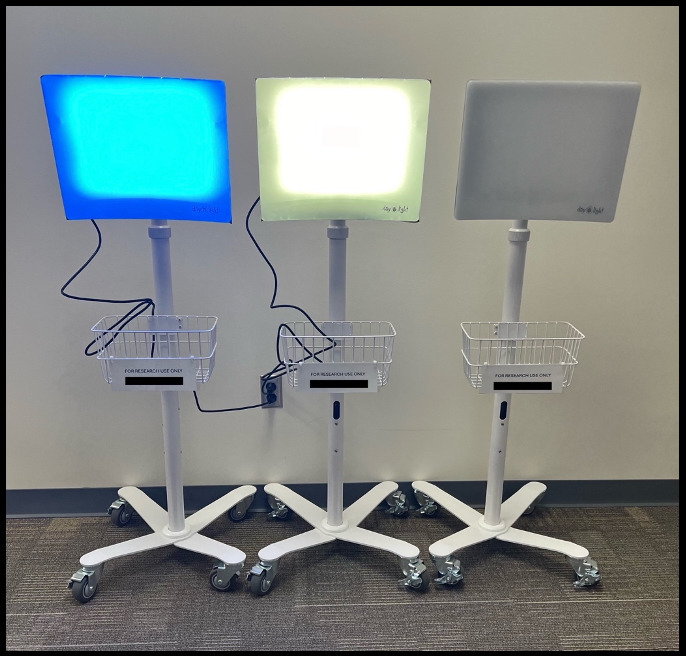
After an enrolled participant is randomised, a Day-Light Classic Plus Lamp19 will be delivered to the participant’s inpatient room. The lamp will be mounted on a stand with rolling casters20 (figure 2) to facilitate transport and bedside positioning. If assigned to either the bright blue light or the bright full-spectrum light arm, the light will be fitted with a filter21 of the appropriate colour to achieve the same light intensity. For participants assigned to the usual light intervention, the light will be positioned similarly in the room but will remain off for the duration of study participation.
Figure 2. Day-Light Classic Plus light therapy lamp mounted on a rolling stand with an articulating arm (left to right: bright blue light, bright full-spectrum light, usual ambient light).
If enrolment activities are completed prior to 11 am, the intervention will begin on the same day. If enrolment activities are completed after 11 am, the intervention will begin the subsequent day. On the first intervention day, study day 1 (SD1), the first research blood sample will be drawn. Also, prior to initiating the intervention, a study team member will elicit and record preintervention NRS pain scores both at rest and at end inspiration with incentive spirometer (IS) use. The participant will be specifically asked to rate the pain that they are experiencing in their chest wall. Then, if the participant is assigned to either the bright blue light arm or the bright full-spectrum light arm, the study team member will turn the light on, using a handheld light intensity monitor to position it to yield an illuminance of 1400±50 lux at the level of the participant’s eyes (approximately 30-35 cm). If the participant is assigned to the usual light arm, the study team member will position the lamp at 30-35 cm from the participant’s eye level but will not turn the light on. The brightness of the ambient light at the level of the participant’s eyes will be measured and recorded. Regardless of study arm, the lamp will be angled at approximately 45 degrees such that light shines down on the participant as in mainstream light therapy applications.
Participants will then undergo 4 hours of their assigned light exposure. They will be permitted to take breaks as needed for activities (ie, toileting, physical therapy, diagnostic testing) and will be provided with a pen and paper log to record their breaks. Break time will not be added to the total intervention time, with the light intervention concluding 4 hours after initiation regardless of any breaks. The study team member will discuss study participation with the bedside nurse and provide contact information in case of any issues or if the light needs to be repositioned. After ~2 hours, the study team member will return to the participant’s room to ask about any side effects of the assigned intervention and record any breaks. After the full 4-hour exposure period, the study team member will return once again to collect postexposure NRS pain scores and a 3D-CAM delirium screen before turning off the light to conclude the day’s intervention. The study team member will ask again about any breaks and any side effects experienced, confirming the participant’s willingness to continue the intervention the next day.
The light exposure will be repeated in an identical manner for a total of 3 days (SD1–3) or until the day of discharge, whichever comes first. After the final intervention day, the lamp will be removed from the room, disinfected and stored for future use. On the morning following the final intervention day (SD4), the study team member will collect a final research blood sample and administer final NRS pain scales and a 3D-CAM delirium screen. They will ask once more about any side effects. At no point in the study will the study team interfere with the medical or surgical care received by participants.
Participants can request discontinuation of the intervention at any time and for any reason. The intervention will also be discontinued by the study team if: (1) The participant becomes intubated or otherwise unable to open their eyes or report a pain score; (2) The participant experiences an adverse event that is both serious and considered likely related to the study intervention; or (3) The participant experiences an adverse event that otherwise suggests a greater risk of harm than was previously recognised. When a participant withdraws from the study, they will be asked if they would like to withdraw from procedures (ie, light exposure, NRS and 3D-CAM testing) with continued data collection (ie, EMR abstraction) or if they would like to withdraw completely (ie, no further light exposure, testing, or EMR abstraction). The participant’s wishes will be honoured accordingly. Data already collected will be analysed for research purposes.
Feasibility and acceptability endpoints
Data collected over an initial 12-month pilot period will be analysed for feasibility and acceptability endpoints in October 2025. If predetermined progression criteria are met (total enrolment >25, retention >80%), the trial will proceed to enrol the full cohort needed to detect a clinically significant difference in pain intensity (n=75).
Primary study endpoint
Chest wall pain intensity from day 1 to day 4 is quantified by the NRS with full inspiration. The NRS is a verbally reported pain intensity score ranging from 0 to 10, with greater numerical scores representing greater pain intensity. It is widely accepted as a valid measure of pain in the acute setting22 and has been used as a primary outcome measure in recent peer-reviewed research in this population.23 In this trial, the NRS will be elicited by a study team member at up to eight time points over the course of participation: at baseline, for the purpose of eligibility screening; immediately before each 4-hour intervention period; immediately after each 4-hour intervention period; and, on the morning after the last intervention day. At each time point, the NRS will be measured following slow, full deep breaths, in agreement with methods by Partyka et al.23
Secondary study endpoints
(1) Daily opioid requirement in oral morphine equivalents (OME)24 will be calculated to determine whether blue light is associated with an overall reduction in opioid requirements. (2) Incidence of 30-day pulmonary complications: A participant will be considered positive for pulmonary complications if, within 30 days of enrolment, they develop respiratory insufficiency requiring non-invasive positive pressure ventilation (NIPPV), respiratory failure requiring mechanical ventilation, or a clinical diagnosis of pneumonia. This information will be abstracted from the EMR by a trained study team member. (3) Incidence of in-hospital delirium: A participant will be considered positive for delirium if they score positive on the 3D-CAM16 at any point during the period of active study participation. The 3D-CAM will be administered by a trained study team member at baseline, during each day of the intervention, and on the morning following the last intervention day. (4) ICU-free and hospital-free days at 30 days postenrolment will be abstracted from the EMR by a trained study team member. (5) Heart rate variability data will be collected during active study participation, with the changes in heart rate and low frequency to high frequency (LF/HF) ratio under different lighting conditions depicted graphically to demonstrate differences in autonomic tone. (6) Rev-Erb α expression and cytokine IL-6, IL-10 and tumor necrosis factor alpha (TNF-α) concentrations: Research blood samples will be collected at up to four time points during the period of active participation, and plasma will be stored for western blot (Rev-Erb α expression) and ELISA (cytokine IL-6, IL-10 and TNF-α concentrations) analysis, representing circadian clock entrainment and immune activity, respectively. (7) Safety endpoints will include any side effects of bright light exposure and, although unexpected, any adverse events or other safety concerns related to the interventions.
Data collection
All participant data will be entered by a study team member into a secure REDCap17 18 database designed for the purpose of this study and hosted at the University of Pittsburgh. To protect participant confidentiality, no identifying information will be stored on paper documents. Only those study team members directly involved in data collection will be granted access to the identifying information stored in this database. Any data sets exported from the database for analysis by the study statistician and other investigators will be de-identified. All data points relevant to study outcomes are summarised in table 3.
Table 3. Data collection table.
| Variable | Description/justification | Levels/range |
|---|---|---|
| Demographics | ||
| Identifying Information | Name (first, middle, last), medical record number, date of birth, phone # (cell and/or home), room # | Not available |
| Age | Calculated from date of birth and date of screening | >18 years (continuous) |
| Sex | Self-reported biological sex (choose one) | Female, male, other, unknown/not reported |
| Race | Self-reported (may choose multiple) | Black or African American, White, American Indian or Alaska Native, Asian, Native Hawaiian or Other Pacific Islander |
| Ethnicity | Self-reported (choose one) |
Hispanic or Latino, not Hispanic or Latino, Other, unknown/not reported |
| Baseline data: history | ||
| Pulmonary conditions | Abstracted from EMR, verified with participant (may choose multiple) |
None, asthma, COPD, CHF/pulmonary oedema, interstitial lung disease, other |
| Pulmonary medications | Abstracted from EMR, verified with participant (may choose multiple) |
None, bronchodilators, inhaled corticosteroids, other |
| Pain conditions | Abstracted from EMR, verified with participant (may choose multiple) |
None, fibromyalgia, complex regional pain syndrome, diabetic neuropathy, chronic pain syndrome, other |
| Pain medications | Abstracted from EMR, verified with participant (may choose multiple) |
None, acetaminophen*, NSAIDs*, opioids*, anticonvulsants (prescribed for pain), SNRIs (prescribed for pain), epidural nerve blocks, other *Taken on most days in the past 2 weeks |
| Daily oral morphine milligram equivalents | Calculated from baseline opioid pain medications used | Continuous |
| Immunomodulatory agents | Defined as ‘Any substance that stimulates or suppresses the immune system and may help the body fight cancer, infection, or other diseases’30 Abstracted from EMR, verified with participant |
Yes, no Free text if ‘yes’ |
| Implantable cardioverter defibrillator (ICD) | Bittium Faros HRV monitor cannot be used in patients with an ICD Abstracted from EMR, verified with participant |
Yes, no |
| Smoking history | Self-reported history of tobacco use (choose one) |
No (never), yes (current), yes (former) |
| Body mass index (kg/m2) | Abstracted from EMR | Continuous |
| Charlson Comorbidity Index20 | Validated score predicting 10-year mortality from comorbid conditions calculated from health data abstracted from EMR, verified with patient |
Range 0–33* *Mild comorbidity 1–2, moderate comorbidity 3–4, severe comorbidity >5 |
| Baseline data: trauma | ||
| Date/time of injury (approximate) | Abstracted from EMR (trauma bay records) or patient report | Date/time |
| Mechanism of Injury | Abstracted from EMR (trauma bay records) (choose one) |
Fall, road-traffic collision, other |
| # of acute rib fractures | Abstracted from EMR (imaging results) | Range 1–24 (continuous) |
| Laterality of rib fractures | Abstracted from EMR (imaging results) (choose one) |
Left, right, bilateral |
| Flail segment | Abstracted from EMR (imaging results, clinician documentation) | Yes, No |
| Thoracic interventions | Abstracted from EMR (clinician documentation) (may choose multiple) |
None, tube thoracostomy (large-bore), tube thoracostomy (small-bore/pigtail), rib plating/chest wall reconstruction, video-assisted thoracoscopic surgery, thoracotomy, other |
| Baseline screening | ||
| Numerical Rating Scale, at rest | Participant asked to report their chest wall pain intensity at rest | Range 0–10 (continuous) |
| Numerical Rating Scale, at end inspiration | Participant asked to report their chest wall pain intensity at end inspiration after using an incentive spirometer to take a full deep breath Excluded if pain intensity <4/10 at baseline |
Range 0–10 (continuous) |
| Inspiratory volume (mL) | Inspiratory volume observed and recorded when participant uses an incentive spirometer | Continuous |
| Confusion assessment method | 3D-CAM16 delirium screen Excluded if CAM positive at baseline |
Positive, negative |
| Interval data (SD1-4) | ||
| Pain interventions (past 24 hours) | Abstracted from EMR (clinician documentation) | None, acetaminophen, NSAIDs, opioids, ketamine, intravenous lidocaine, topical lidocaine, regional anaesthesia, muscle relaxants, other |
| Oral morphine milligram equivalents (past 24 hours) | Calculated from opioid pain medications used in the past 24 hours | Continuous |
| Regional anaesthesia type | For participants who received regional anaesthesia in the past 24 hours Abstracted from EMR (clinician documentation) (may choose multiple) |
Thoracic epidural anaesthesia, thoracic paravertebral block, intercostal block, erector spinae plane block, serratus anterior plane block, parasternal block, other |
| Thoracic interventions (past 24 hours) |
Abstracted from EMR (clinician documentation) (may choose multiple) |
None, tube thoracostomy (large-bore), tube thoracostomy (small-bore/pigtail), rib plating/chest wall reconstruction, video-assisted thoracoscopic surgery, thoracotomy, other |
| Numerical Rating Scale, at rest | Participant asked to report their chest wall pain intensity at rest Asked preintervention and postintervention on SD1–3 and again on SD4 (or day of discharge) |
Range 0–10 (continuous) |
| Numerical Rating Scale, at end inspiration | Participant asked to report their chest wall pain intensity at end inspiration after using an incentive spirometer to take a full deep breath Asked preintervention and postintervention on SD1–3 and again on SD4 (or day of discharge) |
Range 0–10 (continuous) |
| Inspiratory volume (mL) | Inspiratory volume observed and recorded when participant uses an incentive spirometer | Continuous |
| Confusion assessment method | 3D-CAM16 delirium screen Asked postintervention on SD1–3 and again on SD4 (or day of discharge) |
Positive, negative |
| Follow-up data | ||
| Clinical diagnosis of pneumonia (at 30 days) |
Abstracted from EMR (imaging results, microbiology results, clinician documentation) or participant-reported (if postdischarge) | Yes, no |
| Method of pneumonia diagnosis | Abstracted from EMR (may choose multiple) |
Clinical diagnosis (antibiotics prescribed for pneumonia per clinician documentation), chest X-ray, chest CT scan, sputum sample, participant-reported, other |
| Respiratory Insufficiency (at 30 days) |
Abstracted from EMR (non-invasive positive pressure ventilation used for respiratory insufficiency) | Yes, no |
| Respiratory failure (at 30 days) |
Abstracted from EMR (mechanical ventilation) | Yes, no |
| Hospital-free days (at 30 days) |
Number of calendar days that the participant remained outside of the hospital | Range 0–29 |
| ICU-free days (at 30 days) |
Number of calendar days that the participant remained outside of the ICU | Range 0–30 |
| Injury Severity Score22 | Validated scale describing overall injury severity in multisystem trauma | Range 1–75 (continuous) ≥16 defines major trauma |
CAM, confusion assessment method; CHF, congestive heart failure; COPD, chronic obstructive pulmonary disease; 3D-CAM, 3 min diagnostic interview for Confusion Assessment Method-defined delirium; EMR, electronic medical record; HRV, heart rate variability; ICU, intensive care unit; NSAID, non-steroidal anti-inflammatory drug; SD, study day.
At the time of enrolment, the EMR will be reviewed for demographic and baseline clinical data. The Charlson Comorbidity Index (CCI)25 will be completed as a measure of baseline health. NRS and 3D-CAM data will be collected over the course of study participation, and blood samples will be collected, as detailed above. The participant’s inspiratory volume with IS use will also be recorded at each time point. Blood samples will be analysed for (1) Rev-Erbα concentration using western blot and (2) Cytokine concentrations (IL-6, TNF-α, IL-10) using ELISA testing. Potential side effects of light exposure (ie, vision strain, headaches, excessive energy) will be elicited from participants systematically.
Over the course of active study participation, participants will be asked to wear a heart rate monitor26 to capture heart rate variability parameters (ie, heart rate, LF/HF ratio) as a reflection of autonomic tone. The device is small (47 mm × 30 mm × 11 mm), lightweight (20 g) and attaches to the chest using two standard ECG leads with a battery life of 7 days. Thus, the device will be worn over the entire course of active study participation but will be removed for certain clinical activities including ECGs, imaging studies (ie, CT scans, MRIs), and surgeries and/or special procedures. Participants who are already wearing a cardiac monitor for clinical purposes or who have an implantable cardioverter defibrillator will be excluded from wearing a Bittium Faros 180 monitor due to the possibility of interference from the device. These participants will be permitted to participate in all other aspects of the trial.
At ~30 days postenrolment, the EMR will be reviewed by a study team member for follow-up information including respiratory complications and any adverse events. Respiratory complications recorded will include respiratory insufficiency requiring NIPPV, respiratory failure requiring mechanical ventilation and clinical pneumonia. ICU-free days and hospital-free days will also be collected at 30 days postenrolment. Injury Severity Score (ISS)27 will be collected as a measure of participants’ overall injury severity due to the expectation of participants having injuries to multiple organ systems. Participants who have been discharged from the hospital will be contacted with a single phone call at ~30 days to ask about any re-admissions or adverse effects experienced postdischarge.
A Data Monitoring Committee consisting of three faculty members of the Departments of Surgery and Anaesthesiology and Perioperative Medicine will convene at regular intervals over the course of trial recruitment. These individuals will not be members of the research team but will have expertise in clinical trials. They will meet at intervals defined by enrolment of 20 participants to review progress of the research study. Discussions will include review of (1) Participant recruitment and retention; (2) Data timeliness and quality; (3) Adverse events, unanticipated problems and participant withdrawals; (4) External factors or information that may impact the safety of study participants or the ethics of the research study (ie, new literature or therapeutic developments); (5) Study procedures designed to protect the privacy of the research participants and confidentiality of their research data; and, (6) Protocol deviations. This information will be used to determine whether there is any change to the anticipated risk-benefit assessment of study participation and whether the study should continue as originally designed, should be modified or should be closed. Additionally, identified breaches of confidentiality or new risks or adverse events related to the study intervention will be reported to the University of Pittsburgh Institutional Review Board (IRB) as per reporting guidelines (within 24 hours for life-threatening events and within 10 business days for all other events). Finally, the above data monitoring points will be reported to the IRB at the time of renewal.
Statistical analysis
Sample size and power justifications
The sample size is determined based on the primary study endpoint. Repeated measures of chest wall pain intensity from day 1 to day 4 will be compared between any two of the three study groups using generalised estimating equation (GEE) models. A total of 63 subjects (21 per group) among all three treatment groups will achieve 82% power to detect a clinically meaningful difference of 2 points28 29 in the group time-averaged responses in chest wall pain intensity in a design with at least three repeated measurements having an AR(1) covariance structure when the SD is two using data from a published trial of a similar adult population with rib fractures.24 The correlation between observations on the same subject is 0.8, and the α level is set at 0.05. To account for 20% dropout, a total of 75 participants (25 per treatment group) will be recruited for this trial. Given the volume of trauma patients seen at our institution annually (>5000) and the prevalence of rib fractures among trauma patients (~10%), sufficient eligible patients should present to complete enrolment within ~24 months.
Analysis plan
Intention-to-treat analyses will be performed for all study outcomes, meaning that all participants will be analysed as randomised regardless of withdrawal or non-adherence. Baseline characteristics will be reported as means and SD or median and IQRs for continuous variables and as frequencies and percentages for categorical variables. The χ2 test or exact test will be used for differences in proportions for categorical variables and the non-parametrical Kruskal-Wallis test will be used to determine the differences in the distribution of continuous data across three treatment groups. A value of p<0.05 will be used to indicate statistical significance for primary and secondary outcomes. SAS V.9.4 (SAS Institute, Cary, North Carolina, USA) and R (R Foundation for Statistical Computing) will be used for statistical analyses.
Analysis of the primary endpoint
GEE models will be used to compare repeated measures of chest wall pain intensity NRS from days 1 to 4. Three levels of treatment groups will be introduced in the model. The group time-averaged responses in chest wall pain intensity will be contrasted between two of the three groups. Statistical significance will be declared for any differences at an α level of 0.05. An interaction term between time (in days) and treatment groups will be introduced in the model to examine if the treatment effect differs by time. To account for potential confounders, the adjusted GEE model will control for confounders associated with the pain intensity outcome including CCI, ISS, time post-trauma, baseline pain conditions and medications, number and laterality of fractured ribs, flail chest (yes/no), pain interventions (ie, medications, blocks), and thoracic interventions (ie, tube thoracostomy, rib plating) that are found to be unbalanced between the treatment groups.
Analysis of secondary endpoints
GEE models will be used to compare repeated measures of secondary outcomes (ie, daily opioid requirement in OME, LF/HF ratio, and Rev-Erb α and cytokine concentrations) over time among three treatment groups. The non-parametrical Kruskal-Wallis test will be used to determine differences in ICU-free and hospital-free days across the three treatment groups. The χ2 test will be used to compare categorical secondary outcomes including incidence of 30-day pulmonary complications and incidence of in-hospital delirium across the three treatment groups.
Study start date (actual)
23 October 2024.
Study end date (anticipated)
23 October 2026.
Patient and public involvement
Patients and/or the public were not involved in the design, conduct, reporting or dissemination plans for this research study.
Ethics and dissemination
The Blue Light as an Anti-inflammatory and Analgesic Strategy in Thoracic Trauma Trial has been approved by the University of Pittsburgh IRB (STUDY24040163) and is registered at ClinicalTrials.gov (NCT06626334). Any important protocol modifications will be shared with all investigators, approved by the University of Pittsburgh IRB, posted to ClinicalTrials.gov and communicated in writing to BMJ Open for open access publication. Following the completion of target enrolment, study results will be published and summarised at ClinicalTrials.gov.
De-identified study data may be provided to researchers at the University of Pittsburgh, other institutions and/or federal repositories for the purposes of research collaboration. Sharing will be completed only under an approved sharing agreement. Data will be made available beginning 12 months and ending 36 months following article publication. Data will be shared with those researchers who provide a methodologically sound proposal. Only those data necessary to achieve the aims in the approved proposal will be shared. Proposals should be directed to the corresponding author and will undergo approval by the study team. Data will be available to those requesting the data for 1 year after proposal approval.
Supplementary material
Acknowledgements
The authors thank the University of Pittsburgh Institute for Clinical Research Education (ICRE) and Professor Charity Patterson for the clinical trials coursework during which initial ideas for this trial were developed. The authors also thank Ms Sandra Hirsch for her coordination and Ms Katherine Underwood and Ms Shannon Lynn Valenti of the University of Pittsburgh Clinical and Translational Science Institute (CTSI) for their regulatory support of this trial. The authors also thank the University of Pittsburgh Trauma and Transfusion Medicine Research Center (TTMRC) for laboratory facility and technical support. The authors also thank the University of Pittsburgh Division of General/Trauma Surgery, the Acute Interventional Perioperative Pain Service (AIPPS), Dr Scott Gunn and the staff of the Surgical Trauma ICU, and the nursing staff of Presbyterian Hospital’s monitored trauma units for their support of participant recruitment and protocol implementation.
Footnotes
Funding: REK is supported by the National Institutes of Health (NIH) Ruth L Kirschstein National Service Award (T32GM075770 to YX). Study design and regulatory support were received through the University of Pittsburgh CTSI (NIH Grant UL1 TR001857). The project is also supported by a seed award from the Department of Anesthesiology and Perioperative Medicine at the University of Pittsburgh. Funding through seed award mechanisms by the University of Pittsburgh will have no influence over the study’s results, despite the authors’ affiliation with the university.
Prepublication history and additional supplemental material for this paper are available online. To view these files, please visit the journal online (https://doi.org/10.1136/bmjopen-2024-097462).
Provenance and peer review: Not commissioned; externally peer reviewed.
Patient consent for publication: Not applicable.
Patient and public involvement: Patients and/or the public were not involved in the design, or conduct, or reporting, or dissemination plans of this research.
References
- 1.Yuan D, Collage RD, Huang H, et al. Blue light reduces organ injury from ischemia and reperfusion. Proc Natl Acad Sci U S A. 2016;113:5239–44. doi: 10.1073/pnas.1515296113. [DOI] [PMC free article] [PubMed] [Google Scholar]
- 2.Lewis AJ, Zhang X, Griepentrog JE, et al. Blue Light Enhances Bacterial Clearance and Reduces Organ Injury During Sepsis. Crit Care Med. 2018;46:e779–87. doi: 10.1097/CCM.0000000000003190. [DOI] [PMC free article] [PubMed] [Google Scholar]
- 3.Griepentrog JE, Zhang X, Lewis AJ, et al. Frontline Science: Rev-Erbα links blue light with enhanced bacterial clearance and improved survival in murine Klebsiella pneumoniae pneumonia. J Leukoc Biol. 2020;107:11–25. doi: 10.1002/JLB.4HI0519-155R. [DOI] [PMC free article] [PubMed] [Google Scholar]
- 4.Lord JM, Midwinter MJ, Chen Y-F, et al. The systemic immune response to trauma: an overview of pathophysiology and treatment. The Lancet. 2014;384:1455–65. doi: 10.1016/S0140-6736(14)60687-5. [DOI] [PMC free article] [PubMed] [Google Scholar]
- 5.Costantini TW, Kornblith LZ, Pritts T, et al. The intersection of coagulation activation and inflammation after injury: What you need to know. J Trauma Acute Care Surg. 2024;96:347–56. doi: 10.1097/TA.0000000000004190. [DOI] [PMC free article] [PubMed] [Google Scholar]
- 6.Bergmann CB, Beckmann N, Salyer CE, et al. Potential Targets to Mitigate Trauma- or Sepsis-Induced Immune Suppression. Front Immunol. 2021;12:622601. doi: 10.3389/fimmu.2021.622601. [DOI] [PMC free article] [PubMed] [Google Scholar]
- 7.Mukherjee K, Schubl SD, Tominaga G, et al. Non-surgical management and analgesia strategies for older adults with multiple rib fractures: A systematic review, meta-analysis, and joint practice management guideline from the Eastern Association for the Surgery of Trauma and the Chest Wall Injury Society. J Trauma Acute Care Surg. 2023;94:398–407. doi: 10.1097/TA.0000000000003830. [DOI] [PubMed] [Google Scholar]
- 8.Flagel BT, Luchette FA, Reed RL, et al. Half-a-dozen ribs: the breakpoint for mortality. Surgery. 2005;138:717–23. doi: 10.1016/j.surg.2005.07.022. [DOI] [PubMed] [Google Scholar]
- 9.Martin TJ, Eltorai AS, Dunn R, et al. Clinical management of rib fractures and methods for prevention of pulmonary complications: A review. Injury. 2019;50:1159–65. doi: 10.1016/j.injury.2019.04.020. [DOI] [PubMed] [Google Scholar]
- 10.Burton SW, Riojas C, Gesin G, et al. Multimodal analgesia reduces opioid requirements in trauma patients with rib fractures. J Trauma Acute Care Surg. 2022;92:588–96. doi: 10.1097/TA.0000000000003486. [DOI] [PMC free article] [PubMed] [Google Scholar]
- 11.Baron R, Morlion B, Dahan A, et al. A prospective, randomized, controlled, double-blind, multi-center study to evaluate the efficacy and safety of a blue light device for the treatment of chronic back pain. Front Pain Res. 2024;5:1444401. doi: 10.3389/fpain.2024.1444401. [DOI] [PMC free article] [PubMed] [Google Scholar]
- 12.de Oliveira CMB, Sakata RK, Issy AM, et al. Cytokines and Pain. Braz J Anesthesiol. 2011;61:255–65. doi: 10.1016/S0034-7094(11)70029-0. [DOI] [Google Scholar]
- 13.Zhang JM, An J. Cytokines, inflammation, and pain. Int Anesthesiol Clin. 2007;45:27–37. doi: 10.1097/AIA.0b013e318034194e. [DOI] [PMC free article] [PubMed] [Google Scholar]
- 14.Zhou Y-Q, Liu Z, Liu Z-H, et al. Interleukin-6: an emerging regulator of pathological pain. J Neuroinflammation. 2016;13:141. doi: 10.1186/s12974-016-0607-6. [DOI] [PMC free article] [PubMed] [Google Scholar]
- 15.Bantel C, Trapp S. The role of the autonomic nervous system in acute surgical pain processing - what do we know? Anaesthesia. 2011;66:541–4. doi: 10.1111/j.1365-2044.2011.06791.x. [DOI] [PubMed] [Google Scholar]
- 16.Marcantonio ER, Ngo LH, O’Connor M, et al. 3D-CAM: derivation and validation of a 3-minute diagnostic interview for CAM-defined delirium: a cross-sectional diagnostic test study. Ann Intern Med. 2014;161:554–61. doi: 10.7326/M14-0865. [DOI] [PMC free article] [PubMed] [Google Scholar]
- 17.Harris PA, Taylor R, Thielke R, et al. Research electronic data capture (REDCap)—A metadata-driven methodology and workflow process for providing translational research informatics support. J Biomed Inform. 2009;42:377–81. doi: 10.1016/j.jbi.2008.08.010. [DOI] [PMC free article] [PubMed] [Google Scholar]
- 18.Harris PA, Taylor R, Minor BL, et al. The REDCap consortium: Building an international community of software platform partners. J Biomed Inform. 2019;95:103208. doi: 10.1016/j.jbi.2019.103208. [DOI] [PMC free article] [PubMed] [Google Scholar]
- 19.Carex day-light classic plus light therapy lamp. 2024. https://carex.com/products/carex-day-light-classic-plus-light-therapy-sun-lamp Available.
- 20.Medical rolling cart for vesa mounts - rise freedom extended. 2024. https://www.maclocks.com/rise-freedom-extended-rolling-kiosk.html Available.
- 21.Colour Effect Filters. 2024. https://leefilters.com/lighting/colour-effect-lighting-filters/ Available.
- 22.Karcioglu O, Topacoglu H, Dikme O, et al. A systematic review of the pain scales in adults: Which to use? Am J Emerg Med. 2018;36:707–14. doi: 10.1016/j.ajem.2018.01.008. [DOI] [PubMed] [Google Scholar]
- 23.Partyka C, Asha S, Berry M, et al. Serratus Anterior Plane Blocks for Early Rib Fracture Pain Management: The SABRE Randomized Clinical Trial. JAMA Surg. 2024;159:810–7. doi: 10.1001/jamasurg.2024.0969. [DOI] [PMC free article] [PubMed] [Google Scholar]
- 24.Nielsen S, Degenhardt L, Hoban B, et al. A synthesis of oral morphine equivalents (OME) for opioid utilisation studies. Pharmacoepidemiol Drug Saf. 2016;25:733–7. doi: 10.1002/pds.3945. [DOI] [PubMed] [Google Scholar]
- 25.Charlson ME, Pompei P, Ales KL, et al. A new method of classifying prognostic comorbidity in longitudinal studies: development and validation. J Chronic Dis. 1987;40:373–83. doi: 10.1016/0021-9681(87)90171-8. [DOI] [PubMed] [Google Scholar]
- 26.Bittium faros - waterproof ecg devices for cardiac monitoring. 2024. https://www.bittium.com/medical/bittium-faros Available.
- 27.Baker SP, O’Neill B, Haddon W, Jr, et al. The injury severity score: a method for describing patients with multiple injuries and evaluating emergency care. J Trauma. 1974;14:187–96. [PubMed] [Google Scholar]
- 28.Farley P, Griffin RL, Jansen JO, et al. Quantifying Pain Associated With Rib Fractures. J Surg Res. 2020;246:476–81. doi: 10.1016/j.jss.2019.09.032. [DOI] [PubMed] [Google Scholar]
- 29.Patton P, Vogt K, Priestap F, et al. Intravenous lidocaine for the management of traumatic rib fractures: A double-blind randomized controlled trial (INITIATE program of research) J Trauma Acute Care Surg. 2022;93:496–502. doi: 10.1097/TA.0000000000003562. [DOI] [PubMed] [Google Scholar]
- 30.NCI Dictionary of Cancer Terms. 2024. https://www.cancer.gov/publications/dictionaries/cancer-terms/def/immunomodulating-agent Available.