



Abstract
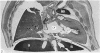
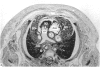
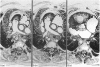
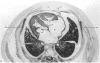
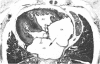
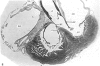
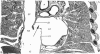
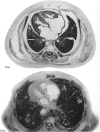
This study of the newborn child heart is based mainly on observations made on thin (0.2 mm) serial transverse sections of an entire thorax. Several features of the cardiovascular system associated with the fetal circulation are discussed. Despite considerable differences between the cardiac form in the newborn child and that in later postnatal life, the orientation of the heart in the newborn child has already attained many of its postnatal features. For example, it lies more nearly in the horizontal than the vertical plane and the atrial and ventricular septa are in line with each other at an angle of about 45 degrees to the median plane. This angulation of the septa determines that the right atrium and ventricle lie as much in front of the corresponding chambers of the left heart as they do to their right side. The cardiothoracic ratio and thoracic index are derived from a section through the thorax of the newborn child and these values are compared with those from a section through an adult man. A major purpose of this communication is to make a plea that the nomenclature given to all cardiac structures, even in the newborn child, should be consistent with the heart in situ in the anatomical position.
Full text
PDF


Images in this article




Selected References
These references are in PubMed. This may not be the complete list of references from this article.
- Allwork S. P., Anderson R. H. Developmental anatomy of the membranous part of the ventricular septum in the human heart. Br Heart J. 1979 Mar;41(3):275–280. doi: 10.1136/hrt.41.3.275. [DOI] [PMC free article] [PubMed] [Google Scholar]
- Cooper M. H., O'Rahilly R. The human heart at seven postovulatory weeks. Acta Anat (Basel) 1971;79(2):280–299. doi: 10.1159/000143644. [DOI] [PubMed] [Google Scholar]
- Ho S. Y., Anderson R. H. Coarctation, tubular hypoplasia, and the ductus arteriosus. Histological study of 35 specimens. Br Heart J. 1979 Mar;41(3):268–274. doi: 10.1136/hrt.41.3.268. [DOI] [PMC free article] [PubMed] [Google Scholar]
- Ringertz H. G. Normal radiographic heart volume in the neonate. 1. Dependence of ductal closure. Pediatr Radiol. 1983;13(4):195–198. doi: 10.1007/BF00973155. [DOI] [PubMed] [Google Scholar]
- Van Meurs-Van Woezik H., Krediet P. Changes after birth in the tunica media and in the internal diameter of the aortic isthmus in normal newborns. J Anat. 1982 May;134(Pt 3):573–581. [PMC free article] [PubMed] [Google Scholar]
- WALMSLEY R. The orientation of the heart and the appearance of its chambers in the adult cadaver. Br Heart J. 1958 Oct;20(4):441–458. doi: 10.1136/hrt.20.4.441. [DOI] [PMC free article] [PubMed] [Google Scholar]
- van Meurs-van Woezik H., Debets T., Klein H. W. Growth of the internal diameters in the pulmonary arterial tree in infants and children. J Anat. 1987 Apr;151:107–115. [PMC free article] [PubMed] [Google Scholar]