



Abstract
1. Changes in the structure and function of the rough-surfaced endoplasmic reticulum of the rat liver as deduced by electron microscopy, polysome analysis and the amino acid-incorporating activity of microsome fractions have been followed at various time-intervals after a single intraperitoneal dose of the hepatocarcinogen 4-dimethylaminoazobenzene. 2. The earliest effect observed was detachment of polysomes and disorganization and vesiculation of the cisternae of the rough-surfaced endoplasmic reticulum. This occurred after 6hr. 3. Subsequent to this was a phase of polysome disaggregation accompanied by impaired amino acid-incorporating activity by microsomes together with a much enhanced stimulating effect of polyuridylic acid on amino acid uptake. This reached a maximum at 24hr. 4. By 40hr. polysomes had re-formed and the amino acid-incorporating activity, together with the polyuridylic acid effect, were similar to those in controls. 5. It was not until 112hr. that something like the normal structure of the rough-surfaced endoplasmic reticulum was re-established. 6. It is not yet possible to relate these changes specifically with the process of azo-dye carcinogenesis.
Full text
PDF


Images in this article

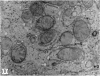

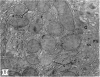
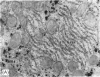
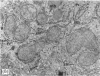
Selected References
These references are in PubMed. This may not be the complete list of references from this article.
- BAGLIO C. M., FARBER E. CORRESPONDENCE BETWEEN RIBOSOME AGGREGATION PATTERNS IN RAT LIVER HOMOGENATES AND IN ELECTRON MICROGRAPHS FOLLOWING ADMINISTRATION OF ETHIONINE. J Mol Biol. 1965 Jun;12:466–467. doi: 10.1016/s0022-2836(65)80269-8. [DOI] [PubMed] [Google Scholar]
- Clifford J. I., Rees K. R. Aflatoxin: a site of action in the rat liver cell. Nature. 1966 Jan 15;209(5020):312–313. doi: 10.1038/209312a0. [DOI] [PubMed] [Google Scholar]
- Daudel P., Jacquier A., Touplain A. Effet de quelques azoïques sur l'incorporation de l-leucine par un système microsomal de foie. C R Acad Sci Hebd Seances Acad Sci D. 1965 May 3;260(18):4871–4873. [PubMed] [Google Scholar]
- HENSHAW E. C., BOJARSKI T. B., HIATT H. H. PROTEIN SYNTHESIS BY FREE AND BOUND RAT LIVER RIBOSOMES IN VIVO AND IN VITRO. J Mol Biol. 1963 Aug;7:122–129. doi: 10.1016/s0022-2836(63)80041-8. [DOI] [PubMed] [Google Scholar]
- Hawtrey A. O., Nourse L. D. The effect of 4-dimethylamino-3'-methylazobenzene on 14-C-labelled amino acid incorporation by rat-liver polysome preparations. Biochem J. 1966 Mar;98(3):682–688. doi: 10.1042/bj0980682. [DOI] [PMC free article] [PubMed] [Google Scholar]
- Hawtrey A. O., Schirren V., Dijkstra J. Studies on azo-dye carcinogenesis in rat liver. The effect of 4-dimethylamino-3'-methylazobenzene on the incorporation of [C]leucine into rat-liver microsomal protein. Biochem J. 1963 Jul;88(1):106–114. doi: 10.1042/bj0880106. [DOI] [PMC free article] [PubMed] [Google Scholar]
- LAFONTAINE J. G., ALLARD C. A LIGHT AND ELECTRON MICROSCOPE STUDY OF THE MORPHOLOGICAL CHANGES INDUCED IN RAT LIVER CELLS BY THE AZO DYE 2-ME-DAB. J Cell Biol. 1964 Jul;22:143–172. doi: 10.1083/jcb.22.1.143. [DOI] [PMC free article] [PubMed] [Google Scholar]
- LOWRY O. H., ROSEBROUGH N. J., FARR A. L., RANDALL R. J. Protein measurement with the Folin phenol reagent. J Biol Chem. 1951 Nov;193(1):265–275. [PubMed] [Google Scholar]
- LUFT J. H. Improvements in epoxy resin embedding methods. J Biophys Biochem Cytol. 1961 Feb;9:409–414. doi: 10.1083/jcb.9.2.409. [DOI] [PMC free article] [PubMed] [Google Scholar]
- MAGEE P. N. Toxic liver injury; inhibition of protein synthesis in rat liver by dimethylnitrosamine in vivo. Biochem J. 1958 Dec;70(4):606–611. doi: 10.1042/bj0700606. [DOI] [PMC free article] [PubMed] [Google Scholar]
- MAGER J., BORNSTEIN S., HALBREICH A. ENHANCEMENT OF THE POLYURIDYLIC ACID-DIRECTED PHENYLALANINE POLYMERIZATION IN LIVER-MICROSOME PREPARATIONS FROM RATS TREATED WITH CARBON TETRACHLORIDE OR DIMETHYLNITROSAMINE. Biochim Biophys Acta. 1965 Apr 19;95:682–684. doi: 10.1016/0005-2787(65)90528-9. [DOI] [PubMed] [Google Scholar]
- MIZRAHI I. J., EMMELOT P. ON THE MODE OF ACTION BY WHICH THE CARCINOGEN DIMETHYLNITROSAMINE INHIBITS PROTEIN SYNTHESIS IN THE LIVER. Biochim Biophys Acta. 1964 Oct 16;91:362–364. doi: 10.1016/0926-6550(64)90271-3. [DOI] [PubMed] [Google Scholar]
- MUKHERJEE T., GUSTAFSSON R. G., AFZELIUS B. A., ARRHENIUS E. EFFECTS OF CARCINOGENIC AMINES ON AMINO ACID INCORPORATION BY LIVER SYSTEMS. II. A MORPHOLOGICAL AND BIOCHEMICAL STUDY ON THE EFFECT OF DIMETHYLNITROSAMINE. Cancer Res. 1963 Jul;23:944–953. [PubMed] [Google Scholar]
- Ma M. H., Webber A. J. Fine structure of liver tumors induced in the rat by 3'-methyl-4-dimethylaminoazobenzene. Cancer Res. 1966 May;26(5):935–946. [PubMed] [Google Scholar]
- PORTER K. R., BRUNI C. An electron microscope study of the early effects of 3'-Me-DAB on rat liver cells. Cancer Res. 1959 Nov;19:997–1009. [PubMed] [Google Scholar]
- PORTER K. R., BRUNI C. COMPARATIVE FINE STRUCTURE OF SLOW- AND FAST-GROWING HEPATOMAS. Acta Unio Int Contra Cancrum. 1964;20:1271–1274. [PubMed] [Google Scholar]
- REICH E., FRANKLIN R. M., SHATKIN A. J., TATUM E. L. Effect of actinomycin D on cellular nucleic acid synthesis and virus production. Science. 1961 Aug 25;134(3478):556–557. doi: 10.1126/science.134.3478.556. [DOI] [PubMed] [Google Scholar]
- REVEL M., HIATT H. H., REVEL J. P. ACTINOMYCIN D: AN EFFECT ON RAT LIVER HOMOGENATES UNRELATED TO ITS ACTION ON RNA SYNTHESIS. Science. 1964 Dec 4;146(3649):1311–1313. doi: 10.1126/science.146.3649.1311. [DOI] [PubMed] [Google Scholar]
- REYNOLDS E. S. The use of lead citrate at high pH as an electron-opaque stain in electron microscopy. J Cell Biol. 1963 Apr;17:208–212. doi: 10.1083/jcb.17.1.208. [DOI] [PMC free article] [PubMed] [Google Scholar]
- SABATINI D. D., BENSCH K., BARRNETT R. J. Cytochemistry and electron microscopy. The preservation of cellular ultrastructure and enzymatic activity by aldehyde fixation. J Cell Biol. 1963 Apr;17:19–58. doi: 10.1083/jcb.17.1.19. [DOI] [PMC free article] [PubMed] [Google Scholar]
- SMUCKLER E. A., BENDITT E. P. STUDIES ON CARBON TETRACHLORIDE INTOXICATION. 3. A SUBCELLULAR DEFECT IN PROTEIN SYNTHESIS. Biochemistry. 1965 Apr;4:671–679. doi: 10.1021/bi00880a009. [DOI] [PubMed] [Google Scholar]
- WETTSTEIN F. O., STAEHELIN T., NOLL H. Ribosomal aggregate engaged in protein synthesis: characterization of the ergosome. Nature. 1963 Feb 2;197:430–435. doi: 10.1038/197430a0. [DOI] [PubMed] [Google Scholar]