



Abstract
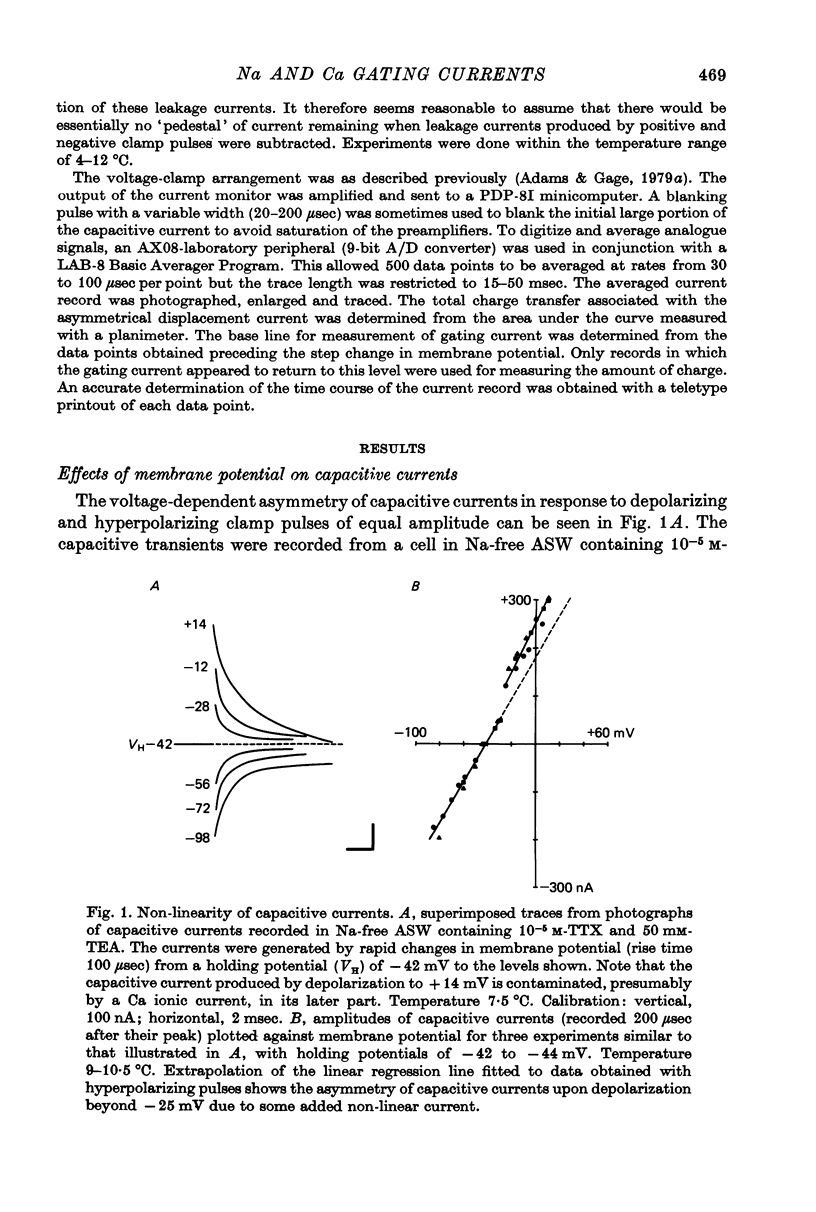
1. Currents generated by depolarizing the hyperpolarizing voltage pulses were recorded at temperatures of 4--12 degrees C in the voltage-clamped soma of R15 in aplysia abdominal ganglia exposed to solutions which suppressed ionic currents. 2. Subtraction of linear capacitive and leakage currents from current generated by voltage pulses to levels more positive than -20mV revealed non-linear transient outward displacement currents at the onset of the clamp step (on-current) and transient inward displacement currents after the membrane potential returned to the holding potential (off-current). Only on-currents were studied. 3. Pulses to membrane potentials of -20 to 0 mV generated a displacement current with rapid onset and exponential decay. At membrane potentials more positive than o mV a second displacement current with a much slower onset and slower exponential decay was seen. Because the different threshold potentials for the two displacement currents were close to the different threshold potentials for Na and Ca ion currents, the two displacement currents were called Na and Ca 'gating' currents. 4. The amount of charge transfer during Ca gating currents increased sigmoidally with increasing depolarization, reaching a maximum at +30 to +40 mV. Half-maximum charge transfer occurred at +15 mV. 5. Total charge movement during Ca gating currents was maximal with holding potentials of -30 to -40 mV. More positive or more negative holding potentials produced a decrease in charge movement. 6. The time course of the gating currents, but not the total charge displaced, was very sensitive to temperature. The time constant of decay of Ca gating currents had a Q10 of about 3, whereas the total amount of charge displaced had a Q10 of 1.2. 7. The charge transfer during both Na and Ca gating currents and the amplitude of Na and Ca (but not K) ionic currents were reduced in solutions containing 1 mm-n-octanol.
Full text
PDF



Selected References
These references are in PubMed. This may not be the complete list of references from this article.
- ARMSTRONG C. M., BINSTOCK L. THE EFFECTS OF SEVERAL ALCOHOLS ON THE PROPERTIES OF THE SQUID GIANT AXON. J Gen Physiol. 1964 Nov;48:265–277. doi: 10.1085/jgp.48.2.265. [DOI] [PMC free article] [PubMed] [Google Scholar]
- Adams D. J., Gage P. W. Characteristics of sodium and calcium conductance changes produced by membrane depolarization in an Aplysia neurone. J Physiol. 1979 Apr;289:143–161. doi: 10.1113/jphysiol.1979.sp012729. [DOI] [PMC free article] [PubMed] [Google Scholar]
- Adams D. J., Gage P. W. Gating currents associated with sodium and calcium currents in an Aplysia neuron. Science. 1976 May 21;192(4241):783–784. doi: 10.1126/science.1265479. [DOI] [PubMed] [Google Scholar]
- Adams D. J., Gage P. W. Ionic currents in response to membrane depolarization in an Aplysia neurone. J Physiol. 1979 Apr;289:115–141. doi: 10.1113/jphysiol.1979.sp012728. [DOI] [PMC free article] [PubMed] [Google Scholar]
- Armstrong C. M., Bezanilla F. Charge movement associated with the opening and closing of the activation gates of the Na channels. J Gen Physiol. 1974 May;63(5):533–552. doi: 10.1085/jgp.63.5.533. [DOI] [PMC free article] [PubMed] [Google Scholar]
- Armstrong C. M., Bezanilla F. Currents related to movement of the gating particles of the sodium channels. Nature. 1973 Apr 13;242(5398):459–461. doi: 10.1038/242459a0. [DOI] [PubMed] [Google Scholar]
- Bezanilla F., Armstrong C. M. Gating currents of the sodium channels: three ways to block them. Science. 1974 Feb 22;183(4126):753–754. doi: 10.1126/science.183.4126.753. [DOI] [PubMed] [Google Scholar]
- Bezanilla F., Armstrong C. M. Properties of the sodium channel gating current. Cold Spring Harb Symp Quant Biol. 1976;40:297–304. doi: 10.1101/sqb.1976.040.01.030. [DOI] [PubMed] [Google Scholar]
- Connor J. A., Stevens C. F. Voltage clamp studies of a transient outward membrane current in gastropod neural somata. J Physiol. 1971 Feb;213(1):21–30. doi: 10.1113/jphysiol.1971.sp009365. [DOI] [PMC free article] [PubMed] [Google Scholar]
- Danielli J. F. On the permeability change of stimulated nerve. J Physiol. 1941 Aug 11;100(1):117–124. doi: 10.1113/jphysiol.1941.sp003928. [DOI] [PMC free article] [PubMed] [Google Scholar]
- Grisham C. M., Barnett R. E. The effects of long-chain alcohols on membrane lipids and the (Na++K+)-ATPase. Biochim Biophys Acta. 1973 Jul 6;311(3):417–422. doi: 10.1016/0005-2736(73)90322-2. [DOI] [PubMed] [Google Scholar]
- HAGIWARA S., SAITO N. Voltage-current relations in nerve cell membrane of Onchidium verruculatum. J Physiol. 1959 Oct;148:161–179. doi: 10.1113/jphysiol.1959.sp006279. [DOI] [PMC free article] [PubMed] [Google Scholar]
- HODGKIN A. L., HUXLEY A. F. A quantitative description of membrane current and its application to conduction and excitation in nerve. J Physiol. 1952 Aug;117(4):500–544. doi: 10.1113/jphysiol.1952.sp004764. [DOI] [PMC free article] [PubMed] [Google Scholar]
- KLERMAN G. L., COLE J. O. EFFECTS OF ANESTHESIA ON METABOLISM AND CELLULAR FUNCTIONS. A WORKSHOP HELD UNDER THE COMMITTEE ON ANESTHESIA OF THE NATIONAL ACADEMY OF SCIENCES--NATIONAL RESEARCH COUNCIL. Pharmacol Rev. 1965 Jun;17:183–263. [PubMed] [Google Scholar]
- Keynes R. D., Rojas E. Characteristics of the sodium gating current in the squid giant axon. J Physiol. 1973 Aug;233(1):28P–30P. [PubMed] [Google Scholar]
- Keynes R. D., Rojas E. Kinetics and steady-state properties of the charged system controlling sodium conductance in the squid giant axon. J Physiol. 1974 Jun;239(2):393–434. doi: 10.1113/jphysiol.1974.sp010575. [DOI] [PMC free article] [PubMed] [Google Scholar]
- Kostyuk P. G., Krishtal O. A., Pidoplichko V. I. Asymmetrical displacement currents in nerve cell membrane and effect of internal fluoride. Nature. 1977 May 5;267(5606):70–72. doi: 10.1038/267070a0. [DOI] [PubMed] [Google Scholar]
- Kostyuk P. G., Krishtal O. A., Shakhovalov Y. A. Separation of sodium and calcium currents in the somatic membrane of mollusc neurones. J Physiol. 1977 Sep;270(3):545–568. doi: 10.1113/jphysiol.1977.sp011968. [DOI] [PMC free article] [PubMed] [Google Scholar]
- Marmor M. F. The effects of temperature and ions on the current-voltage relation and electrical characteristics of a molluscan neurone. J Physiol. 1971 Nov;218(3):573–598. doi: 10.1113/jphysiol.1971.sp009634. [DOI] [PMC free article] [PubMed] [Google Scholar]
- Meves H. The effect of holding potential on the asymmetry currents in squid gaint axons. J Physiol. 1974 Dec;243(3):847–867. doi: 10.1113/jphysiol.1974.sp010780. [DOI] [PMC free article] [PubMed] [Google Scholar]
- Nonner W., Rojas E., Stämpfli H. Displacement currents in the node of Ranvier. Voltage and time dependence. Pflugers Arch. 1975;354(1):1–18. doi: 10.1007/BF00584499. [DOI] [PubMed] [Google Scholar]
- RUDOLPH G., STAMPFLI R. Anodenöffnungserregungen einzelner Ranvier-Schnürringe. Pflugers Arch. 1958;267(5):524–531. doi: 10.1007/BF00361739. [DOI] [PubMed] [Google Scholar]
- Rudy B. Sodium gating currents in Myxicola giant axons. Proc R Soc Lond B Biol Sci. 1976 Jun 30;193(1113):469–475. doi: 10.1098/rspb.1976.0059. [DOI] [PubMed] [Google Scholar]
- Thompson S. H. Three pharmacologically distinct potassium channels in molluscan neurones. J Physiol. 1977 Feb;265(2):465–488. doi: 10.1113/jphysiol.1977.sp011725. [DOI] [PMC free article] [PubMed] [Google Scholar]