



Abstract
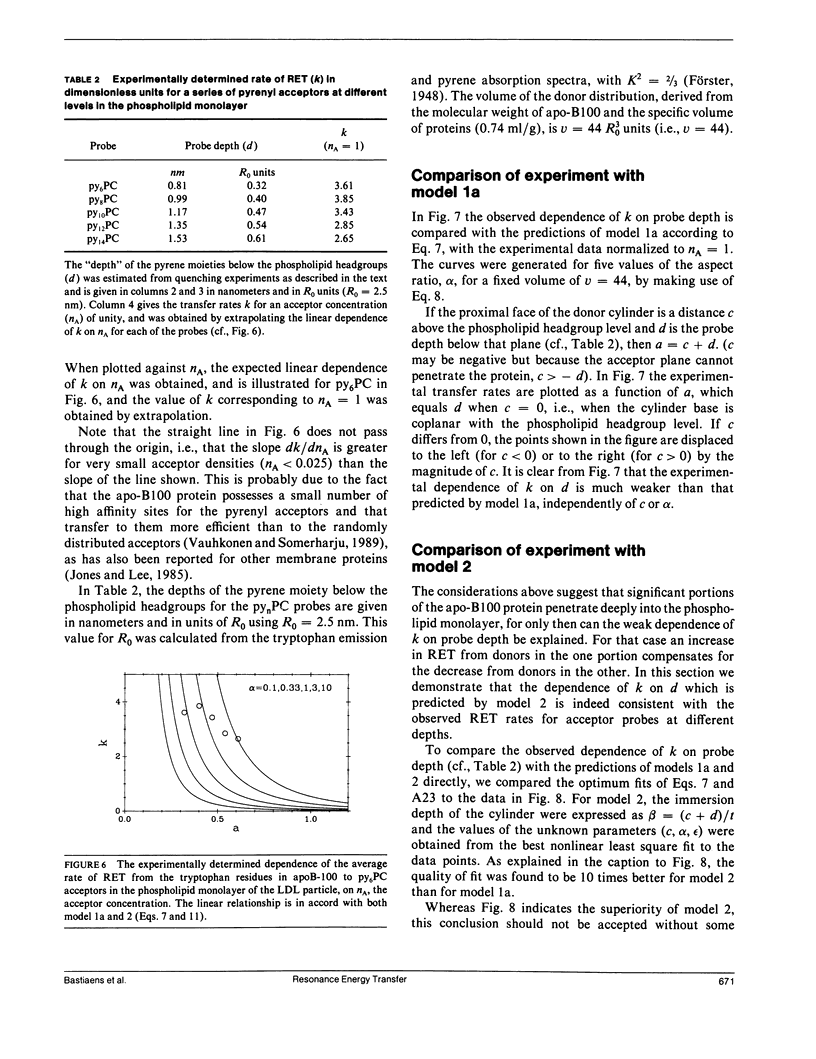
The resonance energy transfer (RET) from a cylindrical assembly of donors to acceptors in a plane was investigated, and the dependence the average RET rate (kT) on the cylinder's size, shape, and proximity to the acceptor plane was determined. This geometry provides a model for the RET from a donor-containing protein to acceptors embedded in an associated phospholipid mono- or bilayer. The determination of kT for a series of acceptors at different levels in the phospholipid layer is shown to provide information on the protein's relationship to the phospholipid layer. Two models for the donor (D) and acceptor (A) distributions are employed: (a) The D's and A's are uniformly distributed in the cylinder and the plane, respectively, and analytical expressions for kT in terms of experimental parameters are derived. (b) The RET rates between all D, A pairs within the cylinder and in the plane are calculated and averaged for a large number of random D and A distributions. The average transfer rates obtained by the two approaches are in agreement and the width of the frequency distribution of kT for the latter provides an estimate of the error to be expected when, as is usually the case, the true D and A locations are unknown. This methodology is illustrated by analyzing RET from the 37 tryptophan residues of the apo-B100 protein to a series of pyrenylphosphatidylcholine acceptors inserted in the phospholipid monolayer of the human low-density lipoprotein particle, and it is concluded that significant portions of the protein penetrate the phospholipid layer.
Full text
PDF




Selected References
These references are in PubMed. This may not be the complete list of references from this article.
- Burley S. K., Petsko G. A. Aromatic-aromatic interaction: a mechanism of protein structure stabilization. Science. 1985 Jul 5;229(4708):23–28. doi: 10.1126/science.3892686. [DOI] [PubMed] [Google Scholar]
- Dale R. E., Eisinger J., Blumberg W. E. The orientational freedom of molecular probes. The orientation factor in intramolecular energy transfer. Biophys J. 1979 May;26(2):161–193. doi: 10.1016/S0006-3495(79)85243-1. [DOI] [PMC free article] [PubMed] [Google Scholar]
- Eisinger J., Flores J., Bookchin R. M. The cytosol-membrane interface of normal and sickle erythrocytes. Effect of hemoglobin deoxygenation and sickling. J Biol Chem. 1984 Jun 10;259(11):7169–7177. [PubMed] [Google Scholar]
- Eisinger J., Flores J. Cytosol-membrane interface of human erythrocytes. A resonance energy transfer study. Biophys J. 1983 Mar;41(3):367–379. doi: 10.1016/S0006-3495(83)84448-8. [DOI] [PMC free article] [PubMed] [Google Scholar]
- Goldstein J. L., Brown M. S. The low-density lipoprotein pathway and its relation to atherosclerosis. Annu Rev Biochem. 1977;46:897–930. doi: 10.1146/annurev.bi.46.070177.004341. [DOI] [PubMed] [Google Scholar]
- Jones O. T., Lee A. G. Interactions of pyrene derivatives with lipid bilayers and with (Ca2+-Mg2+)-ATPase. Biochemistry. 1985 Apr 23;24(9):2195–2202. doi: 10.1021/bi00330a013. [DOI] [PubMed] [Google Scholar]
- Knott T. J., Pease R. J., Powell L. M., Wallis S. C., Rall S. C., Jr, Innerarity T. L., Blackhart B., Taylor W. H., Marcel Y., Milne R. Complete protein sequence and identification of structural domains of human apolipoprotein B. Nature. 1986 Oct 23;323(6090):734–738. doi: 10.1038/323734a0. [DOI] [PubMed] [Google Scholar]
- Lewis B. A., Engelman D. M. Lipid bilayer thickness varies linearly with acyl chain length in fluid phosphatidylcholine vesicles. J Mol Biol. 1983 May 15;166(2):211–217. doi: 10.1016/s0022-2836(83)80007-2. [DOI] [PubMed] [Google Scholar]
- McIntosh T. J., Holloway P. W. Determination of the depth of bromine atoms in bilayers formed from bromolipid probes. Biochemistry. 1987 Mar 24;26(6):1783–1788. doi: 10.1021/bi00380a042. [DOI] [PubMed] [Google Scholar]
- Olofsson S. O., Bjursell G., Boström K., Carlsson P., Elovson J., Protter A. A., Reuben M. A., Bondjers G. Apolipoprotein B: structure, biosynthesis and role in the lipoprotein assembly process. Atherosclerosis. 1987 Nov;68(1-2):1–17. doi: 10.1016/0021-9150(87)90088-8. [DOI] [PubMed] [Google Scholar]
- Schiller P. W. Study of adrenocorticotropic hormone conformation by evaluation of intramolecular resonance energy transfer in N -dansyllysine 21 -ACTH-(1-24)-tetrakosipeptide. Proc Natl Acad Sci U S A. 1972 Apr;69(4):975–979. doi: 10.1073/pnas.69.4.975. [DOI] [PMC free article] [PubMed] [Google Scholar]
- Shen B. W., Scanu A. M., Kézdy F. J. Structure of human serum lipoproteins inferred from compositional analysis. Proc Natl Acad Sci U S A. 1977 Mar;74(3):837–841. doi: 10.1073/pnas.74.3.837. [DOI] [PMC free article] [PubMed] [Google Scholar]
- Stryer L. Fluorescence energy transfer as a spectroscopic ruler. Annu Rev Biochem. 1978;47:819–846. doi: 10.1146/annurev.bi.47.070178.004131. [DOI] [PubMed] [Google Scholar]
- Torgerson P. M., Morales M. F. Application of the Dale-Eisinger analysis to proximity mapping in the contractile system. Proc Natl Acad Sci U S A. 1984 Jun;81(12):3723–3727. doi: 10.1073/pnas.81.12.3723. [DOI] [PMC free article] [PubMed] [Google Scholar]
- Vauhkonen M., Somerharju P. Parinaroyl and pyrenyl phospholipids as probes for the lipid surface layer of human low density lipoproteins. Biochim Biophys Acta. 1989 Aug 21;984(1):81–87. doi: 10.1016/0005-2736(89)90345-3. [DOI] [PubMed] [Google Scholar]
- Yang C. Y., Chen S. H., Gianturco S. H., Bradley W. A., Sparrow J. T., Tanimura M., Li W. H., Sparrow D. A., DeLoof H., Rosseneu M. Sequence, structure, receptor-binding domains and internal repeats of human apolipoprotein B-100. Nature. 1986 Oct 23;323(6090):738–742. doi: 10.1038/323738a0. [DOI] [PubMed] [Google Scholar]