



Abstract
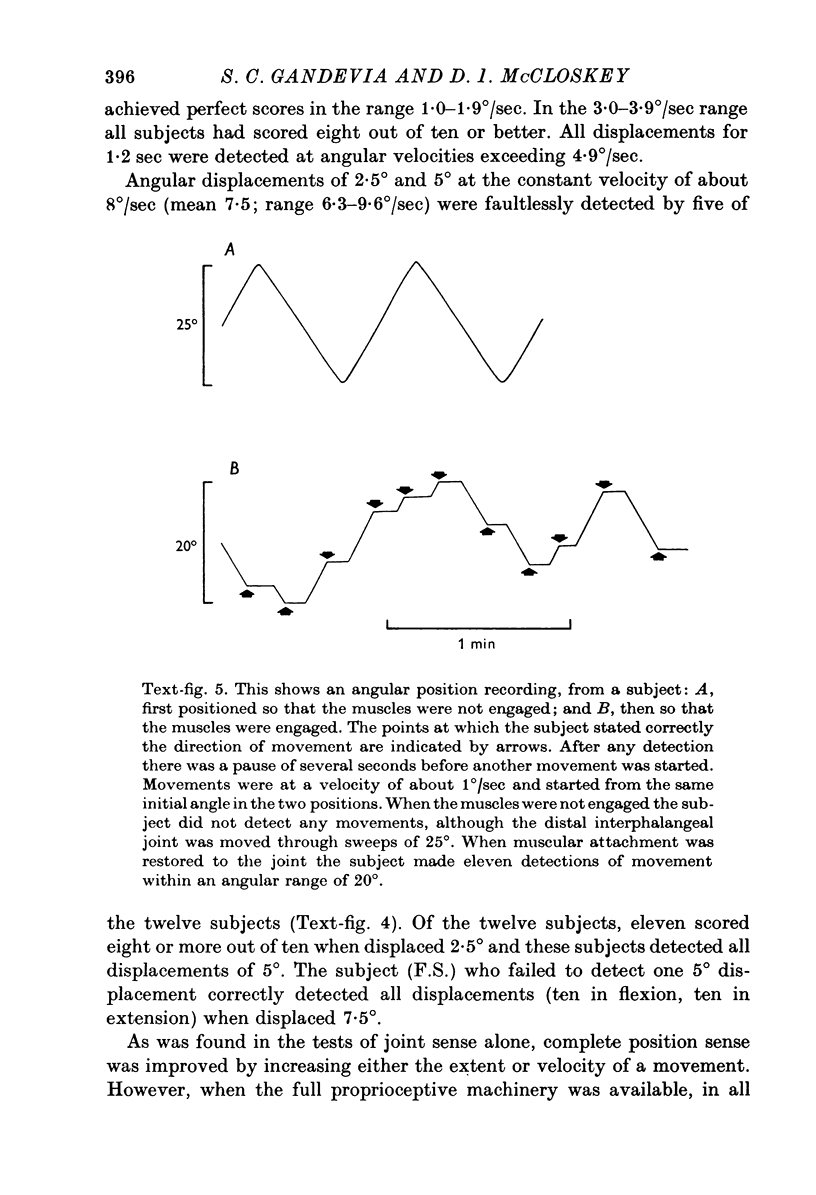
1. An anatomical peculiarity allows the hand to be positioned so that the terminal phalanx of the middle finger cannot be moved by voluntary effort. When positioned in this way only joint and cutaneous mechanisms subserve position sense. By altering the position of the hand the muscles are again engaged and able to move the finger. Moving the joint then also excites muscular afferents. 2. The position sense of twelve subjects was assessed with and without engagement of the muscles at the joint. Three tests were used in which either angular displacement, angular velocity or duration of displacement were held constant. 3. When muscular attachment was restored, performance in all tests was greatly enhanced. As engagement of the muscles caused little change in the 'stiffness' of the joint, it is unlikely that the improved performance resulted from increased discharges from the joint receptors. Cutaneous mechanisms are unlikely to mediate this improvement as they are likely to have been unaffected by engagement of muscles. It is concluded that intramuscular receptors are partly responsible for normal position sense. 4. In seven of the twelve subjects the test finger was anaesthetized to isolate the contribution of intramuscular receptors. This muscle sense was variable. In some subjects it provided accurate kinaesthetic information but in others the information was crude. If with the test finger anaesthetized subjects exerted voluntary tension with the muscles that move the joint the muscle sense was improved.
Full text
PDF




Images in this article
Selected References
These references are in PubMed. This may not be the complete list of references from this article.
- BOYD I. A., ROBERTS T. D. Proprioceptive discharges from stretch-receptors in the knee-joint of the cat. J Physiol. 1953 Oct;122(1):38–58. doi: 10.1113/jphysiol.1953.sp004977. [DOI] [PMC free article] [PubMed] [Google Scholar]
- BROWNE K., LEE J., RING P. A. The sensation of passive movement at the metatarso-phalangeal joint of the great toe in man. man. J Physiol. 1954 Dec 10;126(3):448–458. doi: 10.1113/jphysiol.1954.sp005221. [DOI] [PMC free article] [PubMed] [Google Scholar]
- Burgess P. R., Clark F. J. Characteristics of knee joint receptors in the cat. J Physiol. 1969 Aug;203(2):317–335. doi: 10.1113/jphysiol.1969.sp008866. [DOI] [PMC free article] [PubMed] [Google Scholar]
- COHEN L. A. Activity of knee joint proprioceptors recorded from the posterior articular nerve. Yale J Biol Med. 1955 Dec;28(3-4):225–232. [PMC free article] [PubMed] [Google Scholar]
- COHEN L. A. Contributions of tactile, musculo-tendinous and joint mechanisms to position sense in human shoulder. J Neurophysiol. 1958 Nov;21(6):563–568. doi: 10.1152/jn.1958.21.6.563. [DOI] [PubMed] [Google Scholar]
- Clark F. J., Burgess P. R. Slowly adapting receptors in cat knee joint: can they signal joint angle? J Neurophysiol. 1975 Nov;38(6):1448–1463. doi: 10.1152/jn.1975.38.6.1448. [DOI] [PubMed] [Google Scholar]
- Cross M. J., McCloskey D. I. Position sense following surgical removal of joints in man. Brain Res. 1973 Jun 15;55(2):443–445. doi: 10.1016/0006-8993(73)90310-7. [DOI] [PubMed] [Google Scholar]
- Fukuda Y., Iwama K. A relation between latencies of initial and late spike discharges of rat lateral geniculate cells to optic tract stimulation. Brain Res. 1972 Feb 25;37(2):322–325. doi: 10.1016/0006-8993(72)90678-6. [DOI] [PubMed] [Google Scholar]
- Gelfan S., Carter S. Muscle sense in man. Exp Neurol. 1967 Aug;18(4):469–473. doi: 10.1016/0014-4886(67)90064-7. [DOI] [PubMed] [Google Scholar]
- Goodwin G. M., McCloskey D. I., Matthews P. B. Proprioceptive illusions induced by muscle vibration: contribution by muscle spindles to perception? Science. 1972 Mar 24;175(4028):1382–1384. doi: 10.1126/science.175.4028.1382. [DOI] [PubMed] [Google Scholar]
- Goodwin G. M., McCloskey D. I., Matthews P. B. The contribution of muscle afferents to kinaesthesia shown by vibration induced illusions of movement and by the effects of paralysing joint afferents. Brain. 1972;95(4):705–748. doi: 10.1093/brain/95.4.705. [DOI] [PubMed] [Google Scholar]
- MOUNTCASTLE V. B., POWELL T. P. Central nervous mechanisms subserving position sense and kinesthesis. Bull Johns Hopkins Hosp. 1959 Oct;105:173–200. [PubMed] [Google Scholar]
- Matthews P. B., Simmonds A. Sensations of finger movement elicited by pulling upon flexor tendons in man. J Physiol. 1974 May;239(1):27P–28P. [PubMed] [Google Scholar]
- McCloskey D. I. Differences between the senses of movement and position shown by the effects of loading and vibration of muscles in man. Brain Res. 1973 Oct 26;61:119–131. doi: 10.1016/0006-8993(73)90521-0. [DOI] [PubMed] [Google Scholar]
- Merton P. A. Human position sense and sense of effort. Symp Soc Exp Biol. 1964;18:387–400. [PubMed] [Google Scholar]
- Millar J. Joint afferent fibres responding to muscle stretch, vibration and contraction. Brain Res. 1973 Dec 7;63:380–383. doi: 10.1016/0006-8993(73)90108-x. [DOI] [PubMed] [Google Scholar]
- OSCARSSON O., ROSEN I. PROJECTION TO CEREBRAL CORTEX OF LARGE MUSCLE-SPINDLE AFFERENTS IN FORELIMB NERVES OF THE CAT. J Physiol. 1963 Dec;169:924–945. doi: 10.1113/jphysiol.1963.sp007305. [DOI] [PMC free article] [PubMed] [Google Scholar]
- PROVINS K. A. The effect of peripheral nerve block on the appreciation and execution of finger movements. J Physiol. 1958 Aug 29;143(1):55–67. doi: 10.1113/jphysiol.1958.sp006043. [DOI] [PMC free article] [PubMed] [Google Scholar]
- Paillard J., Brouchon M. A proprioceptive contribution to the spatial encoding of position cues for ballistic movements. Brain Res. 1974 May 17;71(2-3):273–284. doi: 10.1016/0006-8993(74)90971-8. [DOI] [PubMed] [Google Scholar]
- Phillips C. G., Powell T. P., Wiesendanger M. Projection from low-threshold muscle afferents of hand and forearm to area 3a of baboon's cortex. J Physiol. 1971 Sep;217(2):419–446. doi: 10.1113/jphysiol.1971.sp009579. [DOI] [PMC free article] [PubMed] [Google Scholar]
- SKOGLUND S. Anatomical and physiological studies of knee joint innervation in the cat. Acta Physiol Scand Suppl. 1956;36(124):1–101. [PubMed] [Google Scholar]
- STOUGHTON R. B., FRITSCH W. INFLUENCE OF DIMETHYLSULFOXIDE (DMSO) ON HUMAN PERCUTANEOUS ABSORPTION. Arch Dermatol. 1964 Nov;90:512–517. doi: 10.1001/archderm.1964.01600050060012. [DOI] [PubMed] [Google Scholar]
- Skavenski A. A. Inflow as a source of extraretinal eye position information. Vision Res. 1972 Feb;12(2):221–229. doi: 10.1016/0042-6989(72)90113-7. [DOI] [PubMed] [Google Scholar]
- Talbot W. H., Darian-Smith I., Kornhuber H. H., Mountcastle V. B. The sense of flutter-vibration: comparison of the human capacity with response patterns of mechanoreceptive afferents from the monkey hand. J Neurophysiol. 1968 Mar;31(2):301–334. doi: 10.1152/jn.1968.31.2.301. [DOI] [PubMed] [Google Scholar]
- Vallbo A. B. Afferent discharge from human muscle spindles in non-contracting muscles. Steady state impulse frequency as a function of joint angle. Acta Physiol Scand. 1974 Feb;90(2):303–318. doi: 10.1111/j.1748-1716.1974.tb05593.x. [DOI] [PubMed] [Google Scholar]
- Vallbo A. B. Human muscle spindle discharge during isometric voluntary contractions. Amplitude relations between spindle frequency and torque. Acta Physiol Scand. 1974 Feb;90(2):319–336. doi: 10.1111/j.1748-1716.1974.tb05594.x. [DOI] [PubMed] [Google Scholar]