



Abstract
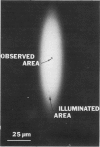
An experimental application of total internal reflection with fluorescence correlation spectroscopy (TIR/FCS) is presented. TIR/FCS is a new technique for measuring the binding and unbinding rates and surface diffusion coefficient of fluorescent-labeled solute molecules in equilibrium at a surface. A laser beam totally internally reflects at the solid-liquid interface, selectively exciting surface-adsorbed molecules. Fluorescence collected by a microscope from a small, well-defined surface area approximately 5 micron2 spontaneously fluctuates as solute molecules randomly bind to, unbind from, and/or diffuse along the surface in chemical equilibrium. The fluorescence is detected by a photomultiplier and autocorrelated on-line by a minicomputer. The shape of the autocorrelation function depends on the bulk and surface diffusion coefficients, the binding rate constants, and the shape of the illuminated and observed region. The normalized amplitude of the autocorrelation function depends on the average number of molecules bound within the observed area. TIR/FCS requires no spectroscopic or thermodynamic change between dissociated and complexed states and no extrinsic perturbation from equilibrium. Using TIR/FCS, we determine that rhodamine-labeled immunoglobulin and insulin each nonspecifically adsorb to serum albumin-coated fused silica with both reversible and irreversible components. The characteristic time of the most rapidly reversible component measured is approximately 5 ms and is limited by the rate of bulk diffusion. Rhodamine-labeled bivalent antibodies to dinitrophenyl (DNP) bind to DNP-coated fused silica virtually irreversibly. Univalent Fab fragments of these same antibodies appear to specifically bind to DNP-coated fused silica, accompanied by a large amount of nonspecific binding. TIR/FCS is shown to be a feasible technique for measuring absorption/desorption kinetic rates at equilibrium. In suitable systems where nonspecific binding is low, TIR/FCS should prove useful for measuring specific solute-surface kinetic rates.
Full text
PDF


Images in this article
Selected References
These references are in PubMed. This may not be the complete list of references from this article.
- Amante L., Ancona A., Forni L. The conjugation of immunoglobulins with tetramethylrhodamine isothiocyanate. A comparison between the amorphous and the crystalline fluorochrome. J Immunol Methods. 1972 May;1(3):289–301. doi: 10.1016/0022-1759(72)90006-3. [DOI] [PubMed] [Google Scholar]
- Axelrod D. Carbocyanine dye orientation in red cell membrane studied by microscopic fluorescence polarization. Biophys J. 1979 Jun;26(3):557–573. doi: 10.1016/S0006-3495(79)85271-6. [DOI] [PMC free article] [PubMed] [Google Scholar]
- Axelrod D. Cell surface heating during fluorescence photobleaching recovery experiments. Biophys J. 1977 Apr;18(1):129–131. doi: 10.1016/S0006-3495(77)85601-4. [DOI] [PMC free article] [PubMed] [Google Scholar]
- Axelrod D. Cell-substrate contacts illuminated by total internal reflection fluorescence. J Cell Biol. 1981 Apr;89(1):141–145. doi: 10.1083/jcb.89.1.141. [DOI] [PMC free article] [PubMed] [Google Scholar]
- Axelrod D., Koppel D. E., Schlessinger J., Elson E., Webb W. W. Mobility measurement by analysis of fluorescence photobleaching recovery kinetics. Biophys J. 1976 Sep;16(9):1055–1069. doi: 10.1016/S0006-3495(76)85755-4. [DOI] [PMC free article] [PubMed] [Google Scholar]
- Axelrod D., Thompson N. L., Burghardt T. P. Total internal inflection fluorescent microscopy. J Microsc. 1983 Jan;129(Pt 1):19–28. doi: 10.1111/j.1365-2818.1983.tb04158.x. [DOI] [PubMed] [Google Scholar]
- Berg H. C., Purcell E. M. Physics of chemoreception. Biophys J. 1977 Nov;20(2):193–219. doi: 10.1016/S0006-3495(77)85544-6. [DOI] [PMC free article] [PubMed] [Google Scholar]
- Borejdo J. Motion of myosin fragments during actin-activated ATPase: fluorescence correlation spectroscopy study. Biopolymers. 1979 Nov;18(11):2807–2820. doi: 10.1002/bip.1979.360181111. [DOI] [PubMed] [Google Scholar]
- Borejdo J., Putnam S., Morales M. F. Fluctuations in polarized fluorescence: evidence that muscle cross bridges rotate repetitively during contraction. Proc Natl Acad Sci U S A. 1979 Dec;76(12):6346–6350. doi: 10.1073/pnas.76.12.6346. [DOI] [PMC free article] [PubMed] [Google Scholar]
- Burghardt T. P., Axelrod D. Total internal reflection fluorescence study of energy transfer in surface-adsorbed and dissolved bovine serum albumin. Biochemistry. 1983 Feb 15;22(4):979–985. doi: 10.1021/bi00273a042. [DOI] [PubMed] [Google Scholar]
- Burghardt T. P., Axelrod D. Total internal reflection/fluorescence photobleaching recovery study of serum albumin adsorption dynamics. Biophys J. 1981 Mar;33(3):455–467. doi: 10.1016/S0006-3495(81)84906-5. [DOI] [PMC free article] [PubMed] [Google Scholar]
- Dragsten P. R., Webb W. W. Mechanism of the membrane potential sensitivity of the fluorescent membrane probe merocyanine 540. Biochemistry. 1978 Nov 28;17(24):5228–5240. doi: 10.1021/bi00617a024. [DOI] [PubMed] [Google Scholar]
- Dubbelman T. M., de Goeij A. F., van Steveninck J. Photodynamic effects of protoporphyrin on human erythrocytes. Nature of the cross-linking of membrane proteins. Biochim Biophys Acta. 1978 Aug 4;511(2):141–151. doi: 10.1016/0005-2736(78)90309-7. [DOI] [PubMed] [Google Scholar]
- Ehrenberg M., Rigler R. Fluorescence correlation spectroscopy applied to rotational diffusion of macromolecules. Q Rev Biophys. 1976 Feb;9(1):69–81. doi: 10.1017/s003358350000216x. [DOI] [PubMed] [Google Scholar]
- Eisen H. N., Simms E. S., Potter M. Mouse myeloma proteins with antihapten antibody acitivity. The protein produced by plasma cell tumor MOPC-315. Biochemistry. 1968 Nov;7(11):4126–4134. doi: 10.1021/bi00851a048. [DOI] [PubMed] [Google Scholar]
- Fahey P. F., Koppel D. E., Barak L. S., Wolf D. E., Elson E. L., Webb W. W. Lateral diffusion in planar lipid bilayers. Science. 1977 Jan 21;195(4275):305–306. doi: 10.1126/science.831279. [DOI] [PubMed] [Google Scholar]
- Fahey P. F., Webb W. W. Lateral diffusion in phospholipid bilayer membranes and multilamellar liquid crystals. Biochemistry. 1978 Jul 25;17(15):3046–3053. doi: 10.1021/bi00608a016. [DOI] [PubMed] [Google Scholar]
- Giaever I. A simple visual surface immunology test. J Immunol Methods. 1978;24(1-2):57–61. doi: 10.1016/0022-1759(78)90086-8. [DOI] [PubMed] [Google Scholar]
- Goetzl E. J., Metzger H. Affinity labeling of a mouse myeloma protein which binds nitrophenyl ligands. Kinetics of labeling and isolation of a labeled peptide. Biochemistry. 1970 Mar 3;9(5):1267–1278. doi: 10.1021/bi00807a031. [DOI] [PubMed] [Google Scholar]
- Grinnell F., Feld M. K. Fibronectin adsorption on hydrophilic and hydrophobic surfaces detected by antibody binding and analyzed during cell adhesion in serum-containing medium. J Biol Chem. 1982 May 10;257(9):4888–4893. [PubMed] [Google Scholar]
- Hirschfeld T., Block M. J., Mueller W. Virometer: an optical instrument for visual observation, measurement and classification of free viruses. J Histochem Cytochem. 1977 Jul;25(7):719–723. doi: 10.1177/25.7.70452. [DOI] [PubMed] [Google Scholar]
- Horbett T. A., Weathersby P. K. Adsorption of proteins from plasma to a series of hydrophilic-hydrophobic copolymers. I. Analysis with the in situ radioiodination technique. J Biomed Mater Res. 1981 May;15(3):403–423. doi: 10.1002/jbm.820150311. [DOI] [PubMed] [Google Scholar]
- Janatova J., Fuller J. K., Hunter M. J. The heterogeneity of bovine albumin with respect to sulfhydryl and dimer content. J Biol Chem. 1968 Jul 10;243(13):3612–3622. [PubMed] [Google Scholar]
- Kahn C. R. Membrane receptors for hormones and neurotransmitters. J Cell Biol. 1976 Aug;70(2 Pt 1):261–286. doi: 10.1083/jcb.70.2.261. [DOI] [PMC free article] [PubMed] [Google Scholar]
- Koppel D. E., Axelrod D., Schlessinger J., Elson E. L., Webb W. W. Dynamics of fluorescence marker concentration as a probe of mobility. Biophys J. 1976 Nov;16(11):1315–1329. doi: 10.1016/S0006-3495(76)85776-1. [DOI] [PMC free article] [PubMed] [Google Scholar]
- Kronick M. N., Little W. A. A new immunoassay based on fluorescence excitation by internal reflection spectroscopy. J Immunol Methods. 1975 Sep;8(3):235–240. doi: 10.1016/0022-1759(75)90116-7. [DOI] [PubMed] [Google Scholar]
- LOWRY O. H., ROSEBROUGH N. J., FARR A. L., RANDALL R. J. Protein measurement with the Folin phenol reagent. J Biol Chem. 1951 Nov;193(1):265–275. [PubMed] [Google Scholar]
- Lahav J., Schwartz M. A., Hynes R. O. Analysis of platelet adhesion with a radioactive chemical crosslinking reagent: interaction of thrombospondin with fibronectin and collagen. Cell. 1982 Nov;31(1):253–262. doi: 10.1016/0092-8674(82)90425-1. [DOI] [PubMed] [Google Scholar]
- Lanni F., Taylor D. L., Ware B. R. Fluorescence photobleaching recovery in solutions of labeled actin. Biophys J. 1981 Aug;35(2):351–364. doi: 10.1016/S0006-3495(81)84794-7. [DOI] [PMC free article] [PubMed] [Google Scholar]
- Macritchie F. Proteins at interfaces. Adv Protein Chem. 1978;32:283–326. doi: 10.1016/s0065-3233(08)60577-x. [DOI] [PubMed] [Google Scholar]
- Magde D., Elson E. L., Webb W. W. Fluorescence correlation spectroscopy. II. An experimental realization. Biopolymers. 1974 Jan;13(1):29–61. doi: 10.1002/bip.1974.360130103. [DOI] [PubMed] [Google Scholar]
- Nicoli D. F., Briggs J., Elings V. B. Fluorescence immunoassay based on long time correlations of number fluctuations. Proc Natl Acad Sci U S A. 1980 Aug;77(8):4904–4908. doi: 10.1073/pnas.77.8.4904. [DOI] [PMC free article] [PubMed] [Google Scholar]
- Potter M. Immunoglobulin-producing tumors and myeloma proteins of mice. Physiol Rev. 1972 Jul;52(3):631–719. doi: 10.1152/physrev.1972.52.3.631. [DOI] [PubMed] [Google Scholar]
- Potter M., Lieberman R. Common individual antigenic determinants in five of eight BALB-c IgA myeloma proteins that bind phosphoryl choline. J Exp Med. 1970 Oct 1;132(4):737–751. doi: 10.1084/jem.132.4.737. [DOI] [PMC free article] [PubMed] [Google Scholar]
- Roberts H., Hess B. Kinetics of cytochrome c oxidase from yeast. Membrane-facilitated electrostatic binding of cytochrone c showing a specific interaction with cytochrome c oxidase and inhibition by ATP. Biochim Biophys Acta. 1977 Oct 12;462(1):215–234. doi: 10.1016/0005-2728(77)90204-3. [DOI] [PubMed] [Google Scholar]
- Shechter Y., Schlessinger J., Jacobs S., Chang K. J., Cuatrecasas P. Fluorescent labeling of hormone receptors in viable cells: preparation and properties of highly fluorescent derivatives of epidermal growth factor and insulin. Proc Natl Acad Sci U S A. 1978 May;75(5):2135–2139. doi: 10.1073/pnas.75.5.2135. [DOI] [PMC free article] [PubMed] [Google Scholar]
- Sheetz M. P., Koppel D. E. Membrane damage caused by irradiation of fluorescent concanavalin A. Proc Natl Acad Sci U S A. 1979 Jul;76(7):3314–3317. doi: 10.1073/pnas.76.7.3314. [DOI] [PMC free article] [PubMed] [Google Scholar]
- Sorscher S. M., Bartholomew J. C., Klein M. P. The use of fluorescence correlations spectroscopy to probe chromatin in the cell nucleus. Biochim Biophys Acta. 1980 Nov 14;610(1):28–46. doi: 10.1016/0005-2787(80)90053-2. [DOI] [PubMed] [Google Scholar]
- Taylor D. L., Wang Y. L. Fluorescently labelled molecules as probes of the structure and function of living cells. Nature. 1980 Apr 3;284(5755):405–410. doi: 10.1038/284405a0. [DOI] [PubMed] [Google Scholar]
- Thompson N. L., Burghardt T. P., Axelrod D. Measuring surface dynamics of biomolecules by total internal reflection fluorescence with photobleaching recovery or correlation spectroscopy. Biophys J. 1981 Mar;33(3):435–454. doi: 10.1016/S0006-3495(81)84905-3. [DOI] [PMC free article] [PubMed] [Google Scholar]
- Thompson N. L. Surface binding rates of nonfluorescent molecules may be obtained by total internal reflection with fluorescence correlation spectroscopy. Biophys J. 1982 Jun;38(3):327–329. doi: 10.1016/S0006-3495(82)84567-0. [DOI] [PMC free article] [PubMed] [Google Scholar]
- Underdown B. J., Simms E. S., Eisen H. N. Subunit structure and number of combining sites of the immunoglobulin A myeloma protein produced by mouse plasmacytoma MOPC-315. Biochemistry. 1971 Nov 23;10(24):4359–4368. doi: 10.1021/bi00800a002. [DOI] [PubMed] [Google Scholar]
- Watkins R. W., Robertson C. R. A total internal-reflection technique for the examination of protein adsorption. J Biomed Mater Res. 1977 Nov;11(6):915–938. doi: 10.1002/jbm.820110611. [DOI] [PubMed] [Google Scholar]
- Weis R. M., Balakrishnan K., Smith B. A., McConnell H. M. Stimulation of fluorescence in a small contact region between rat basophil leukemia cells and planar lipid membrane targets by coherent evanescent radiation. J Biol Chem. 1982 Jun 10;257(11):6440–6445. [PubMed] [Google Scholar]
- Weissman M., Schindler H., Feher G. Determination of molecular weights by fluctuation spectroscopy: application to DNA. Proc Natl Acad Sci U S A. 1976 Aug;73(8):2776–2780. doi: 10.1073/pnas.73.8.2776. [DOI] [PMC free article] [PubMed] [Google Scholar]
- Wong M., Bayer M. E., Litwin S. Virus--cell interaction: prediction of the time course of observable effects from virus interaction at cell injection sites, and mechanisms leading to attachment. FEBS Lett. 1978 Nov 1;95(1):26–30. doi: 10.1016/0014-5793(78)80044-1. [DOI] [PubMed] [Google Scholar]