



Abstract
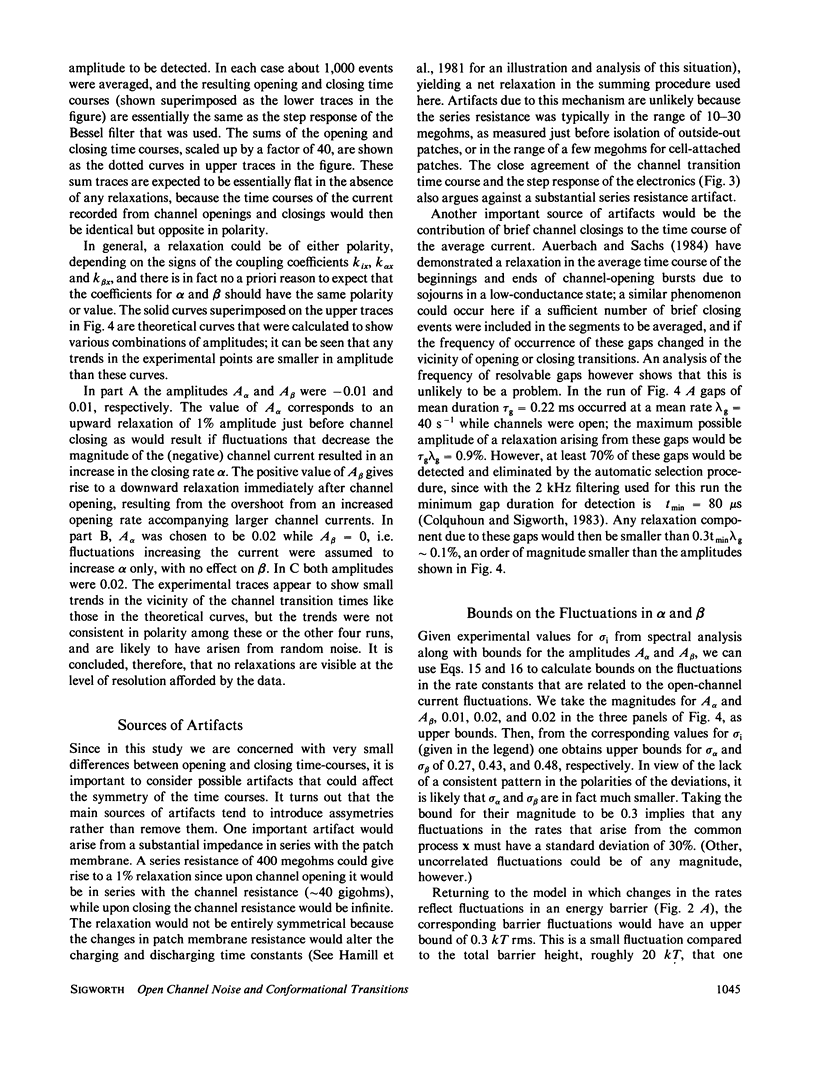
The first paper of this series demonstrated that the open-channel currents in the acetylcholine receptors in cultured rat muscle show fluctuations on a time scale of approximately 1 ms. In this paper the hypothesis is tested that these fluctuations are coupled to the gating mechanism that opens and closes the channel. Such a coupling could arise if the channel current and the energy barrier for gating transitions both showed fluctuations having a common origin such as a motion of part of the receptor molecule. A test for coupled fluctuations is made by averaging approximately 1,000 channel opening or closing transitions to search for the small relaxation in the current that is predicted. At a resolution of approximately 1% of the single-channel current amplitude, no such relaxation is observed. It is concluded that any coupled fluctuations are small; fluctuations in the energy barrier for the open-closed conformational transition must be smaller than about 0.3 kT.
Full text
PDF
Selected References
These references are in PubMed. This may not be the complete list of references from this article.
- Auerbach A., Sachs F. Flickering of a nicotinic ion channel to a subconductance state. Biophys J. 1983 Apr;42(1):1–10. doi: 10.1016/S0006-3495(83)84362-8. [DOI] [PMC free article] [PubMed] [Google Scholar]
- Hamill O. P., Marty A., Neher E., Sakmann B., Sigworth F. J. Improved patch-clamp techniques for high-resolution current recording from cells and cell-free membrane patches. Pflugers Arch. 1981 Aug;391(2):85–100. doi: 10.1007/BF00656997. [DOI] [PubMed] [Google Scholar]
- Sigworth F. J. Open channel noise. I. Noise in acetylcholine receptor currents suggests conformational fluctuations. Biophys J. 1985 May;47(5):709–720. doi: 10.1016/S0006-3495(85)83968-0. [DOI] [PMC free article] [PubMed] [Google Scholar]