



Abstract
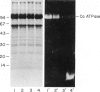
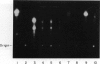
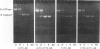
Ca2+-ATPase molecules were labeled in intact sarcoplasmic reticulum (SR) vesicles, sequentially with a donor fluorophore, fluorescein-5'-isothiocyanate (FITC), and with an acceptor fluorophore, eosin-5'-isothiocyanate (EITC), each at a mole ratio of 0.25-0.5 mol/mol of ATPase. The resonance energy transfer was determined from the effect of acceptor on the intensity and lifetime of donor fluorescence. Due to structural similarities, the two dyes compete for the same site(s) on the Ca2+-ATPase, and under optimal conditions each ATPase molecule is labeled either with donor or acceptor fluorophore, but not with both. There is only slight labeling of phospholipids and other proteins in SR, even at concentrations of FITC or EITC higher than those used in the reported experiments. Efficient energy transfer was observed from the covalently bound FITC to EITC that is assumed to reflect interaction between ATPase molecules. Protein denaturing agents (8 M urea and 4 M guanidine) or nonsolubilizing concentrations of detergents (C12E8 or lysolecithin) abolish the energy transfer. These results are consistent with earlier observations that a large portion of the Ca2+-ATPase is present in oligomeric form in the native membrane. The technique is suitable for kinetic analysis of the effect of various treatments on the monomer-oligomer equilibrium of Ca2+-ATPase. A drawback of the method is that the labeled ATPase, although it retains conformational responses, is enzymatically inactive.
Full text
PDF


Images in this article
Selected References
These references are in PubMed. This may not be the complete list of references from this article.
- Andersen J. P., Møller J. V., Jørgensen P. L. The functional unit of sarcoplasmic reticulum Ca2+-ATPase. Active site titration and fluorescence measurements. J Biol Chem. 1982 Jul 25;257(14):8300–8307. [PubMed] [Google Scholar]
- Beeler T. J. Ca2+ uptake and membrane potential in sarcoplasmic reticulum vesicles. J Biol Chem. 1980 Oct 10;255(19):9156–9161. [PubMed] [Google Scholar]
- Beeler T. J., Dux L., Martonosi A. N. Effect of Na3VO4 and membrane potential on the structure of sarcoplasmic reticulum membrane. J Membr Biol. 1984;78(1):73–79. doi: 10.1007/BF01872534. [DOI] [PubMed] [Google Scholar]
- Beeler T. J., Farmen R. H., Martonosi A. N. The mechanism of voltage-sensitive dye responses on sarcoplasmic reticulum. J Membr Biol. 1981;62(1-2):113–137. doi: 10.1007/BF01870205. [DOI] [PubMed] [Google Scholar]
- Brandl C. J., Green N. M., Korczak B., MacLennan D. H. Two Ca2+ ATPase genes: homologies and mechanistic implications of deduced amino acid sequences. Cell. 1986 Feb 28;44(4):597–607. doi: 10.1016/0092-8674(86)90269-2. [DOI] [PubMed] [Google Scholar]
- Bürkli A., Cherry R. J. Rotational motion and flexibility of Ca2+,Mg2+-dependent adenosine 5'-triphosphatase in sarcoplasmic reticulum membranes. Biochemistry. 1981 Jan 6;20(1):138–145. doi: 10.1021/bi00504a023. [DOI] [PubMed] [Google Scholar]
- Castellani L., Hardwicke P. M., Vibert P. Dimer ribbons in the three-dimensional structure of sarcoplasmic reticulum. J Mol Biol. 1985 Oct 5;185(3):579–594. doi: 10.1016/0022-2836(85)90073-7. [DOI] [PubMed] [Google Scholar]
- Champeil P., Rigaud J. L., Gingold M. P. Fluorescence energy transfer between ATPase monomers in sarcoplasmic reticulum reconstituted vesicles, in the presence of low concentrations of a nonionic detergent. Z Naturforsch C. 1982 May-Jun;37(5-6):513–516. doi: 10.1515/znc-1982-5-624. [DOI] [PubMed] [Google Scholar]
- Csermely P., Varga S., Martonosi A. Competition between decavanadate and fluorescein isothiocyanate on the Ca2+-ATPase of sarcoplasmic reticulum. Eur J Biochem. 1985 Aug 1;150(3):455–460. doi: 10.1111/j.1432-1033.1985.tb09043.x. [DOI] [PubMed] [Google Scholar]
- Dean W. L., Tanford C. Properties of a delipidated, detergent-activated Ca2+--ATPase. Biochemistry. 1978 May 2;17(9):1683–1690. doi: 10.1021/bi00602a016. [DOI] [PubMed] [Google Scholar]
- Dean W. L., Tanford C. Reactivation of lipid-depleted Ca2+-ATPase by a nonionic detergent. J Biol Chem. 1977 May 25;252(10):3551–3553. [PubMed] [Google Scholar]
- Dux L., Martonosi A. Ca2+-ATPase membrane crystals in sarcoplasmic reticulum. The effect of trypsin digestion. J Biol Chem. 1983 Aug 25;258(16):10111–10115. [PubMed] [Google Scholar]
- Dux L., Martonosi A. The regulation of ATPase-ATPase interactions in sarcoplasmic reticulum membrane. I. The effects of Ca2+, ATP, and inorganic phosphate. J Biol Chem. 1983 Oct 10;258(19):11896–11902. [PubMed] [Google Scholar]
- Dux L., Martonosi A. Two-dimensional arrays of proteins in sarcoplasmic reticulum and purified Ca2+-ATPase vesicles treated with vanadate. J Biol Chem. 1983 Feb 25;258(4):2599–2603. [PubMed] [Google Scholar]
- Dux L., Papp S., Martonosi A. Conformational responses of the tryptic cleavage products of the Ca2+-ATPase of sarcoplasmic reticulum. J Biol Chem. 1985 Nov 5;260(25):13454–13458. [PubMed] [Google Scholar]
- Dux L., Taylor K. A., Ting-Beall H. P., Martonosi A. Crystallization of the Ca2+-ATPase of sarcoplasmic reticulum by calcium and lanthanide ions. J Biol Chem. 1985 Sep 25;260(21):11730–11743. [PubMed] [Google Scholar]
- Epe B., Steinhäuser K. G., Woolley P. Theory of measurement of Förster-type energy transfer in macromolecules. Proc Natl Acad Sci U S A. 1983 May;80(9):2579–2583. doi: 10.1073/pnas.80.9.2579. [DOI] [PMC free article] [PubMed] [Google Scholar]
- Ferguson D. G., Franzini-Armstrong C., Castellani L., Hardwicke P. M., Kenney L. J. Ordered arrays of Ca2+-ATPase on the cytoplasmic surface of isolated sarcoplasmic reticulum. Biophys J. 1985 Oct;48(4):597–605. doi: 10.1016/S0006-3495(85)83815-7. [DOI] [PMC free article] [PubMed] [Google Scholar]
- Franzini-Armstrong C., Ferguson D. G. Density and disposition of Ca2+-ATPase in sarcoplasmic reticulum membrane as determined by shadowing techniques. Biophys J. 1985 Oct;48(4):607–615. doi: 10.1016/S0006-3495(85)83816-9. [DOI] [PMC free article] [PubMed] [Google Scholar]
- Gingold M. P., Rigaud J. L., Champeil P. Fluorescence energy transfer between ATPase monomers in sarcoplasmic reticulum reconstituted vesicles. Biochimie. 1981 Nov-Dec;63(11-12):923–925. doi: 10.1016/s0300-9084(82)80288-5. [DOI] [PubMed] [Google Scholar]
- Hardwicke P. M., Green N. M. The effect of delipidation on the adenosine triphosphatase of sarcoplasmic reticulum. Electron microscopy and physical properties. Eur J Biochem. 1974 Feb 15;42(1):183–193. doi: 10.1111/j.1432-1033.1974.tb03328.x. [DOI] [PubMed] [Google Scholar]
- Herbette L., Scarpa A., Blasie J. K., Wang C. T., Hymel L., Seelig J., Fleischer S. The determination of the separate Ca2+ pump protein and phospholipid profile structures within reconstituted sarcoplasmic reticulum membranes via X-ray and neutron diffraction. Biochim Biophys Acta. 1983 May 5;730(2):369–378. doi: 10.1016/0005-2736(83)90354-1. [DOI] [PubMed] [Google Scholar]
- Jona I., Martonosi A. The effects of membrane potential and lanthanides on the conformation of the Ca2+-transport ATPase in sarcoplasmic reticulum. Biochem J. 1986 Mar 1;234(2):363–371. doi: 10.1042/bj2340363. [DOI] [PMC free article] [PubMed] [Google Scholar]
- Kondo M., Kasai M. Photodynamic inactivation of sarcoplasmic reticulum vesicle membranes by xanthene dyes. Photochem Photobiol. 1974 Jan;19(1):35–41. doi: 10.1111/j.1751-1097.1974.tb06471.x. [DOI] [PubMed] [Google Scholar]
- LOWRY O. H., ROSEBROUGH N. J., FARR A. L., RANDALL R. J. Protein measurement with the Folin phenol reagent. J Biol Chem. 1951 Nov;193(1):265–275. [PubMed] [Google Scholar]
- Lüdi H., Hasselbach W. Excimer formation of ATPase from sarcoplasmic reticulum labeled with N-(3-pyrene)maleinimide. Eur J Biochem. 1983 Jan 17;130(1):5–8. doi: 10.1111/j.1432-1033.1983.tb07108.x. [DOI] [PubMed] [Google Scholar]
- Lüdi H., Hasselbach W. Fluorescence studies on N-(3-pyrene)maleinimide-labeled sarcoplasmic reticulum ATPase in native and solubilized membranes. Z Naturforsch C. 1982 Nov-Dec;37(11-12):1170–1179. doi: 10.1515/znc-1982-11-1220. [DOI] [PubMed] [Google Scholar]
- MARTONOSI A., FERETOS R. SARCOPLASMIC RETICULUM. I. THE UPTAKE OF CA++ BY SARCOPLASMIC RETICULUM FRAGMENTS. J Biol Chem. 1964 Feb;239:648–658. [PubMed] [Google Scholar]
- MacLennan D. H., Brandl C. J., Korczak B., Green N. M. Amino-acid sequence of a Ca2+ + Mg2+-dependent ATPase from rabbit muscle sarcoplasmic reticulum, deduced from its complementary DNA sequence. Nature. 1985 Aug 22;316(6030):696–700. doi: 10.1038/316696a0. [DOI] [PubMed] [Google Scholar]
- Martin D. W. Active unit of solubilized sarcoplasmic reticulum calcium adenosinetriphosphatase: an active enzyme centrifugation analysis. Biochemistry. 1983 Apr 26;22(9):2276–2282. doi: 10.1021/bi00278a034. [DOI] [PubMed] [Google Scholar]
- Martin D. W., Tanford C., Reynolds J. A. Monomeric solubilized sarcoplasmic reticulum Ca pump protein: demonstration of Ca binding and dissociation coupled to ATP hydrolysis. Proc Natl Acad Sci U S A. 1984 Nov;81(21):6623–6626. doi: 10.1073/pnas.81.21.6623. [DOI] [PMC free article] [PubMed] [Google Scholar]
- Martonosi A. N. Mechanisms of Ca2+ release from sarcoplasmic reticulum of skeletal muscle. Physiol Rev. 1984 Oct;64(4):1240–1320. doi: 10.1152/physrev.1984.64.4.1240. [DOI] [PubMed] [Google Scholar]
- Martonosi A. The effect of ATP upon the reactivity of SH groups in sarcoplasmic reticulum membranes. FEBS Lett. 1976 Aug 15;67(2):153–155. doi: 10.1016/0014-5793(76)80354-7. [DOI] [PubMed] [Google Scholar]
- Masotti L., Urry D. W., Krivacic J. R., Long M. M. Circular dichroism of biological membranes. II. Plasma membranes and sarcotubular vesicles. Biochim Biophys Acta. 1972 Apr 14;266(1):7–17. doi: 10.1016/0005-2736(72)90114-9. [DOI] [PubMed] [Google Scholar]
- Mommaerts W. F. Conformational studies on the membrane protein of sarcotubular vesicles. Proc Natl Acad Sci U S A. 1967 Dec;58(6):2476–2482. doi: 10.1073/pnas.58.6.2476. [DOI] [PMC free article] [PubMed] [Google Scholar]
- Morris S. J., Silbergeld E. K., Brown R. R., Haynes D. H. Erythrosin B (USFD&C RED 3) inhibits calcium transport and atpase activity of muscle sarcoplasmic reticulum. Biochem Biophys Res Commun. 1982 Feb 26;104(4):1306–1311. doi: 10.1016/0006-291x(82)91392-4. [DOI] [PubMed] [Google Scholar]
- Møller J. V., Andersen J. P., le Maire M. The sarcoplasmic reticulum Ca2+-ATPase. Mol Cell Biochem. 1982 Feb 5;42(2):83–107. doi: 10.1007/BF00222696. [DOI] [PubMed] [Google Scholar]
- Nakamoto R. K., Inesi G. Retention of ellipticity between enzymatic states of the Ca2+-ATPase of sarcoplasmic reticulum. FEBS Lett. 1986 Jan 6;194(2):258–262. doi: 10.1016/0014-5793(86)80096-5. [DOI] [PubMed] [Google Scholar]
- Nakamura H., Jilka R. L., Boland R., Martonosi A. N. Mechanism of ATP hydrolysis by sarcoplasmic reticulum and the role of phospholipids. J Biol Chem. 1976 Sep 10;251(17):5414–5423. [PubMed] [Google Scholar]
- Papp S., Kracke G., Joshi N., Martonosi A. The reaction of N-(1-pyrene)maleimide with sarcoplasmic reticulum. Biophys J. 1986 Feb;49(2):411–424. doi: 10.1016/S0006-3495(86)83651-7. [DOI] [PMC free article] [PubMed] [Google Scholar]
- Pick U., Bassilian S. Modification of the ATP binding site of the Ca2+ -ATPase from sarcoplasmic reticulum by fluorescein isothiocyanate. FEBS Lett. 1981 Jan 12;123(1):127–130. doi: 10.1016/0014-5793(81)80035-x. [DOI] [PubMed] [Google Scholar]
- Pick U., Karlish S. J. Indications for an oligomeric structure and for conformational changes in sarcoplasmic reticulum Ca2+-ATPase labelled selectively with fluorescein. Biochim Biophys Acta. 1980 Nov 20;626(1):255–261. doi: 10.1016/0005-2795(80)90216-0. [DOI] [PubMed] [Google Scholar]
- Pick U., Karlish S. J. Regulation of the conformation transition in the Ca-ATPase from sarcoplasmic reticulum by pH, temperature, and calcium ions. J Biol Chem. 1982 Jun 10;257(11):6120–6126. [PubMed] [Google Scholar]
- Restall C. J., Arrondo J. L., Elliot D. A., Jaśkowska A., Weber W. V., Chapman D. Protein rotation, enzyme activity and photooxidation of SH groups in sarcoplasmic reticulum Ca2+-ATPase. Biochim Biophys Acta. 1981 Oct 28;670(3):433–440. doi: 10.1016/0005-2795(81)90118-5. [DOI] [PubMed] [Google Scholar]
- Restall C. J., Coke M., Murray E. K., Chapman D. Conformational changes in the (Ca2+ + Mg2+)-ATPase of sarcoplasmic reticulum detected using phosphorescence polarization. Biochim Biophys Acta. 1985 Feb 28;813(1):96–102. doi: 10.1016/0005-2736(85)90349-9. [DOI] [PubMed] [Google Scholar]
- Silva J. L., Verjovski-Almeida S. Monomer-dimer association constant of solubilized sarcoplasmic reticulum ATPase. J Biol Chem. 1985 Apr 25;260(8):4764–4769. [PubMed] [Google Scholar]
- Speirs A., Moore C. H., Boxer D. H., Garland P. B. Segmental motion and rotational diffusion of the Ca2+-translocating adenosine triphosphatase of sarcoplasmic reticulum, measured by time-resolved phosphorescence depolarization. Biochem J. 1983 Jul 1;213(1):67–74. doi: 10.1042/bj2130067. [DOI] [PMC free article] [PubMed] [Google Scholar]
- Stryer L. Fluorescence energy transfer as a spectroscopic ruler. Annu Rev Biochem. 1978;47:819–846. doi: 10.1146/annurev.bi.47.070178.004131. [DOI] [PubMed] [Google Scholar]
- Tanford C. Twenty questions concerning the reaction cycle of the sarcoplasmic reticulum calcium pump. CRC Crit Rev Biochem. 1984;17(2):123–151. doi: 10.3109/10409238409113603. [DOI] [PubMed] [Google Scholar]
- Taylor K. A., Dux L., Martonosi A. Three-dimensional reconstruction of negatively stained crystals of the Ca2+-ATPase from muscle sarcoplasmic reticulum. J Mol Biol. 1986 Feb 5;187(3):417–427. doi: 10.1016/0022-2836(86)90442-0. [DOI] [PubMed] [Google Scholar]
- Taylor K., Dux L., Martonosi A. Structure of the vanadate-induced crystals of sarcoplasmic reticulum Ca2+-ATPase. J Mol Biol. 1984 Mar 25;174(1):193–204. doi: 10.1016/0022-2836(84)90372-3. [DOI] [PubMed] [Google Scholar]
- Vanderkooi J. M., Ierokomas A., Nakamura H., Martonosi A. Fluorescence energy transfer between Ca2+ transport ATPase molecules in artificial membranes. Biochemistry. 1977 Apr 5;16(7):1262–1267. doi: 10.1021/bi00626a003. [DOI] [PubMed] [Google Scholar]
- Watanabe T., Inesi G. Structural effects of substrate utilization on the adenosinetriphosphatase chains of sarcoplasmic reticulum. Biochemistry. 1982 Jul 6;21(14):3254–3259. doi: 10.1021/bi00257a001. [DOI] [PubMed] [Google Scholar]
- Watson B. D., Haynes D. H. Structural and functional degradation of Ca2+:Mg2+-ATPase rich sarcoplasmic reticulum vesicles photosensitized by erythrosin B. Chem Biol Interact. 1982 Sep;41(3):313–325. doi: 10.1016/0009-2797(82)90108-9. [DOI] [PubMed] [Google Scholar]
- Yantorno R. E., Yamamoto T., Tonomura Y. Energy transfer between fluorescent dyes attached to Ca2+,Mg2+-ATPase in the sarcoplasmic reticulum. J Biochem. 1983 Oct;94(4):1137–1145. doi: 10.1093/oxfordjournals.jbchem.a134458. [DOI] [PubMed] [Google Scholar]
- Yu B. P., Masoro E. J., Bertrand H. A. The functioning of histidine residues of sarcoplasmic reticulum in Ca2+ transport and related activities. Biochemistry. 1974 Dec 3;13(25):5083–5087. doi: 10.1021/bi00722a004. [DOI] [PubMed] [Google Scholar]
- le Maire M., Jorgensen K. E., Roigaard-Petersen H., Moller J. V. Properties of deoxycholate solubilized sarcoplasmic reticulum Ca2+-ATPase. Biochemistry. 1976 Dec 28;15(26):5805–5812. doi: 10.1021/bi00671a018. [DOI] [PubMed] [Google Scholar]