



Abstract
1. Blood flow in resting forearm and calf were measured plethysmographically in healthy young men during isometric contraction performed both as a handgrip and as a dorsiflexion of the foot. The isometric contraction was maintained for 2 min at one third maximal voluntary contraction for the handgrip and half maximal voluntary contraction for the dorsiflexion of the foot. In some experiments the possible influence on blood flow of inadvertent muscle activation in the resting limb was checked by recording the e.m.g.
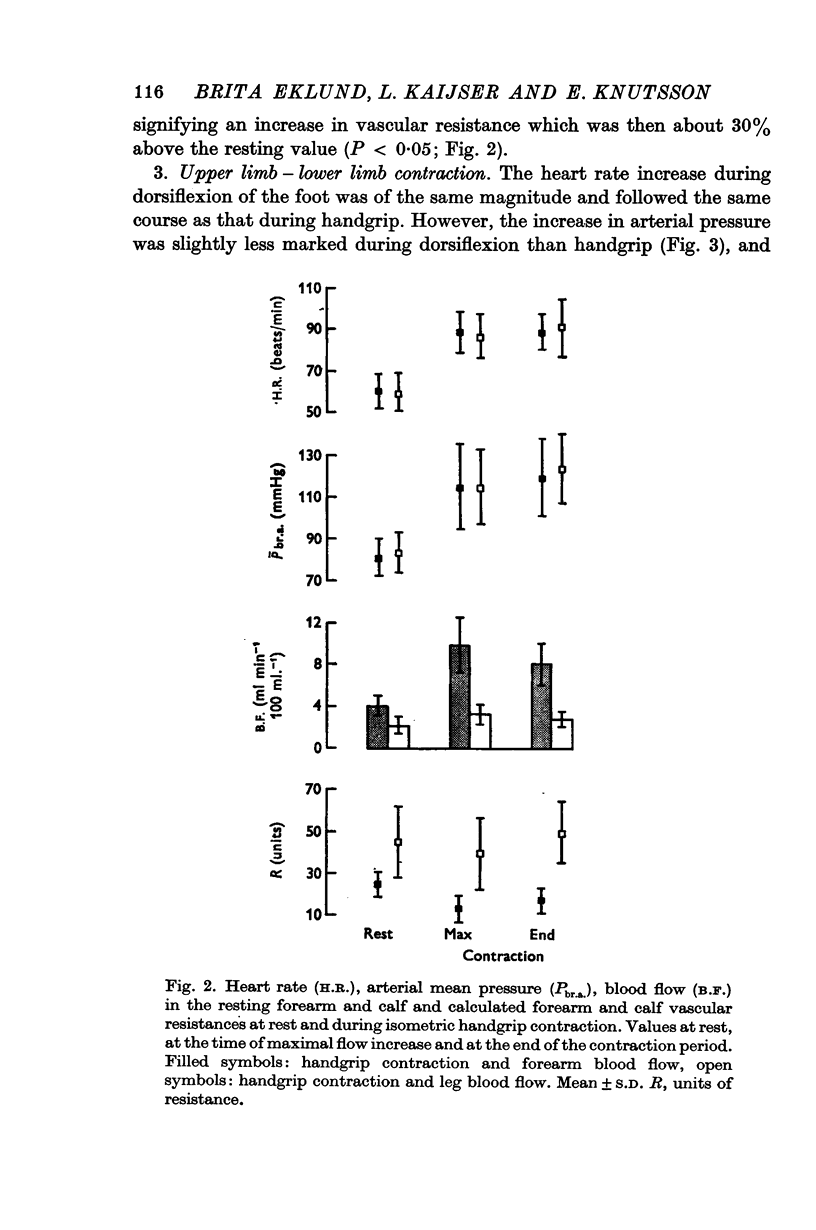
2. Both handgrip and dorsiflexion of the foot produced substantial increases in heart rate and mean arterial pressure, the pressure rise being almost linear with time throughout the contraction.
3. Isometric contraction produced a rapid increase in forearm blood flow which reached a maximum on average two and a half times the resting value after 1 min and then declined slightly. Similar increases in forearm blood flow were produced by handgrip and dorsiflexion of the foot.
4. Unlike in the resting forearm, the blood flow in the resting calf increased only slightly during the first minute of contraction and then decreased again to the resting level.
5. The flow increase in the resting limbs could not be ascribed to inadvertent muscle activation as judged from the e.m.g. recordings.
6. It is concluded that isometric muscle contraction produces a rapid increase in blood flow in the resting forearm, but only a very slight flow increase in the calf. Since the flow increased faster than the arterial pressure it must to a certain extent be induced by active neurogenic vasodilatation. Similarly, the relative flow decrease during the latter half of the contraction concomitantly with a progressively rising arterial pressure suggests that the neurogenic effect on the resistance vessels changes character, becoming more vasoconstrictive, and this might be related to increased effort in sustaining the contraction.
Full text
PDF




Selected References
These references are in PubMed. This may not be the complete list of references from this article.
- BULBRING E. Correlation between membrane potential, spike discharge and tension in smooth muscle. J Physiol. 1955 Apr 28;128(1):200–221. doi: 10.1113/jphysiol.1955.sp005299. [DOI] [PMC free article] [PubMed] [Google Scholar]
- Barcroft H., Bonnar W. M., Edholm O. G., Effron A. S. On sympathetic vasoconstrictor tone in human skeletal muscle. J Physiol. 1943 Jun 30;102(1):21–31. doi: 10.1113/jphysiol.1943.sp004010. [DOI] [PMC free article] [PubMed] [Google Scholar]
- Bayliss W. M. On the local reactions of the arterial wall to changes of internal pressure. J Physiol. 1902 May 28;28(3):220–231. doi: 10.1113/jphysiol.1902.sp000911. [DOI] [PMC free article] [PubMed] [Google Scholar]
- Bevegård B. S., Shepherd J. T. Reaction in man of resistance and capacity vessels in forearm and hand to leg exercise. J Appl Physiol. 1966 Jan;21(1):123–132. doi: 10.1152/jappl.1966.21.1.123. [DOI] [PubMed] [Google Scholar]
- Bevegård S., Freyschuss U., Strandell T. Circulatory adaptation to arm and leg exercise in supine and sitting position. J Appl Physiol. 1966 Jan;21(1):37–46. doi: 10.1152/jappl.1966.21.1.37. [DOI] [PubMed] [Google Scholar]
- Bolme P., Fuxe K. Adrenergic and cholinergic nerve terminals in skeletal muscle vessels. Acta Physiol Scand. 1970 Jan;78(1):52–59. doi: 10.1111/j.1748-1716.1970.tb04638.x. [DOI] [PubMed] [Google Scholar]
- Bolme P., Novotný J., Uvnäs B., Wright P. G. Species distribution of sympathetic cholinergic vasodilator nerves in skeletal muscle. Acta Physiol Scand. 1970 Jan;78(1):60–64. doi: 10.1111/j.1748-1716.1970.tb04639.x. [DOI] [PubMed] [Google Scholar]
- CELANDER O., FOLKOW B. A comparison of the sympathetic vasomotor fibre control of the vessels within the skin and the muscles. Acta Physiol Scand. 1953 Oct 6;29(2-3):241–250. doi: 10.1111/j.1748-1716.1953.tb01021.x. [DOI] [PubMed] [Google Scholar]
- CLARKE R. S., HELLON R. F., LIND A. R. The duration of sustained contractions of the human forearm at different muscle temperatures. J Physiol. 1958 Oct 31;143(3):454–473. doi: 10.1113/jphysiol.1958.sp006071. [DOI] [PMC free article] [PubMed] [Google Scholar]
- Delius W., Hagbarth K. E., Hongell A., Wallin B. G. Manoeuvres affecting sympathetic outflow in human muscle nerves. Acta Physiol Scand. 1972 Jan;84(1):82–94. doi: 10.1111/j.1748-1716.1972.tb05157.x. [DOI] [PubMed] [Google Scholar]
- FOLKOW B., LOFVING B. The distensibility of the systemic resistance blood vessels. Acta Physiol Scand. 1956 Dec 29;38(1):37–52. doi: 10.1111/j.1748-1716.1957.tb00172.x. [DOI] [PubMed] [Google Scholar]
- FURUYAMA M. Histometrical investigations of arteries in reference to arterial hypertension. Tohoku J Exp Med. 1962 May 25;76:388–414. doi: 10.1620/tjem.76.388. [DOI] [PubMed] [Google Scholar]
- HOLMGREN A. Circulatory changes during muscular work in man; with special reference to arterial and central venous pressures in the systemic circulation. Scand J Clin Lab Invest. 1956;8 (Suppl 24):1–97. [PubMed] [Google Scholar]
- Holmberg S., Serzysko W., Varnauskas E. Coronary circulation during heavy exercise in control subjects and patients with coronary heart disease. Acta Med Scand. 1971 Dec;190(6):465–480. doi: 10.1111/j.0954-6820.1971.tb07462.x. [DOI] [PubMed] [Google Scholar]
- Kellerová E., Delius W. Unterschiede der vasomotorischen Reaktivität im Muskel- und akralen Hautgefässgebiet der oberen und unteren Extremitäten. Z Kreislaufforsch. 1969 Sep;58(9):917–925. [PubMed] [Google Scholar]
- Kozlowski S., Brzezinska Z., Nazar K., Kowalski W., Franczyk M. Plasma catecholamines during sustained isometric exercise. Clin Sci Mol Med. 1973 Dec;45(6):723–731. doi: 10.1042/cs0450723. [DOI] [PubMed] [Google Scholar]
- LIND A. R., TAYLOR S. H., HUMPHREYS P. W., KENNELLY B. M., DONALD K. W. THE CIRCULATIORY EFFECTS OF SUSTAINED VOLUNTARY MUSCLE CONTRACTION. Clin Sci. 1964 Oct;27:229–244. [PubMed] [Google Scholar]
- RODDIE I. C., SHEPHERD J. T. Nervous control of the circulation in skeletal muscle. Br Med Bull. 1963 May;19:115–119. doi: 10.1093/oxfordjournals.bmb.a070028. [DOI] [PubMed] [Google Scholar]
- TUTTLE W. W., HORVATH S. M. Comparison of effects of static and dynamic work on blood pressure and heart rate. J Appl Physiol. 1957 Mar;10(2):294–296. doi: 10.1152/jappl.1957.10.2.294. [DOI] [PubMed] [Google Scholar]
- Viveros O. H., Garlick D. G., Renkin E. M. Sympathetic beta adrenergic vasodilatation in skeletal muscle of the dog. Am J Physiol. 1968 Nov;215(5):1218–1225. doi: 10.1152/ajplegacy.1968.215.5.1218. [DOI] [PubMed] [Google Scholar]