



Abstract
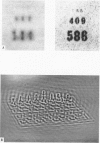
The perception of contrast was measured in humans by a technique of subjective contrast-matching, and was compared with contrast sensitivity as defined by threshold measures. 2. Contrast-matching between different spatial frequencies was performed correctly (especially at frequencies above 5 c/deg) despite the attenuation by optical and neural factors which cause large differences in contrast thresholds. 3. Contrast-matching between single lines of different widths was also veridical, and was not limited by the spatial integration (Ricco's Law) present at threshold. Adaptation to gratings altered the appearance of lines, and this could be best understood in Fourier terms. 4. The generality of these results was shown by matching the contrast of pictures which had been filtered so that each contained a one octave band of spatial frequencies. 5. Within the limits imposed by threshold and resolution, contrast-matching was largely independent of luminance and position on the retina. 6. Six out of eleven astigmatic observers showed considerable suprathreshold compensation for their orientation-specific neural deficit in contrast sensitivity. 7. These results define a new property of vision: contrast constancy. It is argued that spatial frequency channels in the visual cortex are organized to compensate for earlier attenuation. This achieves a dramatic 'deblurring' of the image, and optimizes the clarity of vision.
Full text
PDF


Images in this article
Selected References
These references are in PubMed. This may not be the complete list of references from this article.
- ARDEN G. B., WEALE R. A. Nervous mechanisms and dark-adaptation. J Physiol. 1954 Sep 28;125(3):417–426. doi: 10.1113/jphysiol.1954.sp005169. [DOI] [PMC free article] [PubMed] [Google Scholar]
- BARLOW H. B., FITZHUGH R., KUFFLER S. W. Change of organization in the receptive fields of the cat's retina during dark adaptation. J Physiol. 1957 Aug 6;137(3):338–354. doi: 10.1113/jphysiol.1957.sp005817. [DOI] [PMC free article] [PubMed] [Google Scholar]
- Blakemore C., Campbell F. W. On the existence of neurones in the human visual system selectively sensitive to the orientation and size of retinal images. J Physiol. 1969 Jul;203(1):237–260. doi: 10.1113/jphysiol.1969.sp008862. [DOI] [PMC free article] [PubMed] [Google Scholar]
- Blakemore C., Cooper G. F. Development of the brain depends on the visual environment. Nature. 1970 Oct 31;228(5270):477–478. doi: 10.1038/228477a0. [DOI] [PubMed] [Google Scholar]
- Blakemore C., Muncey J. P., Ridley R. M. Stimulus specificity in the human visual system. Vision Res. 1973 Oct;13(10):1915–1931. doi: 10.1016/0042-6989(73)90063-1. [DOI] [PubMed] [Google Scholar]
- Bryngdahl O. Characteristics of the visual system. Psychophysical measurements of the response to spatial sine-wave stimuli in the photopic region. J Opt Soc Am. 1966 Jun;56(6):811–821. doi: 10.1364/josa.56.000811. [DOI] [PubMed] [Google Scholar]
- Campbell F. W., Green D. G. Optical and retinal factors affecting visual resolution. J Physiol. 1965 Dec;181(3):576–593. doi: 10.1113/jphysiol.1965.sp007784. [DOI] [PMC free article] [PubMed] [Google Scholar]
- Campbell F. W., Gubisch R. W. Optical quality of the human eye. J Physiol. 1966 Oct;186(3):558–578. doi: 10.1113/jphysiol.1966.sp008056. [DOI] [PMC free article] [PubMed] [Google Scholar]
- Campbell F. W., Maffei L. Electrophysiological evidence for the existence of orientation and size detectors in the human visual system. J Physiol. 1970 May;207(3):635–652. doi: 10.1113/jphysiol.1970.sp009085. [DOI] [PMC free article] [PubMed] [Google Scholar]
- Campbell F. W., Robson J. G. Application of Fourier analysis to the visibility of gratings. J Physiol. 1968 Aug;197(3):551–566. doi: 10.1113/jphysiol.1968.sp008574. [DOI] [PMC free article] [PubMed] [Google Scholar]
- Daitch J. M., Green D. G. Contrast sensitivity of the human peripheral retina. Vision Res. 1969 Aug;9(8):947–952. doi: 10.1016/0042-6989(69)90100-x. [DOI] [PubMed] [Google Scholar]
- Davidson M. Perturbation approach to spatial brightness interaction in human vision. J Opt Soc Am. 1968 Sep;58(9):1300–1308. doi: 10.1364/josa.58.001300. [DOI] [PubMed] [Google Scholar]
- De Valois R. L., Morgan H., Snodderly D. M. Psychophysical studies of monkey vision. 3. Spatial luminance contrast sensitivity tests of macaque and human observers. Vision Res. 1974 Jan;14(1):75–81. doi: 10.1016/0042-6989(74)90118-7. [DOI] [PubMed] [Google Scholar]
- Dowling J. E. The site of visual adaptation. Science. 1967 Jan 20;155(3760):273–279. doi: 10.1126/science.155.3760.273. [DOI] [PubMed] [Google Scholar]
- Enroth-Cugell C., Robson J. G. The contrast sensitivity of retinal ganglion cells of the cat. J Physiol. 1966 Dec;187(3):517–552. doi: 10.1113/jphysiol.1966.sp008107. [DOI] [PMC free article] [PubMed] [Google Scholar]
- Graham N. Spatial frequency channels in the human visual system: effects of luminance and pattern drift rate. Vision Res. 1972 Jan;12(1):53–68. doi: 10.1016/0042-6989(72)90137-x. [DOI] [PubMed] [Google Scholar]
- HUBEL D. H., WIESEL T. N. RECEPTIVE FIELDS AND FUNCTIONAL ARCHITECTURE IN TWO NONSTRIATE VISUAL AREAS (18 AND 19) OF THE CAT. J Neurophysiol. 1965 Mar;28:229–289. doi: 10.1152/jn.1965.28.2.229. [DOI] [PubMed] [Google Scholar]
- HUBEL D. H., WIESEL T. N. Receptive fields, binocular interaction and functional architecture in the cat's visual cortex. J Physiol. 1962 Jan;160:106–154. doi: 10.1113/jphysiol.1962.sp006837. [DOI] [PMC free article] [PubMed] [Google Scholar]
- Hay G. A., Chesters M. S. Signal-transfer funcions in threshold and suprathreshold vision. J Opt Soc Am. 1972 Aug;62(8):990–998. doi: 10.1364/josa.62.000990. [DOI] [PubMed] [Google Scholar]
- Hilz R., Cavonius C. R. Functional organization of the peripheral retina: sensitivity to periodic stimuli. Vision Res. 1974 Dec;14(12):1333–1337. doi: 10.1016/0042-6989(74)90006-6. [DOI] [PubMed] [Google Scholar]
- Hirsch H. V., Spinelli D. N. Modification of the distribution of receptive field orientation in cats by selective visual exposure during development. Exp Brain Res. 1971 Jun 29;12(5):509–527. doi: 10.1007/BF00234246. [DOI] [PubMed] [Google Scholar]
- Kulikowski J. J., King-Smith P. E. Spatial arrangement of line, edge and grating detectors revealed by subthreshold summation. Vision Res. 1973 Aug;13(8):1455–1478. doi: 10.1016/0042-6989(73)90006-0. [DOI] [PubMed] [Google Scholar]
- LOWRY E. M., DEPALMA J. J. Sine-wave response of the visual system. I. The Mach phenomenon. J Opt Soc Am. 1961 Jul;51:740–746. doi: 10.1364/josa.51.000740. [DOI] [PubMed] [Google Scholar]
- Maffei L., Fiorentini A. The visual cortex as a spatial frequency analyser. Vision Res. 1973 Jul;13(7):1255–1267. doi: 10.1016/0042-6989(73)90201-0. [DOI] [PubMed] [Google Scholar]
- Mitchell D. E., Freeman R. D., Millodot M., Haegerstrom G. Meridional amblyopia: evidence for modification of the human visual system by early visual experience. Vision Res. 1973 Mar;13(3):535–558. doi: 10.1016/0042-6989(73)90023-0. [DOI] [PubMed] [Google Scholar]
- Patel A. S. Spatial resolution by the human visual system. The effect of mean retinal illuminance. J Opt Soc Am. 1966 May;56(5):689–694. doi: 10.1364/josa.56.000689. [DOI] [PubMed] [Google Scholar]
- Sharpe C. R., Tolhurst D. J. Orientation and spatial frequency channels in peripheral vision. Vision Res. 1973 Nov;13(11):2103–2112. doi: 10.1016/0042-6989(73)90187-9. [DOI] [PubMed] [Google Scholar]
- Sullivan G. D., Georgeson M. A., Oatley K. Channels for spatial frequency selection and the detection of single bars by the human visual system. Vision Res. 1972 Mar;12(3):383–394. doi: 10.1016/0042-6989(72)90083-1. [DOI] [PubMed] [Google Scholar]
- Tolhurst D. J. Adaptation to square-wave gratings: inhibition between spatial frequency channels in the human visual system. J Physiol. 1972 Oct;226(1):231–248. doi: 10.1113/jphysiol.1972.sp009982. [DOI] [PMC free article] [PubMed] [Google Scholar]
- Watanabe A., Mori T., Nagata S., Hiwatashi K. Spatial sine-wave responses of the human visual system. Vision Res. 1968 Sep;8(9):1245–1263. doi: 10.1016/0042-6989(68)90031-x. [DOI] [PubMed] [Google Scholar]