



Abstract
Pyrimidine (deoxy)nucleoside triphosphates are required in mitochondria for the synthesis of DNA and the various types of RNA present in these organelles. In Saccharomyces cerevisiae, these nucleotides are synthesized outside the mitochondrial matrix and must therefore be transported across the permeability barrier of the mitochondrial inner membrane. However, no protein has ever been found to be associated with this transport activity. In the present study, Rim2p has been identified as a yeast mitochondrial pyrimidine nucleotide transporter. Rim2p (replication in mitochondria 2p) is a member of the mitochondrial carrier protein family having some special features. The RIM2 gene was overexpressed in bacteria. The purified protein was reconstituted into liposomes and its transport properties and kinetic parameters were characterized. It transported the pyrimidine (deoxy)nucleoside tri- and di-phosphates and, to a lesser extent, pyrimidine (deoxy)nucleoside monophosphates, by a counter-exchange mechanism. Transport was saturable, with an apparent Km of 207 μM for TTP, 404 μM for UTP and 435 μM for CTP. Rim2p was strongly inhibited by mercurials, bathophenanthroline, tannic acid and Bromocresol Purple, and partially inhibited by bongkrekic acid. Furthermore, the Rim2p-mediated heteroexchanges, TTP/TMP and TTP/TDP, are electroneutral and probably H+-compensated. The main physiological role of Rim2p is proposed to be to transport (deoxy)pyrimidine nucleoside triphosphates into mitochondria in exchange for intramitochondrially generated (deoxy)pyrimidine nucleoside monophosphates.
Keywords: mitochondria, pyrimidine nucleotide carrier, proteomics, replication in mitochondria 2p (Rim2p), Saccharomyces cerevisiae, transport
Abbreviations: mtDNA, mitochondrial DNA; Py(d)NDPs, pyrimidine (deoxy)nucleoside diphosphates; Py(d)NMPs, pyrimidine (deoxy)nucleoside monophosphates; Py(d)NTPs, pyrimidine (deoxy)nucleoside triphosphates; Rim, replication in mitochondria; TMS, transmembrane segment
INTRODUCTION
In the mitochondrial matrix, Py(d)NTPs [(deoxy)pyrimidine nucleoside triphosphates] are required for the synthesis of DNA, mRNA, tRNA, rRNA and RNA primers. However, pyrimidine nucleoside diphosphates are synthesized by two processes, salvage pathways and de novo synthesis, that occur outside the mitochondria [1]. Furthermore, in Saccharomyces cerevisiae, the nucleoside diphosphate kinase (Ynk1p) and ribonucleotide reductase (Rnr1p–Rnr4p) enzymes are also localized outside the mitochondrial inner membrane and absent from the matrix [2,3]. Py(d)NTPs therefore have to be imported into the mitochondria probably via a carrier system embedded in the mitochondrial inner membrane. Despite the importance of pyrimidine nucleotides in mitochondrial metabolism, their transport has not been characterized in mitochondria, nor has any mitochondrial protein responsible for this transport been identified. There is only an indirect observation suggesting that pyrimidine nucleotides are transported across the mitochondrial inner membrane of S. cerevisiae. On incubating yeast mitochondria with labelled TTP, the amount of radioactivity associated with mitochondria was time-dependent and inhibited by unlabelled TDP but not by TMP [4].
The inner membranes of mitochondria contain a family of proteins that transport important metabolites, nucleotides and cofactors into and out of the matrix (see [5] for a review). These proteins have some common properties, i.e. a tripartite structure made up of three tandemly repeated sequences of about 100 amino acids in length, the presence of six α-helical TMSs (transmembrane segments) and a conserved PX(D/E)XX(K/R)X(K/R) sequence, called the ‘mitochondrial carrier signature motif’, located at the C-terminal end of the odd transmembrane helices. The nuclear genome of S. cerevisiae encodes 35 members of this family [6–8], of which about 20 have been characterized by biochemical and/or genetic studies (see [9] for a review, and [10–21]). Until now, several proteins have been identified as carriers for purine nucleotides and purine nucleotide analogues, such as the three ADP/ATP carrier isoforms, the peroxisomal adenine nucleotide transporter and the carriers for GTP/GDP, CoA and S-adenosylmethionine [10,11,14–19], but none have been identified for pyrimidine nucleotides.
A mitochondrial carrier whose function is still unknown, because the substrates transported have not yet been discovered, is Rim2p (replication in mitochondria 2p) encoded by RIM2/MRS12 (YBR192W). This protein was first described by Van Dyck et al. [22] as a multicopy suppressor capable of partially rescuing both a DNA helicase and an RNA splicing defect in yeast mitochondria and has been shown to be localized to mitochondria [22]. Its importance is highlighted by the observations that deletion of RIM2 in the BY strain causes loss of viability [23] and in the W303 strain loss of mtDNA (mitochondrial DNA) and lack of growth on non-fermentable carbon sources [22]. Discussing the substrates that might be transported by Rim2p, Van Dyck et al. [22] hypothesized that “… RIM2/MRS12 transports mtDNA precursors or compounds necessary for the mtDNA synthesis machinery …” on the basis of the loss of mtDNA in the rim2-null mutant. Moreover, the same authors also hypothesized Mg2+ to be “… an attractive candidate …” for a substrate transported by Rim2p, given its additional role in mtRNA intron splicing [22].
In the present study we demonstrated that Rim2p is the mitochondrial pyrimidine nucleotide transporter in S. cerevisiae. We have overexpressed RIM2 in Escherichia coli, and the gene product has been purified, reconstituted into phospholipid vesicles and identified, from its transport properties and kinetic characteristics, as a carrier for pyrimidine nucleotides. The main physiological role of Rim2p is probably to catalyse the exchange between external Py(d)NTPs and internal Py(d)NMPs [(deoxy)pyrimidine nucleoside monophosphates]. The present paper reports the first identification of a mitochondrial pyrimidine nucleotide carrier and its gene in S. cerevisiae.
EXPERIMENTAL
Sequence search and analysis
Databases were screened with the sequence of Rim2p (encoded by YBR192W) with BLASTP and TBLASTN. The amino acid sequences were aligned with ClustalW (Version 1.7).
Bacterial expression and purification of Rim2p
The coding sequence of Rim2p (encoded by YBR192W) was amplified from S. cerevisiae genomic DNA by PCR using primers corresponding to the extremities of the coding sequence with additional NdeI and EcoRI sites. The product was cloned into the pMW7 expression vector. Transformants of E. coli DH5α cells were selected on 2×TY (tryptone/yeast extract) plates containing ampicillin (100 μg/ml) and screened by direct colony PCR and restriction digestion of plasmids (1×TY is 16 g/l tryptone, 10 g/l yeast extract and 5 g/l NaCl, pH 7.4). The overproduction of Rim2p as inclusion bodies in the cytosol of E. coli was accomplished as described previously [24], except that the host cells were E. coli C0214(DE3) [25]. Inclusion bodies were purified on a sucrose density gradient [24], and Rim2p was purified by centrifugation and with the washing steps previously described [25].
Reconstitution into liposomes and transport assays
The recombinant protein in Sarkosyl® (N-dodecanoyl-N-methylglycine sodium salt) was reconstituted into liposomes in the presence of substrates, as described previously [26]. External substrate was removed from proteoliposomes on Sephadex G-75 columns pre-equilibrated with 50 mM NaCl/10 mM Pipes/NaOH, pH 7.0 (buffer A). Transport at 25 °C was initiated by adding the indicated labelled substrate to proteoliposomes and terminated by the addition of 0.5 mM p-hydroxymercuribenzoate (the ‘inhibitor stop’ method [26]). In controls, the inhibitor was added together with the radioactively labelled substrate. The external substrate was removed, and the radioactivity in the liposomes was measured [26]. The experimental values were corrected by subtracting control values. The initial transport rate was calculated from the radioactivity taken up by proteoliposomes after 45 s (in the initial linear range of substrate uptake). For efflux measurements, proteoliposomes containing 1 mM TTP were labelled with 25 μM [3H]TTP by carrier-mediated exchange equilibration [26]. After 50 min, external radioactivity was removed by passing the proteoliposomes through Sephadex G-75. Efflux was initiated by adding unlabelled external substrate or buffer A alone and terminated by the addition of the inhibitor indicated above.
The experimental conditions for reconstitution and transport measurements had to be optimized, since the activity of reconstituted Rim2p is sensitive to cation and anion type and concentration and to pH variation both in the internal and external compartments of the proteoliposomes. Optimal activity of Rim2p was obtained with 30 mM NaCl/10 mM Pipes/NaOH, pH 7.0, inside the proteoliposomes, and with 50 mM NaCl/10 mM Pipes/NaOH, pH 7.0, outside. Accordingly these conditions were applied in all the experiments, except those in which the influence of the K+ diffusion potential was investigated. In these experiments, 1 mM KCl was added inside the proteoliposomes and 50 mM KCl was used outside instead of 50 mM NaCl.
Other methods
Proteins were analysed by SDS/PAGE and stained with Coomassie Blue dye. The N-terminus was sequenced and the yield of purified Rim2p was estimated as previously described [27]. The amount of protein incorporated into liposomes was measured as described [27] and was about 25% of the protein added to the reconstitution mixture. For the formation of an artificial membrane potential (negative outside), valinomycin (1.5 μg/mg of phospholipid) was added to proteoliposomes in the presence of a K+ gradient of 1 mM:50 mM (in/out).
RESULTS
Sequence features of Rim2p
As previously recognized [22], the protein encoded by RIM2/MRS12 (YBR192W) belongs to the mitochondrial carrier family. In fact, the Rim2p amino acid sequence displays three repeats, each containing two putative TMSs and the signature sequence motif PXD/EXXR/K. However, Rim2p, consisting of 377 residues, is longer than the great majority of mitochondrial carriers (molecular mass 30–34 kDa) and shorter than the Ca2+-activated mitochondrial carriers (molecular mass 50–60 kDa) (see [5] for a review, and [28]). A major difference between Rim2p and most members of the mitochondrial carrier family is that the N-terminal extension, the matrix loop between TMS I and II and the cytosolic loop between TMS IV and V of Rim2p are longer than usual. Another typical feature of Rim2p is the presence of a tryptophan residue (PIWLIK) instead of the acidic residue in the signature motif of the second repeat.
Bacterial expression of Rim2p
Rim2p was expressed at high levels in E. coli C0214(DE3) (Figure 1, lane 4). The protein accumulated as inclusion bodies and was purified by centrifugation and washing (Figure 1, lane 5). The apparent molecular mass of the recombinant protein was 42 kDa (calculated value with an initiator methionine residue, 42101 Da). The protein was not detected in bacteria harvested immediately before induction of expression (Figure 1, lanes 1 and 2) nor in cells harvested after induction but lacking the coding sequence in the expression vector (Figure 1, lane 3). The identity of the purified protein was confirmed by N-terminal sequencing. Approx. 70 mg of purified protein/l of culture was obtained.
Figure 1. Expression of Rim2p in E. coli and its purification.
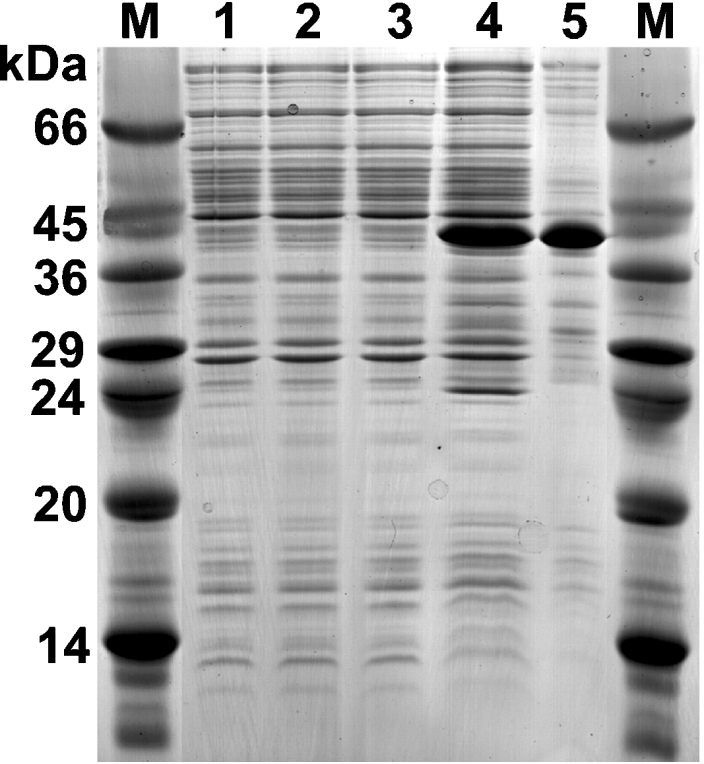
Proteins were separated by SDS-PAGE and stained with Coomassie Blue dye. Markers (‘M’; BSA, ovalbumin, glyceraldehyde-3-phosphate dehydrogenase, carbonic anhydrase, trypsinogen, trypsin inhibitor and α-lactalbumin) are shown on the left and on the right. Lanes 1–4, E. coli CO214(DE3) containing the expression vector with (lanes 2 and 4) and without (lanes 1 and 3) the coding sequence of Rim2p. Samples were taken at the time of induction (lanes 1 and 2) and 5 h later (lanes 3 and 4). The same number of bacteria was analysed in each sample. Lane 5, purified Rim2p (6 μg) originating from bacteria shown in lane 4.
Functional characterization of recombinant Rim2p
Rim2p was reconstituted into liposomes and its transport activities for a variety of potential substrates were tested in homoexchange experiments (that is, with the same substrate internally and externally). Using external and internal substrate concentrations of 0.2 and 10 mM respectively, the reconstituted protein catalysed active [3H]TTP/TTP, [3H]UTP/UTP and [3H]CTP/CTP exchanges (Figure 2) that were inhibited by p-hydroxymercuribenzoate. Despite the long incubation period (i.e. 30 min), much lower homoexchange activities were measured for GTP, ATP, acetyl-CoA, NAD+, NMN, folate, aspartate, carnitine, citrate, glutamine, methionine, phosphate and pyruvate. Furthermore, no [3H]TTP/TTP exchange activity was detected if Rim2p had been boiled before incorporation into liposomes or if liposomes were reconstituted with Sarkosyl®-solubilized material from bacterial cells lacking the expression vector for Rim2p or harvested immediately before the induction of expression. Likewise, no such activity was detected in liposomes reconstituted with two unrelated mitochondrial carriers, Dic1p and Sam5p [6,17], which had been expressed and purified from E. coli using the same expression vector.
Figure 2. Homoexchange activities of various substrates in proteoliposomes reconstituted with Rim2p.

Transport was initiated by adding radioactively labelled substrate (final concn. 0.2 mM) to proteoliposomes preloaded internally with the same substrate (concn. 10 mM). The reaction time was 30 min. Results are means±S.D. for at least three independent experiments.
The substrate specificity of Rim2p was further investigated by measuring the uptake of [3H]TTP into proteoliposomes that had been preloaded with a high concentration (10 mM) of various potential substrates (Figure 3). The highest rates of [3H]TTP uptake into proteoliposomes were observed with internal TTP, TDP, UTP, UDP, CTP, CDP and the corresponding deoxynucleotides. [3H]TTP also exchanged significantly with Py(d)NMPs, (d)GTP and (d)GDP. Low activity was found with internal GMP, dGMP, ITP, IDP and IMP. In contrast, the uptake of [3H]TTP was negligible in the presence of the following internal substrates: adenine (deoxy)nucleoside mono-, di- and tri-phosphates, xanthosine monophosphate, cGMP, NaCl (Figure 3) and FAD, FMN, tetrahydrofolate, thiamine mono- and di-phosphate, NAD+, NADH, NMN, UDP-glucose, UDP-galactose, nucleosides of T, U, C, A and G, pyrimidine (T, U, C) and purine (A and G) bases, thiamine, S-adenosylmethionine, pyruvate, phosphate, pyrophosphate, carnitine, citrate, glutamate, lysine, malate, ornithine, oxoglutarate and succinate (results not shown). Therefore the substrate specificity of Rim2p is confined essentially to pyrimidine (deoxy)nucleotides.
Figure 3. Dependence of Rim2p activity on internal substrate.

Proteoliposomes were preloaded internally with various substrates (concn. 10 mM). Transport was initiated by adding 0.25 mM [3H]TTP to proteoliposomes and the reaction was terminated after 45 s. Results are means±S.D. for at least three independent experiments.
The effects of inhibitors of other mitochondrial carriers on the [3H]TTP/TTP exchange reaction catalysed by reconstituted Rim2p were also examined. TTP exchange (at 0.25 and 10 mM external and internal concentrations respectively) was inhibited completely by 0.2 mM p-hydroxymercuribenzoate, 0.2 mM mercuric chloride and 20 mM bathophenanthroline, strongly by 0.2% tannic acid (87% inhibition), 0.3 mM Bromocresol Purple (79%), 20 mM pyridoxal 5′-phosphate (68%) and 0.2 mM mersalyl (60%) and only partially by 1 mM N-ethylmaleimide (39%) and 1 mM α-cyano-4-hydroxycinnamate (32%) (results not shown). In contrast, very little or no effect was observed with 2 mM butylmalonate and 2 mM benzene-1,2,3-tricarboxylate. Interestingly, bongkrekic acid inhibited the activity of Rim2p partially (47%), whereas carboxyatractyloside had little effect (8%) at a concentration (10 μM) that completely inhibits the ADP/ATP carrier (29,30) (results not shown).
Kinetic characteristics of recombinant Rim2p
In Figure 4(A), the kinetics are compared for the uptake by proteoliposomes of 1 mM [3H]TTP, either as uniport (in the absence of internal TTP) or as exchange (in the presence of internal 10 mM TTP). The uptake of TTP by exchange followed first-order kinetics (rate constant 0.1 min−1; initial rate 0.13 mmol/min per g of protein), isotopic equilibrium being approached exponentially (Figure 4A). In contrast, the uniport uptake of [3H]TTP was negligible, suggesting that Rim2p does not catalyse a unidirectional transport (uniport) of TTP. This issue was further investigated by measuring the efflux of [3H]TTP from prelabelled active proteoliposomes, as this provides a more sensitive assay for unidirectional transport [26]. In the absence of external substrate, no significant efflux was observed, even after incubation for 90 min (Figure 4B). However, upon addition of external TTP, an extensive efflux of radioactivity occurred, which was prevented by the presence of the inhibitor p-hydroxymercuribenzoate. These results demonstrate that, at least under the experimental conditions used, reconstituted Rim2p catalyses an obligatory exchange reaction of substrates.
Figure 4. Kinetics of [3H]TTP transport in proteoliposomes reconstituted with Rim2p.

(A) Uptake of TTP. [3H]TTP (1 mM) was added to proteoliposomes containing 10 mM TTP (exchange, ■) or 10 mM NaCl and no substrate (uniport, □). (B) Efflux of [3H]TTP from proteoliposomes reconstituted in the presence of 1 mM TTP. The internal substrate pool was labelled with [3H]TTP by carrier-mediated exchange equilibration. The proteoliposomes were then passed through Sephadex G-75. The efflux of [3H]TTP was initiated by adding buffer A alone (●), buffer A and 0.5 mM p-hydroxymercuribenzoate (○), 5 mM TTP in buffer A (■) or 5 mM TTP and 0.5 mM p-hydroxymercuribenzoate in buffer A (□). Similar results were obtained in three independent experiments for both uptake and efflux of TTP.
The kinetic constants of Rim2p were determined from the initial transport rate of the homoexchanges TTP/TTP, UTP/UTP and CTP/CTP at various external labelled substrate concentrations, in the presence of a constant internal substrate concentration of 10 mM. With all three homoexchanges, linear functions were obtained in double-reciprocal plots. The lines intersected the ordinate close to a common point (results not shown). For TTP, UTP and CTP, the transport affinities (Km) were 207±19, 404±57 and 435±54 μM (mean values for 55, four and five experiments respectively). The average value of Vmax was 150±27 μmol/min per g of protein. Several external substrates were competitive inhibitors of [3H]TTP uptake (Table 1), as they increased the apparent Km without changing the Vmax (results not shown). These results show that the (deoxy)nucleoside di- and tri-phosphates of the pyrimidine bases T, U and C are the highest affinity external substrates (Ki from 131 to 584 μM). The Ki values for these nucleotides for Rim2p are not significantly different from the TMP value. However, the Ki of UMP, CMP, GTP and GDP are significantly higher (P<0.001) than those of the other compounds listed in Table 1. Furthermore, no inhibition was observed by the simultaneous addition of 5 mM ATP, dATP, ADP, AMP, cAMP or cGMP with the labelled substrate on the reconstituted [3H]TTP/TTP exchange activity at external and internal substrate concentrations of 250 μM and 10 mM respectively (results not shown).
Table 1. Competitive inhibition by various substrates of [3H]TTP uptake into proteoliposomes reconstituted with Rim2p.
The Ki values were calculated from Lineweaver–Burk plots of the rate of [3H]TTP versus substrate concentrations. The competing substrates at appropriate constant concentrations were added together with 38.5–2000 μM [3H]TTP to proteoliposomes containing 10 mM TTP. Results are means±S.D. for at least three independent experiments.
| Substrate | Ki (μM) |
|---|---|
| TTP | 205±23 |
| TDP | 131±17 |
| TMP | 476±68 |
| UTP | 437±70 |
| UDP | 289±39 |
| UMP | 2360±337 |
| dUTP | 522±61 |
| CTP | 419±57 |
| CDP | 314±42 |
| CMP | 2692±444 |
| dCTP | 584±93 |
| GTP | 2377±273 |
| GDP | 1865±312 |
DISCUSSION
In the present study the function of Rim2p was investigated by overexpressing RIM2 in E. coli and functionally reconstituting the purified gene product into phospholipid vesicles. In recent years the same strategy has enabled the definitive identification and detailed characterization of several novel mitochondrial transporters (see [5,31,32] for reviews, and [16–18,20,28]).
The transport properties and kinetic characteristics of recombinant and reconstituted Rim2p described in the present study, together with its mitochondrial localization (reported previously [22]), demonstrate that this protein is a mitochondrial transporter for pyrimidine nucleotides. This is the first time that a mitochondrial carrier for pyrimidine nucleotides has been identified at the molecular level. In a phylogenetic tree of S. cerevisiae members of the mitochondrial carrier family [7,8,32], Rim2p clusters together with the transporter for FAD [19], the carrier for pyruvate [21] and YEL006W, whose function has not yet been identified. Apart from the relatively low identity that Rim2p shows with these carriers (26–29% of identical amino acids), Rim2p does not show significant sequence identity with any other mitochondrial carrier functionally identified so far above the basic similarity existing between the different members of the mitochondrial carrier family. However, several protein sequences available in databases are likely orthologues of this transporter in other organisms. These sequences include XP_455018.1 from the yeast Kluyveromyces lactis (67% of identical amino acids), EAK93725.1 from the yeast Candida albicans (50%), EAA36311.1 from the fungus Neurospora crassa (47%), XP_404483.1 from the fungus Aspergillus nidulans (40%), AAG45135.1 from the cellular slime mould Dictyostelium discoideum (36%), AAH76521.1 from the zebrafish Danio rerio (32%), CAA53722.1 from the nematode worm Caenorhabditis elegans (35%), AAL13964.1 from the fruitfly (Drosophila melanogaster) (32%), CAG31696.1 from chicken (Gallus gallus) (32%), XP_613313.1 from ox (Bos taurus) (34%) and human (Homo sapiens) AAH14064.1 (32%). The wide distribution of Rim2p in the Eukaryotic Kingdom indicates that this transporter plays an important role that has been conserved throughout evolution.
Besides transporting Py(d)NDPs and Py(d)NTPs, reconstituted Rim2p also transports, with lower efficiency, Py(d)NMPs, (d)GTP, (d)GDP and, to a much lesser extent, GMP, ITP, IDP and IMP, but not adenine (deoxy)nucleotides and none of the many other compounds tested. The substrate specificity of Rim2p is distinct from that of any previously characterized mitochondrial carrier for nucleotides. The ADP/ATP carrier transports only adenine nucleotides [29,30]; the GTP/GDP carrier (Ggc1p) is specific for GTP and GDP [18]; the human ATP/phosphate carrier (APC) transports virtually only adenine nucleotides and phosphate [28]; and the yeast thiamine pyrophosphate carrier (Tpc1p) transports thiamine pyrophosphate and thiamine monophosphate, and, to some extent, nucleotides with a preference for adenine nucleotides [16]. Furthermore, unlike Rim2p, Tpc1p catalyses both the uniport and exchange modes of transport.
In mitochondria, Py(d)NTPs are incorporated into DNA and the various types of RNA present in mitochondria, including the RNA primers, which are required for the initiation of DNA replication and repair. Therefore, as Py(d)NTPs in S. cerevisiae are not synthesized in the mitochondrial matrix [1–3], Rim2p appears to be essential for a number of major processes occurring in the organelles. Furthermore, since Rim2p functions almost exclusively by a counter-exchange mechanism, the carrier-mediated uptake of Py(d)NTPs requires the efflux of a counter-substrate. On the basis of our transport measurements, PyNMPs that are produced intramitochondrially in the catabolism of nucleic acids may serve as the counter-substrates of Rim2p for PyNTPs. Therefore, the main physiological role of Rim2p is probably to catalyse the uptake of PyNTPs into the mitochondrial matrix in exchange for internal PyNMPs. The Rim2p-mediated import of PyNDPs in exchange for PyNMPs should be relatively minor as compared with the uptake of PyNTPs in exchange for PyNMPs for thermodynamic reasons, and also because PyNDPs in the presence of sufficient ATP are phosphorylated by the nucleoside diphosphate kinase outside the inner membrane of yeast mitochondria [2]. Even if transported into mitochondria in exchange for PyNMPs, PyNDPs would recycle across the membrane exchanging with external PyNTPs, thus accomplishing a net PyNTPsout/PyNMPsin exchange. We have found that Rim2p-mediated transport is electroneutral, since reconstituted TTP/TMP and TTP/TDP exchanges are not influenced by the membrane potential generated by K+ plus valinomycin (results not shown). These results suggest that the charge imbalance of the Rim2p-mediated TTP/TMP and TTP/TDP heteroexchanges is H+-compensated and that therefore, in mitochondria, they are driven by the ΔpH component of the protonmotive force generated by electron transport. Other nucleotide transporters of the mitochondrial carrier family, i.e. the GTP/GDP carrier, the ATP/phosphate carrier and the peroxisomal adenine nucleotide transporter, use H+ as counter-ions for electroneutral exchange of nucleotides [18,28,33], and this may be the case for Rim2p also.
The identification of the mitochondrial pyrimidine nucleotide carrier Rim2p reported in the present study provides a new tool for gaining further insight into the molecular mechanisms underlying the regulation of mtDNA maintenance and mtRNA metabolism in yeast.
Acknowledgments
This work was supported by grants from Ministero dell'Istruzione, dell'Università e della Ricerca (MIUR), CNR-MIUR project ‘Genomica Funzionale’ (Functional genomics), the Centro di Eccellenza Geni in campo Biosanitario e Agroalimentare (CEGBA), European Commission (EC) contract LSHM-CT-2004-503116 and the European Social Fund.
References
- 1.Kumar A., Agarwal S., Heyman J. A., Matson S., Heidtman M., Piccirillo S., Umansky L., Drawid A., Jansen R., Liu Y., et al. Subcellular localization of the yeast proteome. Genes Dev. 2002;16:707–719. doi: 10.1101/gad.970902. [DOI] [PMC free article] [PubMed] [Google Scholar]
- 2.Amutha B., Pain D. Nucleoside diphosphate kinase of Saccharomyces cerevisiae, Ynk1p: localization to the mitochondrial intermembrane space. Biochem. J. 2003;370:805–815. doi: 10.1042/BJ20021415. [DOI] [PMC free article] [PubMed] [Google Scholar]
- 3.Yao R., Zhang Z., An X., Bucci B., Perlstein D. L., Stubbe J., Huang M. Subcellular localization of yeast ribonucleotide reductase regulated by the DNA replication and damage checkpoint pathways. Proc. Natl. Acad. Sci. U.S.A. 2003;100:6628–6633. doi: 10.1073/pnas.1131932100. [DOI] [PMC free article] [PubMed] [Google Scholar]
- 4.Mattick J. S., Hall R. M. Replicative deoxyribonucleic acid synthesis in isolated mitochondria from Saccharomyces cerevisiae. J. Bacteriol. 1977;130:973–982. doi: 10.1128/jb.130.3.973-982.1977. [DOI] [PMC free article] [PubMed] [Google Scholar]
- 5.Palmieri F. The mitochondrial transporter family (SLC25): physiological and pathological implications. Pflueger's Arch. 2004;447:689–709. doi: 10.1007/s00424-003-1099-7. [DOI] [PubMed] [Google Scholar]
- 6.Palmieri L., Palmieri F., Runswick M., Walker J. E. Identification by bacterial expression and functional reconstitution of the yeast genomic sequence encoding the mitochondrial dicarboxylate carrier protein. FEBS Lett. 1996;399:299–302. doi: 10.1016/s0014-5793(96)01350-6. [DOI] [PubMed] [Google Scholar]
- 7.el Moualij B., Duyckaerts C., Lamotte-Brasseur J., Sluse F. E. Phylogenetic classification of the mitochondrial carrier family of Saccharomyces cerevisiae. Yeast. 1997;13:573–581. doi: 10.1002/(SICI)1097-0061(199705)13:6<573::AID-YEA107>3.0.CO;2-I. [DOI] [PubMed] [Google Scholar]
- 8.Nelson D. R., Felix C. M., Swanson J. M. Highly conserved charge-pair networks in the mitochondrial carrier family. J. Mol. Biol. 1998;277:285–308. doi: 10.1006/jmbi.1997.1594. [DOI] [PubMed] [Google Scholar]
- 9.Palmieri L., Lasorsa F. M., Vozza A., Agrimi G., Fiermonte G., Runswick M. J., Walker J. E., Palmieri F. Identification and functions of new transporters in yeast mitochondria. Biochim. Biophys. Acta. 2000;1459:363–369. doi: 10.1016/s0005-2728(00)00173-0. [DOI] [PubMed] [Google Scholar]
- 10.Kolarov J., Kolarova N., Nelson N. A third ADP/ATP translocator gene in yeast. J. Biol. Chem. 1990;265:12711–12716. [PubMed] [Google Scholar]
- 11.Gawaz M., Douglas M. G., Klingenberg M. Structure–function studies of adenine nucleotide transport in mitochondria. II. Biochemical analysis of distinct AAC1 and AAC2 proteins in yeast. J. Biol. Chem. 1990;265:14202–14208. [PubMed] [Google Scholar]
- 12.Wohlrab H., Briggs C. Yeast mitochondrial phosphate transport protein expressed in Escherichia coli. Site-directed mutations at threonine-43 and at a similar location in the second tandem repeat (isoleucine-141) Biochemistry. 1994;33:9371–9375. doi: 10.1021/bi00198a001. [DOI] [PubMed] [Google Scholar]
- 13.Kaplan R. S., Mayor J. A., Gremes D. A., Wood D. O. High level expression and characterization of the mitochondrial citrate transport protein from the yeast Saccharomyces cerevisiae. J. Biol. Chem. 1995;270:4108–4114. doi: 10.1074/jbc.270.8.4108. [DOI] [PubMed] [Google Scholar]
- 14.Palmieri L., Rottensteiner H., Girzalsky W., Scarcia P., Palmieri F., Erdmann R. Identification and functional reconstitution of the yeast peroxisomal adenine nucleotide transporter. EMBO J. 2001;20:5049–5059. doi: 10.1093/emboj/20.18.5049. [DOI] [PMC free article] [PubMed] [Google Scholar]
- 15.Prohl C., Pelzer W., Diekert K., Kmita H., Bedekovics T., Kispal G., Lill R. The yeast mitochondrial carrier Leu5p and its human homologue Graves' disease protein are required for accumulation of coenzyme A in the matrix. Mol. Cell. Biol. 2001;21:1089–1097. doi: 10.1128/MCB.21.4.1089-1097.2001. [DOI] [PMC free article] [PubMed] [Google Scholar]
- 16.Marobbio C. M. T., Vozza A., Harding M., Bisaccia F., Palmieri F., Walker J. E. Identification and reconstitution of the yeast mitochondrial transporter for thiamine pyrophosphate. EMBO J. 2002;21:5653–5661. doi: 10.1093/emboj/cdf583. [DOI] [PMC free article] [PubMed] [Google Scholar]
- 17.Marobbio C. M. T., Agrimi G., Lasorsa F. M., Palmieri F. Identification and functional reconstitution of yeast mitochondrial carrier for S-adenosylmethionine. EMBO J. 2003;22:5975–5982. doi: 10.1093/emboj/cdg574. [DOI] [PMC free article] [PubMed] [Google Scholar]
- 18.Vozza A., Blanco E., Palmieri L., Palmieri F. Identification of the mitochondrial GTP/GDP transporter in Saccharomyces cerevisiae. J. Biol. Chem. 2004;279:20850–20857. doi: 10.1074/jbc.M313610200. [DOI] [PubMed] [Google Scholar]
- 19.Tzagoloff A., Jang J., Glerum D. M., Wu M. FLX1 codes for a carrier protein involved in maintaining a proper balance of flavin nucleotides in yeast mitochondria. J. Biol. Chem. 1996;271:7392–7397. doi: 10.1074/jbc.271.13.7392. [DOI] [PubMed] [Google Scholar]
- 20.Cavero S., Vozza A., del Arco A., Palmieri L., Villa A., Blanco E., Runswick M. J., Walker J. E., Cerdan S., Palmieri F., Satrustegui J. Identification and metabolic role of the mitochondrial aspartate–glutamate transporter in Saccharomyces cerevisiae. Mol. Microbiol. 2003;50:1257–1269. doi: 10.1046/j.1365-2958.2003.03742.x. [DOI] [PubMed] [Google Scholar]
- 21.Hildyard J. C., Halestrap A. P. Identification of the mitochondrial pyruvate carrier in Saccharomyces cerevisiae. Biochem. J. 2003;374:607–611. doi: 10.1042/BJ20030995. [DOI] [PMC free article] [PubMed] [Google Scholar]
- 22.Van Dyck E., Jank B., Ragnini A., Schweyen R. J., Duyckaerts C., Sluse F., Foury F. Replicative deoxyribonucleic acid synthesis in isolated mitochondria from Saccharomyces cerevisiae. Mol. Gen. Genet. 1995;246:426–436. doi: 10.1007/BF00290446. [DOI] [PubMed] [Google Scholar]
- 23.Giaever G., et al. Functional profiling of the Saccharomyces cerevisiae genome. Nature (London) 2002;418:387–391. doi: 10.1038/nature00935. [DOI] [PubMed] [Google Scholar]
- 24.Fiermonte G., Walker J. E., Palmieri F. Abundant bacterial expression and reconstitution of an intrinsic membrane-transport protein from bovine mitochondria. Biochem. J. 1993;294:293–299. doi: 10.1042/bj2940293. [DOI] [PMC free article] [PubMed] [Google Scholar]
- 25.Palmieri L., Pardo B., Lasorsa F. M., del Arco A., Kobayashi K., Iijima M., Runswick M. J., Walker J. E., Saheki T., Satrustegui J., Palmieri F. Citrin and aralar1 are Ca2+-stimulated aspartate/glutamate transporters in mitochondria. EMBO J. 2001;20:5060–5069. doi: 10.1093/emboj/20.18.5060. [DOI] [PMC free article] [PubMed] [Google Scholar]
- 26.Palmieri F., Indiveri C., Bisaccia F., Iacobazzi V. Mitochondrial metabolite carrier proteins: purification, reconstitution, and transport studies. Methods Enzymol. 1995;260:349–369. doi: 10.1016/0076-6879(95)60150-3. [DOI] [PubMed] [Google Scholar]
- 27.Fiermonte G., Dolce V., Palmieri F. Expression in Escherichia coli, functional characterization, and tissue distribution of isoforms A and B of the phosphate carrier from bovine mitochondria. J. Biol. Chem. 1998;273:22782–22787. doi: 10.1074/jbc.273.35.22782. [DOI] [PubMed] [Google Scholar]
- 28.Fiermonte G., De Leonardis F., Todisco S., Palmieri L., Lasorsa F. M., Palmieri F. Identification of the mitochondrial ATP-Mg/Pi transporter. Bacterial expression, reconstitution, functional characterization, and tissue distribution. J. Biol. Chem. 2004;279:30722–30730. doi: 10.1074/jbc.M400445200. [DOI] [PubMed] [Google Scholar]
- 29.Klingenberg M. Molecular aspects of the adenine nucleotide carrier from mitochondria. Arch. Biochem. Biophys. 1989;270:1–14. doi: 10.1016/0003-9861(89)90001-5. [DOI] [PubMed] [Google Scholar]
- 30.Fiore C., Trezeguet V., Le Saux A., Roux P., Schwimmer C., Dianoux A. C., Noel F., Lauquin G. J.-M., Brandolin G., Vignais P. V. The mitochondrial ADP/ATP carrier: structural, physiological and pathological aspects. Biochemie. 1998;80:137–150. doi: 10.1016/s0300-9084(98)80020-5. [DOI] [PubMed] [Google Scholar]
- 31.Picault N., Hodges M., Palmieri L., Palmieri F. The growing family of mitochondrial carriers in Arabidopsis. Trends Plant Sci. 2004;9:138–146. doi: 10.1016/j.tplants.2004.01.007. [DOI] [PubMed] [Google Scholar]
- 32.Palmieri L., Runswick M. J., Fiermonte G., Walker J. E., Palmieri F. Yeast mitochondrial carriers: bacterial expression, biochemical identification and metabolic significance. J. Bioenerg. Biomembr. 2000;32:67–77. doi: 10.1023/a:1005564429242. [DOI] [PubMed] [Google Scholar]
- 33.Lasorsa F. M., Scarcia P., Erdmann R., Palmieri F., Rottensteiner H., Palmieri L. The yeast peroxisomal adenine nucleotide transporter: characterization of two transport modes and involvement in ΔpH formation across peroxisomal membranes. Biochem. J. 2004;381:581–585. doi: 10.1042/BJ20040856. [DOI] [PMC free article] [PubMed] [Google Scholar]