



Abstract
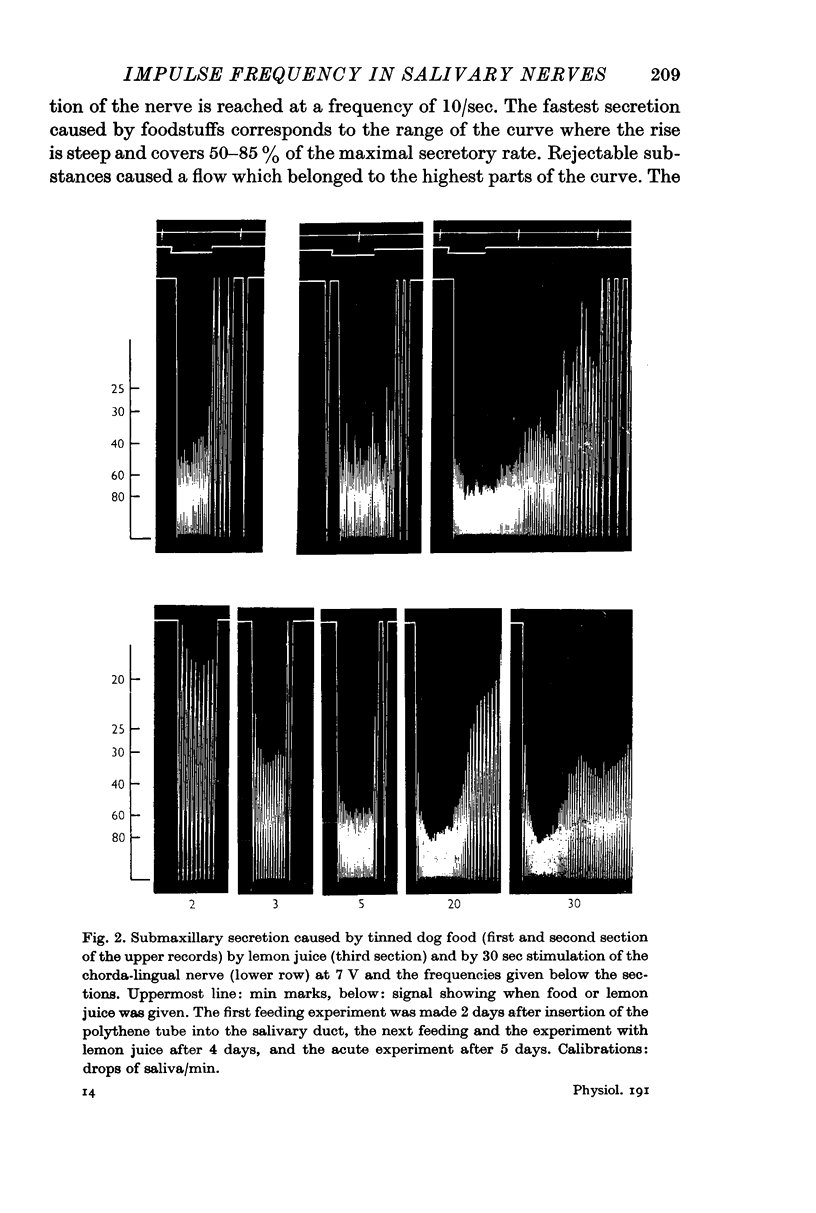
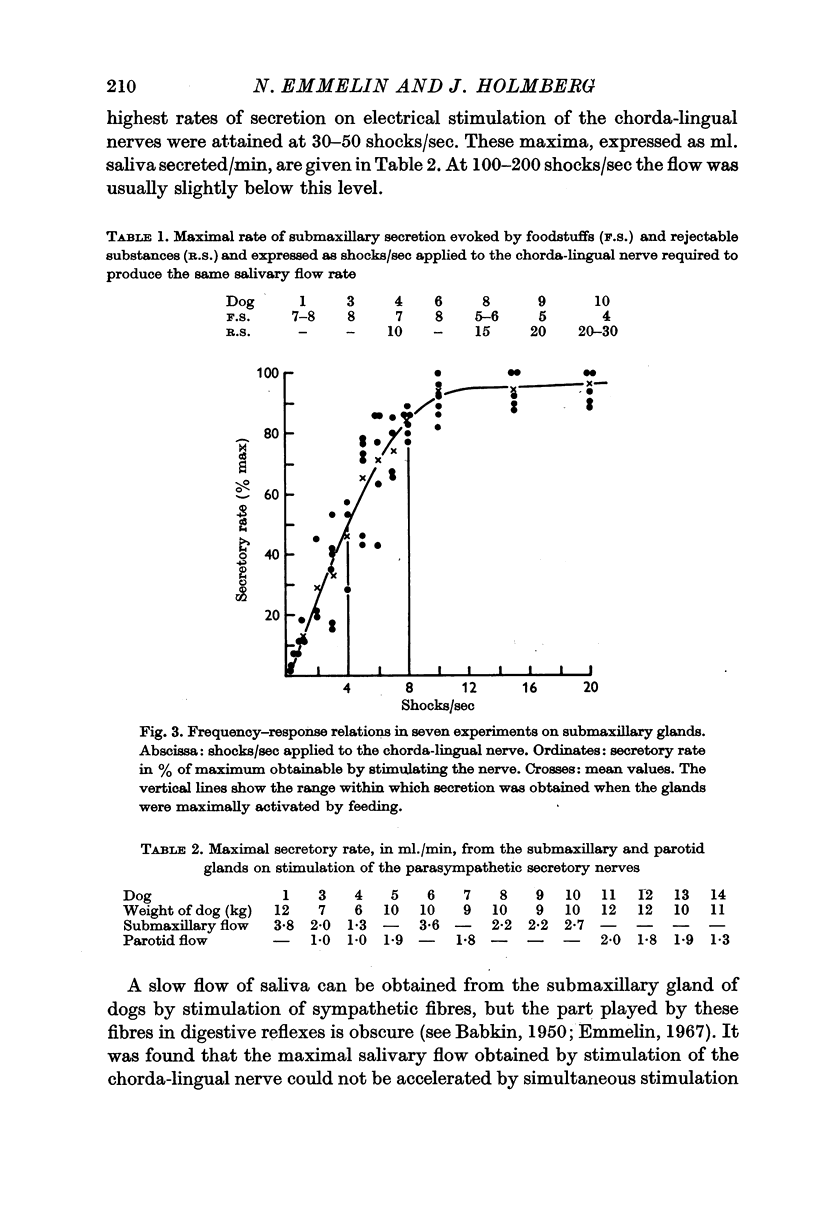
1. In dogs under pentothal anaesthesia the submaxillary duct was exposed in the neck and a polythene tube tied into it. During the following days the dogs were examined repeatedly, standing in a frame. The highest rates of submaxillary secretion evoked by introducing various foodstuffs or rejectable substances into the mouth were estimated. Finally, the dogs were anaesthetized and the rates of salivary flow recorded during electrical stimulation of the chordalingual nerve at different frequencies.
2. The frequency—response curve for electrical stimulation has a steep slope up to a frequency of 10/sec, where a salivary flow at a rate of about 90% of the maximal is evoked.
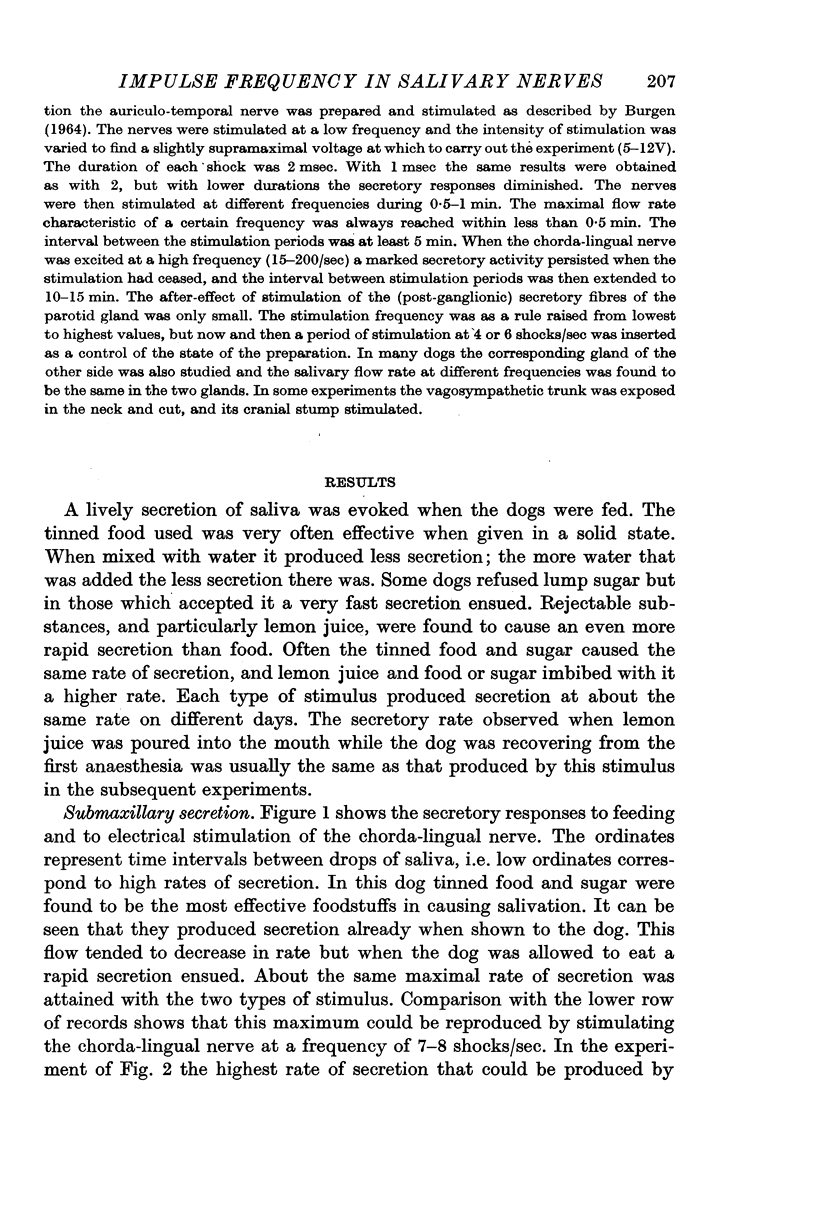
3. The fastest secretion that is obtained reflexly on feeding corresponds to a flow which in different experiments varies between 4 and 8 shocks/sec. The very rapid secretion caused by rejectable substances can be reproduced by stimulating at 10-30/sec.
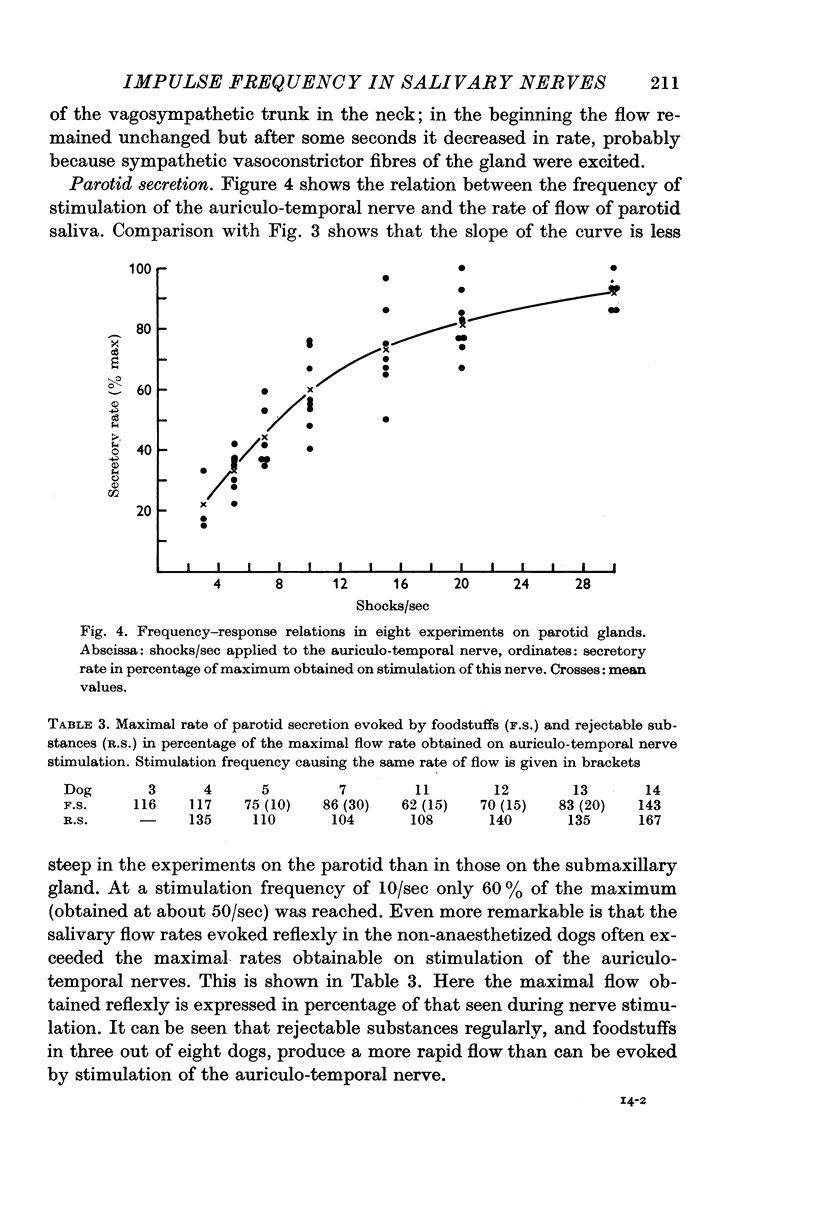
4. In similar experiments on the parotid gland foodstuffs were often, and rejectable substances always found to cause a salivary flow at a rate which exceeded that obtained on maximal stimulation of the auriculotemporal nerve. This supports the view expressed by previous investigators that additional secretory fibres reach the parotid gland of the dog by anatomically unknown routes.
Full text
PDF
Selected References
These references are in PubMed. This may not be the complete list of references from this article.
- BRUNER J., KOZAK W. Wydzielanie śliny na pojedyncze i rytmiczne salwy impulsów. Acta Physiol Pol. 1957;8(3-3A):291–293. [PubMed] [Google Scholar]
- BURGEN A. S. TECHNIQUES FOR STIMULATING THE AURICULO-TEMPORAL NERVE AND RECORDING THE FLOW OF SALIVA. Int Ser Monogr Oral Biol. 1964;3:303–307. doi: 10.1016/b978-1-4832-2871-6.50026-6. [DOI] [PubMed] [Google Scholar]
- CARLSTEN A., FOLKOW B., HAMBERGER C. A. Cardiovascular effects of direct vagal stimulation in man. Acta Physiol Scand. 1957 Nov 26;41(1):68–76. doi: 10.1111/j.1748-1716.1957.tb01510.x. [DOI] [PubMed] [Google Scholar]
- DIAMANT H., ENFORS B., HOLMSTEDT B. Salivary secretion in man elicited by means of stimulation of the chorda tympani. Acta Physiol Scand. 1959 Apr 22;45(4):293–299. doi: 10.1111/j.1748-1716.1959.tb01701.x. [DOI] [PubMed] [Google Scholar]
- EMMELIN N., STROMBLAD R. Salivary secretion after section of the chorda tympani in non-anaesthetized dogs. Acta Physiol Scand Suppl. 1953;111:65–74. [PubMed] [Google Scholar]
- FOLKOW B. Impulse frequency in sympathetic vasomotor fibres correlated to the release and elimination of the transmitter. Acta Physiol Scand. 1952;25(1):49–76. doi: 10.1111/j.1748-1716.1952.tb00858.x. [DOI] [PubMed] [Google Scholar]
- FOLKOW B., LOFVING B., MELLANDER S. Quantitative aspects of the sympathetic neuro-hormonal control of the heart rate. Acta Physiol Scand. 1956 Nov 5;37(4):363–369. doi: 10.1111/j.1748-1716.1956.tb01372.x. [DOI] [PubMed] [Google Scholar]