



Abstract
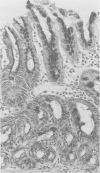
The effects of tetragastrin and truncal vagotomy on the incidence of gastric type epithelium in the duodenum by intraduodenal instillation of 5% NaOH solution were investigated in Wistar rats. Prolonged administration of 1 mg tetragastrin/kg body weight in depot form starting one week after NaOH treatment resulted in a significant increase in gastric acid secretion and the incidence and number of villi with gastric epithelium in the duodenum in experimental week 10. Villi with gastric epithelium were found in five (23%) of 22 rats in control group, whereas abnormal villi were found in 13 (59%) of 22 rats in the tetragastrin treated group (p less than 0.05). The average number of villi with gastric epithelium rose from 0.6 (0.4) per 100 villi in control rats to 2.4 (0.6) per 100 villi in tetragastrin treated rats (p less than 0.01). On histological examination, gastric type epithelium was most often found on stunted or flattened villi, and was always within the boundaries of the area of Brunner's glands. These mucosal changes reverted toward normal with time. In week 35, the incidence of gastric epithelium was significantly less than at week 10 (p less than 0.05). In contrast, no villi with gastric epithelium were found in vagotomised rats in week 10 (p less than 0.05). Vagotomy also caused a significant decrease in gastric acid secretion. These results show that exposure of the duodenal mucosa to high levels of gastric acid enhance the induction of gastric eithelium in the duodenum.
Full text
PDF


Images in this article
Selected References
These references are in PubMed. This may not be the complete list of references from this article.
- Gregory M. A., Moshal M. G., Spitaels J. M. Changes in the morphology of villar epithelial cells adjacent to duodenal ulcers during the process of healing. Scand J Gastroenterol. 1982 Apr;17(3):441–448. doi: 10.3109/00365528209182083. [DOI] [PubMed] [Google Scholar]
- JAMES A. H. GASTRIC EPITHELIUM IN THE DUODENUM. Gut. 1964 Aug;5:285–294. doi: 10.1136/gut.5.4.285. [DOI] [PMC free article] [PubMed] [Google Scholar]
- Morrissey S. M., Ward P. M., Jayaraj A. P., Tovey F. I., Clark C. G. Histochemical changes in mucus in duodenal ulceration. Gut. 1983 Oct;24(10):909–913. doi: 10.1136/gut.24.10.909. [DOI] [PMC free article] [PubMed] [Google Scholar]
- Patrick W. J., Denham D., Forrest A. P. Mucous change in the human duodenum: a light and electron microscopic study and correlation with disease and gastric acid secretion. Gut. 1974 Oct;15(10):767–776. doi: 10.1136/gut.15.10.767. [DOI] [PMC free article] [PubMed] [Google Scholar]
- RHODES J. EXPERMENTAL PRODUCTION OF GASTRIC EPITHELIUM IN THE DUODENUM. Gut. 1964 Oct;5:454–458. doi: 10.1136/gut.5.5.454. [DOI] [PMC free article] [PubMed] [Google Scholar]
- SHAY H., SUN D. C., GRUENSTEIN M. A quantitative method for measuring spontaneous gastric secretion in the rat. Gastroenterology. 1954 Jun;26(6):906–913. [PubMed] [Google Scholar]
- Shousha S., Spiller R. C., Parkins R. A. The endoscopically abnormal duodenum in patients with dyspepsia: biopsy findings in 60 cases. Histopathology. 1983 Jan;7(1):23–34. doi: 10.1111/j.1365-2559.1983.tb02213.x. [DOI] [PubMed] [Google Scholar]
- Spicer S. S., Leppi T. J., Stoward P. J. Suggestions for a histochemical terminology of carbohydrate-rich tissue components. J Histochem Cytochem. 1965 Sep-Oct;13(7):599–603. doi: 10.1177/13.7.599. [DOI] [PubMed] [Google Scholar]
- Tatsuta M., Yamamura H., Baba M., Yamamoto R., Iishi H., Taniguchi H. Inhibitory effect of prolonged administration of tetragastrin on experimentally induced intestinal metaplasia in Wistar rats. Cancer. 1988 May 15;61(10):2051–2056. doi: 10.1002/1097-0142(19880515)61:10<2051::aid-cncr2820611020>3.0.co;2-h. [DOI] [PubMed] [Google Scholar]