



Abstract
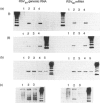
During the initial phase of respiratory syncytial virus (RSV) infection, when a low virus-cell ratio is most probable, signs of inflammation are detectable in the infected respiratory tissue. Therefore we analysed the release of the proinflammatory cytokines interleukin-6 (IL-6), IL-8, tumour necrosis factor-alpha (TNF-alpha), and the soluble form of the TNF receptor-I (sTNFR-I), from peripheral blood mononuclear cells (PBMC) after exposure to low infectious RSV doses (multiplicity of infection, MOI, 0.001-1) and incubation times of up to 24 hr. The PBMC secreted IL-8 in a time- and virus dose-dependent fashion. As was verified by Northern blot analysis, the increased IL-8 secretion rate was accompanied by an enhanced IL-8 mRNA steady-state level. The infection of the PBMC after 4 hr post-RSV exposure was verified by detection of RSVSH genomic RNA and mRNA after reverse transcription and polymerase chain reaction (PCR) amplification. In addition, after 24 hr post-infection we determined the percentage of infected cells by specific immunofluorescence using monoclonal antibodies directed against the F- and G-proteins. After exposure of PBMC to inactivated RSV, we observed only RSVSH genomic RNA and a reduced IL-8 release. Thus, even the binding and/or phagocytosis of RSV by PBMC induced an IL-8 synthesis to some extent. Following an incubation time of 24 hr, PBMC exposed to small RSV doses synthesized and released high amounts of IL-6 into the cell supernatant. In contrast, only low amounts of TNF-alpha were released from PBMC. In addition to the release of the proinflammatory cytokines, an enhanced level of the sTNFR-I was measured in the cell supernatants at a MOI of 0.1. However, there was no correlation between TNFR-I membrane expression and cell supernatant concentration. Co-culture experiments performed with PBMC and human epithelial cells (A549) revealed that the enhanced IL-8 secretion profile observed in the coculture was partially dependent on the cytokines TNF-alpha, IL-1 beta and TNF-beta/lymphotoxin released by the cells themselves.
Full text
PDF


Images in this article

Selected References
These references are in PubMed. This may not be the complete list of references from this article.
- Anderson J. J., Harrop J. A., Peers H., Turnbull T., Toms G. L., Scott R. Recognition of respiratory syncytial (RS) virus proteins by human and BALB/C CD4+ lymphocytes. J Med Virol. 1991 Nov;35(3):165–173. doi: 10.1002/jmv.1890350305. [DOI] [PubMed] [Google Scholar]
- Arnold R., Humbert B., Werchau H., Gallati H., König W. Interleukin-8, interleukin-6, and soluble tumour necrosis factor receptor type I release from a human pulmonary epithelial cell line (A549) exposed to respiratory syncytial virus. Immunology. 1994 May;82(1):126–133. [PMC free article] [PubMed] [Google Scholar]
- Arnold R., Werner F., Humbert B., Werchau H., König W. Effect of respiratory syncytial virus-antibody complexes on cytokine (IL-8, IL-6, TNF-alpha) release and respiratory burst in human granulocytes. Immunology. 1994 Jun;82(2):184–191. [PMC free article] [PubMed] [Google Scholar]
- Baggiolini M., Walz A., Kunkel S. L. Neutrophil-activating peptide-1/interleukin 8, a novel cytokine that activates neutrophils. J Clin Invest. 1989 Oct;84(4):1045–1049. doi: 10.1172/JCI114265. [DOI] [PMC free article] [PubMed] [Google Scholar]
- Becker S., Quay J., Soukup J. Cytokine (tumor necrosis factor, IL-6, and IL-8) production by respiratory syncytial virus-infected human alveolar macrophages. J Immunol. 1991 Dec 15;147(12):4307–4312. [PubMed] [Google Scholar]
- Böyum A. A one-stage procedure for isolation of granulocytes and lymphocytes from human blood. General sedimentation properties of white blood cells in a 1g gravity field. Scand J Clin Lab Invest Suppl. 1968;97:51–76. [PubMed] [Google Scholar]
- Chen T. R. In situ detection of mycoplasma contamination in cell cultures by fluorescent Hoechst 33258 stain. Exp Cell Res. 1977 Feb;104(2):255–262. doi: 10.1016/0014-4827(77)90089-1. [DOI] [PubMed] [Google Scholar]
- Chollet-Martin S., Montravers P., Gibert C., Elbim C., Desmonts J. M., Fagon J. Y., Gougerot-Pocidalo M. A. High levels of interleukin-8 in the blood and alveolar spaces of patients with pneumonia and adult respiratory distress syndrome. Infect Immun. 1993 Nov;61(11):4553–4559. doi: 10.1128/iai.61.11.4553-4559.1993. [DOI] [PMC free article] [PubMed] [Google Scholar]
- Chomczynski P., Sacchi N. Single-step method of RNA isolation by acid guanidinium thiocyanate-phenol-chloroform extraction. Anal Biochem. 1987 Apr;162(1):156–159. doi: 10.1006/abio.1987.9999. [DOI] [PubMed] [Google Scholar]
- Chonmaitree T., Lett-Brown M. A., Grant J. A. Respiratory viruses induce production of histamine-releasing factor by mononuclear leukocytes: a possible role in the mechanism of virus-induced asthma. J Infect Dis. 1991 Sep;164(3):592–594. doi: 10.1093/infdis/164.3.592. [DOI] [PubMed] [Google Scholar]
- Cirino N. M., Panuska J. R., Villani A., Taraf H., Rebert N. A., Merolla R., Tsivitse P., Gilbert I. A. Restricted replication of respiratory syncytial virus in human alveolar macrophages. J Gen Virol. 1993 Aug;74(Pt 8):1527–1537. doi: 10.1099/0022-1317-74-8-1527. [DOI] [PubMed] [Google Scholar]
- Dahinden C. A., Kurimoto Y., De Weck A. L., Lindley I., Dewald B., Baggiolini M. The neutrophil-activating peptide NAF/NAP-1 induces histamine and leukotriene release by interleukin 3-primed basophils. J Exp Med. 1989 Nov 1;170(5):1787–1792. doi: 10.1084/jem.170.5.1787. [DOI] [PMC free article] [PubMed] [Google Scholar]
- Domurat F., Roberts N. J., Jr, Walsh E. E., Dagan R. Respiratory syncytial virus infection of human mononuclear leukocytes in vitro and in vivo. J Infect Dis. 1985 Nov;152(5):895–902. doi: 10.1093/infdis/152.5.895. [DOI] [PubMed] [Google Scholar]
- Feinberg A. P., Vogelstein B. A technique for radiolabeling DNA restriction endonuclease fragments to high specific activity. Anal Biochem. 1983 Jul 1;132(1):6–13. doi: 10.1016/0003-2697(83)90418-9. [DOI] [PubMed] [Google Scholar]
- Fernie B. F., Gerin J. L. The stabilization and purification of respiratory syncytial virus using MgSO4. Virology. 1980 Oct 15;106(1):141–144. doi: 10.1016/0042-6822(80)90229-9. [DOI] [PubMed] [Google Scholar]
- Gooding L. R. Virus proteins that counteract host immune defenses. Cell. 1992 Oct 2;71(1):5–7. doi: 10.1016/0092-8674(92)90259-f. [DOI] [PubMed] [Google Scholar]
- Graham B. S., Perkins M. D., Wright P. F., Karzon D. T. Primary respiratory syncytial virus infection in mice. J Med Virol. 1988 Oct;26(2):153–162. doi: 10.1002/jmv.1890260207. [DOI] [PubMed] [Google Scholar]
- Hall C. B., Powell K. R., MacDonald N. E., Gala C. L., Menegus M. E., Suffin S. C., Cohen H. J. Respiratory syncytial viral infection in children with compromised immune function. N Engl J Med. 1986 Jul 10;315(2):77–81. doi: 10.1056/NEJM198607103150201. [DOI] [PubMed] [Google Scholar]
- Hall W. J., Hall C. B., Speers D. M. Respiratory syncytial virus infection in adults: clinical, virologic, and serial pulmonary function studies. Ann Intern Med. 1978 Feb;88(2):203–205. doi: 10.7326/0003-4819-88-2-203. [DOI] [PubMed] [Google Scholar]
- Hayes P. J., Scott R., Wheeler J. In vivo production of tumour necrosis factor-alpha and interleukin-6 in BALB/c mice inoculated intranasally with a high dose of respiratory syncytial virus. J Med Virol. 1994 Apr;42(4):323–329. doi: 10.1002/jmv.1890420402. [DOI] [PubMed] [Google Scholar]
- Kasahara K., Strieter R. M., Chensue S. W., Standiford T. J., Kunkel S. L. Mononuclear cell adherence induces neutrophil chemotactic factor/interleukin-8 gene expression. J Leukoc Biol. 1991 Sep;50(3):287–295. doi: 10.1002/jlb.50.3.287. [DOI] [PubMed] [Google Scholar]
- Kern P., Hemmer C. J., Gallati H., Neifer S., Kremsner P., Dietrich M., Porzsolt F. Soluble tumor necrosis factor receptors correlate with parasitemia and disease severity in human malaria. J Infect Dis. 1992 Oct;166(4):930–934. doi: 10.1093/infdis/166.4.930. [DOI] [PubMed] [Google Scholar]
- Krilov L. R., Hendry R. M., Godfrey E., McIntosh K. Respiratory virus infection of peripheral blood monocytes: correlation with ageing of cells and interferon production in vitro. J Gen Virol. 1987 Jun;68(Pt 6):1749–1753. doi: 10.1099/0022-1317-68-6-1749. [DOI] [PubMed] [Google Scholar]
- Larsen C. G., Anderson A. O., Appella E., Oppenheim J. J., Matsushima K. The neutrophil-activating protein (NAP-1) is also chemotactic for T lymphocytes. Science. 1989 Mar 17;243(4897):1464–1466. doi: 10.1126/science.2648569. [DOI] [PubMed] [Google Scholar]
- Lieber M., Smith B., Szakal A., Nelson-Rees W., Todaro G. A continuous tumor-cell line from a human lung carcinoma with properties of type II alveolar epithelial cells. Int J Cancer. 1976 Jan 15;17(1):62–70. doi: 10.1002/ijc.2910170110. [DOI] [PubMed] [Google Scholar]
- Mathur U., Bentley D. W., Hall C. B. Concurrent respiratory syncytial virus and influenza A infections in the institutionalized elderly and chronically ill. Ann Intern Med. 1980 Jul;93(1):49–52. doi: 10.7326/0003-4819-93-1-49. [DOI] [PubMed] [Google Scholar]
- Matsushima K., Oppenheim J. J. Interleukin 8 and MCAF: novel inflammatory cytokines inducible by IL 1 and TNF. Cytokine. 1989 Nov;1(1):2–13. doi: 10.1016/1043-4666(89)91043-0. [DOI] [PubMed] [Google Scholar]
- Midulla F., Huang Y. T., Gilbert I. A., Cirino N. M., McFadden E. R., Jr, Panuska J. R. Respiratory syncytial virus infection of human cord and adult blood monocytes and alveolar macrophages. Am Rev Respir Dis. 1989 Sep;140(3):771–777. doi: 10.1164/ajrccm/140.3.771. [DOI] [PubMed] [Google Scholar]
- Noah T. L., Becker S. Respiratory syncytial virus-induced cytokine production by a human bronchial epithelial cell line. Am J Physiol. 1993 Nov;265(5 Pt 1):L472–L478. doi: 10.1152/ajplung.1993.265.5.L472. [DOI] [PubMed] [Google Scholar]
- Olsson I., Gatanaga T., Gullberg U., Lantz M., Granger G. A. Tumour necrosis factor (TNF) binding proteins (soluble TNF receptor forms) with possible roles in inflammation and malignancy. Eur Cytokine Netw. 1993 May-Jun;4(3):169–180. [PubMed] [Google Scholar]
- Panuska J. R., Midulla F., Cirino N. M., Villani A., Gilbert I. A., McFadden E. R., Jr, Huang Y. T. Virus-induced alterations in macrophage production of tumor necrosis factor and prostaglandin E2. Am J Physiol. 1990 Dec;259(6 Pt 1):L396–L402. doi: 10.1152/ajplung.1990.259.6.L396. [DOI] [PubMed] [Google Scholar]
- Parrott R. H., Kim H. W., Arrobio J. O., Hodes D. S., Murphy B. R., Brandt C. D., Camargo E., Chanock R. M. Epidemiology of respiratory syncytial virus infection in Washington, D.C. II. Infection and disease with respect to age, immunologic status, race and sex. Am J Epidemiol. 1973 Oct;98(4):289–300. doi: 10.1093/oxfordjournals.aje.a121558. [DOI] [PubMed] [Google Scholar]
- Ramsay A. J., Husband A. J., Ramshaw I. A., Bao S., Matthaei K. I., Koehler G., Kopf M. The role of interleukin-6 in mucosal IgA antibody responses in vivo. Science. 1994 Apr 22;264(5158):561–563. doi: 10.1126/science.8160012. [DOI] [PubMed] [Google Scholar]
- Roberts N. J., Jr, Prill A. H., Mann T. N. Interleukin 1 and interleukin 1 inhibitor production by human macrophages exposed to influenza virus or respiratory syncytial virus. Respiratory syncytial virus is a potent inducer of inhibitor activity. J Exp Med. 1986 Mar 1;163(3):511–519. doi: 10.1084/jem.163.3.511. [DOI] [PMC free article] [PubMed] [Google Scholar]
- Standiford T. J., Kunkel S. L., Basha M. A., Chensue S. W., Lynch J. P., 3rd, Toews G. B., Westwick J., Strieter R. M. Interleukin-8 gene expression by a pulmonary epithelial cell line. A model for cytokine networks in the lung. J Clin Invest. 1990 Dec;86(6):1945–1953. doi: 10.1172/JCI114928. [DOI] [PMC free article] [PubMed] [Google Scholar]
- Stott E. J., Taylor G. Respiratory syncytial virus. Brief review. Arch Virol. 1985;84(1-2):1–52. doi: 10.1007/BF01310552. [DOI] [PubMed] [Google Scholar]
- Tartaglia L. A., Goeddel D. V. Two TNF receptors. Immunol Today. 1992 May;13(5):151–153. doi: 10.1016/0167-5699(92)90116-O. [DOI] [PubMed] [Google Scholar]
- Treuhaft M. W., Beem M. O. Defective interfering particles of respiratory syncytial virus. Infect Immun. 1982 Aug;37(2):439–444. doi: 10.1128/iai.37.2.439-444.1982. [DOI] [PMC free article] [PubMed] [Google Scholar]
- Weber E., Humbert B., Streckert H. J., Werchau H. Nonstructural protein 2 (NS2) of respiratory syncytial virus (RSV) detected by an antipeptide serum. Respiration. 1995;62(1):27–33. doi: 10.1159/000196385. [DOI] [PubMed] [Google Scholar]
- Wong G. H., Tartaglia L. A., Lee M. S., Goeddel D. V. Antiviral activity of tumor necrosis factor is signaled through the 55-kDa type I TNF receptor [corrected]. J Immunol. 1992 Nov 15;149(10):3350–3353. [PubMed] [Google Scholar]