



Abstract
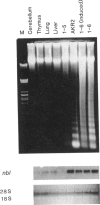
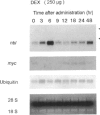
A gene of unknown biological function, nbl, was originally isolated by virtue of its abundance in a Namalwa Burkitt Lymphoma cDNA library. nbl expression was initially found to be higher in tissues which exhibited internucleosomal DNA cleavage characteristic of apoptosis, than in tissues which did not exhibit a 'DNA ladder'. nbl expression was therefore examined in mouse thymus in vivo, in which apoptosis is induced by the glucocorticoid, dexamethasone. nbl expression was markedly enhanced by dexamethasone treatment and then sharply decreased prior to the occurrence of maximal 'DNA ladder' formation. In contrast, expression of myc, which is believed to be involved in apoptosis in other cell systems, declined as thymic apoptosis increased. Thymic apoptosis was blocked by the transcriptional inhibitor actinomycin D, if administered when nbl expression was enhanced, but not before or after the peak of nbl expression. These results suggest that nbl expression is associated with thymic apoptosis.
Full text
PDF


Images in this article


Selected References
These references are in PubMed. This may not be the complete list of references from this article.
- Auclair D., Lang B. F., Forest P., Desgroseillers L. Analysis of genes encoding highly conserved lysine-rich proteins in Aplysia californica and Saccharomyces cerevisiae. Eur J Biochem. 1994 Mar 15;220(3):997–1003. doi: 10.1111/j.1432-1033.1994.tb18704.x. [DOI] [PubMed] [Google Scholar]
- Baker R. T., Board P. G. The human ubiquitin gene family: structure of a gene and pseudogenes from the Ub B subfamily. Nucleic Acids Res. 1987 Jan 26;15(2):443–463. doi: 10.1093/nar/15.2.443. [DOI] [PMC free article] [PubMed] [Google Scholar]
- Baughman G., Harrigan M. T., Campbell N. F., Nurrish S. J., Bourgeois S. Genes newly identified as regulated by glucocorticoids in murine thymocytes. Mol Endocrinol. 1991 May;5(5):637–644. doi: 10.1210/mend-5-5-637. [DOI] [PubMed] [Google Scholar]
- Clarke A. R., Purdie C. A., Harrison D. J., Morris R. G., Bird C. C., Hooper M. L., Wyllie A. H. Thymocyte apoptosis induced by p53-dependent and independent pathways. Nature. 1993 Apr 29;362(6423):849–852. doi: 10.1038/362849a0. [DOI] [PubMed] [Google Scholar]
- Evan G. I., Wyllie A. H., Gilbert C. S., Littlewood T. D., Land H., Brooks M., Waters C. M., Penn L. Z., Hancock D. C. Induction of apoptosis in fibroblasts by c-myc protein. Cell. 1992 Apr 3;69(1):119–128. doi: 10.1016/0092-8674(92)90123-t. [DOI] [PubMed] [Google Scholar]
- Fesus L., Davies P. J., Piacentini M. Apoptosis: molecular mechanisms in programmed cell death. Eur J Cell Biol. 1991 Dec;56(2):170–177. [PubMed] [Google Scholar]
- Garrett J. M., Singh K. K., Vonder Haar R. A., Emr S. D. Mitochondrial protein import: isolation and characterization of the Saccharomyces cerevisiae MFT1 gene. Mol Gen Genet. 1991 Mar;225(3):483–491. doi: 10.1007/BF00261691. [DOI] [PubMed] [Google Scholar]
- Grassilli E., Carcereri de Prati A., Monti D., Troiano L., Menegazzi M., Barbieri D., Franceschi C., Suzuki H. Studies of the relationship between cell proliferation and cell death. II. Early gene expression during concanavalin A-induced proliferation or dexamethasone-induced apoptosis of rat thymocytes. Biochem Biophys Res Commun. 1992 Nov 16;188(3):1261–1266. doi: 10.1016/0006-291x(92)91367-y. [DOI] [PubMed] [Google Scholar]
- Ito M., Yasui A., Komamine A. A gene family homologous to the S-phase specific gene in higher plants is essential for cell proliferation in Saccharomyces cerevisiae. FEBS Lett. 1992 Apr 13;301(1):29–33. doi: 10.1016/0014-5793(92)80203-s. [DOI] [PubMed] [Google Scholar]
- Kho C. J., Zarbl H. Fte-1, a v-fos transformation effector gene, encodes the mammalian homologue of a yeast gene involved in protein import into mitochondria. Proc Natl Acad Sci U S A. 1992 Mar 15;89(6):2200–2204. doi: 10.1073/pnas.89.6.2200. [DOI] [PMC free article] [PubMed] [Google Scholar]
- Kyprianou N., English H. F., Davidson N. E., Isaacs J. T. Programmed cell death during regression of the MCF-7 human breast cancer following estrogen ablation. Cancer Res. 1991 Jan 1;51(1):162–166. [PubMed] [Google Scholar]
- Lin J. K., Chou C. K. In vitro apoptosis in the human hepatoma cell line induced by transforming growth factor beta 1. Cancer Res. 1992 Jan 15;52(2):385–388. [PubMed] [Google Scholar]
- McConkey D. J., Nicotera P., Hartzell P., Bellomo G., Wyllie A. H., Orrenius S. Glucocorticoids activate a suicide process in thymocytes through an elevation of cytosolic Ca2+ concentration. Arch Biochem Biophys. 1989 Feb 15;269(1):365–370. doi: 10.1016/0003-9861(89)90119-7. [DOI] [PubMed] [Google Scholar]
- Naora H., Altin J. G., Young I. G. TCR-dependent and -independent signaling mechanisms differentially regulate lymphokine gene expression in the murine T helper clone D10.G4.1. J Immunol. 1994 Jun 15;152(12):5691–5702. [PubMed] [Google Scholar]
- Naora H., Xu Z. Z., Miyahara K., Liszczynsky H., Seno S. Gene ecology: a cis-acting gene-to-gene interaction due to the spatial arrangement of genes in chromosomes affects neighbouring transfected c-H-ras expression. Chromosome Res. 1994 May;2(3):171–183. doi: 10.1007/BF01553317. [DOI] [PubMed] [Google Scholar]
- Owens G. P., Hahn W. E., Cohen J. J. Identification of mRNAs associated with programmed cell death in immature thymocytes. Mol Cell Biol. 1991 Aug;11(8):4177–4188. doi: 10.1128/mcb.11.8.4177. [DOI] [PMC free article] [PubMed] [Google Scholar]
- Ro T. S., Busch H. Concentration of [14C]actinomycin D in various tissues following intravenous injection. Biochim Biophys Acta. 1965 Oct 11;108(2):317–318. doi: 10.1016/0005-2787(65)90019-5. [DOI] [PubMed] [Google Scholar]
- Rotello R. J., Lieberman R. C., Purchio A. F., Gerschenson L. E. Coordinated regulation of apoptosis and cell proliferation by transforming growth factor beta 1 in cultured uterine epithelial cells. Proc Natl Acad Sci U S A. 1991 Apr 15;88(8):3412–3415. doi: 10.1073/pnas.88.8.3412. [DOI] [PMC free article] [PubMed] [Google Scholar]
- Schwartz L. M., Smith S. W., Jones M. E., Osborne B. A. Do all programmed cell deaths occur via apoptosis? Proc Natl Acad Sci U S A. 1993 Feb 1;90(3):980–984. doi: 10.1073/pnas.90.3.980. [DOI] [PMC free article] [PubMed] [Google Scholar]
- Sentman C. L., Shutter J. R., Hockenbery D., Kanagawa O., Korsmeyer S. J. bcl-2 inhibits multiple forms of apoptosis but not negative selection in thymocytes. Cell. 1991 Nov 29;67(5):879–888. doi: 10.1016/0092-8674(91)90361-2. [DOI] [PubMed] [Google Scholar]
- Shi Y., Glynn J. M., Guilbert L. J., Cotter T. G., Bissonnette R. P., Green D. R. Role for c-myc in activation-induced apoptotic cell death in T cell hybridomas. Science. 1992 Jul 10;257(5067):212–214. doi: 10.1126/science.1378649. [DOI] [PubMed] [Google Scholar]
- Smith C. A., Williams G. T., Kingston R., Jenkinson E. J., Owen J. J. Antibodies to CD3/T-cell receptor complex induce death by apoptosis in immature T cells in thymic cultures. Nature. 1989 Jan 12;337(6203):181–184. doi: 10.1038/337181a0. [DOI] [PubMed] [Google Scholar]
- Tattersall M. H., Sodergren J. E., Dengupta S. K., Trites D. H., Modest E. J., Frei E., 3rd Pharmacokinetics of actinoymcin D in patients with malignant melanoma. Clin Pharmacol Ther. 1975 Jun;17(6):701–708. doi: 10.1002/cpt1975176701. [DOI] [PubMed] [Google Scholar]
- Williams G. T., Smith C. A., McCarthy N. J., Grimes E. A. Apoptosis: final control point in cell biology. Trends Cell Biol. 1992 Sep;2(9):263–267. doi: 10.1016/0962-8924(92)90198-v. [DOI] [PubMed] [Google Scholar]
- Williams G. T., Smith C. A. Molecular regulation of apoptosis: genetic controls on cell death. Cell. 1993 Sep 10;74(5):777–779. doi: 10.1016/0092-8674(93)90457-2. [DOI] [PubMed] [Google Scholar]
- Wyllie A. H. Apoptosis and the regulation of cell numbers in normal and neoplastic tissues: an overview. Cancer Metastasis Rev. 1992 Sep;11(2):95–103. doi: 10.1007/BF00048057. [DOI] [PubMed] [Google Scholar]
- Wyllie A. H., Morris R. G., Smith A. L., Dunlop D. Chromatin cleavage in apoptosis: association with condensed chromatin morphology and dependence on macromolecular synthesis. J Pathol. 1984 Jan;142(1):67–77. doi: 10.1002/path.1711420112. [DOI] [PubMed] [Google Scholar]
- Yerushalmi A. Combined treatment of a solid tumour by local hyperthermia and actionomycin D. Br J Cancer. 1978 May;37(5):827–832. doi: 10.1038/bjc.1978.121. [DOI] [PMC free article] [PubMed] [Google Scholar]
- Yuh Y. S., Thompson E. B. Glucocorticoid effect on oncogene/growth gene expression in human T lymphoblastic leukemic cell line CCRF-CEM. Specific c-myc mRNA suppression by dexamethasone. J Biol Chem. 1989 Jun 25;264(18):10904–10910. [PubMed] [Google Scholar]