



Abstract
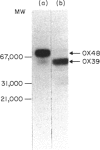
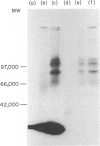
The monoclonal antibody (mAb) OX48 recognizes a 70,000 MW cell-surface protein present in a small percentage of activated rat T cells and in CD8+ rat x BW5147 interleukin-2 (IL-2)-dependent T-cell hybridomas, but not in resting spleen cells or in IL-2-independent T-cell hybrids. OX48 antibody added simultaneously with concanavalin A (Con A) to resting spleen cells inhibits the cell proliferation and reduces the IL-2 production. However, addition of IL-2 does not restore the mitogenic response. Growth of rat blast T cells or IL-2-dependent hybrids is not affected by the OX48 antibody. There is a close correlation between the expression of high-affinity IL-2 receptors (IL-2R) and the OX48 antigen in T-cell hybridomas. In spite of this striking correlation, OX48 mAb does not inhibit the binding of 125I-IL-2 to the IL-2-dependent hybrids, and is unable to immunoprecipitate any of the proteins chemically cross-linked to 125I-IL-2. Therefore, the OX48 molecule represents a new rat activation antigen, undefined in other species, and probably involved in the early steps of T-cell activation.
Full text
PDF


Images in this article
Selected References
These references are in PubMed. This may not be the complete list of references from this article.
- Greene W. C., Leonard W. J. The human interleukin-2 receptor. Annu Rev Immunol. 1986;4:69–95. doi: 10.1146/annurev.iy.04.040186.000441. [DOI] [PubMed] [Google Scholar]
- Landegren U. Measurement of cell numbers by means of the endogenous enzyme hexosaminidase. Applications to detection of lymphokines and cell surface antigens. J Immunol Methods. 1984 Mar 16;67(2):379–388. doi: 10.1016/0022-1759(84)90477-0. [DOI] [PubMed] [Google Scholar]
- Leonard W. J., Depper J. M., Crabtree G. R., Rudikoff S., Pumphrey J., Robb R. J., Krönke M., Svetlik P. B., Peffer N. J., Waldmann T. A. Molecular cloning and expression of cDNAs for the human interleukin-2 receptor. Nature. 1984 Oct 18;311(5987):626–631. doi: 10.1038/311626a0. [DOI] [PubMed] [Google Scholar]
- Leonard W. J., Depper J. M., Uchiyama T., Smith K. A., Waldmann T. A., Greene W. C. A monoclonal antibody that appears to recognize the receptor for human T-cell growth factor; partial characterization of the receptor. Nature. 1982 Nov 18;300(5889):267–269. doi: 10.1038/300267a0. [DOI] [PubMed] [Google Scholar]
- Lowenthal J. W., Corthésy P., Tougne C., Lees R., MacDonald H. R., Nabholz M. High and low affinity IL 2 receptors: analysis by IL 2 dissociation rate and reactivity with monoclonal anti-receptor antibody PC61. J Immunol. 1985 Dec;135(6):3988–3994. [PubMed] [Google Scholar]
- Nakamura Y., Inamoto T., Sugie K., Masutani H., Shindo T., Tagaya Y., Yamauchi A., Ozawa K., Yodoi J. Mitogenicity and down-regulation of high-affinity interleukin 2 receptor by YTA-1 and YTA-2, monoclonal antibodies that recognize 75-kDa molecules on human large granular lymphocytes. Proc Natl Acad Sci U S A. 1989 Feb;86(4):1318–1322. doi: 10.1073/pnas.86.4.1318. [DOI] [PMC free article] [PubMed] [Google Scholar]
- Nikaido T., Shimizu A., Ishida N., Sabe H., Teshigawara K., Maeda M., Uchiyama T., Yodoi J., Honjo T. Molecular cloning of cDNA encoding human interleukin-2 receptor. Nature. 1984 Oct 18;311(5987):631–635. doi: 10.1038/311631a0. [DOI] [PubMed] [Google Scholar]
- Paterson D. J., Jefferies W. A., Green J. R., Brandon M. R., Corthesy P., Puklavec M., Williams A. F. Antigens of activated rat T lymphocytes including a molecule of 50,000 Mr detected only on CD4 positive T blasts. Mol Immunol. 1987 Dec;24(12):1281–1290. doi: 10.1016/0161-5890(87)90122-2. [DOI] [PubMed] [Google Scholar]
- Robb R. J., Munck A., Smith K. A. T cell growth factor receptors. Quantitation, specificity, and biological relevance. J Exp Med. 1981 Nov 1;154(5):1455–1474. doi: 10.1084/jem.154.5.1455. [DOI] [PMC free article] [PubMed] [Google Scholar]
- Saragovi H., Malek T. R. The murine interleukin 2 receptor. Irreversible cross-linking of radiolabeled interleukin 2 to high affinity interleukin 2 receptors reveals a noncovalently associated subunit. J Immunol. 1987 Sep 15;139(6):1918–1926. [PubMed] [Google Scholar]
- Schulz T. F., Mitterer M., Neumayer H. P., Vogetseder W., Dierich M. P. Involvement in the initiation of T cell responses and structural features of an 85-kDa membrane activation antigen. Eur J Immunol. 1988 Aug;18(8):1253–1258. doi: 10.1002/eji.1830180816. [DOI] [PubMed] [Google Scholar]
- Somoza C., Fernández-Ruiz E., Jotterand-Bellomo M., Sanz E., Nabholz M., Silva A. Loss of interleukin 2 dependence in cloned interleukin 2-dependent rat T lymphocyte x BW5147 hybridomas is not associated with segregation of a specific pair of rat chromosomes. Eur J Immunol. 1989 Jul;19(7):1177–1181. doi: 10.1002/eji.1830190704. [DOI] [PubMed] [Google Scholar]
- Springer T. A., Dustin M. L., Kishimoto T. K., Marlin S. D. The lymphocyte function-associated LFA-1, CD2, and LFA-3 molecules: cell adhesion receptors of the immune system. Annu Rev Immunol. 1987;5:223–252. doi: 10.1146/annurev.iy.05.040187.001255. [DOI] [PubMed] [Google Scholar]
- Takeshita T., Goto Y., Tada K., Nagata K., Asao H., Sugamura K. Monoclonal antibody defining a molecule possibly identical to the p75 subunit of interleukin 2 receptor. J Exp Med. 1989 Apr 1;169(4):1323–1332. doi: 10.1084/jem.169.4.1323. [DOI] [PMC free article] [PubMed] [Google Scholar]
- Teshigawara K., Wang H. M., Kato K., Smith K. A. Interleukin 2 high-affinity receptor expression requires two distinct binding proteins. J Exp Med. 1987 Jan 1;165(1):223–238. doi: 10.1084/jem.165.1.223. [DOI] [PMC free article] [PubMed] [Google Scholar]
- Tsudo M., Kitamura F., Miyasaka M. Characterization of the interleukin 2 receptor beta chain using three distinct monoclonal antibodies. Proc Natl Acad Sci U S A. 1989 Mar;86(6):1982–1986. doi: 10.1073/pnas.86.6.1982. [DOI] [PMC free article] [PubMed] [Google Scholar]
- Tsudo M., Kozak R. W., Goldman C. K., Waldmann T. A. Demonstration of a non-Tac peptide that binds interleukin 2: a potential participant in a multichain interleukin 2 receptor complex. Proc Natl Acad Sci U S A. 1986 Dec;83(24):9694–9698. doi: 10.1073/pnas.83.24.9694. [DOI] [PMC free article] [PubMed] [Google Scholar]