



Abstract
Studies on coupled transfer of soil moisture and heat have been widely carried out for decades. However, little work has been done on red soils, widespread in southern China. The simultaneous transfer of soil moisture and heat depends on soil physical properties and the climate conditions. Red soil is heavy clay and high content of free iron and aluminum oxide. The climate conditions are characterized by the clear four seasons and the serious seasonal drought. The great annual and diurnal air temperature differences result in significant fluctuation in soil temperature in top layer. The closed and evaporating columns experiments with red soil were conducted to simulate the coupled transfer of soil water and heat under the overlaying and opening fields’ conditions, and to analyze the effects of soil temperature gradient on the water transfer and the effects of initial soil water contents on the transfer of soil water and heat. The closed and evaporating columns were designed similarly with about 18 °C temperatures differences between the top and bottom boundary, except of the upper end closed or exposed to the air, respectively. Results showed that in the closed column, water moved towards the cold end driven by temperature gradient, while the transported water decreased with the increasing initial soil water content until the initial soil water content reached to field capacity equivalent, when almost no changes for the soil moisture profile. In the evaporating column, the net transport of soil water was simultaneously driven by evaporation and temperature gradients, and the drier soil was more influenced by temperature gradient than by evaporation. In drier soil, it took a longer time for the temperature to reach equilibrium, because of more net amount of transported water.
Keywords: Red soil, Coupled transfer of water and heat, Evaporation, Initial soil moisture
INTRODUCTION
Located in subtropical monsoon area, the red soil region in western Zhejiang, China, is one of the main cash crop production bases of this province. Due to the climate, the temporal and spatial distribution of rainfall varies greatly in this region. Only 15 percent of rainfall occurs in summer (July, August and September), while about 60 percent of rainfall occurs in spring (from March to June). The region suffers drought in summer and waterlogging in spring. The parent material of the soil is Quaternary red clay, with the soil belonging to Ultisol order in the US Taxonomy System. The soil has high clay content, but low moisture content (Lu, 1998).
Moisture movement in red soil is determined by its particular hydrological and physical characteristics and by the climatic conditions, and so, has long been studied by soil scientists (Yao, 1996). Quantitative soil moisture studies revealed that the change of soil temperature is positively correlated with the transfer and evaporation of soil moisture. At the same time, moisture transfer also leads to the diffusion and convection of heat, and this results in the variation of thermal distribution (Han, 1999). Therefore, the transfer of water and heat in soil is closely interrelated, so heat transport must be included in studies on moisture transport as an indispensable factor.
Studies on coupled transfer of soil moisture and heat have been widely carried out since the 1950s. Following Philip and de Vries (1957) and Taylor and Cary (1964), many scientists successively made advances in research on the subject (Cassel et al., 1969; Jackson et al., 1974; Jury and Letey, 1979; Nassar and Horton, 1989; Nassar et al., 1992a; 1992b). In China, some researches on coupled transfer of soil moisture and heat have also been conducted, and most of them focused on the soils in arid northern China (Yang, 1989; Zhang et al., 1990; Hu et al., 1992; Kang et al., 1993; Liu et al., 1994; Guo and Li, 1997; Ren et al., 1998). However, little work has been done on red soils in southern China. The coupled transfer of soil water and heat is influenced by the soil physical properties and the climate conditions. Red soil is characterized by high clay content, compactness and acidity. The climate in this region results in frequent occurrence of seasonal drought and waterlogging. The great annual and diurnal air temperature differences lead to significant fluctuation in top layer soil temperature. In order to improve soil water management for these soils, it is necessary to understand in detail the specific behavior of moisture and heat transport in red soil. Accordingly, laboratory experiments were carried out to provide improved understanding for optimized utilization and scientific regulation of moisture and heat resources in this region.
MATERIALS AND METHODS
Soil properties
Soil samples were taken from the Lanxi Experiment Base in Jinhua, Zhejiang Province. The parent material of the soil is Quaternary red clay, and the soil belongs to Ultisol order in the US Taxonomy System. Soil samples were collected from leveled off upland field deserted for several years. The air-dried soil was ground and passed through a 1-mm screen. Such conventional analysis methods were used to analyze the chemical and physical characteristics of the soil (Table 1): soil mechanical composition and micro-aggregate analysis were studied with pipette method, soil particle specific weight with hydrometer method, bulk density with cutting ring method (Soil Physics Laboratory, Institute of Soil Science, Chinese Academy of Sciences, 1978), organic matter with potassium dichromate-oil of vitriol heating method (Bao, 1981), and soil moisture retention curve with pressure plate method (Yao, 1986).
Table 1.
Basic chemical and physical characteristics of soil samples
| Soil sampling | Sampling depth (cm) | Structure coefficient (%) | Bulk density (g/cm3) | Specific weight (g/cm3) | Organic matter (%) | %sand (2~0.05 mm) | %silt (0.05~0.002 mm) | %clay (<0.002 mm) | Texture |
| Red soil | 0~20 | 97.08 | 1.20 | 2.69 | 1.02 | 13.47 | 47.25 | 39.28 | Silty |
Soil column equipment
Vertical soil columns made of polymethyl methacrylate were 0.21 m in length and 0.085 m in diameter, sealed with knock-down copper disks at both ends. From the upper to the lower end of the column, a total of eight 0.04 m diameter holes were drilled for inserting thermocouples every 0.03 m depth. Fig.1 shows the soil column (Han, 1999).
Fig. 1.

Soil column equipments
Design of experiments
Closed and evaporating columns experiments were conducted to simulate the coupled soil water and heat transfer under the overlaying and opening fields’ conditions, respectively, and to analyze the effects of the soil temperature gradient on the water transfer and the effects of initial soil water contents on the transfer of soil water and heat. Soil was passed through a 1-mm screen, and mixed thoroughly. Distilled water was mixed with the air-dried soil until the desired initial water content was obtained. The moistened soil was then packed into a vertical column to a bulk density of 1.2 g/cm3, and the column was sealed at both ends with copper disks. A 0.05 m thick asbestos strip was twined around the column to prevent heat exchange. In the closed experiments, temperature at the lower end of the column was controlled by an ice-water mixture, while temperature at the upper end was adjusted by an air-conditioner. During the experiments, the cold and hot end temperatures were maintained to constant boundary temperatures. Two replicates were conducted for each soil column. Soil temperatures at different time and different soil profile depths were measured at an interval of 0.03 m with thermocouples connected to digital display thermometer. Soil moisture content at every soil profile depth was measured at the end of the experiment by the oven drying method. Triplicate soil samples were taken from a column every 0.03 m depth, placed in aluminum boxes, and oven dried at 105 °C for 24 h. In the evaporating column experiments, the upper ends of the above columns were all exposed to the air controlled at constant temperature. Table 2 shows the design of the experiment, and similar columns whose lower ends are used for the evaporation experiments.
Table 2.
Design of soil column experiments
| Soil column | Initial volume moisture content (%) | Temperature of soil column |
Time (d) | |
| Upper end (°C) | Lower end (°C) | |||
| A | 14.8 | 18.3 | 1.1 | 10 |
| B | 18.7 | 20.7 | 1.1 | 10 |
| C | 23.3 | 19.4 | 1.1 | 10 |
RESULTS AND DISCUSSION
Soil moisture distribution under a temperature gradient
Fig.2 compares soil moisture distribution with depth in the closed columns, with initial moisture contents of 14.8%, 18.7%, and 23.3%, under the same temperature gradient on day 10. Fig.2 shows that apart from some few data apparently having slight deviation, results between replications for each of columns agreed very well, which proved the credibility of the experiment results. It may be concluded that in each group, with homogeneous initial moisture content, soil water moved from hot ends to cold ends driven by the temperature gradient.
Fig. 2.

Comparison of distribution of soil moisture in the closed columns with different moisture contents (14.8% (A), 18.7% (B), 23.3% (C)) under the same temperature gradient
In the three column experiments under the same temperature gradient, after coupled transport of moisture and heat lasting the same duration of time, net moisture transport varied with different initial moisture contents. The largest amount of water transport was observed in the soil column with initial moisture content of 14.8%. Its moisture contents at the upper and lower ends were 8.4% and 23.6%, respectively, with the difference reaching 15.2%. The second was that with initial moisture content of 18.7%, with moisture content difference between upper end and lower end equaling 10.7%. The smallest change was that with initial moisture content of 23.3%, with a moisture content difference between upper end and lower end equaling 4.5%. This indicated that soil wetness and temperature gradient were reversely correlated, that is to say, the temperature gradient had a greater effect on drier soils than on wetter soils. Nassar and Horton (1989) also obtained the similar results and provided detailed explanation.
In order to show more clearly the effect of initial moisture content on net moisture transport, an experiment (Fig.3) was carried out, in which after 360 h, soil moisture distribution was studied with higher initial moisture of 37.2% in a closed column with upper temperature of 25.7 °C and lower temperature of 1.1 °C. Compared with the former experiment, net moisture transport almost did not change although the temperature gradient was increased by more than 5 °C, and the duration of time for water and heat transport was twice that of the previous experiments. At the end of the experiment, moisture content at the upper end of the column was 36.8%, and at the lower end was 38.3%, the difference of only 1.5%, which might be caused by gravity. Because field capacity equivalent (the water content at 1/3 bar soil-water pressure) of the soil sample in laboratory condition was 36.7%, it may be concluded that temperature gradient had little effect on soil moisture transport at equivalent field capacity.
Fig. 3.
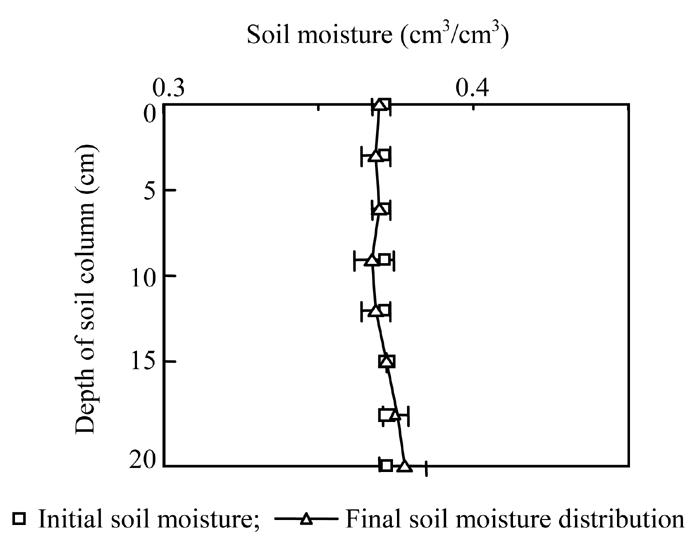
Distribution of soil moisture in the closed columns with higher initial soil moisture content (37.2%) under the same temperature gradient
Gurr et al.(1952) and Nassar et al.(1992a; 1996) concluded that water in dry soil moves from hot ends to cold ends mainly in the form of moisture vapor, condensing at the cold ends; driven by moisture potential gradient in the opposite direction, water moved in the liquid phase from the cold ends towards the hot ends. This bidirectional movement reached equilibrium after a certain period of time. In sufficiently wet soil, moisture is transported only in the form of continuous liquid. Due to the simultaneous action of the downward temperature gradient and gravity with a moisture potential gradient in the opposite direction, continued evaporation and condensation did not allow attainment of equilibrium, which resulted in smaller net moisture transport.
In the evaporating column, soil moisture transport was affected by the simultaneous action of evaporation and temperature operating in opposite directions. Thus, Fig.4 shows that, driven by the temperature gradient, soil moisture tended to transfer from hot ends to cold ends; and at the same time, due to evaporation, moisture lost from the soil surface resulted in reduction of total moisture volume and less moisture transported downwards.
Fig. 4.

Comparison of distribution of soil moisture in the evaporating column with different moisture contents (14.8% (A), 18.7% (B), 23.3% (C)) under the same temperature
In both evaporating columns with initial moisture content of 14.8% and 18.7%, distribution of soil moisture was similar, with almost the same moisture content at the lower soil layer, and, on the upper layer, moisture content was less than that of the closed column due to evaporation. Moisture content in the evaporating column with initial water content of 23.3% appeared obviously less, and moisture content in the whole column was lower than the initial moisture content. As far as evaporation was concerned, that in the column with initial moisture content of 23.3% was highest, while that with initial moisture content of 14.8% was lowest. The results indicated that soil moisture movement in drier soil, especially on the lower layer soil, was more affected by temperature than by evaporation, leading to more moisture flowing downwards despite evaporating, but the condition was opposite in the wetter soil.
Temporal and spatial distribution of temperature in the columns
Fig.5 shows the temporal and spatial distribution of temperature when the closed columns were sectioned. In Fig.5, temperature distributions in all the soil columns had a similar shape for temperature distribution, showing spatial non-linear decrease from the hot to the cold ends of soil columns. Soil temperature changed due to the variation of soil heat conductivity and heat capacity. Because both of these heat coefficients were functions of moisture content, the non-linear distribution of soil temperature was probably associated with non-uniform distribution of soil moisture. Nassar and Horton (1989) and Nassar et al.(1992a) presented their similar observation of non-linear shape of temperature distribution caused by changing soil water content along the column. And Nassar and Horton (1989) concluded that temperature deviations from linearity resulted from the dependence of soil thermal properties (volumetric heat capacity and thermal conductivity) upon soil water content. In the first several hours (about six hours), temperature showed a rapid change, and then the change became slower and slower, and finally reached equilibrium. Temperatures at different depths in Columns B and C were similar at the first, fifth and tenth day, while the change of temperature in Column A was larger. This phenomenon indicated a positive relationship between temperature distribution and moisture transport.
Fig. 5.

Comparison of soil temperature distribution in the closed columns with initial soil moisture content of 14.8% (A), 18.7% (B) and 23.3% (C), respectively
In the evaporating column, the temperature distribution was slightly different from that in the closed column (Fig.6). In this condition, surface temperature of the soil column decreased due to evaporative cooling. As the experiment time increased, the surface temperature increased gradually owing to the upper soil becoming drier and the rate of evaporation decreased.
Fig. 6.

Comparison of soil temperature distribution in the evaporating columns with initial soil moisture content of 14.8% (A), 18.7% (B) and 23.3% (C), respectively
Influence of initial moisture content on change of soil temperature
It was known that a temperature gradient would lead to moisture transferring from hot ends of a column to its cold ends, whereas, redistribution of soil moisture also caused the change of temperature. It was indicated in the above section that soil temperature with lower initial moisture content took longer time to reach equilibrium, and in the same duration of time, more water was transported. Thus, that the change of temperature was further affected by redistribution of soil moisture was shown again. However, under the same temperature gradient, the changes of soil temperatures with different initial moisture contents were not the same.
Table 3 shows the differences in the change of soil temperature within closed columns with initial moisture content of 15.0% and 18.5% under the same temperature gradient of an upper end temperature of 19.6 °C and a lower end temperature of 2.0 °C at 4 h, 8 h, 12 h, 28 h, 32 h, and 48 h.
Table 3.
Comparison of the changes of soil temperatures (°C) with different initial moisture contents at the different time
| H* (cm) | 4 h |
8 h |
12 h |
28 h |
32 h |
48 h |
||||||
|
#θI=15% |
θI=18.5% |
θI=15% |
θI=18.5% |
θI=15% |
θI=18.5% |
θI=15% |
θI=18.5% |
θI=15% |
θI=18.5% |
θI=15% |
θI=18.5% |
|
| Soil temperature (°C) | ||||||||||||
| 0 | 19.6 | 19.6 | 19.6 | 19.6 | 19.6 | 19.6 | 19.6 | 19.6 | 19.6 | 19.6 | 19.6 | 19.6 |
| 3 | 19.5 | 19.2 | 18.5 | 18.2 | 18.5 | 18.3 | 18.4 | 18.3 | 18.2 | 18.0 | 17.6 | 17.5 |
| 6 | 19.0 | 18.5 | 17.6 | 17.0 | 17.4 | 17.0 | 17.5 | 17.1 | 17.2 | 16.8 | 16.5 | 16.2 |
| 9 | 17.9 | 17.0 | 15.9 | 15.1 | 15.4 | 14.9 | 15.8 | 15.2 | 15.5 | 14.9 | 14.7 | 14.1 |
| 12 | 15.2 | 14.8 | 12.8 | 12.8 | 12.2 | 12.5 | 12.5 | 12.9 | 12.3 | 12.6 | 11.6 | 11.9 |
| 15 | 11.9 | 11.1 | 9.6 | 9.3 | 9.1 | 9.1 | 9.5 | 9.4 | 9.2 | 9.1 | 8.6 | 8.5 |
| 18 | 7.8 | 7.0 | 6.2 | 5.7 | 5.8 | 5.5 | 6.1 | 5.9 | 5.7 | 5.4 | 5.5 | 5.2 |
| 21 | 2.0 | 2.0 | 2.0 | 2.0 | 2.0 | 2.0 | 2.0 | 2.0 | 2.0 | 2.0 | 2.0 | 2.0 |
H: Depth of soil column
θI: is the initial soil moisture content
It was shown that under the same temperature gradient, soil temperature with lower initial moisture content (15.0%) decreased slower than that with higher initial moisture content (18.5%) at the beginning of the experiment, and then temperature of the lower moisture column gradually approached that of the higher moisture content column. It was expected that after a certain period of time, the change of the former would be larger than that of the latter. This was because that under the same temperature gradient, soil temperature showed a slower change due to lower thermal conductibility coefficients (soil heat conductivity and heat capacity) in soil with lower initial moisture content. With longer time, when soil moisture and temperature with higher initial moisture content reached equilibrium, those with lower water contents were still not at equilibrium, which resulted from the further change of soil temperature due to redistribution of soil moisture. Thus, the larger change of soil temperature occurred in columns with lower initial moisture content.
CONCLUSION
1. In closed columns, moisture transferred from the hot ends to the cold ends driven by temperature gradient, and the amount of transported water was in negative correlation with the initial soil water content. In this experiment, the transported water was 15.2%, 10.7%, and 4.5%, when the corresponding initial water contents were 14.8%, 18.7% and 23.3%, respectively. When the initial soil water content reached the field capacity equivalent (36.7% for the test soil under the laboratory condition), almost no net moisture transported between both ends of the soil column, which implied that the temperature gradient had almost no impact on soil water movement.
2. In evaporating columns, the net transport of soil water was simultaneously driven by evaporation and temperature gradients. Temperature gradient had more effect on drier soil than evaporation did, while the condition in the wetter soil was opposite.
3. Under the action of a temperature gradient, soil moisture distribution in the whole profile was not uniform, which consequently led to the non-linear distribution for soil temperature from the upper ends to the lower ends, even until temperature reached equilibrium. Compared to soil column with lower initial moisture content, the higher moisture content column took a shorter time to reach equilibrium in soil temperature, because of less net amount of transported water.
4. In the evaporating columns, the distribution of temperature was different from that in the closed column. Soil temperature at the upper end of the columns was always invariable under the closed condition; while under the evaporating condition, it couldn’t be kept steady, deviated from the controlled environmental temperature.
Footnotes
rted by the National Natural Science Foundation of China (No. 40171047) and the Doctoral Foundation of National Education Ministry, China
References
- 1.Bao SD. Soil Agricultural Chemistry Analysis. Beijing, China: Chinese Agriculture Press; 1981. (in Chinese) [Google Scholar]
- 2.Cassel DK, Nielson DR, Biggar JW. Soil-water movement in response to imposed temperature gradients. Soil Science Society American Proceedings. 1969;33:493–500. [Google Scholar]
- 3.Guo QR, Li YS. Mathematical simulation of coupled heat and water flow in soil under nonisothermal temperature. Journal of China Agricultural University. 1997;12(Suppl.):33–38. (in Chinese) [Google Scholar]
- 4.Gurr CG, Marshall TJ, Hutton JT. Movement of water in soil due to a temperature gradient. Soil Science. 1952;72(5):335–344. [Google Scholar]
- 5.Han XF. Research on Coupled Soil Moisture and Heat Transport and Its Simulation Model. 1999. Dissertation of Master Degree, Zhejiang University, China (in Chinese) [Google Scholar]
- 6.Hu HP, Yang SX, Lei ZD. A numerical simulation for heat and water transfer during soil freezing. Journal of Hydraulic Engineering. 1992;7:1–8. (in Chinese) [Google Scholar]
- 7.Jackson RD, Reginato RJ, Kimball BA, Nakayama FS. Diurnal soil-water evaporation: Comparison of measured and calculated soil-water fluxes. Soil Science Society American Proceedings. 1974;38:863–866. [Google Scholar]
- 8.Jury WA, Letey J. Water vapor movement in soil: Reconciliation of theory and experiment. Soil Science Society of America Journal. 1979;43:823–827. [Google Scholar]
- 9.Kang SZ, Liu XM, Zhang GY. Simulation of soil water and heat movement with crop canopy shading. Journal of Hydraulic Engineering. 1993;3:11–17. 27. (in Chinese) [Google Scholar]
- 10.Liu SC, Bai JL, Zhang YP, Zhang JC. Effect of temperature gradient on unsaturated soil moisture transport. Journal of North-West China Agricultural University. 1994;22(1):44–49. (in Chinese) [Google Scholar]
- 11.Lu J. Simulation of the effects of soil water condition on winter wheat growth. Journal of Hydraulic Engineering. 1998;7:68–72. (in Chinese) [Google Scholar]
- 12.Nassar IN, Horton R. Moisture transport in unsaturated nonisothermal salty soil: I. Experimental results. Soil Science Society of America Journal. 1989;53:1323–1329. [Google Scholar]
- 13.Nassar IN, Horton R, Globus AM. Simultaneous transfer of heat, moisture, and solute in porous media: II. Experiment and analysis. Soil Science Society of America Journal. 1992;56:1357–1365. [Google Scholar]
- 14.Nassar IN, Globus AM, Horton R. Simultaneous soil heat and water transfer. Soil Science. 1992;154(6):465–472. [Google Scholar]
- 15.Nassar IN, Benjamin JG, Horton R. Thermally induced moisture movement in uniform clayey. Soil Science. 1996;161(8):471–479. [Google Scholar]
- 16.Philip JR, de Vries DA. Moisture movement in porous materials under temperature gradients. Transactions, American Geophysical Union. 1957;38:222–232. [Google Scholar]
- 17.Ren L, Zhang YF, Shen RK. Field experiments and numerical simulation of soil moisture and heat regimes under the condition of summer corn partially covered by mulch strips. Journal of Hydraulic Engineering. 1998;2:1–9. (in Chinese) [Google Scholar]
- 18.Soil Physics Laboratory, Institute of Soil Science, Chinese Academy of Sciences. Soil Physical Characteristic Measuring Methods. Beijing, China: Chinese Science Press; 1978. (in Chinese) [Google Scholar]
- 19.Taylor SA, Cary JW. Linear equations for the simultaneous flux of matter and energy in a continuous soil system. Soil Science Society American Journal. 1964;28:167–172. [Google Scholar]
- 20.Yang BJ. Numerical Model and its Application for Soil Evaporation Process. Beijing, China: Scientific Books and Periodicals Press; 1989. (in Chinese) [Google Scholar]
- 21.Yao XL. Soil Physics. Beijing, China: Agriculture Press; 1986. (in Chinese) [Google Scholar]
- 22.Yao XL. Moisture problem of red soil and its management. Journal of Soil. 1996;33(1):13–20. (in Chinese) [Google Scholar]
- 23.Zhang YP, Bai JL, Zhang JC, Liu SC. A study of the temperature effect on soil moisture potential. Journal of Soil. 1990;27(4):454–458. (in Chinese) [Google Scholar]