



Abstract
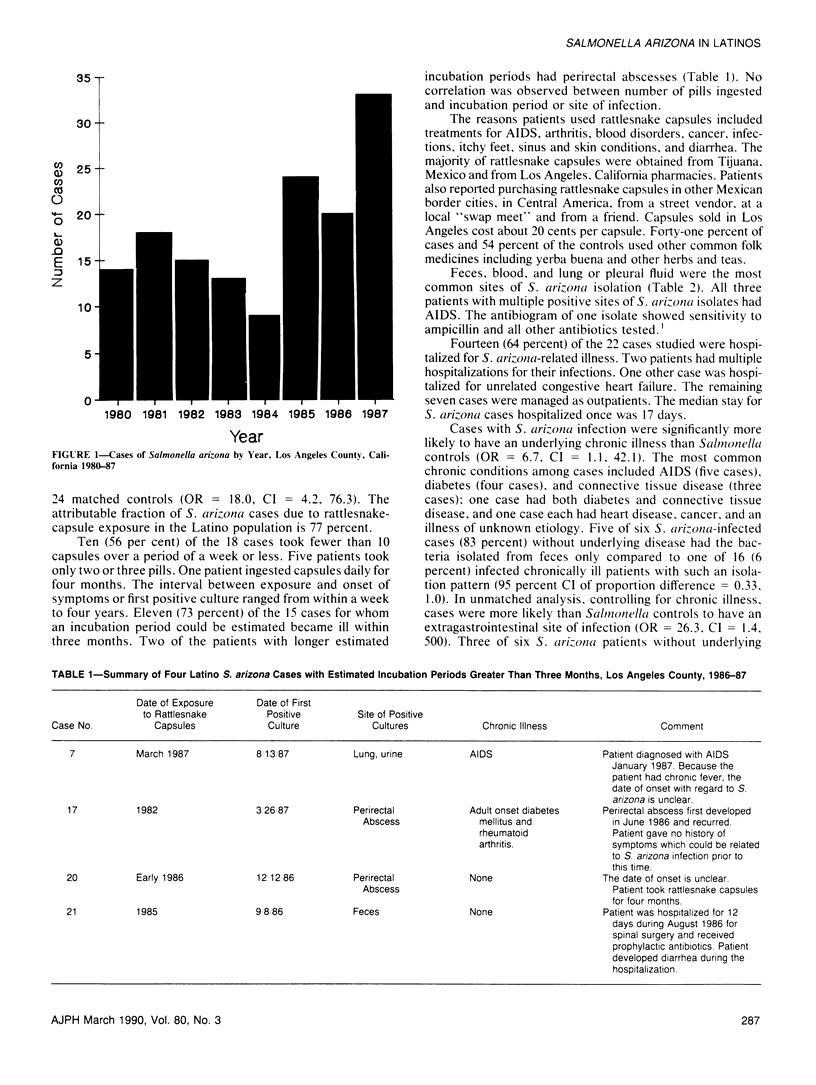
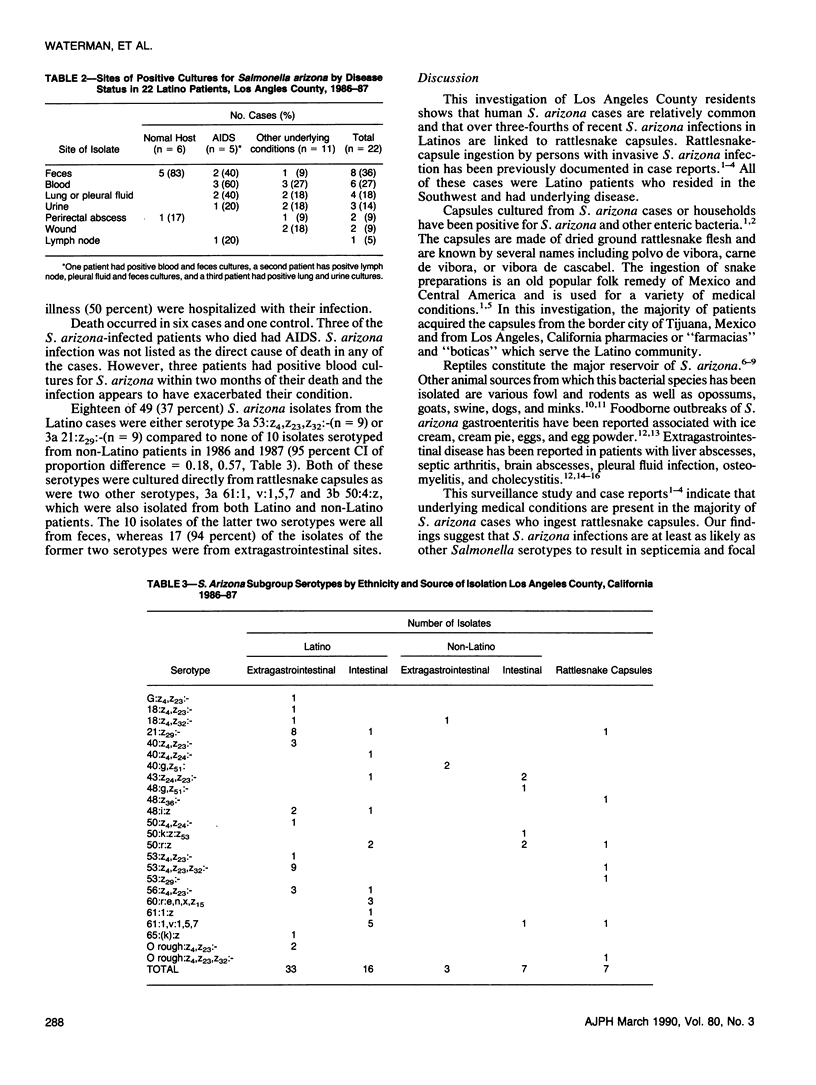
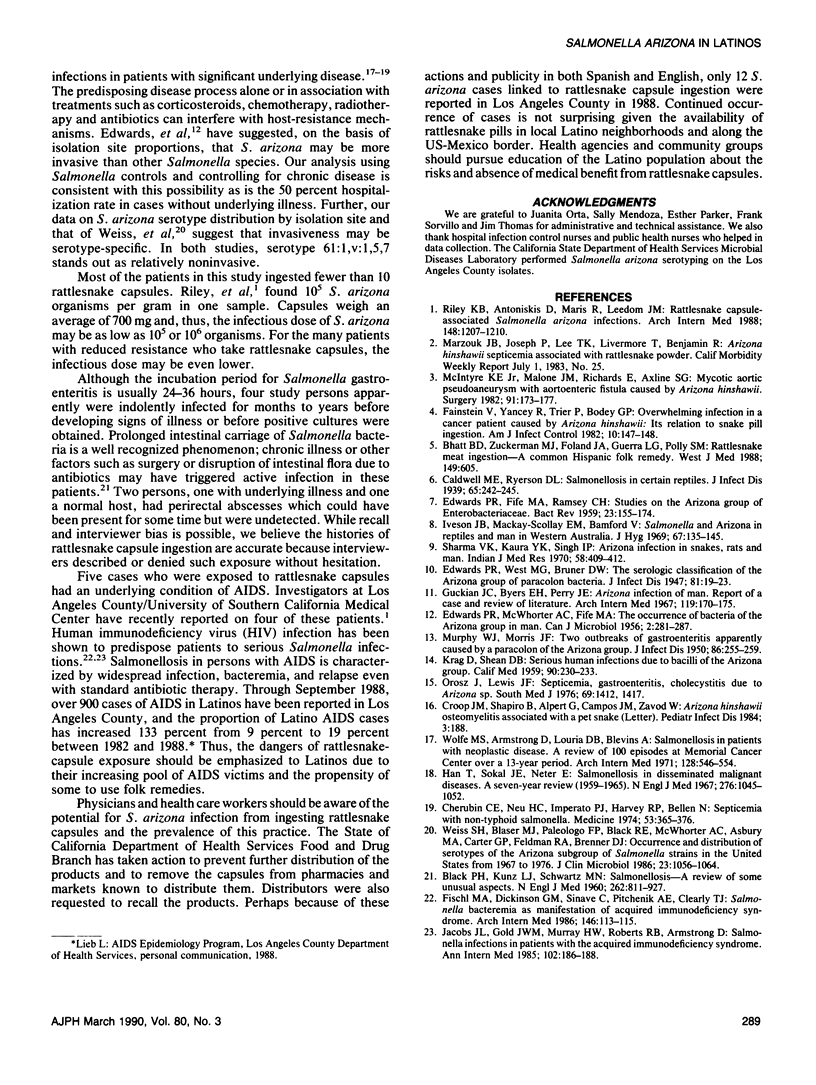
In 1987 two Los Angeles County (California) hospitals reported four Latino patients with serious Salmonella arizona (Salmonella subgroup 3) infections who gave a medical history of taking rattlesnake capsules prior to illness. Capsules supplied by the patients or household members grew Salmonella arizona. We reviewed surveillance data for this Salmonella species and conducted a case-control study to determine the magnitude of this public health problem. Eighteen (82 percent) of the 22 Latino cases in 1986 and 1987 who were questioned reported ingesting snake capsules compared to two (8 percent) of 24 matched Latino controls with non-subgroup 3 salmonellosis or shigellosis (matched pair odds ratio = 18.0, CI = 4.2, 76.3). An average of 18 cases per year of Salmonella arizona were reported in the county between 1980 and 1987. In this investigation the majority of S. arizona cases reporting snake capsule ingestion had underlying illnesses such as acquired immunodeficiency syndrome (AIDS), diabetes, arthritis, cancer. The capsules were obtained primarily from Tijuana, Mexico and from Los Angeles, California pharmacies in Latino neighborhoods. Despite publicity and attempts to remove the capsules from sale in California, Salmonella arizona cases associated with snake-capsule ingestion continue to occur.
Full text
PDF
Selected References
These references are in PubMed. This may not be the complete list of references from this article.
- BLACK P. H., KUNZ L. J., SWARTZ M. N. Salmonellosis--a review of some unusual aspects. N Engl J Med. 1960 Apr 21;262:811–contd. doi: 10.1056/NEJM196004212621606. [DOI] [PubMed] [Google Scholar]
- Bhatt B. D., Zuckerman M. J., Foland J. A., Guerra L. G., Polly S. M. Rattlesnake meat ingestion--a common Hispanic folk remedy. West J Med. 1988 Nov;149(5):605–605. [PMC free article] [PubMed] [Google Scholar]
- Cherubin C. E., Neu H. C., Imperato P. J., Harvey R. P., Bellen N. Septicemia with non-typhoid salmonella. Medicine (Baltimore) 1974 Sep;53(5):365–376. doi: 10.1097/00005792-197409000-00003. [DOI] [PubMed] [Google Scholar]
- Croop J. M., Shapiro B., Alpert G., Campos J. M., Zavod W. Arizona hinshawii osteomyelitis associated with a pet snake. Pediatr Infect Dis. 1984 Mar-Apr;3(2):188–188. doi: 10.1097/00006454-198403000-00028. [DOI] [PubMed] [Google Scholar]
- EDWARDS P. R., FIFE M. A., RAMSEY C. H. Studies on the Arizona group of Enterobacteriaceae. Bacteriol Rev. 1959 Dec;23(4):155–174. doi: 10.1128/br.23.4.155-174.1959. [DOI] [PMC free article] [PubMed] [Google Scholar]
- EDWARDS P. R., MCWHORTER A. C., FIFE M. A. The occurrence of bacteria of the Arizona group in man. Can J Microbiol. 1956 May;2(3):281–287. doi: 10.1139/m56-032. [DOI] [PubMed] [Google Scholar]
- Fainstein V., Yancey R., Trier P., Bodey G. P. Overwhelming infection in a cancer patient caused by Arizona hinshawii: its relation to snake pill ingestion. Am J Infect Control. 1982 Nov;10(4):147–153. doi: 10.1016/s0196-6553(82)80033-3. [DOI] [PubMed] [Google Scholar]
- Fischl M. A., Dickinson G. M., Sinave C., Pitchenik A. E., Cleary T. J. Salmonella bacteremia as manifestation of acquired immunodeficiency syndrome. Arch Intern Med. 1986 Jan;146(1):113–115. [PubMed] [Google Scholar]
- Guckian J. C., Byers E. H., Perry J. E. Arizona infection of man. Report of a case and review of the literature. Arch Intern Med. 1967 Feb;119(2):170–175. [PubMed] [Google Scholar]
- Han T., Sokal J. E., Neter E. Salmonellosis in disseminated malignant diseases. A seven-- year review (1959-1965). N Engl J Med. 1967 May 11;276(19):1045–1052. doi: 10.1056/NEJM196705112761901. [DOI] [PubMed] [Google Scholar]
- Iveson J. B., Mackay-Scollay E. M., Bamford V. Salmonella and Arizona in reptiles and man in Western Australia. J Hyg (Lond) 1969 Mar;67(1):135–145. doi: 10.1017/s0022172400041516. [DOI] [PMC free article] [PubMed] [Google Scholar]
- Jacobs J. L., Gold J. W., Murray H. W., Roberts R. B., Armstrong D. Salmonella infections in patients with the acquired immunodeficiency syndrome. Ann Intern Med. 1985 Feb;102(2):186–188. doi: 10.7326/0003-4819-102-2-186. [DOI] [PubMed] [Google Scholar]
- KRAG D., SHEAN D. B. Serious human infections due to bacilli of the Arizona group. Calif Med. 1959 Mar;90(3):230–233. [PMC free article] [PubMed] [Google Scholar]
- MURPHY W. J., MORRIS J. F. Two outbreaks of gastroenteritis apparently caused by a paracolon of the Arizona group. J Infect Dis. 1950 May-Jun;86(3):255–259. doi: 10.1093/infdis/86.3.255. [DOI] [PubMed] [Google Scholar]
- McIntyre K. E., Jr, Malone J. M., Richards E., Axline S. G. Mycotic aortic pseudoaneurysm with aortoenteric fistula caused by Arizona hinshawii. Surgery. 1982 Feb;91(2):173–177. [PubMed] [Google Scholar]
- Orosz J., Lewis J. F. Septicemia, gastroenteritis, cholecystitis due to Arizona sp. South Med J. 1976 Nov;69(11):1412–1417. [PubMed] [Google Scholar]
- Riley K. B., Antoniskis D., Maris R., Leedom J. M. Rattlesnake capsule-associated Salmonella arizona infections. Arch Intern Med. 1988 May;148(5):1207–1210. [PubMed] [Google Scholar]
- Sharma V. K., Kaura Y. K., Singh I. P. Arizona infection in snakes, rats and man. Indian J Med Res. 1970 Apr;58(4):409–412. [PubMed] [Google Scholar]
- Weiss S. H., Blaser M. J., Paleologo F. P., Black R. E., McWhorter A. C., Asbury M. A., Carter G. P., Feldman R. A., Brenner D. J. Occurrence and distribution of serotypes of the Arizona subgroup of Salmonella strains in the United States from 1967 to 1976. J Clin Microbiol. 1986 Jun;23(6):1056–1064. doi: 10.1128/jcm.23.6.1056-1064.1986. [DOI] [PMC free article] [PubMed] [Google Scholar]
- Wolfe M. S., Louria D. B., Armstrong D., Blevins A. Salmonellosis in patients with neoplastic disease. A review of 100 episodes at Memorial Cancer Center over a 13-year period. Arch Intern Med. 1971 Oct;128(4):546–554. doi: 10.1001/archinte.128.4.546. [DOI] [PubMed] [Google Scholar]