



Abstract
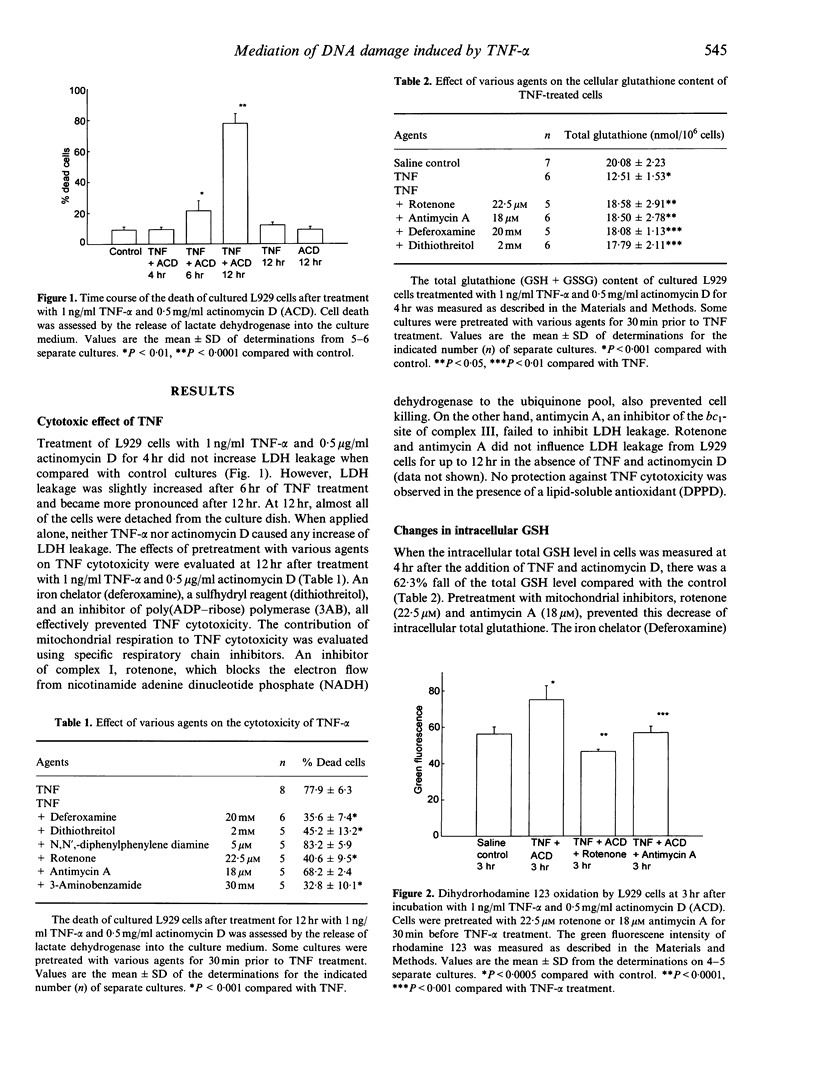
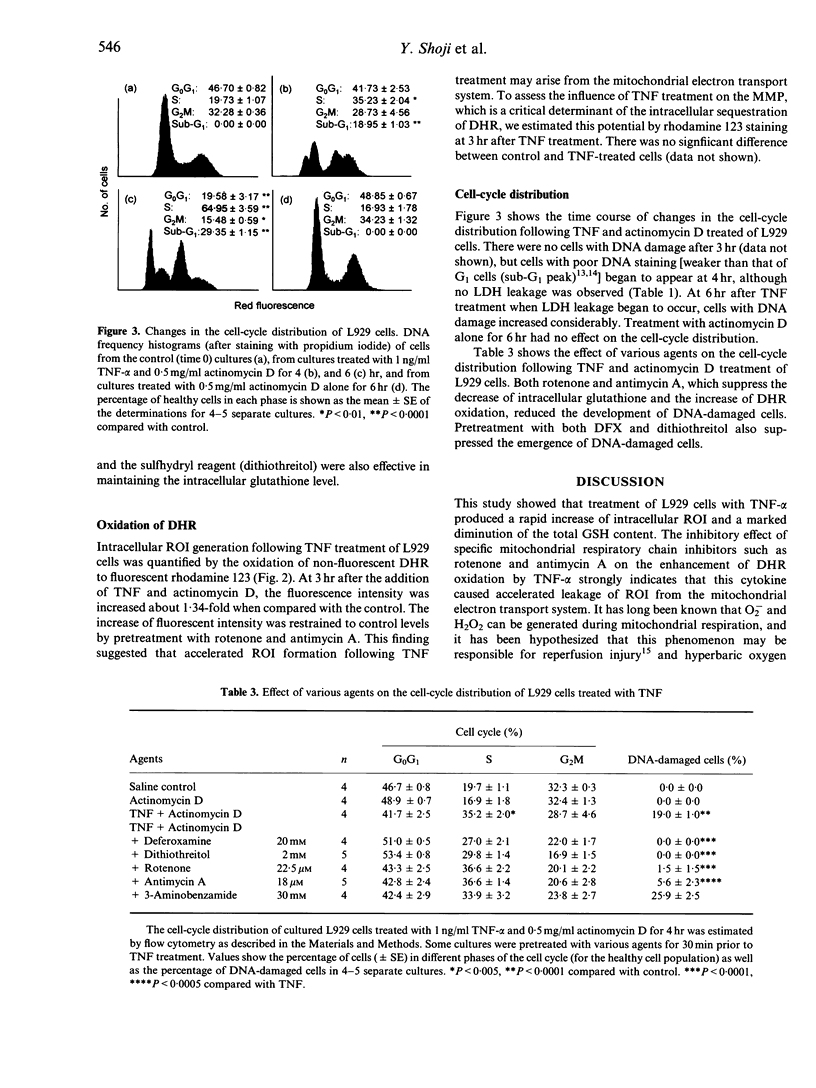
Treatment of L929 cells with tumour necrosis factor-alpha (TNF-alpha) plus actinomycin D induced DNA damage (indicated by the appearance of a sub-G1 peak due to extracellular leakage of low molecular weight DNA following DNA fragmentation) before significant cell lysis occurred. The DNA damage occurred in parallel with a decrease of the intracellular total glutathione content and an increase of intracellular reactive oxygen intermediates (ROI), as indicated by increased dihydrorhodamine 123 oxidation. Because the inhibition of mitochondrial respiration suppressed the increase of dihydrorhodamine 123 oxidation and DNA damage as well as the decrease in the total glutathione content, it was suggested that increased mitochondrial formation of ROI was responsible for DNA damage after TNF treatment. Deferoxamine (a ferric iron chelator) and dithiothreitol (a sulfhydryl reagent) both prevented DNA damage and cell killing, indicate that hydroxyl radicals generated from O2- and H2O2 produced by the mitochondria in a process catalysed by iron contributed to DNA damage and that this pathway may be involved in TNF-alpha-induced cytotoxicity. An inhibitor of poly(ADP)-ribose polymerase (3-aminobenzamide), worsened DNA damage, but was protective against cell lysis, suggesting that DNA repair subsequent to injury was more important than DNA damage per se in development of TNF-alpha cytotoxicity.
Full text
PDF
Selected References
These references are in PubMed. This may not be the complete list of references from this article.
- Banati R. B., Rothe G., Valet G., Kreutzberg G. W. Respiratory burst activity in brain macrophages: a flow cytometric study on cultured rat microglia. Neuropathol Appl Neurobiol. 1991 Jun;17(3):223–230. doi: 10.1111/j.1365-2990.1991.tb00718.x. [DOI] [PubMed] [Google Scholar]
- Boobis A. R., Fawthrop D. J., Davies D. S. Mechanisms of cell death. Trends Pharmacol Sci. 1989 Jul;10(7):275–280. doi: 10.1016/0165-6147(89)90027-8. [DOI] [PubMed] [Google Scholar]
- Brawn K., Fridovich I. DNA strand scission by enzymically generated oxygen radicals. Arch Biochem Biophys. 1981 Feb;206(2):414–419. doi: 10.1016/0003-9861(81)90108-9. [DOI] [PubMed] [Google Scholar]
- Buttke T. M., Sandstrom P. A. Oxidative stress as a mediator of apoptosis. Immunol Today. 1994 Jan;15(1):7–10. doi: 10.1016/0167-5699(94)90018-3. [DOI] [PubMed] [Google Scholar]
- Carini R., Parola M., Dianzani M. U., Albano E. Mitochondrial damage and its role in causing hepatocyte injury during stimulation of lipid peroxidation by iron nitriloacetate. Arch Biochem Biophys. 1992 Aug 15;297(1):110–118. doi: 10.1016/0003-9861(92)90647-f. [DOI] [PubMed] [Google Scholar]
- Chance B., Sies H., Boveris A. Hydroperoxide metabolism in mammalian organs. Physiol Rev. 1979 Jul;59(3):527–605. doi: 10.1152/physrev.1979.59.3.527. [DOI] [PubMed] [Google Scholar]
- Di Monte D., Bellomo G., Thor H., Nicotera P., Orrenius S. Menadione-induced cytotoxicity is associated with protein thiol oxidation and alteration in intracellular Ca2+ homeostasis. Arch Biochem Biophys. 1984 Dec;235(2):343–350. doi: 10.1016/0003-9861(84)90207-8. [DOI] [PubMed] [Google Scholar]
- Dypbukt J. M., Thor H., Nicotera P. Intracellular Ca2+ chelators prevent DNA damage and protect hepatoma 1C1C7 cells from quinone-induced cell killing. Free Radic Res Commun. 1990;8(4-6):347–354. doi: 10.3109/10715769009053368. [DOI] [PubMed] [Google Scholar]
- Fehsel K., Kolb-Bachofen V., Kolb H. Analysis of TNF alpha-induced DNA strand breaks at the single cell level. Am J Pathol. 1991 Aug;139(2):251–254. [PMC free article] [PubMed] [Google Scholar]
- Fernández-Checa J. C., García-Ruiz C., Ookhtens M., Kaplowitz N. Impaired uptake of glutathione by hepatic mitochondria from chronic ethanol-fed rats. Tracer kinetic studies in vitro and in vivo and susceptibility to oxidant stress. J Clin Invest. 1991 Feb;87(2):397–405. doi: 10.1172/JCI115010. [DOI] [PMC free article] [PubMed] [Google Scholar]
- Goeddel D. V., Aggarwal B. B., Gray P. W., Leung D. W., Nedwin G. E., Palladino M. A., Patton J. S., Pennica D., Shepard H. M., Sugarman B. J. Tumor necrosis factors: gene structure and biological activities. Cold Spring Harb Symp Quant Biol. 1986;51(Pt 1):597–609. doi: 10.1101/sqb.1986.051.01.072. [DOI] [PubMed] [Google Scholar]
- Gorczyca W., Gong J., Ardelt B., Traganos F., Darzynkiewicz Z. The cell cycle related differences in susceptibility of HL-60 cells to apoptosis induced by various antitumor agents. Cancer Res. 1993 Jul 1;53(13):3186–3192. [PubMed] [Google Scholar]
- Halliwell B. Superoxide-dependent formation of hydroxyl radicals in the presence of iron salts. Its role in degradation of hyaluronic acid by a superoxide-generating system. FEBS Lett. 1978 Dec 15;96(2):238–242. doi: 10.1016/0014-5793(78)80409-8. [DOI] [PubMed] [Google Scholar]
- Hennet T., Richter C., Peterhans E. Tumour necrosis factor-alpha induces superoxide anion generation in mitochondria of L929 cells. Biochem J. 1993 Jan 15;289(Pt 2):587–592. doi: 10.1042/bj2890587. [DOI] [PMC free article] [PubMed] [Google Scholar]
- Ishii Y., Partridge C. A., Del Vecchio P. J., Malik A. B. Tumor necrosis factor-alpha-mediated decrease in glutathione increases the sensitivity of pulmonary vascular endothelial cells to H2O2. J Clin Invest. 1992 Mar;89(3):794–802. doi: 10.1172/JCI115658. [DOI] [PMC free article] [PubMed] [Google Scholar]
- Keller G. A., Barke R., Harty J. T., Humphrey E., Simmons R. L. Decreased hepatic glutathione levels in septic shock. Predisposition of hepatocytes to oxidative stress: an experimental approach. Arch Surg. 1985 Aug;120(8):941–945. doi: 10.1001/archsurg.1985.01390320065013. [DOI] [PubMed] [Google Scholar]
- Kolachana P., Subrahmanyam V. V., Meyer K. B., Zhang L., Smith M. T. Benzene and its phenolic metabolites produce oxidative DNA damage in HL60 cells in vitro and in the bone marrow in vivo. Cancer Res. 1993 Mar 1;53(5):1023–1026. [PubMed] [Google Scholar]
- Larrick J. W., Wright S. C. Cytotoxic mechanism of tumor necrosis factor-alpha. FASEB J. 1990 Nov;4(14):3215–3223. doi: 10.1096/fasebj.4.14.2172061. [DOI] [PubMed] [Google Scholar]
- Masaki N., Kyle M. E., Farber J. L. tert-butyl hydroperoxide kills cultured hepatocytes by peroxidizing membrane lipids. Arch Biochem Biophys. 1989 Mar;269(2):390–399. doi: 10.1016/0003-9861(89)90122-7. [DOI] [PubMed] [Google Scholar]
- Matthews N., Neale M. L., Jackson S. K., Stark J. M. Tumour cell killing by tumour necrosis factor: inhibition by anaerobic conditions, free-radical scavengers and inhibitors of arachidonate metabolism. Immunology. 1987 Sep;62(1):153–155. [PMC free article] [PubMed] [Google Scholar]
- Meier B., Radeke H. H., Selle S., Younes M., Sies H., Resch K., Habermehl G. G. Human fibroblasts release reactive oxygen species in response to interleukin-1 or tumour necrosis factor-alpha. Biochem J. 1989 Oct 15;263(2):539–545. doi: 10.1042/bj2630539. [DOI] [PMC free article] [PubMed] [Google Scholar]
- Neuschwander-Tetri B. A., Roll F. J. Glutathione measurement by high-performance liquid chromatography separation and fluorometric detection of the glutathione-orthophthalaldehyde adduct. Anal Biochem. 1989 Jun;179(2):236–241. doi: 10.1016/0003-2697(89)90121-8. [DOI] [PubMed] [Google Scholar]
- Richter C., Frei B. Ca2+ release from mitochondria induced by prooxidants. Free Radic Biol Med. 1988;4(6):365–375. doi: 10.1016/0891-5849(88)90088-3. [DOI] [PubMed] [Google Scholar]
- Richter C., Theus M., Schlegel J. Cyclosporine A inhibits mitochondrial pyridine nucleotide hydrolysis and calcium release. Biochem Pharmacol. 1990 Aug 15;40(4):779–782. doi: 10.1016/0006-2952(90)90315-c. [DOI] [PubMed] [Google Scholar]
- Robaye B., Mosselmans R., Fiers W., Dumont J. E., Galand P. Tumor necrosis factor induces apoptosis (programmed cell death) in normal endothelial cells in vitro. Am J Pathol. 1991 Feb;138(2):447–453. [PMC free article] [PubMed] [Google Scholar]
- Royall J. A., Ischiropoulos H. Evaluation of 2',7'-dichlorofluorescin and dihydrorhodamine 123 as fluorescent probes for intracellular H2O2 in cultured endothelial cells. Arch Biochem Biophys. 1993 May;302(2):348–355. doi: 10.1006/abbi.1993.1222. [DOI] [PubMed] [Google Scholar]
- Schmid D. S., Hornung R., McGrath K. M., Paul N., Ruddle N. H. Target cell DNA fragmentation is mediated by lymphotoxin and tumor necrosis factor. Lymphokine Res. 1987 Summer;6(3):195–202. [PubMed] [Google Scholar]
- Schulze-Osthoff K., Bakker A. C., Vanhaesebroeck B., Beyaert R., Jacob W. A., Fiers W. Cytotoxic activity of tumor necrosis factor is mediated by early damage of mitochondrial functions. Evidence for the involvement of mitochondrial radical generation. J Biol Chem. 1992 Mar 15;267(8):5317–5323. [PubMed] [Google Scholar]
- Skidmore C. J., Davies M. I., Goodwin P. M., Halldorsson H., Lewis P. J., Shall S., Zia'ee A. A. The involvement of poly(ADP-ribose) polymerase in the degradation of NAD caused by gamma-radiation and N-methyl-N-nitrosourea. Eur J Biochem. 1979 Nov 1;101(1):135–142. doi: 10.1111/j.1432-1033.1979.tb04225.x. [DOI] [PubMed] [Google Scholar]
- Takeyama N., Matsuo N., Tanaka T. Oxidative damage to mitochondria is mediated by the Ca(2+)-dependent inner-membrane permeability transition. Biochem J. 1993 Sep 15;294(Pt 3):719–725. doi: 10.1042/bj2940719. [DOI] [PMC free article] [PubMed] [Google Scholar]
- Zamai L., Falcieri E., Zauli G., Cataldi A., Vitale M. Optimal detection of apoptosis by flow cytometry depends on cell morphology. Cytometry. 1993 Nov;14(8):891–897. doi: 10.1002/cyto.990140807. [DOI] [PubMed] [Google Scholar]