



Abstract
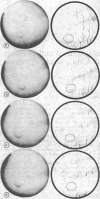
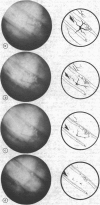
Large volume, low pressure endotracheal tube cuffs are claimed to have less deleterious effect on tracheal mucosa than high pressure, low volume cuffs. Low pressure cuffs, however, may easily be overinflated to yield pressures that will exceed capillary perfusion pressure. Various large volume cuffed endotracheal tubes were studied, including Portex Profile, Searle Sensiv, Mallinkrodt Hi-Lo, and Lanz. Tracheal mucosal blood flow in 40 patients undergoing surgery was assessed using an endoscopic photographic technique while varying the cuff inflation pressure. It was found that these cuffs when overpressurised impaired mucosal blood flow. This impairment of tracheal mucosal blood flow is an important factor in tracheal morbidity associated with intubation. Hence it is recommended that a cuff inflation pressure of 30 cm H2O (22 mm Hg) should not be exceeded.
Full text
PDF


Images in this article

Selected References
These references are in PubMed. This may not be the complete list of references from this article.
- Bernhard W. N., Yost L. C., Turndorf H., Cottrell J. E., Paegle R. D. Physical characteristics of and rates of nitrous oxide diffusion into tracheal tube cuffs. Anesthesiology. 1978 Jun;48(6):413–417. doi: 10.1097/00000542-197806000-00007. [DOI] [PubMed] [Google Scholar]
- Black A. M., Seegobin R. D. Pressures on endotracheal tube cuffs. Anaesthesia. 1981 May;36(5):498–511. doi: 10.1111/j.1365-2044.1981.tb10286.x. [DOI] [PubMed] [Google Scholar]
- Carroll R. G., McGinnis G. E., Grenvik A. Performance characteristics of tracheal cuffs. Int Anesthesiol Clin. 1974 Fall;12(3):111–141. doi: 10.1097/00004311-197412030-00008. [DOI] [PubMed] [Google Scholar]
- Crawley B. E., Cross D. E. Tracheal cuffs. A review and dynamic pressure study. Anaesthesia. 1975 Jan;30(1):4–11. doi: 10.1111/j.1365-2044.1975.tb00787.x. [DOI] [PubMed] [Google Scholar]
- Dobrin P., Canfield T. Cuffed endotracheal tubes: mucosal pressures and tracheal wall blood flow. Am J Surg. 1977 May;133(5):562–568. doi: 10.1016/0002-9610(77)90008-3. [DOI] [PubMed] [Google Scholar]
- Homi J., Notcutt W., Jones J. J., Sparke B. R. A method for comparing endotracheal cuffs. A controlled study of tracheal trauma in dogs. Br J Anaesth. 1978 May;50(5):435–444. doi: 10.1093/bja/50.5.435. [DOI] [PubMed] [Google Scholar]
- Lewis F. R., Jr, Schiobohm R. M., Thomas A. N. Prevention of complications from prolonged tracheal intubation. Am J Surg. 1978 Mar;135(3):452–457. doi: 10.1016/0002-9610(78)90083-1. [DOI] [PubMed] [Google Scholar]
- Loeser E. A., Hodges M., Gliedman J., Stanley T. H., Johansen R. K., Yonetani D. Tracheal pathology following short-term intubation with low- and high-pressure endotracheal tube cuffs. Anesth Analg. 1978 Sep-Oct;57(5):577–579. doi: 10.1213/00000539-197809000-00013. [DOI] [PubMed] [Google Scholar]
- MacKenzie C. F., Klose S., Browne D. R. A study of inflatable cuffs on endotracheal tubes. Pressures exerted on the trachea. Br J Anaesth. 1976 Feb;48(2):105–110. doi: 10.1093/bja/48.2.105. [DOI] [PubMed] [Google Scholar]
- Nordin U. The trachea and cuff-induced tracheal injury. An experimental study on causative factors and prevention. Acta Otolaryngol Suppl. 1977;345:1–71. [PubMed] [Google Scholar]
- Stanley T. H. Nitrous oxide and pressures and volumes of high- and low-pressure endotracheal-tube cuffs in intubated patients. Anesthesiology. 1975 May;42(5):637–640. doi: 10.1097/00000542-197505000-00035. [DOI] [PubMed] [Google Scholar]