



Abstract
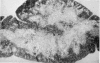
The in vivo effect of rabbit anti-AKR mouse brain-associated serum (RAMB) was determined on theta bearing lymphocytes present in the spleens and thymuses of mature C3H mice and AKR mice staged into preleukemic, leukaemic and overtly leukaemic states.Following seven daily injections of RAMB serum, the splenic plaque-forming cell (PFC) response to sheep erythrocytes (SRBC) and the percentage of theta-bearing lymphocytes in the spleen were significantly decreased in the C3H and the preleukaemic AKR mice. Decreases in thymic weight and thymocyte numbers were also apparent. Determinations of theta antigen density using in vitro cytoxicity tests indicated that splenic and thymic T lymphocytes (thymus-derived) remaining in the RAMB-treated C3H and preleukemic AKR mice consisted primarily of cells bearing less of the theta surface antigen. Histopathological studies of tissues from these two treated groups revealed cortical lymphocyte depletion in the thymus, and marginal and periarteriolar depletion in the spleen. Leukaemic AKR mice, administered seven injections of RAMB serum, demonstrated less dramatic changes in thymus weight, histopathology and theta-bearing cell percentages when compared with the data from the preleukaemic AKR or matureC3H mice. The results from testing overtly luekaemic AKR mice administered RAMB serum for the 7 or 9 days did not demonstrate differences from findings from groupsof overtly leukaemic control mice. These data indicate that the in vivo activity of RAMB serum in C3H mice and preleukaemic AKR mice is directed primarily toward the less mature T-lymphocyte population. This influence of RAMB serum is lesspronounced in leukaemic and the more overtly leukaemic mice, suggesting that a decreasedpopulation of RAMB-susceptible lymphocytes are present in these animals.
Full text
PDF


Images in this article
Selected References
These references are in PubMed. This may not be the complete list of references from this article.
- Aoki T., Takahashi T. Viral and cellular surface antigens of murine leukemias and myelomas. Serological analysis by immunoelectron microscopy. J Exp Med. 1972 Mar 1;135(3):443–457. doi: 10.1084/jem.135.3.443. [DOI] [PMC free article] [PubMed] [Google Scholar]
- Barker A. D., Waksal S. D. Thymus-derived lymphocyte differentiation and lymphocytic leukemias. I. Evidence for the existence of functionally different subpopulations of thymus-derived cells in leukemic AKR mice. Cell Immunol. 1974 Apr;12(1):140–149. doi: 10.1016/0008-8749(74)90065-3. [DOI] [PubMed] [Google Scholar]
- Barth R. F., Singla O., Ward P. A. Immunosuppressive effects of anti-lymphocyte serum in complement deficient mice. II. Evidence that activity is mediated by C3 independent antibodies. J Immunol. 1974 Feb;112(2):858–861. [PubMed] [Google Scholar]
- Cantor H., Asofsky R. Synergy among lymphoid cells mediating the graft-versus-host response. 3. Evidence for interaction between two types of thymus-derived cells. J Exp Med. 1972 Apr 1;135(4):764–779. doi: 10.1084/jem.135.4.764. [DOI] [PMC free article] [PubMed] [Google Scholar]
- Cohen A., Schlesinger M. Absorption of guinea pig serum with agar. A method for elimination of itscytotoxicity for murine thymus cells. Transplantation. 1970 Jul;10(1):130–132. doi: 10.1097/00007890-197007000-00027. [DOI] [PubMed] [Google Scholar]
- Golub E. S. Brain-associated theta antigen: reactivity of rabbit anti-mouse brain with mouse lymphoid cells. Cell Immunol. 1971 Aug;2(4):353–361. doi: 10.1016/0008-8749(71)90070-0. [DOI] [PubMed] [Google Scholar]
- HATTLER B. G., Jr, SCHLESINGER M., AMOS D. B. THE DIFFERING SURVIVAL OF NORMAL AND SENSITIZED SPLEEN CELLS TRANSFERRED TO ALLOGENEIC HOSTS. J Exp Med. 1964 Nov 1;120:783–793. doi: 10.1084/jem.120.5.783. [DOI] [PMC free article] [PubMed] [Google Scholar]
- JERNE N. K., NORDIN A. A. Plaque formation in agar by single antibody-producing cells. Science. 1963 Apr 26;140(3565):405–405. [PubMed] [Google Scholar]
- Kassel R. L., Old L. J., Carswell E. A., Fiore N. C., Hardy W. D., Jr Serum-mediated leukemia cell destruction in AKR mice. J Exp Med. 1973 Oct 1;138(4):925–938. doi: 10.1084/jem.138.4.925. [DOI] [PMC free article] [PubMed] [Google Scholar]
- MOLLER E., MOLLER G. Quantitative studies of the sensitivity of normal and neoplastic mouse cells to the cytotoxic action of isoantibodies. J Exp Med. 1962 Mar 1;115:527–553. doi: 10.1084/jem.115.3.527. [DOI] [PMC free article] [PubMed] [Google Scholar]
- Nagaya H. Thymus function in spontaneous lymphoid leukemia. II. In vitro response of "preleukemic" and leukemic thymus cells to mitogens. J Immunol. 1973 Oct;111(4):1052–1060. [PubMed] [Google Scholar]
- REIF A. E., ALLEN J. M. SPECIFICITY OF ISOANTISERA AGAINST LEUKAEMIC AND THYMIC LYMPHOCYTES. Nature. 1963 Dec 28;200:1332–1333. doi: 10.1038/2001332b0. [DOI] [PubMed] [Google Scholar]
- REIF A. E., ALLEN J. M. THE AKR THYMIC ANTIGEN AND ITS DISTRIBUTION IN LEUKEMIAS AND NERVOUS TISSUES. J Exp Med. 1964 Sep 1;120:413–433. doi: 10.1084/jem.120.3.413. [DOI] [PMC free article] [PubMed] [Google Scholar]
- Schabel F. M., Jr, Skipper H. E., Trader M. W., Laster W. R., Jr, Simpson-Herren L. Spontaneous AK leukemia (lymphoma) as a model system. Cancer Chemother Rep. 1969 Dec;53(6):329–344. [PubMed] [Google Scholar]
- Schlesinger M., Gottesfeld S., Korzash Z. Thymus cell subpopulations separated on discontinuous BSA gradients: antigenic properties and circulation capacity. Cell Immunol. 1973 Jan;6(1):49–58. doi: 10.1016/0008-8749(73)90005-1. [DOI] [PubMed] [Google Scholar]
- Stobo J. D., Paul W. E. Functional heterogeneity of murine lymphoid cells. 3. Differential responsiveness of T cells to phytohemagglutinin and concanavalin A as a probe for T cell subsets. J Immunol. 1973 Feb;110(2):362–375. [PubMed] [Google Scholar]