



Abstract
OBJECTIVE
Although treatment of hepatitis C has improved, up to 50% do not respond to standard therapy with interferon regimes or cannot tolerate the treatment due to side effects. The purpose of the present investigation was to evaluate the safety and effectiveness of the antiviral drug amantadine for the treatment of hepatitis C in those who had either previously failed interferon therapy or were not candidates for interferon.
DESIGN
A prospective double-blind randomized placebo-controlled trial.
SETTING
Outpatient research clinic of a teaching hospital.
PATIENTS/PARTICIPANTS
One hundred fifty-two patients with confirmed hepatitis C with abnormal liver enzymes, detectable hepatitis C RNA in the blood, and abnormal liver histology by biopsy were randomized to receive treatment or placebo.
MEASUREMENTS AND MAIN RESULTS
Patients received either amantadine 100 mg twice daily by mouth or placebo for 6 months. After 6 months, placebo-treated patients were crossed over and treated with amantadine for 6 months and amantadine-treated subjects received 6 additional months of therapy. Amantadine therapy resulted in a significant decline in serum alanine aminotransferase compared to placebo (P = .03). Nine percent cleared the virus at the end of therapy and 6.8% had a sustained virologic response 6 months after discontinuation of amantadine, but this was not statistically significant. Side effects were minimal, and the social quality of life survey improved with 12 months of amantadine (P = .02).
CONCLUSIONS
Oral amantadine may provide a safe alternative treatment for those patients who are intolerant or unresponsive to interferon.
Keywords: amantadine, liver, virus, cirrhosis, interferon
Currently, the only approved therapy for the treatment of chronic hepatitis C is either interferon alone or in combination with ribavirin.1 Newer interferon formulations have recently been approved for the treatment-naive patient (i.e., pegylated interferons), which may decrease the side effect profile 2; however, the pegylated formulations of interferon are not FDA approved in those who have previously been treated for hepatitis C. Unfortunately, up to 40% to 50% of those who respond to therapy with interferon or interferon with ribavirin will relapse upon discontinuation of therapy.3 The response rate appears to depend upon the hepatitis C genotype, pretreatment hepatitis C viral blood level, and liver histology.4,5 Patients having advanced liver disease, such as cirrhosis, have a decreased sustained response to interferon therapy compared to those with mild histology, such as without fibrosis.6
Previously, two end points have been used when determining a response to treatment of hepatitis C, including normalization of the liver enzymes (biochemical response) and loss of hepatitis C RNA in the blood (virological response). Although serum alanine aminotransferase (ALT) values decrease as an indication of response to therapy, it is becoming clear that the aminotransferases are imperfect indicators of infection. Hepatitis C viral RNA (HCV RNA) has been detected in plasma of patients with normal ALT values.7,8 Studies have shown that if HCV RNA is detected in blood at the termination of interferon therapy, these subjects will have persistent disease regardless of normalization of liver enzymes.9 Although these subjects still have detectable viral RNA, normalization of liver enzymes with therapy has been correlated with improvement of histology by liver biopsy.10
Interferon has been associated with numerous side effects, and some patients, as a result, discontinue therapy prematurely.11,12 Ribavirin, which is now given in conjunction with interferon and considered standard of care, has been associated with hemolytic anemia.13 Patients with coronary artery disease who develop ribavirin-induced anemia are at risk of developing cardiac complications, and myocardial infarction has been reported.13,14 Ribavirin is also a teratogen and may not be given to children or sexually active adults without effective birth control.
The antiviral drug amantadine has previously been shown in a small pilot study to have a response rate of about 18% in patients with hepatitis C who had previously failed interferon therapy.15 The mechanism of action of amantadine on the hepatitis C virus may be related to blockade of the p7 protein activity necessary for particle replication.16
The purpose of the present study was to evaluate the safety and efficacy of amantadine monotherapy when administered to patients with chronic hepatitis C compared to that of a placebo in a population of patients who were either interferon failures or not candidates for interferon therapy. Efficacy of 6 months of amantadine therapy was also compared to 12 months of amantadine therapy.
METHODS
Study Design
The study was designed as a double-blind, placebo-controlled semi-crossover clinical trial. Patients were randomized to receive either amantadine 100 mg (Symmetrel) or placebo by mouth twice daily for a total duration of 6 months. After 6 months, patients receiving the placebo were crossed over to amantadine therapy for 6 months, while those on amantadine continued on this treatment for 6 additional months. Hence, one group was treated with amantadine for 12 months (treatment group A) and another group was treated with amantadine for 6 months (treatment group B). After the discontinuation of therapy, all patients were followed off therapy for 6 additional months. A history and physical examination were performed and laboratory tests were assessed at baseline and monthly. Also at baseline and monthly thereafter, symptoms or medication side effects (fatigue, insomnia, arthralgias, difficulty concentrating, headache, and depression) were recorded and scored for severity on a scale of 1 to 5 with 5 being most severe. Every 3 months during the study and follow-up phase, the patients completed a quality of life survey (McMaster Health Index 17). HCV RNA was evaluated prior to treatment and every 3 months utilizing the quantitative branched chain DNA analysis (bDNA) methodology (bDNA version 2.0 assay, Chiron/Bayer, Hershey, Penn) with a sensitivity of 0.2 MEq/ml. Negative serum HCV RNA values by bDNA were confirmed with a qualitative polymerase chain reaction (PCR) assay (COBAS Amplicor version 2.0 assay, Roche, Hershey, Penn) with a sensitivity of 50 IU/ml.18 The study protocol and consent were approved by the Institutional Review Board Committee from Pennsylvania State University College of Medicine, the Food and Drug Administration, and the National Institutes of Health; each patient or guardian read and signed the informed consent. All subjects had a liver biopsy performed within 2 years of enrollment.
Sample Size
The sample size was determined by the biostatistician in the Health Evaluation Science Department at the Pennsylvania State College of Medicine. The biostatistician used the following information: the primary outcome variable for this study was response to treatment with loss of RNA, so that the proportional hazard regression analysis was appropriate for the statistical comparing of the two arms. Allowing for a 10% withdrawal rate, a sample size of 152 randomized patients yielded an 80% statistical power with a two-sided, 0.05-significance level for detecting hazard for an amantadine group that was less than or equal to 40% of the hazard of the placebo group. In order to calculate the number of patients needed, the biostatistician utilized the 18% response rate in the pilot study that was previously published 15 and the placebo response rate of 8% found by Davis et al.11 It was calculated that if amantadine therapy resulted in a response rate of at least 22% in treatment-naive patients as reported by Davis for interferon 11 or in a 14% response achieved in interferon failure patients as reported by Brillanti et al.,19 then the number of patients needed for this study was as stated. At the time this study was designed, these were the only references and response rates that were available for treatment of hepatitis C. Additionally, when this study was designed, pegylated interferons were not yet FDA approved and statistics were not available for that mode of therapy.
Determination of Response
A biochemical response was defined as normalization of ALT and a virological response by loss of HCV RNA by PCR. The end-of-treatment response (ETR) refers to loss of HCV RNA at the end of the treatment phase, whereas a sustained virological response (SVR) was defined as negative HCV RNA 6 months after completion of amantadine therapy.
Inclusion Criteria and Randomization
A stratified randomized scheme was invoked in which subjects were randomized within 1 of 32 strata, based on a 5-way classification of age, gender, HCV RNA blood level, severity of liver disease (fibrosis by histology), and whether they had previously received interferon therapy or were naive to therapy. The age stratification for inclusion criteria included 4 groups as follows: age 0 to 9 years, greater than 9 years and up to 18 years of age, 18 years to 50 years old, and greater than 50 years of age. HCV RNA levels used for randomization criteria were either high (greater than 2 × 10⁶IU/ml) or low (2 × 10⁶IU/ml or less). Randomization according to histology was determined according the Metavir scoring system 20 where patients were classified as either severe (a score of 3 or 4) or mild (a score of less than 3). SAS statistical software (SAS Institute, Cary, NC) was used to generate the treatment codes within each of the 32 strata for implementation by the pharmacy.
Patients were eligible for the study if they had previously failed interferon, were intolerant of interferon side effects, or were not candidates for interferon therapy due to either depression, neutropenia, or thrombocytopenia. In patients who had previously been treated with interferon, a period of 6 months off therapy and a liver biopsy were required before enrollment. The minimum age for the study was 1 year. Patients over the age of 65 years were eligible if a chest x-ray, electrocardiogram, and creatinine clearance were normal prior to enrollment. Patients were eligible for the study if the liver enzymes were abnormal, HCV RNA was detectable in the blood, and inflammation was identified by liver biopsy. Females of childbearing potential were required to use medically accepted contraceptive regimens if sexually active, and pregnancy tests were performed at each visit. All patients enrolled in the study had compensated liver disease with a serum albumin greater than 3.0 g/dL, and a prothrombin time not greater than 2 seconds over control. Other inclusion criteria included a serum creatinine less than or equal to 1.5 mg/dL, hemoglobin greater than or equal to 12.0 g/dL, leukocyte count greater than or equal to 3.5 × 10⁶ g/dL, ANA less than 1:160, platelet count greater than or equal to 40,000 U/L, and alpha-fetoprotein level below 50 ng/ml. If the alpha-fetoprotein level was between 25 and 50 ng/ml, the patient was required to have an ultrasound, computerized tomography, or magnetic resonance imaging of the liver.
Exclusion Criteria
Exclusion criteria included evidence of decompensated liver disease such as ascites, encephalopathy, bleeding esophageal varices, or abnormal laboratory values as listed above. Patients with other forms of liver disease (i.e., alcoholic, hepatitis B, autoimmune hepatitis) were excluded from the study, as were patients with active HIV infection. Those with other serious medical conditions such as cancer, renal failure, congestive heart failure, or other active cardiac disorders, diabetic ketoacidosis, extensive eczema, seizure disorders, and patients with severe psychosis or psychoneuroses were all excluded from the study. Patients actively using illicit drugs or alcohol were also excluded; and antiviral medications, oral steroids, immunosuppressive medications, or anticoagulation therapy were not allowed during the study.
Dosing Schedule
Adult patients and children age 10 years or greater meeting the eligibility criteria were randomized to treatment with either amantadine 100 mg orally twice daily for 12 months or placebo twice daily for 6 months followed by amantadine 100 mg orally twice daily for 6 months. Placebo consisted of sucrose in ghost capsules. Identical ghost capsules were filled by the pharmacist with amantadine and sucrose, so that neither staff nor patients could distinguish between placebo and active drug. Children ages 1 to 9 years were randomized to receive one of two regimens: either placebo twice daily for 6 months in a sucrose elixir followed by amantadine 4.4 mg/kg per day in 2 divided doses for 6 additional months (not to exceed 150 mg daily), or amantadine 4.4 mg/kg per day in 2 divided doses for 12 months. In these children, amantadine was given in the elixir formulations at a concentration of 50 mg/5 cc. Placebo elixir consisted of sucrose syrup mixed with raspberry flavoring and food coloring to match the taste and color of the amantadine elixir. Amantadine (Symmetrel) was supplied by Endo Pharmaceuticals Inc. (Chadds Ford, Pa).
Biostatistics
All data were evaluated using an intent-to-treat analysis. A χ2test was used to compare treatment groups for binary responses (e.g., genotype, responder status). Pearson χ2test was used to compare treatment group A to group B for binary responses at a specific point in time (e.g., gender and prior interferon treatment at baseline). For correlated binary responses (e.g., symptoms at baseline and 6 months), generalized estimating equation methodology was used to fit logistic regression models to compare the treatment groups.21 Two-sample t tests were used to compare paired differences (e.g., baseline to 6 months for weight change) between the treatment groups. Comparisons were made between and within treatment groups. To meet modeling assumptions, transformations of the response variables (e.g., natural logarithm) were taken when necessary. All data were analyzed using the SAS statistical software 22 or S-Plus statistical software (MathSoft Inc., Seattle, Wash).23
RESULTS
Patient Demographics
One hundred fifty-two patients enrolled in this research study: 144 were white, 2 were Hispanic, and 6 were African American. One hundred and two participants were males and 50 were females. Patients’ ages are shown in Table 1, with the most common age distribution being between 41 and 50 years. Of the 152 subjects enrolling in the study, 148 completed the first 6 months, 140 completed the 12-month treatment phase of study, and 132 completed 18 months, which included the 6-month follow-up period. The randomization stratification factors used in this study on enrollment, genotype, and the number of patients in each arm of the study are shown in Table 2 . As expected, due to the stratified randomization, there was no statistically significant difference between the two treatment arms in relationship to age, gender, histology of liver biopsy, prior treatment with interferon, HCV RNA level, or genotype at the onset. Two patients were unable to be genotyped by two separate laboratories. There were no statistical differences between the pretreatment ALT or HCV RNA values in the groups.
Table 1.
Patient Distribution According to Age
| Age, y | 1 to 17 | 18 to 30 | 31 to 40 | 41 to 50 | 51 to 60 | 61 to 70 | >70 |
|---|---|---|---|---|---|---|---|
| Number of subjects | 7 | 4 | 45 | 75 | 15 | 5 | 1 |
Table 2.
Randomization Stratification Factors
| Stratification Factor | Treatment A * N= 73 n(%) | Treatment B † N= 79N(%) | P Value ‡ |
|---|---|---|---|
| Age <50 years | 13 (17.8) | 18 (22.8) | .45 |
| Gender, male | 52 (71.2) | 50 (63.3) | .30 |
| Severe liver histology Stage 3 or 4 | 34 (46.6) | 39 (49.4) | .73 |
| High hepatitis C RNA Level >200 MEq/ml | 21 (28.8) | 22 (27.9) | .90 |
| Prior interferon treatment | 32 (43.8) | 33 (41.8) | .80 |
| Genotype 1 | 57 (78.1) | 59 (77.6) | .66 |
| 2 | 9 (12.3) | 9 (11.8) | |
| 3 | 6 (8.2) | 5 (6.5) | |
| 4 | 1 (1.4) | 4 (5.3) |
Treatment A: group received 12 months of amantadine therapy.
Treatment B: group received 6 months of placebo followed by 6 months of amantadine.
Pearson χ2test.
Biochemical Response to Treatment
ALT values significantly decreased from a median baseline level of 106 U/L to 77.5 U/L (P = .008) in subjects treated with amantadine over the first 6 months (Fig. 1). ALT values in subjects receiving amantadine also were significantly less (P= .04) after 6 months (77.5 U/L) compared to ALT values of those receiving placebo (97.5 U/L) for the same time interval. Twenty-five percent of those treated with amantadine had ALT levels in the normal range at the end of 6 months of therapy compared to 7.6% of placebo-treated subjects. When the placebo-treated subjects were then treated with amantadine during the second 6 months of the study, their ALT values fell significantly to a value of 82 U/L from the pretreatment value of 97.5 U/L (P = .0008) and pre-placebo ALT values of 103 U/L (P = .02;Fig. 1). After 12 months of amantadine 22.5% had normal enzymes, which was not statistically different than the response to 6 months of therapy. Six months after cessation of amantadine treatment, 50% of those with normal ALT levels determined at the end of treatment still had normal enzyme values.
FIGURE 1.
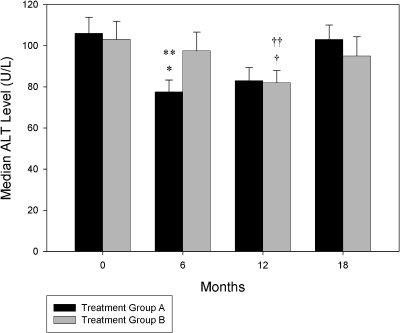
ALT response to amantadine treatment. The responses of hepatic serum alanine aminotransferase (ALT) levels with amantadine 100 mg twice daily is compared to placebo. No difference in baseline ALT levels is observed between those treated with amantadine (Treatment Group A, black column) compared to those receiving placebo (Treatment Group B, gray column). Amantadine therapy significantly reduced blood ALT values at 6 months compared to placebo. Patients who received amantadine treatment only in the second 6-month interval of the study also improved compared to baseline. No difference was detected between those receiving 6 versus 12 months of therapy. Values returned to near basal values when treatment was stopped (month 18). Columns represent median ALT values and bars show the first quartile range. * Significantly different from placebo at 6 months at P= .04. ** Significantly different from baseline value at P = .008.† Significantly different from placebo at 6 months at P= .02.†† Significantly different from baseline value at P= .0008.
Virological Response to Therapy
HCV RNA was negative after 6 months of amantadine treatment in 9% of the patients. Only 3 additional subjects cleared virus by extending the amantadine treatment to 12 months, making the end of treatment response rate 11.4%. Only 1 child under the age of 18 responded, but relapsed after amantadine was stopped. The SVR 6 months after amantadine was discontinued was 6.8%. The mean age of those with an SVR was 45.3 years (range 40 to 56). Fifty-six percent of those with an SVR 6 months after discontinuation of amantadine were females and 56% had been treated with amantadine to 12 months while 44% had 6 months of therapy. Sixty-seven percent had mild disease on the pretreatment liver biopsy. Pretreatment HCV RNA values were significantly lower in subjects obtaining an SVR (70,769 ± 13,750 IU). HCV RNA values were performed twice in all subjects after discontinuation of therapy and negative results were confirmed by the qualitative HCV RNA assay by PCR. Of those treated with placebo, only 1.6% had undetectable HCV RNA by PCR and this difference was not significant compared to the amantadine treatment.
Virological Response by Randomization Criteria
When response rate to amantadine compared to placebo at 6 months was analyzed by logistic regression for the various randomization groups, some differences were discovered. Female patients responded better than male patients with an odds ratio of 4.8 (P = .01). Those 50 years of age and greater had a better response to therapy compared to those less than 50 years with an odds ratio of 3.2 (P = .09). No difference in response was found based upon prior treatment, HCV RNA levels, liver histology, or genotype.
Other Laboratory Results
White blood cell count increased (P= .004) and total bilirubin decreased (P= .002) in patients receiving amantadine versus placebo; however, both the white blood cell count and bilirubin levels remained within the normal range in both groups. There was no statistically significant difference between the 2 treatment groups in regard to other blood values, including blood urea nitrogen, serum creatinine, alkaline phosphatase, albumin, or prothrombin time.
Symptom Surveys
Six different symptoms were scored prior to therapy (Table 3) and at each subsequent visit. Fatigue was the most common symptom, followed by arthralgias and depression at baseline and after 6 months (Table 3). There was no significant change in the symptoms during the study in either treatment arm.
Table 3.
Symptom Percentages at Baseline and Month 6 of Study
| Amantadine | Placebo | ||||
|---|---|---|---|---|---|
| Symptom | Baseline, % | Month 6, % | Baseline, % | Month 6, % | P Value * |
| Fatigue | 75.3 | 59.7 | 73.4 | 58.6 | .70 |
| Arthralgias | 65.8 | 49.3 | 63.3 | 45.7 | .73 |
| Depression | 58.9 | 53.7 | 59.5 | 47.1 | .50 |
| Headache | 61.6 | 43.3 | 46.8 | 45.7 | .10 |
| Concentration | 57.5 | 49.3 | 46.8 | 42.9 | .68 |
| Insomnia | 46.6 | 46.3 | 51.9 | 35.7 | .08 |
Comparison of the change in symptoms between the 2 treatment groups was based on logistic regression models using generalized estimating equation methodology to account for the correlated nature of the data.
Quality of Life
The McMaster quality of life survey divides questions into 3 categories: emotional, social, and physical. No statistical differences were observed in any category during the first 6 months of the study. However, the social scale markedly improved in subjects receiving amantadine for 12 months compared to those receiving amantadine for only 6 months (P = .02).
Dropouts and Adverse Events
Compliance to the protocol regimen was excellent, with 98% completing the first segment of the study and 92% completing the 12 months of therapy. Twenty subjects did not complete the entire 18-month study period. One patient was terminated during the first month due to pregnancy; she had received placebo. Three additional study subjects were lost to follow-up in the first 6 months; hence, 148 patients were evaluable. One patient discontinued therapy due to depression after 6 months; she had been receiving placebo. Another patient with cirrhosis was terminated from the study at month 6 due to progressive liver disease and ascites; he had received placebo. Twelve patients were lost to follow-up between month 6 and month 12, and 8 additional subjects failed to keep the 18-month appointment, 6 months after completion of therapy although they were evaluated 3 months after drug cessation. One subject terminated in the 11th month of therapy due to mental confusion, which resolved after discontinuation of amantadine. Other adverse events reported that did not warrant discontinuation of the study drug included one of each of the following: impotence; hoarseness; weight loss greater than 10% body weight; urticaria after shiitake mushroom ingestion; depression; pruritus; and Bell's palsy. All of the above adverse events resolved without discontinuation of amantadine.
Two patients experienced severe ataxia when the medication Wellbutrin was administered for smoking cessation in combination with amantadine. The symptoms resolved with discontinuation of Wellbutrin.
DISCUSSION
The present study revealed that amantadine monotherapy induced a significant biochemical response in subjects with chronic hepatitis C infection compared to placebo. This response was sustained in half of those who normalized the ALT even after the amantadine therapy was discontinued. More subjects cleared the HCV RNA with amantadine than on placebo and 6.8% had a sustained virological response after amantadine was discontinued. Although these numbers may appear small and do not meet statistical significance with the size of this study, they are similar to the responses seen in those who have failed interferon therapy and are retreated with interferon.24
Studies from others using amantadine support the finding of our trial in that amantadine therapy has antiviral properties against hepatitis C.25–28 Even though the response with amantadine monotherapy is low, it may be beneficial to those who cannot tolerate interferon by normalizing enzymes and improving fatigue. In subjects who have not responded to interferon, retreatment with the triple regimen offers a better response rate than double (combination) treatment.28 Although many of these studies have demonstrated an improved response with the addition of amantadine to standard therapy, none of these studies has examined the effects of amantadine therapy alone in interferon-failures or interferon-intolerant subjects. Tabone et al. studied the effects of 2 months of amantadine monotherapy in 40 hepatitis C subjects and found a significant decline in ALT levels without a response in HCV RNA.29 The findings in the present clinical trial confirm and support these preceding studies indicating that the drug amantadine has antiviral properties against the hepatitis C virus and may improve long-term response.
Nearly half the patients in this study (48%) had advanced liver histology with either bridging fibrosis or cirrhosis. Frequently, these patients are not candidates for interferon therapy due to hypersplenism or other factors such as thrombocytopenia or leukopenia. Additionally, cirrhotic patients have been shown to be less likely to maintain a sustained response to interferon.30 Apart from the patient with cirrhosis, there may be other reasons why subjects are not good candidates for interferon. A recent study 31 found that of 293 hepatitis C–infected patients presenting for evaluation, 72% were not eligible for interferon for reasons including noncompliance, medical contraindications, active substance abuse, patient preference, or normal ALT. Because the patients in this study exhibited a favorable response to amantadine with excellent compliance, perhaps amantadine may be useful in patients intolerant or unresponsive to interferon, or in whom interferon is contraindicated or provides high risk.
The majority of the study subjects were genotype-1, which is consistent with the distribution of genotypes in America. Historically, genotype-1 exhibits the greatest resistance to therapy with interferon 32; however, our results showed a favorable response to amantadine in those with genotype-1 that was significantly greater than the other 3 genotypes studied (2, 3, and 4).
Although the number of children treated in this study was small, children tolerated amantadine without serious side effects. Because amantadine is available for administration in an elixir formulation, it can easily and safely be administered to children under age 10. The dropout rate in this present study was low mostly due to the tolerability of amantadine with minimal side effects. The pretreatment symptom analysis demonstrated that patients with hepatitis C have high incidence of fatigue, arthralgias, and depression; therapy with amantadine at the doses given did not significantly alter the symptoms. The development of side effects from amantadine therapy was infrequent, and only 1 subject terminated the study in the 11th month, due to confusion. Depression, which occurs with a frequency of 30% to 53% in those treated with the interferon-ribavirin combination,33 was a rare side effect of amantadine. In the present study, 1 subject receiving placebo discontinued therapy due to depression, and a second subject on amantadine developed depression, but continued the study drug with counseling and supportive care. With this low frequency of drug-induced depression with amantadine (approximately 1%), amantadine may be safer than interferon in subjects with underlying depressive or psychiatric disorders.
Quality of life did not deteriorate while on amantadine. Rather, significant improvement was found in the social category of those subjects treated for 12 months with amantadine, and there was a trend toward increased energy and less fatigue. Others have also reported improved quality of life in subjects when amantadine is added to combination therapy compared to combination therapy alone.26 Many subjects in the present study felt an overall improvement in well-being and ability to exercise or work while on therapy. With the low side effect profile, amantadine could be less likely to interfere with the ability to work.
Although the placebo-treated group was crossed over to therapy for the second 6 months of the study, thus eliminating the comparison of sustained virologic response at follow-up in both groups, the spontaneous remission rate for chronic hepatitis C has been reported between 1% and 3%.10 Hence, the sustained virologic response reported for amantadine for 6 months of therapy or 12 months of therapy in this present study is greater than that reported historically for placebo controls.
It would be of interest to evaluate the effect of utilizing higher doses of amantadine for the treatment of hepatitis C. Additionally, it is uncertain at this time whether the combination of amantadine and ribavirin would have a greater response than amantadine alone. Last, with health care costs today and the prevalence of hepatitis C worldwide, the expense involved to treat someone with oral amantadine is considerably less than that of interferon.34
In conclusion, amantadine oral therapy appears to have activity for treating hepatitis C. Certain populations that either do not respond to, or are intolerant of, interferon may be good candidates for amantadine monotherapy. Further studies are needed to evaluate higher doses and combination therapy with amantadine and other antiviral agents. Amantadine therapy may provide a new hope in the key to treating this common difficult disease.
Acknowledgments
Supported by NIH grant R01 AI41613 and a GCRC Institutional Grant from Pennsylvania State University College of Medicine.
This manuscript is dedicated to my father, James K. Palmer, who died undergoing a liver transplantation. We thank the nursing staff of the General Clinical Research Center for their assistance in this study.
REFERENCES
- 1.Laurence SP. Advances in the treatment of hepatitis C. Adv Intern Med. 2000;45:65–105. [PubMed] [Google Scholar]
- 2.Glue P, Rouzier-Pamis R, Raffanel C, et al. A dose-ranging study of pegylated interferon alfa-2b and ribavirin in chronic hepatitis C. Hepatology. 2000;32:647–53. doi: 10.1053/jhep.2000.16661. [DOI] [PubMed] [Google Scholar]
- 3.DiBisceglie AM, Hoofnagle JH. Optimal therapy of hepatitis C. Hepatology. 2002;36:S121–S127. doi: 10.1053/jhep.2002.36228. [DOI] [PubMed] [Google Scholar]
- 4.Camps J, Crisostomo S, Garcia-Granero M, Riezu-Boj JI, Civeira MP, Prieto J. Prediction of the response of chronic hepatitis C to interferon alfa: a statistical analysis of pretreatment variables. Gut. 1993;34:1714–7. doi: 10.1136/gut.34.12.1714. [DOI] [PMC free article] [PubMed] [Google Scholar]
- 5.Trepo C. Genotype and viral load as prognostic indicators in the treatment of hepatitis C. J Viral Hepat. 2000;7:250–7. doi: 10.1046/j.1365-2893.2000.00233.x. [DOI] [PubMed] [Google Scholar]
- 6.Jouet P, Roudot-Thoraval F, Dhumeaux D, Metreau JM. Comparative efficacy of interferon alfa in cirrhotic and noncirrhotic patients with non-A, non-B, C hepatitis. Gastroenterology. 1994;106:686–90. doi: 10.1016/0016-5085(94)90703-x. [DOI] [PubMed] [Google Scholar]
- 7.Gordon SC, Fang JW, Silverman AC, McHutchison JG, Albrecht JK. The significance of baseline serum alanine aminotransferase on pretreatment disease characteristics and response to antiviral therapy in chronic hepatitis C. Hepatology. 2000;32:400–4. doi: 10.1053/jhep.2000.9321. [DOI] [PubMed] [Google Scholar]
- 8.DiBisceglie AM. Chronic hepatitis C viral infection in patients with normal serum alanine aminotransferases. Am J Med. 1999;107:535–55. doi: 10.1016/s0002-9343(99)00383-6. [DOI] [PubMed] [Google Scholar]
- 9.Jacobson I. Management of interferon relapsers. Am J Med. 1999;107:625–65. doi: 10.1016/s0002-9343(99)00385-x. [DOI] [PubMed] [Google Scholar]
- 10.Hoofnagle JH, Ghany MG, Kleiner DE, et al. Maintenance therapy with ribavirin in patients with chronic hepatitis C who fail to respond to combination therapy with interferon alfa and ribavirin. Hepatology. 2003;38:66–74. doi: 10.1053/jhep.2003.50258. [DOI] [PubMed] [Google Scholar]
- 11.Davis GL, Balart LA, Schiff ER, et al. Treatment of chronic hepatitis C with recombinant interferon alfa. N Eng J Med. 1989;321:1501–6. doi: 10.1056/NEJM198911303212203. [DOI] [PubMed] [Google Scholar]
- 12.DiBisceglie AM, Martin P, Kassianides C, et al. Recombinant interferon alfa therapy for chronic hepatitis C: a randomized, double-blind, placebo-controlled trial. N Engl J Med. 1989;321:1506–10. doi: 10.1056/NEJM198911303212204. [DOI] [PubMed] [Google Scholar]
- 13.De Franceschi L, Faltovich G, Turrini F, et al. Hemolytic anemia induced by ribavirin therapy in patients with chronic hepatitis C infection: role of membrane oxidative damage. Hepatology. 2000;31:997–1004. doi: 10.1053/he.2000.5789. [DOI] [PubMed] [Google Scholar]
- 14.Maddrey WC. Safety of combination interferon alfa-2b/ribavirin therapy in chronic hepatitis C-relapse and treatment-naiïve patients. Semin Liver Dis. 1999;1(19 suppl):67–75. [PubMed] [Google Scholar]
- 15.Smith JP. Treatment of chronic hepatitis C with amantadine. Dig Dis Sci. 1997;42:1681–7. doi: 10.1023/a:1018857314351. [DOI] [PubMed] [Google Scholar]
- 16.Griffin SDC, Beales LP, Clarke DS, et al. The p7 protein of hepatitis C virus forms an ion channel that is blocked by the antiviral drug, amantadine. FEBS Lett. 2003;535:34–8. doi: 10.1016/s0014-5793(02)03851-6. [DOI] [PubMed] [Google Scholar]
- 17.Chambers LW. McMaster Health Index Questionnaire (MHIQ) Hamilton, Ontario, Canada: Department of Clinical Epidemiology and Biostatistics, McMaster University; 1993. [Google Scholar]
- 18.Lau JYN, Davis GL, Kniffen J. Significance of serum hepatitis C virus RNA levels in chronic hepatitis C. Lancet. 1993;341:1501–9. doi: 10.1016/0140-6736(93)90635-t. [DOI] [PubMed] [Google Scholar]
- 19.Brillanti S, Miglioli M, Barbara L. Combination antiviral therapy with ribavirin and interferon alfa in interferon alfa relapsers and non-responders: Italian experience. J Hepatol. 1995;23(suppl 2):13–5. [PubMed] [Google Scholar]
- 20.The French METAVIR Cooperative Study Group. Intraobserver and interobserver variations in liver biopsy interpretation in patients with chronic hepatitis. Hepatology. 1994;20:15–20. [PubMed] [Google Scholar]
- 21.Diggle PJ, Liang K, Zeger SL. Analysis of Longitudinal Data. New York, NY: Oxford University Press Inc.; 1994. [Google Scholar]
- 22.Littell RC, Milliken GA, Stroup WW, Wolfinger RD. SAS System for Mixed Models. Cary, NC: SAS Institute Inc.; 1996. [Google Scholar]
- 23.Seattle, Wash: Data Analysis Products Division, MathSoft Inc.; 1999. S-Plus 2000 Programmer's Guide. [Google Scholar]
- 24.Brouwer JT, Hansen BE, Niesters HG, Schalm SW. Early prediction of response in interferon monotherapy and in interferon-ribavirin combination therapy for chronic hepatitis C. J Hepatol. 1999;30:192–8. doi: 10.1016/s0168-8278(99)80061-0. [DOI] [PubMed] [Google Scholar]
- 25.Mangia A, Minerva N, Annese M, et al. A randomized trial of amantadine and interferon versus interferon alone as initial treatment for chronic hepatitis C. Hepatology. 2001;33:989–93. doi: 10.1053/jhep.2001.23537. [DOI] [PubMed] [Google Scholar]
- 26.Zeuzem S, Teuber G, Naumann U, et al. Randomized, double-blind, placebo-controlled trial of interferon alfa 2a with and without amantadine as initial treatment for chronic hepatitis C. Hepatology. 2000;32:835–41. doi: 10.1053/jhep.2000.17740. [DOI] [PMC free article] [PubMed] [Google Scholar]
- 27.Berg T, Kronenberger B, Hinrichsen H, et al. Triple therapy with amantadine in treatment-naive patients with chronic hepatitis C: a placebo-controlled trial. Hepatology. 2003;37:1359–67. doi: 10.1053/jhep.2003.50219. [DOI] [PubMed] [Google Scholar]
- 28.Adinolfi LE, Utili R, Tonziello A, Ruggiero G, et al. Effects of alpha interferon induction plus ribavirin with or without amantadine in the treatment of interferon non-responsive chronic hepatitis C: a randomized trial. Gut. 2003;52:701–5. doi: 10.1136/gut.52.5.701. [DOI] [PMC free article] [PubMed] [Google Scholar]
- 29.Tabone M, Ercole E, Zaffino C, SallioBruno F, Pera A, Bonino F. Amantadine hydrochloride decreases serum ALT activity without effects on serum HCV-RNA in chronic hepatitis C patients. Ital J Gastroenterol Hepatol. 1998;30:611–3. [PubMed] [Google Scholar]
- 30.Schalm SW, Weiland O, Hansen BE, et al. Interferon-ribavirin for chronic hepatitis C with and without cirrhosis. Gastroenterology. 1999;117:408–13. doi: 10.1053/gast.1999.0029900408. [DOI] [PubMed] [Google Scholar]
- 31.Falck-Ytter Y, Kale H, Mullen KD, Sarbah SA, Soresca L, McCullough AJ. Surprisingly small effect of antiviral treatment in patients with hepatitis C. Ann Intern Med. 2002;136:288–92. doi: 10.7326/0003-4819-136-4-200202190-00008. [DOI] [PubMed] [Google Scholar]
- 32.Mondelli MU, Silini E. Clinical significance of hepatitis C virus genotypes. J Hepatol. 1999;31:65–70. doi: 10.1016/s0168-8278(99)80377-8. [DOI] [PubMed] [Google Scholar]
- 33.Maddrey WC. Safety of combination interferon alfa-2b/ribavirin therapy in chronic hepatitis C-relapsed and treatment naive patients. Semin Liver Dis. 1999;1(19 suppl):67–75. [PubMed] [Google Scholar]
- 34.Younossi ZM, Singer ME, McHutchison JG, Shermock KM. Cost effectiveness of interferon alpha 2b combined with ribavirin for the treatment of hepatitis C. Hepatology. 1999;30:1318–24. doi: 10.1002/hep.510300518. [DOI] [PubMed] [Google Scholar]