



Abstract
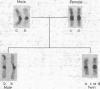
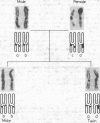
In a case of complete hydatidiform mole with fetus the genetic origins were defined by the use of chromosomal polymorphisms. The fetus had a normal 46,XY karyotype with evidence of the presence of both maternal and paternal chromosomes. The mole was 46,XX and of androgenetic origin. There was no evidence of a maternal contribution, and duplication of paternal chromosomes was shown. In such atypical molar pregnancies examining genetic polymorphisms yields much more information than do sex chromosome studies and karyotyping, particularly in confirming the diagnosis and defining the origin and aetiology of the condition.
Full text
PDF


Images in this article
Selected References
These references are in PubMed. This may not be the complete list of references from this article.
- Angell R. R., Jacobs P. A. Lateral asymmetry in human constitutive heterochromatin: frequency and inheritance. Am J Hum Genet. 1978 Mar;30(2):144–152. [PMC free article] [PubMed] [Google Scholar]
- Beischer N. A., Fortune D. W., Fitzgerald M. G. Hydatidiform Mole and Coexistent Foetus, both with Triploid Chromosome Constitution. Br Med J. 1967 Aug 19;3(5563):476–478. doi: 10.1136/bmj.3.5563.476. [DOI] [PMC free article] [PubMed] [Google Scholar]
- Beischer N. A. Hydatidiform mole with coexistent foetus. Aust N Z J Obstet Gynaecol. 1966 May;6(2):127–141. doi: 10.1111/j.1479-828x.1966.tb00358.x. [DOI] [PubMed] [Google Scholar]
- Blanc B., Papahadji M., Maresca C. Une observation de grossesse gémellaire avec un oeuf môlaire. Bull Fed Soc Gynecol Obstet Lang Fr. 1970 Nov-Dec;22(5):511–513. [PubMed] [Google Scholar]
- Diadhiou F., Cherbonnel G. M., Fall M., Diop P. M., Corréa P. Môle hydatiforme avec produit de conception coexistant (bilan de 15 ans) Bull Soc Med Afr Noire Lang Fr. 1975;20(2):228–236. [PubMed] [Google Scholar]
- Evans H. J., Buckton K. E., Sumner A. T. Cytological mapping of human chromosomes: results obtained with quinacrine fluorescence and the acetic-saline-Giemsa techniques. Chromosoma. 1971;35(3):310–325. doi: 10.1007/BF00326281. [DOI] [PubMed] [Google Scholar]
- Gallimore P. H., Richardson C. R. An improved banding technique exemplified in the karyotype analysis of two strains of rat. Chromosoma. 1973;41(3):259–263. doi: 10.1007/BF00344020. [DOI] [PubMed] [Google Scholar]
- Hohe P. T., Cochrane C. R., Gmelich J. T., Austin J. A. Coexistent trophoblastic tumor and viable pregnancy. Obstet Gynecol. 1971 Dec;38(6):899–904. [PubMed] [Google Scholar]
- Honda J., Ihara S., Sato E., Nemoto K., Fukushima T. [Hydatidiform mole concurrent with normal pregnancy (twins) following clomiphene therapy (author's transl)]. Acta Obstet Gynaecol Jpn. 1980 Dec;32(12):2041–2043. [PubMed] [Google Scholar]
- Jacobs P. A., Hassold T. J., Matsuyama A. M., Newlands I. M. Chromosome constitution of gestational trophoblastic disease. Lancet. 1978 Jul 1;2(8079):49–49. doi: 10.1016/s0140-6736(78)91363-6. [DOI] [PubMed] [Google Scholar]
- Jacobs P. A., Wilson C. M., Sprenkle J. A., Rosenshein N. B., Migeon B. R. Mechanism of origin of complete hydatidiform moles. Nature. 1980 Aug 14;286(5774):714–716. doi: 10.1038/286714a0. [DOI] [PubMed] [Google Scholar]
- KIRK J. A. PERSISTENCE OF ABNORMAL TROPHOBLAST. Am J Obstet Gynecol. 1965 Jul 1;92:667–671. doi: 10.1016/0002-9378(65)90437-0. [DOI] [PubMed] [Google Scholar]
- Kajii T., Ohama K. Androgenetic origin of hydatidiform mole. Nature. 1977 Aug 18;268(5621):633–634. doi: 10.1038/268633a0. [DOI] [PubMed] [Google Scholar]
- Ladehoff P., Maruszczak A. A pregnancy with a hydatidiform mole, thyreotoxicosis and live-born infant. Acta Obstet Gynecol Scand. 1978;57(5):477–478. doi: 10.3109/00016347809156533. [DOI] [PubMed] [Google Scholar]
- Lawler S. D., Pickthall V. J., Fisher R. A., Povey S., Evans M. W., Szulman A. E. Genetic studies of complete and partial hydatidiform moles. Lancet. 1979 Sep 15;2(8142):580–580. doi: 10.1016/s0140-6736(79)91632-5. [DOI] [PubMed] [Google Scholar]
- Paterson W. G., Hobson B. M., Smart G. E., Bain A. D. Two cases of hydatidiform degeneration of the placenta with fetal abnormality and triploid chromosome constitution. J Obstet Gynaecol Br Commonw. 1971 Feb;78(2):136–142. doi: 10.1111/j.1471-0528.1971.tb00247.x. [DOI] [PubMed] [Google Scholar]
- Sauerbrei E. E., Salem S., Fayle B. Coexistent hydatidiform mole and live fetus in the second trimester: an ultrasound study. Radiology. 1980 May;135(2):415–417. doi: 10.1148/radiology.135.2.7367637. [DOI] [PubMed] [Google Scholar]
- Sumner A. T. A simple technique for demonstrating centromeric heterochromatin. Exp Cell Res. 1972 Nov;75(1):304–306. doi: 10.1016/0014-4827(72)90558-7. [DOI] [PubMed] [Google Scholar]
- Suzuki M., Matsunobu A., Wakita K., Nishijima M., Osanai K. Hydatidiform mole with a surviving coexisting fetus. Obstet Gynecol. 1980 Sep;56(3):384–388. [PubMed] [Google Scholar]
- Szulman A. E., Surti U. The syndromes of hydatidiform mole. I. Cytogenetic and morphologic correlations. Am J Obstet Gynecol. 1978 Jul 15;131(6):665–671. doi: 10.1016/0002-9378(78)90829-3. [DOI] [PubMed] [Google Scholar]
- Szulman A. E., Surti U. The syndromes of hydatidiform mole. II. Morphologic evolution of the complete and partial mole. Am J Obstet Gynecol. 1978 Sep 1;132(1):20–27. doi: 10.1016/0002-9378(78)90792-5. [DOI] [PubMed] [Google Scholar]
- Vassilakos P., Riotton G., Kajii T. Hydatidiform mole: two entities. A morphologic and cytogenetic study with some clinical consideration. Am J Obstet Gynecol. 1977 Jan 15;127(2):167–170. doi: 10.1016/s0002-9378(16)33244-6. [DOI] [PubMed] [Google Scholar]