



Abstract
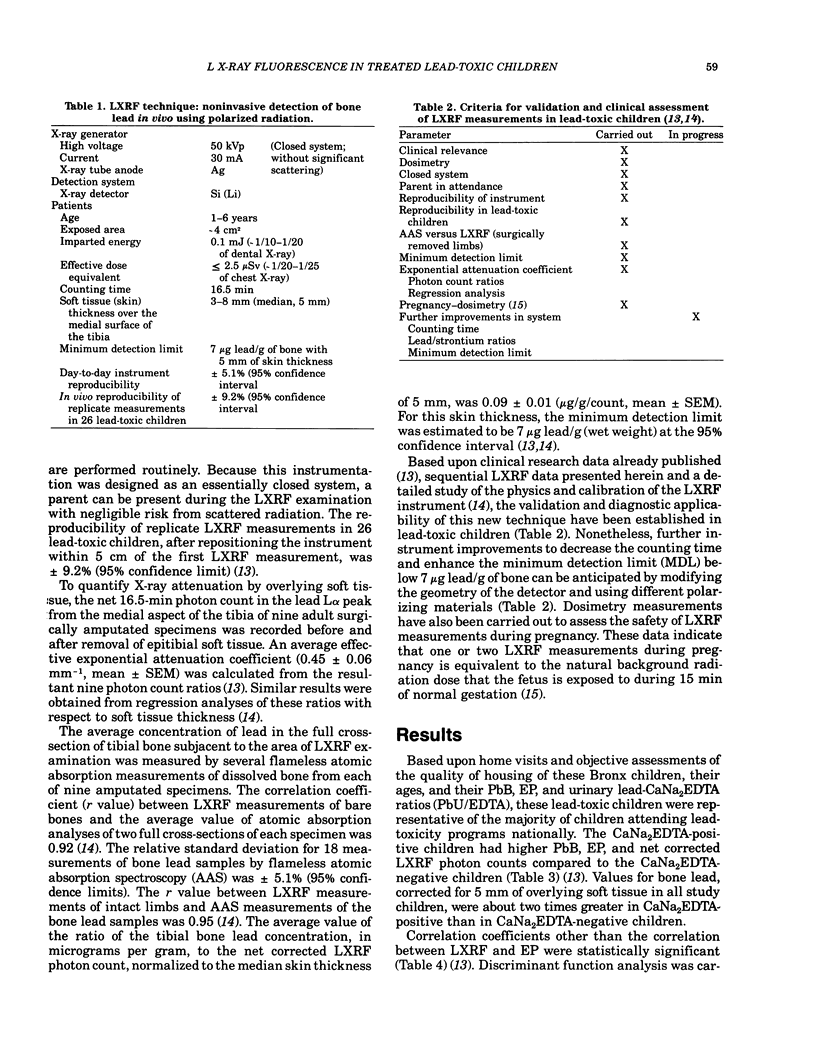
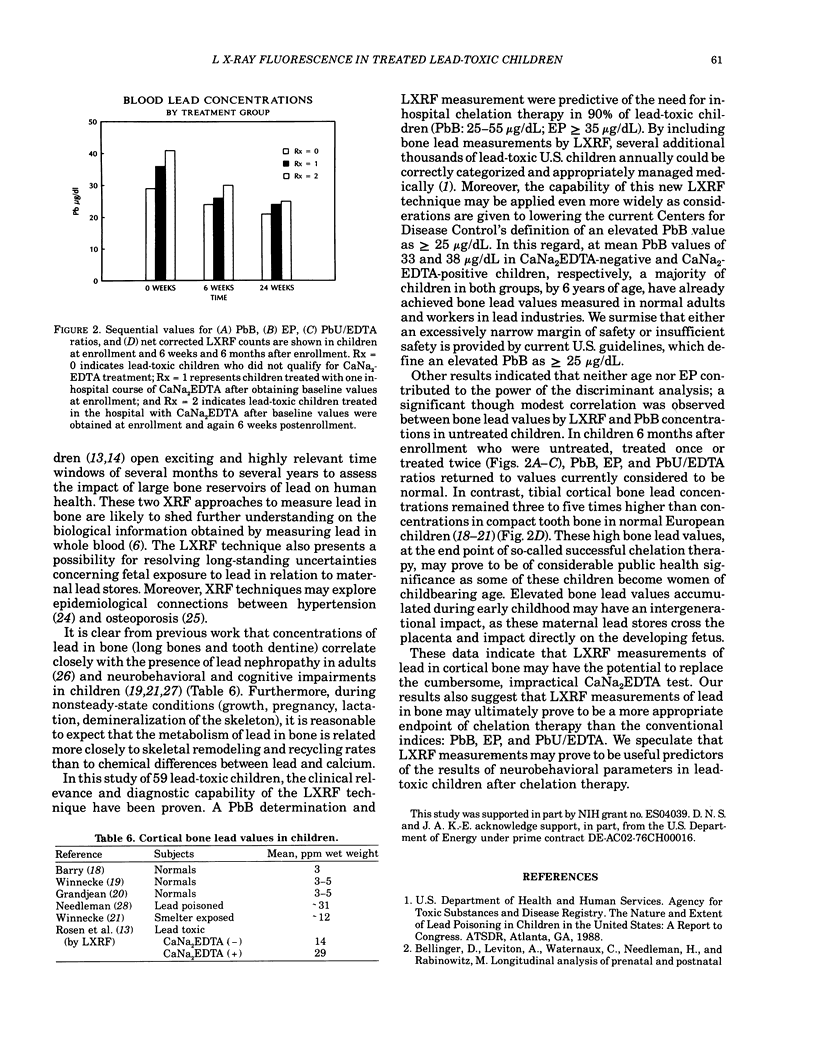
With the development of L X-ray fluorescence (LXRF) to measure cortical bone lead directly, safely, rapidly, and noninvasively, the present study was undertaken to a) evaluate LXRF as a possible replacement for the CaNa2EDTA test; b) quantify lead in tibial cortical bones of mildly to moderately lead-toxic children before treatment; and c) quantify lead in tibial cortical bones of lead-toxic children sequentially following one to two courses of chelation therapy. The clinical research design was based upon a longitudinal assessment of 59 untreated lead-toxic children. At enrollment, if the blood lead (PbB) was 25 to 55 micrograms/dL and the erythrocyte protoporphyrin (EP) concentration was greater than or equal to 35 micrograms/dL, LXRF measurement of tibial bone lead was carried out. One day later, each child underwent a CaNa2EDTA provocative test. If this test was positive, lead-toxic children were admitted to the hospital for 5 days of CaNa2EDTA therapy. These tests were repeated 6 weeks and 6 months after enrollment. Abatement of lead paint hazards was achieved in most apartments by the time of initial hospital discharge. The LXRF instrument consists of a low energy X-ray generator with a silver anode, a lithium-doped silicon detector, a polarizer of incident photons, and a multichannel X-ray analyzer. Partially polarized photons are directed at the subcutaneous, medial mid-tibial cortical bone. The LXRF spectrum, measured 90 degrees from the incident beam, reveals a peak in the 10.5 KeV region, which represents the lead L alpha line.(ABSTRACT TRUNCATED AT 250 WORDS)
Full text
PDF



Selected References
These references are in PubMed. This may not be the complete list of references from this article.
- Barry P. S. Concentrations of lead in the tissues of children. Br J Ind Med. 1981 Feb;38(1):61–71. doi: 10.1136/oem.38.1.61. [DOI] [PMC free article] [PubMed] [Google Scholar]
- Grandjean P., Lyngbye T., Hansen O. N. Lead concentration in deciduous teeth: variation related to tooth type and analytical technique. J Toxicol Environ Health. 1986;19(3):437–444. doi: 10.1080/15287398609530941. [DOI] [PubMed] [Google Scholar]
- Kalef-Ezra J. A., Slatkin D. N., Rosen J. F., Wielopolski L. Radiation risk to the human conceptus from measurement of maternal tibial bone lead by L-line x-ray fluorescence. Health Phys. 1990 Feb;58(2):217–218. [PubMed] [Google Scholar]
- Mahaffey K. R., Annest J. L. Association of erythrocyte protoporphyrin with blood lead level and iron status in the second National Health and Nutrition Examination Survey, 1976-1980. Environ Res. 1986 Oct;41(1):327–338. doi: 10.1016/s0013-9351(86)80194-3. [DOI] [PubMed] [Google Scholar]
- Marcus A. H. Multicompartment kinetic models for lead. I. Bone diffusion models for long-term retention. Environ Res. 1985 Apr;36(2):441–458. doi: 10.1016/0013-9351(85)90037-4. [DOI] [PubMed] [Google Scholar]
- McMichael A. J., Baghurst P. A., Wigg N. R., Vimpani G. V., Robertson E. F., Roberts R. J. Port Pirie Cohort Study: environmental exposure to lead and children's abilities at the age of four years. N Engl J Med. 1988 Aug 25;319(8):468–475. doi: 10.1056/NEJM198808253190803. [DOI] [PubMed] [Google Scholar]
- Needleman H. L., Davidson I., Sewell E. M., Shapiro I. M. Subclinical lead exposure in philadelphia schoolchildren. Identification by dentine lead analysis. N Engl J Med. 1974 Jan 31;290(5):245–248. doi: 10.1056/NEJM197401312900504. [DOI] [PubMed] [Google Scholar]
- Needleman H. L., Gunnoe C., Leviton A., Reed R., Peresie H., Maher C., Barrett P. Deficits in psychologic and classroom performance of children with elevated dentine lead levels. N Engl J Med. 1979 Mar 29;300(13):689–695. doi: 10.1056/NEJM197903293001301. [DOI] [PubMed] [Google Scholar]
- Osterloh J., Becker C. E. Pharmacokinetics of CaNa2EDTA and chelation of lead in renal failure. Clin Pharmacol Ther. 1986 Dec;40(6):686–693. doi: 10.1038/clpt.1986.245. [DOI] [PubMed] [Google Scholar]
- Piomelli S., Rosen J. F., Chisolm J. J., Jr, Graef J. W. Management of childhood lead poisoning. J Pediatr. 1984 Oct;105(4):523–532. doi: 10.1016/s0022-3476(84)80414-x. [DOI] [PubMed] [Google Scholar]
- Pirkle J. L., Schwartz J., Landis J. R., Harlan W. R. The relationship between blood lead levels and blood pressure and its cardiovascular risk implications. Am J Epidemiol. 1985 Feb;121(2):246–258. doi: 10.1093/oxfordjournals.aje.a113995. [DOI] [PubMed] [Google Scholar]
- Rabinowitz M. B., Wetherill G. W., Kopple J. D. Magnitude of lead intake from respiration by normal man. J Lab Clin Med. 1977 Aug;90(2):238–248. [PubMed] [Google Scholar]
- Rosen J. F., Markowitz M. E., Bijur P. E., Jenks S. T., Wielopolski L., Kalef-Ezra J. A., Slatkin D. N. L-line x-ray fluorescence of cortical bone lead compared with the CaNa2EDTA test in lead-toxic children: public health implications. Proc Natl Acad Sci U S A. 1989 Jan;86(2):685–689. doi: 10.1073/pnas.86.2.685. [DOI] [PMC free article] [PubMed] [Google Scholar]
- Schwartz J., Angle C., Pitcher H. Relationship between childhood blood lead levels and stature. Pediatrics. 1986 Mar;77(3):281–288. [PubMed] [Google Scholar]
- Schwartz J., Otto D. Blood lead, hearing thresholds, and neurobehavioral development in children and youth. Arch Environ Health. 1987 May-Jun;42(3):153–160. doi: 10.1080/00039896.1987.9935814. [DOI] [PubMed] [Google Scholar]
- Schütz A., Skerfving S., Christoffersson J. O., Ahlgren L., Mattson S. Lead in vertebral bone biopsies from active and retired lead workers. Arch Environ Health. 1987 Nov-Dec;42(6):340–346. doi: 10.1080/00039896.1987.9934356. [DOI] [PubMed] [Google Scholar]
- Silbergeld E. K., Schwartz J., Mahaffey K. Lead and osteoporosis: mobilization of lead from bone in postmenopausal women. Environ Res. 1988 Oct;47(1):79–94. doi: 10.1016/s0013-9351(88)80023-9. [DOI] [PubMed] [Google Scholar]
- Somervaille L. J., Chettle D. R., Scott M. C. In vivo measurement of lead in bone using x-ray fluorescence. Phys Med Biol. 1985 Sep;30(9):929–943. doi: 10.1088/0031-9155/30/9/005. [DOI] [PubMed] [Google Scholar]
- Somervaille L. J., Chettle D. R., Scott M. C., Tennant D. R., McKiernan M. J., Skilbeck A., Trethowan W. N. In vivo tibia lead measurements as an index of cumulative exposure in occupationally exposed subjects. Br J Ind Med. 1988 Mar;45(3):174–181. doi: 10.1136/oem.45.3.174. [DOI] [PMC free article] [PubMed] [Google Scholar]
- Van de Vyver F. L., D'Haese P. C., Visser W. J., Elseviers M. M., Knippenberg L. J., Lamberts L. V., Wedeen R. P., De Broe M. E. Bone lead in dialysis patients. Kidney Int. 1988 Feb;33(2):601–607. doi: 10.1038/ki.1988.39. [DOI] [PubMed] [Google Scholar]
- Wielopolski L., Rosen J. F., Slatkin D. N., Zhang R., Kalef-Ezra J. A., Rothman J. C., Maryanski M., Jenks S. T. In vivo measurement of cortical bone lead using polarized x rays. Med Phys. 1989 Jul-Aug;16(4):521–528. doi: 10.1118/1.596353. [DOI] [PubMed] [Google Scholar]
- Winneke G., Hrdina K. G., Brockhaus A. Neuropsychological studies in children with elevated tooth-lead concentrations. I. Pilot study. Int Arch Occup Environ Health. 1982;51(2):169–183. doi: 10.1007/BF00378161. [DOI] [PubMed] [Google Scholar]
- Winneke G., Krämer U., Brockhaus A., Ewers U., Kujanek G., Lechner H., Janke W. Neuropsychological studies in children with elevated tooth-lead concentrations. II. Extended study. Int Arch Occup Environ Health. 1983;51(3):231–252. doi: 10.1007/BF00377755. [DOI] [PubMed] [Google Scholar]