



Abstract
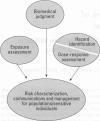
The Agency for Toxic Substances and Disease Registry (ATSDR) is a public health agency with responsibility for assessing the public health implications associated with uncontrolled releases of hazardous substances into the environment. The biological effects of low-level exposures are a primary concern in these assessments. One of the tools used by the agency for this purpose is the risk assessment paradigm originally outlined and described by the National Academy of Science in 1983. Because of its design and inherent concepts, risk assessment has been variously employed by a number of environmental and public health agencies and programs as a means to organize information, as a decision support tool, and as a working hypothesis for biologically based inference and extrapolation. Risk assessment has also been the subject of significant critical review. The ATSDR recognizes the utility of both the qualitative and quantitative conclusions provided by traditional risk assessment, but the agency uses such estimates only in the broader context of professional judgment, internal and external peer review, and extensive public review and comment. This multifaceted approach is consistent with the Council on Environmental Quality's description and use of risk analysis as an organizing construct based on sound biomedical and other scientific judgment in concert with risk assessment to define plausible exposure ranges of concern rather than a single numerical estimate that may convey an artificial sense of precision. In this approach biomedical opinion, host factors, mechanistic interpretation, molecular epidemiology, and actual exposure conditions are all critically important in evaluating the significance of environmental exposure to hazardous substances. As such, the ATSDR risk analysis approach is a multidimensional endeavor encompassing not only the components of risk assessment but also the principles of biomedical judgment, risk management, and risk communication. Within this framework of risk analysis, the ATSDR may rely on one or more of a number of interrelated principles and approaches to screen, organize information, set priorities, make decisions, and define future research needs and directions.
Full text
PDF


Images in this article
Selected References
These references are in PubMed. This may not be the complete list of references from this article.
- Allen B. C., Kavlock R. J., Kimmel C. A., Faustman E. M. Dose-response assessment for developmental toxicity. II. Comparison of generic benchmark dose estimates with no observed adverse effect levels. Fundam Appl Toxicol. 1994 Nov;23(4):487–495. doi: 10.1006/faat.1994.1133. [DOI] [PubMed] [Google Scholar]
- Arito H., Takahashi M., Ishikawa T. Effect of subchronic inhalation exposure to low-level trichloroethylene on heart rate and wakefulness-sleep in freely moving rats. Sangyo Igaku. 1994 Jan;36(1):1–8. doi: 10.1539/joh1959.36.1. [DOI] [PubMed] [Google Scholar]
- Barnes D. G., Dourson M. Reference dose (RfD): description and use in health risk assessments. Regul Toxicol Pharmacol. 1988 Dec;8(4):471–486. doi: 10.1016/0273-2300(88)90047-5. [DOI] [PubMed] [Google Scholar]
- Bi W. F., Wang Y. S., Huang M. Y., Meng D. S. Effect of vinyl chloride on testis in rats. Ecotoxicol Environ Saf. 1985 Dec;10(3):281–289. doi: 10.1016/0147-6513(85)90074-0. [DOI] [PubMed] [Google Scholar]
- Calabrese E. J., Baldwin L. A. Possible examples of chemical hormesis in a previously published study. J Appl Toxicol. 1993 May-Jun;13(3):169–172. doi: 10.1002/jat.2550130305. [DOI] [PubMed] [Google Scholar]
- Calabrese E. J., McCarthy M. E., Kenyon E. The occurrence of chemically induced hormesis. Health Phys. 1987 May;52(5):531–541. doi: 10.1097/00004032-198705000-00002. [DOI] [PubMed] [Google Scholar]
- Chandra R. K. Excessive intake of zinc impairs immune responses. JAMA. 1984 Sep 21;252(11):1443–1446. [PubMed] [Google Scholar]
- Clewell H. J., 3rd, Andersen M. E. Risk assessment extrapolations and physiological modeling. Toxicol Ind Health. 1985 Dec;1(4):111–131. doi: 10.1177/074823378500100408. [DOI] [PubMed] [Google Scholar]
- Crump K. S. A new method for determining allowable daily intakes. Fundam Appl Toxicol. 1984 Oct;4(5):854–871. doi: 10.1016/0272-0590(84)90107-6. [DOI] [PubMed] [Google Scholar]
- Cunningham B. C., Bass S., Fuh G., Wells J. A. Zinc mediation of the binding of human growth hormone to the human prolactin receptor. Science. 1990 Dec 21;250(4988):1709–1712. doi: 10.1126/science.2270485. [DOI] [PubMed] [Google Scholar]
- DeRosa C. T., Stevens Y. W., Johnson B. L. Cancer policy framework for: public health assessment of carcinogens in the environment. Toxicol Ind Health. 1993 Jul-Aug;9(4):559–575. doi: 10.1177/074823379300900401. [DOI] [PubMed] [Google Scholar]
- DeRosa C. Agency for Toxic Substances and Disease Registry's toxicological profiles: contribution to public health. Toxicol Ind Health. 1994 May-Jun;10(3):117–117. doi: 10.1177/074823379401000301. [DOI] [PubMed] [Google Scholar]
- Fischer P. W., Giroux A., L'Abbé M. R. Effect of zinc supplementation on copper status in adult man. Am J Clin Nutr. 1984 Oct;40(4):743–746. doi: 10.1093/ajcn/40.4.743. [DOI] [PubMed] [Google Scholar]
- Fraker P. J., Gershwin M. E., Good R. A., Prasad A. Interrelationships between zinc and immune function. Fed Proc. 1986 Apr;45(5):1474–1479. [PubMed] [Google Scholar]
- Fredriksson A., Danielsson B. R., Eriksson P. Altered behaviour in adult mice orally exposed to tri- and tetrachloroethylene as neonates. Toxicol Lett. 1993 Jan;66(1):13–19. doi: 10.1016/0378-4274(93)90074-8. [DOI] [PubMed] [Google Scholar]
- Holt A. B., Spargo R. M., Iveson J. B., Faulkner G. S., Cheek D. B. Serum and plasma zinc, copper and iron concentrations in Aboriginal communities of North Western Australia. Am J Clin Nutr. 1980 Jan;33(1):119–132. doi: 10.1093/ajcn/33.1.119. [DOI] [PMC free article] [PubMed] [Google Scholar]
- Hooper P. L., Visconti L., Garry P. J., Johnson G. E. Zinc lowers high-density lipoprotein-cholesterol levels. JAMA. 1980 Oct 24;244(17):1960–1961. [PubMed] [Google Scholar]
- John J. A., Smith F. A., Leong B. K., Schwetz B. A. The effects of maternally inhaled vinyl chloride on embryonal and fetal development in mice, rats, and rabbits. Toxicol Appl Pharmacol. 1977 Mar;39(3):497–513. doi: 10.1016/0041-008x(77)90141-7. [DOI] [PubMed] [Google Scholar]
- John J. A., Smith F. A., Schwetz B. A. Vinyl chloride: inhalation teratology study in mice, rats and rabbits. Environ Health Perspect. 1981 Oct;41:171–177. doi: 10.1289/ehp.8141171. [DOI] [PMC free article] [PubMed] [Google Scholar]
- Jonker D., Woutersen R. A., Feron V. J. Toxicity of mixtures of nephrotoxicants with similar or dissimilar mode of action. Food Chem Toxicol. 1996 Nov-Dec;34(11-12):1075–1082. doi: 10.1016/s0278-6915(97)00077-x. [DOI] [PubMed] [Google Scholar]
- Jonker D., Woutersen R. A., van Bladeren P. J., Til H. P., Feron V. J. Subacute (4-wk) oral toxicity of a combination of four nephrotoxins in rats: comparison with the toxicity of the individual compounds. Food Chem Toxicol. 1993 Feb;31(2):125–136. doi: 10.1016/0278-6915(93)90126-j. [DOI] [PubMed] [Google Scholar]
- Mackay C. J., Campbell L., Samuel A. M., Alderman K. J., Idzikowski C., Wilson H. K., Gompertz D. Behavioral changes during exposure to 1,1,1-trichloroethane: time-course and relationship to blood solvent levels. Am J Ind Med. 1987;11(2):223–239. doi: 10.1002/ajim.4700110210. [DOI] [PubMed] [Google Scholar]
- McLachlan J. A. Functional toxicology: a new approach to detect biologically active xenobiotics. Environ Health Perspect. 1993 Oct;101(5):386–387. doi: 10.1289/ehp.93101386. [DOI] [PMC free article] [PubMed] [Google Scholar]
- Mumtaz M. M., Durkin P. R. A weight-of-evidence approach for assessing interactions in chemical mixtures. Toxicol Ind Health. 1992 Nov-Dec;8(6):377–406. [PubMed] [Google Scholar]
- Pierce J. B., Ariyan Z. S., Ovenden G. S. Preparation and antiinflammatory activity of 2- and 4-pyridones. J Med Chem. 1982 Feb;25(2):131–136. doi: 10.1021/jm00344a008. [DOI] [PubMed] [Google Scholar]
- Pohl H., DeRosa C., Holler J. Public health assessment for dioxins exposure from soil. Chemosphere. 1995 Jul;31(1):2437–2454. doi: 10.1016/0045-6535(95)00114-n. [DOI] [PubMed] [Google Scholar]
- Pohl H., Holler J. Halogenated aromatic hydrocarbons and toxicity equivalency factors (TEFs) from the public health assessment perspective. Chemosphere. 1995 Jul;31(1):2547–2559. doi: 10.1016/0045-6535(95)00123-p. [DOI] [PubMed] [Google Scholar]
- Poiger H., Schlatter C. Influence of solvents and adsorbents on dermal and intestinal absorption of TCDD. Food Cosmet Toxicol. 1980 Oct;18(5):477–481. doi: 10.1016/0015-6264(80)90160-1. [DOI] [PubMed] [Google Scholar]
- Prasad A. S., Brewer G. J., Schoomaker E. B., Rabbani P. Hypocupremia induced by zinc therapy in adults. JAMA. 1978 Nov 10;240(20):2166–2168. [PubMed] [Google Scholar]
- Stewart R. D., Dodd H. C., Gay H. H., Erley D. S. Experimental human exposure to trichloroethylene. Arch Environ Health. 1970 Jan;20(1):64–71. doi: 10.1080/00039896.1970.10665543. [DOI] [PubMed] [Google Scholar]
- Weeks M. H., Angerhofer R. A., Bishop R., Thomasino J., Pope C. R. The toxicity of hexachloroethane in laboratory animals. Am Ind Hyg Assoc J. 1979 Mar;40(3):187–199. doi: 10.1080/15298667991429499. [DOI] [PubMed] [Google Scholar]
- White K. L., Jr, Lysy H. H., McCay J. A., Anderson A. C. Modulation of serum complement levels following exposure to polychlorinated dibenzo-p-dioxins. Toxicol Appl Pharmacol. 1986 Jun 30;84(2):209–219. doi: 10.1016/0041-008x(86)90128-6. [DOI] [PubMed] [Google Scholar]
- Yadrick M. K., Kenney M. A., Winterfeldt E. A. Iron, copper, and zinc status: response to supplementation with zinc or zinc and iron in adult females. Am J Clin Nutr. 1989 Jan;49(1):145–150. doi: 10.1093/ajcn/49.1.145. [DOI] [PubMed] [Google Scholar]