



Abstract
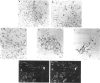
The effect of cyclosporin A (CyA) immunosuppression on the murine thymic microenvironment and T lymphocyte development has been analysed using monoclonal antibodies to epithelial and lymphocyte subpopulations, macrophages and major histocompatibility complex (MHC) class II antigens in immunohistochemistry and flow cytometry. The major microenvironmental target for CyA-induced damage was the thymic medulla, where a reduction in all epithelial cell subsets, dendritic cells and macrophages was observed. In contrast, the thymic cortex appeared essentially normal. CyA had no detectable effect on the intensity of microenvironmental expression of MHC class II molecules in either cortex or medulla, although the number of MHC class II positive medullary cells was reduced after CyA treatment. CyA also had a differential effect on the thymic lymphocyte populations where there was little change in the Thy-1 bright, CD5 dull, CD4+, CD8+ cortical thymocytes but a depletion of the Thy-1 dull, CD5 bright, CD4 or CD8 single-positive medullary cells. This lymphocyte loss may be due partly to increased migration from thymus to spleen and other peripheral lymphoid organs, and partly to a block in the differentiation stage from cortical to medullary lymphocyte. The thymic microenvironment and lymphocyte subpopulations recover rapidly after cessation of CyA treatment, although there may be longer term functional defects resulting from the CyA-induced injury.
Full text
PDF


Images in this article

Selected References
These references are in PubMed. This may not be the complete list of references from this article.
- Baldwin W. M., 3rd, Hutchinson I. F., Meijer C. J., Tilney N. L. Immune responses to organ allografts. III. Marked decrease in medullary thymocytes and splenic T lymphocytes after cyclosporin A treatment. Transplantation. 1981 Feb;31(2):117–120. [PubMed] [Google Scholar]
- Berrih S., Arenzana-Seisdedos F., Cohen S., Devos R., Charron D., Virelizier J. L. Interferon-gamma modulates HLA class II antigen expression on cultured human thymic epithelial cells. J Immunol. 1985 Aug;135(2):1165–1171. [PubMed] [Google Scholar]
- Beschorner W. E., Namnoum J. D., Hess A. D., Shinn C. A., Santos G. W. Cyclosporin A and the thymus. Immunopathology. Am J Pathol. 1987 Mar;126(3):487–496. [PMC free article] [PubMed] [Google Scholar]
- Bevan D. J., Chisholm P. M. Co-expression of CD4 and CD8 molecules and de novo expression of MHC class II antigens on activated rat T cells. Immunology. 1986 Dec;59(4):621–625. [PMC free article] [PubMed] [Google Scholar]
- Bhattacharya A., Dorf M. E., Springer T. A. A shared alloantigenic determinant on Ia antigens encoded by the I-A and I-E subregions: evidence for I region gene duplication. J Immunol. 1981 Dec;127(6):2488–2495. [PubMed] [Google Scholar]
- Bickel M., Tsuda H., Amstad P., Evequoz V., Mergenhagen S. E., Wahl S. M., Pluznik D. H. Differential regulation of colony-stimulating factors and interleukin 2 production by cyclosporin A. Proc Natl Acad Sci U S A. 1987 May;84(10):3274–3277. doi: 10.1073/pnas.84.10.3274. [DOI] [PMC free article] [PubMed] [Google Scholar]
- Borel J. F., Feurer C., Gubler H. U., Stähelin H. Biological effects of cyclosporin A: a new antilymphocytic agent. Agents Actions. 1976 Jul;6(4):468–475. doi: 10.1007/BF01973261. [DOI] [PubMed] [Google Scholar]
- Courtenay-Luck N. S., Epenetos A. A., Moore R., Larche M., Pectasides D., Dhokia B., Ritter M. A. Development of primary and secondary immune responses to mouse monoclonal antibodies used in the diagnosis and therapy of malignant neoplasms. Cancer Res. 1986 Dec;46(12 Pt 1):6489–6493. [PubMed] [Google Scholar]
- Dardenne M., Savino W., Feutren G., Bach J. F. Stimulatory effects of cyclosporin A on human and mouse thymic epithelial cells. Eur J Immunol. 1987 Feb;17(2):275–279. doi: 10.1002/eji.1830170219. [DOI] [PubMed] [Google Scholar]
- Hess A. D., Colombani P. M. Cyclosporin. Mechanism of action: in vitro studies. Prog Allergy. 1986;38:198–221. [PubMed] [Google Scholar]
- Hess A. D., Horwitz L., Beschorner W. E., Santos G. W. Development of graft-vs.-host disease-like syndrome in cyclosporine-treated rats after syngeneic bone marrow transplantation. I. Development of cytotoxic T lymphocytes with apparent polyclonal anti-Ia specificity, including autoreactivity. J Exp Med. 1985 Apr 1;161(4):718–730. doi: 10.1084/jem.161.4.718. [DOI] [PMC free article] [PubMed] [Google Scholar]
- Hows J. M., Palmer S., Gordon-Smith E. C. Use of cyclosporin A in allogeneic bone marrow transplantation for severe aplastic anemia. Transplantation. 1982 Apr;33(4):382–386. doi: 10.1097/00007890-198204000-00008. [DOI] [PubMed] [Google Scholar]
- Jenkinson E. J., Kingston R., Owen J. J. Importance of IL-2 receptors in intra-thymic generation of cells expressing T-cell receptors. Nature. 1987 Sep 10;329(6135):160–162. doi: 10.1038/329160a0. [DOI] [PubMed] [Google Scholar]
- Knight S. C., Balfour B., O'Brien J., Buttifant L. Sensitivity of veiled (dendritic) cells to cyclosporine. Transplantation. 1986 Jan;41(1):96–100. doi: 10.1097/00007890-198601000-00019. [DOI] [PubMed] [Google Scholar]
- Larché M., Lamb J. R., Ritter M. A. A novel T-lymphocyte molecule that may function in the induction of self-tolerance and MHC-restriction within the human thymic microenvironment. Immunology. 1988 May;64(1):101–105. [PMC free article] [PubMed] [Google Scholar]
- Lo D., Sprent J. Identity of cells that imprint H-2-restricted T-cell specificity in the thymus. Nature. 1986 Feb 20;319(6055):672–675. doi: 10.1038/319672a0. [DOI] [PubMed] [Google Scholar]
- Ready A. R., Jenkinson E. J., Kingston R., Owen J. J. Successful transplantation across major histocompatibility barrier of deoxyguanosine-treated embryonic thymus expressing class II antigens. Nature. 1984 Jul 19;310(5974):231–233. doi: 10.1038/310231a0. [DOI] [PubMed] [Google Scholar]
- Rocha B., Lehuen A., Papiernik M. IL-2-dependent proliferation of thymic accessory cells. J Immunol. 1988 Feb 15;140(4):1076–1080. [PubMed] [Google Scholar]
- Sakaguchi S., Sakaguchi N. Thymus and autoimmunity. Transplantation of the thymus from cyclosporin A-treated mice causes organ-specific autoimmune disease in athymic nude mice. J Exp Med. 1988 Apr 1;167(4):1479–1485. doi: 10.1084/jem.167.4.1479. [DOI] [PMC free article] [PubMed] [Google Scholar]
- Shevach E. M. The effects of cyclosporin A on the immune system. Annu Rev Immunol. 1985;3:397–423. doi: 10.1146/annurev.iy.03.040185.002145. [DOI] [PubMed] [Google Scholar]
- Shinozuka H., Gill T. J., 3rd, Kunz H. W., Witkowski L. A., Demetris A. J., Perera M. I. Enhancement of the induction of murine thymic lymphomas by cyclosporine. Transplantation. 1986 Mar;41(3):377–380. doi: 10.1097/00007890-198603000-00018. [DOI] [PubMed] [Google Scholar]
- Sorokin R., Kimura H., Schroder K., Wilson D. H., Wilson D. B. Cyclosporine-induced autoimmunity. Conditions for expressing disease, requirement for intact thymus, and potency estimates of autoimmune lymphocytes in drug-treated rats. J Exp Med. 1986 Nov 1;164(5):1615–1625. doi: 10.1084/jem.164.5.1615. [DOI] [PMC free article] [PubMed] [Google Scholar]
- Tanaka M., Shinohara K., Fukumoto T., Tanaka H., Kaneko T. Effect of Cyclosporin A on rat thymus: time course analysis by immunoperoxidase technique and flow cytofluorometry. Clin Exp Immunol. 1988 May;72(2):216–221. [PMC free article] [PubMed] [Google Scholar]
- Tentori L., Longo D. L., Zuñiga-Pflucker J. C., Wing C., Kruisbeek A. M. Essential role of the interleukin 2-interleukin 2 receptor pathway in thymocyte maturation in vivo. J Exp Med. 1988 Nov 1;168(5):1741–1747. doi: 10.1084/jem.168.5.1741. [DOI] [PMC free article] [PubMed] [Google Scholar]
- Thomson A. W., Milton J. I., Aldridge R. D., Davidson R. J., Simpson J. G. Inhibition of drug-induced eosinophilia by cyclosporin A. Scand J Immunol. 1986 Aug;24(2):163–170. doi: 10.1111/j.1365-3083.1986.tb02082.x. [DOI] [PubMed] [Google Scholar]
- Van Vliet E., Melis M., Van Ewijk W. Monoclonal antibodies to stromal cell types of the mouse thymus. Eur J Immunol. 1984 Jun;14(6):524–529. doi: 10.1002/eji.1830140608. [DOI] [PubMed] [Google Scholar]
- de Maagd R. A., MacKenzie W. A., Schuurman H. J., Ritter M. A., Price K. M., Broekhuizen R., Kater L. The human thymus microenvironment: heterogeneity detected by monoclonal anti-epithelial cell antibodies. Immunology. 1985 Apr;54(4):745–754. [PMC free article] [PubMed] [Google Scholar]