



Abstract
A recently described murine local passive transfer (LPT) system was modified to investigate accessory cell function in the expression of in vivo delayed-type hypersensitivity (DTH). An enriched antigen-presenting accessory cell population was prepared by overnight culturing and antigen pulsing. These cells, when cotransferred locally with enriched populations of immune DTH effector T lymphocytes, induced antigen-specific DTH responses. A consistently positive relationship between DTH expression and quantity of pulsed cells transferred was demonstrated. The further addition of fresh accessory cells to the transfer mixture provided 'augmentation' of DTH responses. In contrast to antigen presentation, 'augmentation' appeared restricted to an optimal range of augmenting cell: T cell ratios. That antigen presentation and augmentation were separate accessory cell functions was further supported by differential selection during overnight culture and differential sensitivity to paraformaldehyde (pCHO) exposure. The demonstration of multiple accessory cell functions indicates considerable promise for this system in the investigation of in vivo immune expression.
Full text
PDF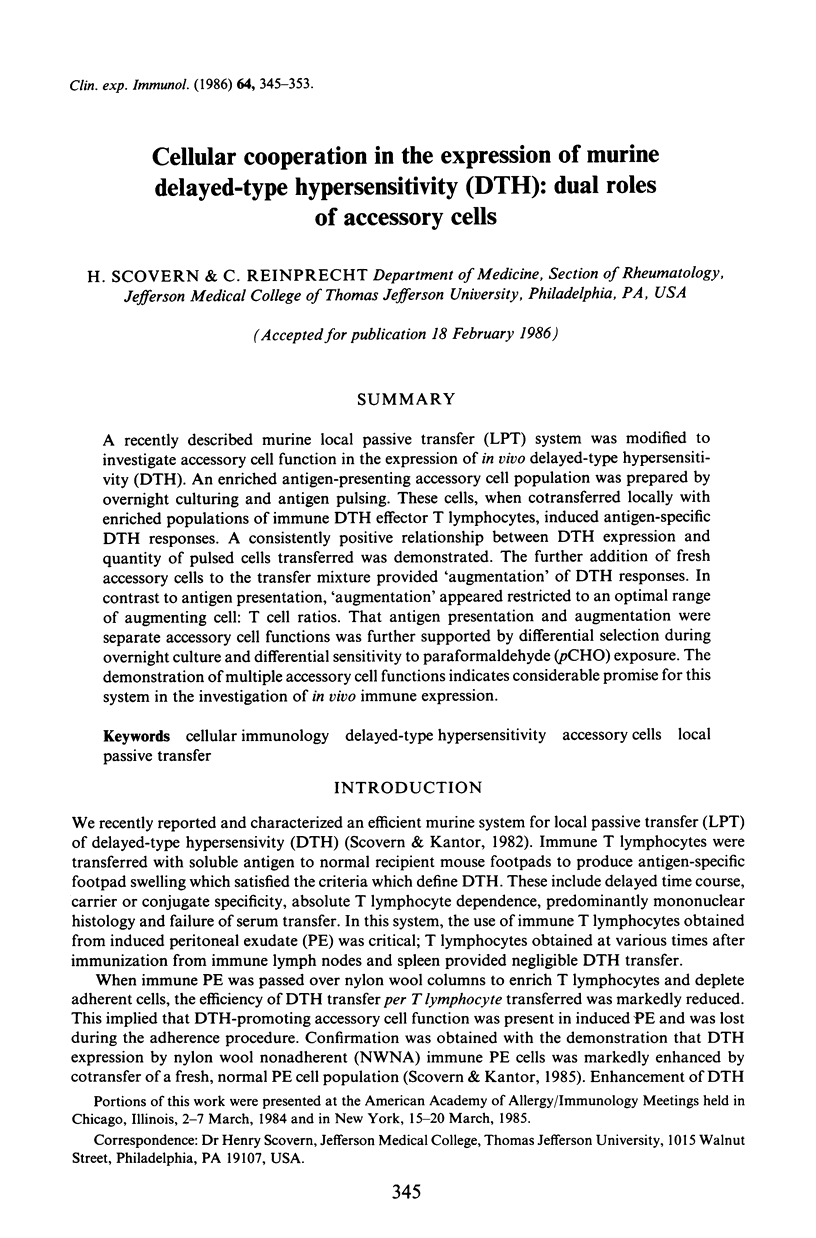




Selected References
These references are in PubMed. This may not be the complete list of references from this article.
- Cowing C., Pincus S. H., Sachs D. H., Dickler H. B. A subpopulation of adherent accessory cells bearing both I-A and I-E or C subregion antigens is required for antigen-specific murine T lymphocyte proliferation. J Immunol. 1978 Nov;121(5):1680–1686. [PubMed] [Google Scholar]
- DeFreitas E. C., Chesnut R. W., Grey H. M., Chiller J. M. Macrophage-dependent activation of antigen-specific T cells requires antigen and a soluble monokine. J Immunol. 1983 Jul;131(1):23–29. [PubMed] [Google Scholar]
- Scovern H., Kantor F. S. Cellular cooperation in the expression of murine delayed-type hypersensitivity (DTH). 1. A normal accessory cell population enhances DTH produced by immune peritoneal exudate T lymphocytes. Cell Immunol. 1985 Apr 1;91(2):344–353. doi: 10.1016/0008-8749(85)90232-1. [DOI] [PubMed] [Google Scholar]
- Scovern H., Kantor F. S. Local passive transfer of delayed-type hypersensitivity in the mouse. J Immunol. 1982 Jul;129(1):25–29. [PubMed] [Google Scholar]
- Steeg P. S., Moore R. N., Johnson H. M., Oppenheim J. J. Regulation of murine macrophage Ia antigen expression by a lymphokine with immune interferon activity. J Exp Med. 1982 Dec 1;156(6):1780–1793. doi: 10.1084/jem.156.6.1780. [DOI] [PMC free article] [PubMed] [Google Scholar]
- Waldron J. A., Jr, Horn R. G., Rosenthal A. S. Antigen-induced proliferation of guinea pig lymphocytes in vitro: functional aspects of antigen handling by macrophages. J Immunol. 1974 Feb;112(2):746–755. [PubMed] [Google Scholar]
- Yarchoan R., Tosato G., Blaese R. M., Simon R. M., Nelson D. L. Limiting dilution analysis of Epstein-Barr virus-induced immunoglobulin production by human B cells. J Exp Med. 1983 Jan 1;157(1):1–14. doi: 10.1084/jem.157.1.1. [DOI] [PMC free article] [PubMed] [Google Scholar]
- Ziegler K., Unanue E. R. Identification of a macrophage antigen-processing event required for I-region-restricted antigen presentation to T lymphocytes. J Immunol. 1981 Nov;127(5):1869–1875. [PubMed] [Google Scholar]