



Abstract
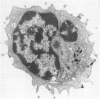
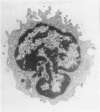
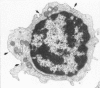
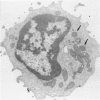
The morphological features of normal peripheral blood lymphocytes reactive with three monoclonal antibodies (MoAb) against natural killer (NK) cells, Leu7, OKM1 (CD11b) and Leu11 (CD16) and with two anti-T cell MoAb, CD4 and CD8, have been analysed at ultrastructural level by an indirect immunogold method. Cells having the features of large granular lymphocytes (LGL) but also lymphocytes displaying different morphological characteristics (non LGL; e.g. high nucleo-cytoplasmic ratio and few cytoplasmic organelles) were seen reactive with each of the MoAb investigated. Leu7 identified a higher proportion of LGL (60-80%) than OKM1 (10-95%) and Leu11 (20-48%), and with a stronger binding. A distinct granular structure, recognized as parallel tubular arrays, was more characteristic of the Leu7+, CD8+ LGL and was less frequently seen in the OKM1 and Leu11 positive LGL subpopulation in four out of the five donors investigated. It is of interest that the Leu11 and OKM1 positive subsets, which correspond functionally to cells with greater NK function, had relatively less LGL than the Leu7 positive subsets, raising the issue of the true morphology of NK cells in man. The existence of a minority of CD4 positive LGL was confirmed. Our findings demonstrate that there is a degree of morphological heterogeneity within the normal NK lymphoid population as defined by the membrane phenotype and that certain variability among normal individuals regarding the proportion and structural features of the NK subpopulations may be present.
Full text
PDF


Images in this article

Selected References
These references are in PubMed. This may not be the complete list of references from this article.
- Abo T., Balch C. M. Characterization of HNK-1+ (Leu-7) human lymphocytes. II. Distinguishing phenotypic and functional properties of natural killer cells from activated NK-like cells. J Immunol. 1982 Oct;129(4):1758–1761. [PubMed] [Google Scholar]
- Abo T., Cooper M. D., Balch C. M. Characterization of HNK-1+ (Leu-7) human lymphocytes. I. Two distinct phenotypes of human NK cells with different cytotoxic capability. J Immunol. 1982 Oct;129(4):1752–1757. [PubMed] [Google Scholar]
- Capron F., PErrot J. Y., Boucheix C., Reynes M., Tricottet V., Bernadou A., Diebold J. Lysosomal localisation of parallel tubular arrays in chronic lymphocytic leukaemia of T cell origin: an ultrastructural cytochemical study. J Clin Pathol. 1982 Feb;35(2):167–171. doi: 10.1136/jcp.35.2.167. [DOI] [PMC free article] [PubMed] [Google Scholar]
- Carpen O., Virtanen I., Saksela E. Ultrastructure of human natural killer cells: nature of the cytolytic contacts in relation to cellular secretion. J Immunol. 1982 Jun;128(6):2691–2697. [PubMed] [Google Scholar]
- Costello C., Catovsky D., O'Brien M., Morilla R., Varadi S. Chronic T-cell leukemias. I. Morphology, cytochemistry and ultrastructure. Leuk Res. 1980;4(5):463–476. doi: 10.1016/0145-2126(80)90028-4. [DOI] [PubMed] [Google Scholar]
- Grossi C. E., Cadoni A., Zicca A., Leprini A., Ferrarini M. Large granular lymphocytes in human peripheral blood: ultrastructural and cytochemical characterization of the granules. Blood. 1982 Feb;59(2):277–283. [PubMed] [Google Scholar]
- Lanier L. L., Engleman E. G., Gatenby P., Babcock G. F., Warner N. L., Herzenberg L. A. Correlation of functional properties of human lymphoid cell subsets and surface marker phenotypes using multiparameter analysis and flow cytometry. Immunol Rev. 1983;74:143–160. doi: 10.1111/j.1600-065x.1983.tb01088.x. [DOI] [PubMed] [Google Scholar]
- Lanier L. L., Kipps T. J., Phillips J. H. Functional properties of a unique subset of cytotoxic CD3+ T lymphocytes that express Fc receptors for IgG (CD16/Leu-11 antigen). J Exp Med. 1985 Dec 1;162(6):2089–2106. doi: 10.1084/jem.162.6.2089. [DOI] [PMC free article] [PubMed] [Google Scholar]
- Lanier L. L., Le A. M., Phillips J. H., Warner N. L., Babcock G. F. Subpopulations of human natural killer cells defined by expression of the Leu-7 (HNK-1) and Leu-11 (NK-15) antigens. J Immunol. 1983 Oct;131(4):1789–1796. [PubMed] [Google Scholar]
- Lohmeyer J., Rieber P., Feucht H., Johnson J., Hadam M., Riethmüller G. A subset of human cells isolated and characterized by monoclonal antibodies. Eur J Immunol. 1981 Dec;11(12):997–1001. doi: 10.1002/eji.1830111209. [DOI] [PubMed] [Google Scholar]
- Matutes E., Catovsky D. The fine structure of normal lymphocyte subpopulations--a study with monoclonal antibodies and the immunogold technique. Clin Exp Immunol. 1982 Nov;50(2):416–425. [PMC free article] [PubMed] [Google Scholar]
- Matutes E., Robinson D., O'Brien M., Haynes B. F., Zola H., Catovsky D. Candidate counterparts of Sézary cells and adult T-cell lymphoma-leukaemia cells in normal peripheral blood: an ultrastructural study with the immunogold method and monoclonal antibodies. Leuk Res. 1983;7(6):787–801. doi: 10.1016/0145-2126(83)90073-5. [DOI] [PubMed] [Google Scholar]
- McKenna R. W., Parkin J., Kersey J. H., Gajl-Peczalska K. J., Peterson L., Brunning R. D. Chronic lymphoproliferative disorder with unusual clinical, morphologic, ultrastructural and membrane surface marker characteristics. Am J Med. 1977 Apr;62(4):588–596. doi: 10.1016/0002-9343(77)90422-3. [DOI] [PubMed] [Google Scholar]
- Moss V. E., Miedema F., Matutes E., Terpstra F., Brownell A., Brozovic M., Catovsky D. An unusual variant of T-CLL: evidence for the existence of a hitherto unrecognized T cell subset. Clin Exp Immunol. 1986 Feb;63(2):303–311. [PMC free article] [PubMed] [Google Scholar]
- Payne C. M., Glasser L. The effect of steroids on peripheral blood lymphocytes containing parallel tubular arrays. Am J Pathol. 1978 Sep;92(3):611–618. [PMC free article] [PubMed] [Google Scholar]
- Perussia B., Fanning V., Trinchieri G. A human NK and K cell subset shares with cytotoxic T cells expression of the antigen recognized by antibody OKT8. J Immunol. 1983 Jul;131(1):223–231. [PubMed] [Google Scholar]
- Robinson D. S., Posnett D. N., Zola H., Catovsky D. Normal counterparts of hairy cells and B-prolymphocytes in the peripheral blood. An ultrastructural study with monoclonal antibodies and the immunogold method. Leuk Res. 1985;9(3):335–348. doi: 10.1016/0145-2126(85)90055-4. [DOI] [PubMed] [Google Scholar]
- Rumpold H., Kraft D., Obexer G., Böck G., Gebhart W. A monoclonal antibody against a surface antigen shared by human large granular lymphocytes and granulocytes. J Immunol. 1982 Oct;129(4):1458–1464. [PubMed] [Google Scholar]
- Rumpold H., Kraft D., Obexer G., Böck G., Möschl P. A monoclonal antibody (VEP10) against an antigen shared by human large granular lymphocytes, thymocytes and activated T cells. Immunology. 1983 Jun;49(2):265–272. [PMC free article] [PubMed] [Google Scholar]
- Velardi A., Grossi C. E., Cooper M. D. A large subpopulation of lymphocytes with T helper phenotype (Leu-3/T4+) exhibits the property of binding to NK cell targets and granular lymphocyte morphology. J Immunol. 1985 Jan;134(1):58–64. [PubMed] [Google Scholar]