



Abstract
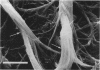
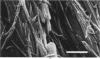
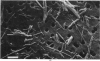
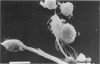
Many asbestiform minerals exhibit temperature-dependent thermoluminescence. Since thermoluminescence involves electronic transitions within crystalline materials, the effect of temperature on asbestos cytotoxicity was evaluated. Heat pretreatment of Canadian chrysotile asbestos reduces its cytotoxicity towards cultured human fibroblasts and bovine alveolar macrophages. When monitored 44 hr after the addition of either 200 degrees C or 400 degrees C heat-pretreated asbestos, alveolar macrophage viability was approximately 40% higher than comparable amounts of unheated asbestos. Similarly, asbestos toxicity, expressed as fibroblast growth inhibition, was inversely related to the asbestos pretreatment temperature in the following manner, 70 degrees C greater than 200 degrees C greater than 400 degrees C = unexposed fibroblast controls. Pretreatment of chrysotile asbestos to 400 degrees C reduced its adsorptive capacity for bovine serum albumin by 25%. Furthermore, asbestos heated to 200 degrees C followed by irradiation with 4 MeV X-rays (4500 rads) resulted in reactivation of asbestos cytotoxicity. Scanning electron microscopy indicated that the ratios of free to fiber-associated alveolar macrophages and the fiber fragment size distributions were unaffected by either heat pretreatment or X-ray irradiation. These observations strongly suggest that the surface charge characteristics and electronic state of asbestos fibers may be responsible for its biological activity.
Full text
PDF


Images in this article


Selected References
These references are in PubMed. This may not be the complete list of references from this article.
- Bradford M. M. A rapid and sensitive method for the quantitation of microgram quantities of protein utilizing the principle of protein-dye binding. Anal Biochem. 1976 May 7;72:248–254. doi: 10.1016/0003-2697(76)90527-3. [DOI] [PubMed] [Google Scholar]
- Brown R. C., Chamberlain M., Griffiths D. M., Timbrell V. The effect of fibre size on the in vitro biological activity of three types of amphibole asbestos. Int J Cancer. 1978 Dec;22(6):721–727. doi: 10.1002/ijc.2910220614. [DOI] [PubMed] [Google Scholar]
- Finch G. L., Fisher G. L., Hayes T. L., Golde D. W. Morphological studies of cultured human pulmonary macrophages. Scan Electron Microsc. 1980;(3):315–326. [PubMed] [Google Scholar]
- Fisher G. L., McNeill K. L., Whaley C. B., Fong J. Attachment and phagocytosis studies with murine pulmonary alveolar macrophages. J Reticuloendothel Soc. 1978 Sep;24(3):243–252. [PubMed] [Google Scholar]
- Harington J. S., Miller K., Macnab G. Hemolysis by asbestos. Environ Res. 1971 Apr;4(2):95–117. doi: 10.1016/0013-9351(71)90038-7. [DOI] [PubMed] [Google Scholar]
- Hart R. W., Daniel F. B., Kindig O. R., Beach C. A., Joseph L. B., Wells R. C. Elemental modifications and polycyclic aromatic hydrocarbon metabolism in human fibroblasts. Environ Health Perspect. 1980 Feb;34:59–68. doi: 10.1289/ehp.803459. [DOI] [PMC free article] [PubMed] [Google Scholar]
- Hayashi H. Cytotoxicity of heated chrysotile. Environ Health Perspect. 1974 Dec;9:267–270. doi: 10.1289/ehp.749267. [DOI] [PMC free article] [PubMed] [Google Scholar]
- Hill J. O., Gray R. H., DeNee P. B., Newton G. J. Comparative damage to alveolar macrophages after phagocytosis of respirable particles. Environ Res. 1982 Feb;27(1):95–109. doi: 10.1016/0013-9351(82)90061-5. [DOI] [PubMed] [Google Scholar]
- Hobza P., Hurych J. Quantum chemical study of properties and reactivity of quartz dust. I. Electronic structure of alpha-quartz. Environ Res. 1978 Jun;15(3):432–442. doi: 10.1016/0013-9351(78)90124-x. [DOI] [PubMed] [Google Scholar]
- Light W. G., Wei E. T. Surface charge and asbestos toxicity. Nature. 1977 Feb 10;265(5594):537–539. doi: 10.1038/265537a0. [DOI] [PubMed] [Google Scholar]
- Morgan A., Davies P., Wagner J. C., Berry G., Holmes A. The biological effects of magnesium-leached chrysotile asbestos. Br J Exp Pathol. 1977 Oct;58(5):465–473. [PMC free article] [PubMed] [Google Scholar]
- Pelfrene A. F. Magnesium and cytotoxic effects of asbestos fibers. Med Lav. 1977 Sep-Oct;68(5):349–354. [PubMed] [Google Scholar]
- Reiss B., Solomon S., Weisburger J. H., Williams G. M. Comparative toxicities of different forms of asbestos in a cell culture assay. Environ Res. 1980 Jun;22(1):109–129. doi: 10.1016/0013-9351(80)90123-1. [DOI] [PubMed] [Google Scholar]
- Schnitzer R. J., Bunescu G., Baden V. Interactions of mineral fiber surfaces with cells in vitro. Ann N Y Acad Sci. 1972;172(23):759–771. [PubMed] [Google Scholar]
- Schnitzer R. J. Modification of biological surface activity of particles. Environ Health Perspect. 1974 Dec;9:261–266. doi: 10.1289/ehp.749261. [DOI] [PMC free article] [PubMed] [Google Scholar]
- Stanton M. F., Wrench C. Mechanisms of mesothelioma induction with asbestos and fibrous glass. J Natl Cancer Inst. 1972 Mar;48(3):797–821. [PubMed] [Google Scholar]
- Valentine R., Goettlich-Riemann W., Fisher G., Rucker R. B. An elastase inhibitor from isolated bovine pulmonary macrophages. Proc Soc Exp Biol Med. 1981 Nov;168(2):238–244. doi: 10.3181/00379727-168-41267. [DOI] [PubMed] [Google Scholar]
- Wagner J. C., Berry G., Timbrell V. Mesotheliomata in rats after inoculation with asbestos and other materials. Br J Cancer. 1973 Aug;28(2):173–185. doi: 10.1038/bjc.1973.134. [DOI] [PMC free article] [PubMed] [Google Scholar]