



Abstract
This report summarizes the Brazilian experience on the design and implementation of environmental health, with contributions from Argentina, Canada, and Cuba, presented at the International Symposium on the Development of Indicators for Environmental Health Integrated Management, held in Recife, Pernambuco, Brazil, on 17–18 June 2004. The methodology for the development of environmental health indicators has been used as a reference in the implementation of environmental health surveillance in Brazil. This methodology has provided tools and processes to facilitate the understanding and to measure the determinants of risks to environmental health, to help decision makers control those risks.
Keywords: environmental health indicators, environmental health surveillance, integrated management
From 1998 to the present, the Ministry of Health of Brazil has implemented environmental health surveillance (EHS) within the National Public Health System. The methodology for the development of environmental health indicators became one of the key issues for the implementation of EHS. The driving force, pressure, state/situation, exposure, effects, action (DPSEEA) model approach was applied to develop appropriate indicators (Corvalan et al. 1999). This matrix model takes into consideration the relationship cycle process among economic and social dynamics, environmental response, and human health. Thus, the driving forces consist of the economic and social processes, resulting in pressures such as the intensive use of particular natural resources. Both driving forces and pressures contribute to the situation/state scenarios where the environment is often contaminated or deteriorated, facilitating human exposure to environmental risk factors that might produce effects on health. For each of these categories, indicators and action proposals are developed to gain a more complete understanding of the problem as well as to visualize measures to be taken in each level of complexity of the cycle (Figure 1).
Figure 1.
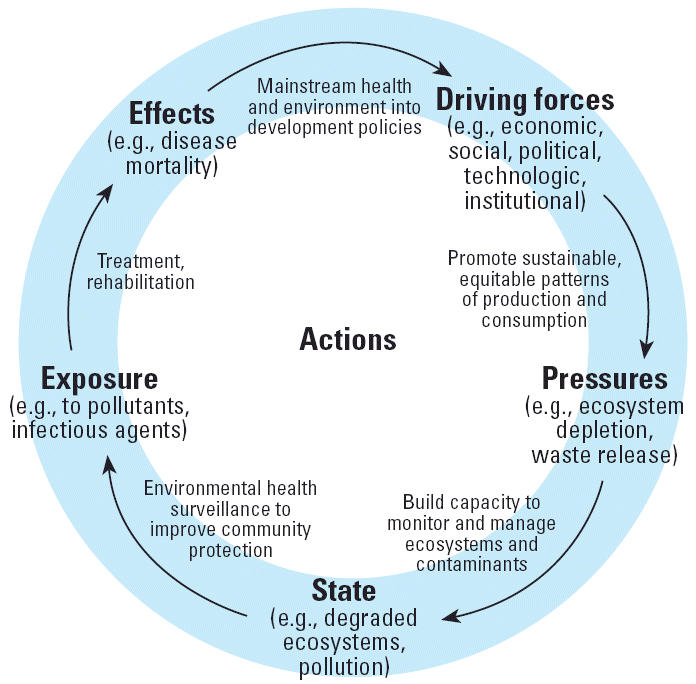
The DPSEEA model (adapted from Corvalan et al. 2000).
The Regional Experience
An international symposium on the development of indicators for integrated environmental health management, as a prior activity to the VI Brazilian Congress of Epidemiology, took place in Recife, Brazil, on 17–18 June 2004. The symposium involved presentation and discussions on the Brazilian experience with the development of environmental health indicators and exchange of experiences with similar initiatives in Canada, Cuba, and Argentina. The symposium was organized by the Ministry of Health of Brazil under the auspices of the Pan American Health Organization/World Health Organization and the Associação Brasileira de Pós-Graduação em Saúde Coletiva’s Health and Environment Working Group.
The main objectives of the symposium were to assess the use of the indicators for the environmental health integrated management in the countries of the Americas, to present the Brazilian experience in the development of indicators regarding the integrated management of environmental health, and to contribute, through the development of environmental health indicators, to the strengthening of the following initiatives: a) the Health and Environment Ministers of the Americas meeting, b) the Pan American Health Organization Environmental Health Collaborating Centers Network, and c) methodologies for the integrated assessment of environmental health in the Americas.
The experiences in developing indicators in some countries in the American continents were evaluated, with particular attention to their usefulness in the decision-making processes. A summary of the indicators developed and evaluated are shown in Table 1, and national and international examples of the application of indicators are described in Table 2.
Table 1.
Some examples of environmental health indicators in use, selected from applying the DPSEEA matrix to different situations.
| Country/topics | Indicators developed | Matrix categories |
|---|---|---|
| Brazil | Per capita consumption | Pressure |
| Water
(Maciel Filho et al. 1999) |
Water bacteriologic quality | Exposure |
| Residual chlorine | Exposure | |
| Water supply services coverage | Situation | |
| Water supply regularity | Situation | |
| Cuba | Economic policy of healthy residences development | Driving force |
| Healthy residences
(Placeres MR et al., unpublished data) |
Percent of resources for the construction of healthy residences | Pressure |
| Percent of households with appropriate ventilation | Situation | |
| Percent of households with appropriate lighting | Situation | |
| Percent of households with appropriate kitchen installations | Situation | |
| Canada | Release of substances that damage the ozone layer | Pressure |
| Ultraviolet radiation
(Bartlett S, unpublished data) |
Ozone layer reduction rate | Exposure |
| Cumulative radiation doses | Exposure | |
| Ultraviolet radiation indicators | Exposure | |
| Incidence of melanoma | Effects | |
| Eye damage | Effects |
Table 2.
National and international experiences in the use of indicators.
| Country | Source | Program | Description |
|---|---|---|---|
| Brazil | Guimarães MJB, Melo NGDO, Lima AAF, Camarão F, Fillho JAN, Lyra TM, unpublished data | EHS drinking water program | Good example of the use of environmental health indicators for decision making: Ministry of Health developed database allowing local-level data entry accessible on line at municipal, state, and federal levels |
| Database can potentially be analyzed together with mortality and morbidity data: Successes include drinking water risk maps generated by the Municipality of Recife that served as a base to restructure and reinforce health surveillance actions to priority areas | |||
| Recognized as a useful application and given an award by the Health Surveillance National Secretariat | |||
| Cuba | Placeres MR, Rojas MC, Diaz VIP, Toste MA, Melián CMG, unpublished data | DPSEEA | Has been used in the family health program, orienting doctors and nurses to consider social, political, economic, and geographic factors in identifying environmental problems that affect people’s health |
| Has oriented the establishment of the environmental primary health care strategy by choosing environmental health local indicators to achieve an integration of local health development | |||
| Canada | Bartlett S, unpublished data | Environment Canada | Has been reporting on environmental indicators since 1990 in its National Environmental Indicator Series and State of the Environment reports |
| In the Environment and Sustainable Development Indicators initiative’s final report, the National Round Table on the Environment and the Economy (NRTEE) proposed six new indicators, developed in collaboration with Environment Canada and Statistics Canada (released May 2003): forest cover, freshwater quality, air quality, greenhouse gas emissions, extent of wetlands, and educational attainment | |||
| Health Canada | Uses the DPSEEA framework to organize the environmental health indicators | ||
| Currently collaborating with Environment Canada on the development of an air–health indicator (AHI) | |||
| The potential AHI builds on ongoing work on improved air quality index to develop a multipollutant trend indicator that directly links potential health impacts to exposure to pollution, as recommended by NRTEE | |||
| Such an indicator has also helped to assess the effectiveness of pollution mitigation strategies and public health interventions |
Conclusions and Recommendations
The symposium, in addition to presenting the experiences in Brazil and other countries, assessed ways of adopting the proposed methodology for the development of environmental health indicators and their use in the integrated management of actions on related health and environment issues, with the following conclusions:
The development of the environmental health indicators should be interdisciplinary and participatory, focused on the economic, social, and environmental contexts that represent risk situations to human health.
The indicators should be built based on priorities, considering what society considers to be a problem, and should lead to health protection and the promotion of changes, as well as to facilitate decision making, considering health as a social value.
The development of environmental health indicators should also respect and incorporate community-based knowledge, the interdisciplinary and intersectorial approach toward integrated management.
The participation of government decision makers in the identification and development of indicators is highly valuable because it results in an improved future management of the problems identified.
The environmental health indicators matrix (DPSEEA) also proved useful for the analysis of complex problems and for the analysis of emerging issues, such as the products of nanotechnology, genetic manipulation, and nonionizing radiation among others.
DPSEEA, which is a framework that organizes information from economic and social dynamics, environmental response, and human health, addresses all the complex levels of a given problem, and it is more efficient in the analysis of such problems compared with other cause-and-effect models. It promotes a holistic view of the issues and is therefore effective in the identification of relevant indicators. It is also a valuable tool for learning, training, and deeper discussions on complex exposure–effect process relationships in environmental health.
Workshop participants commented that DPSEEA would have some limitations if understood only in a linear and vertical form without considering the complex socioenvironmental contexts and their relation with underlying health problems, environment, and quality of life.
Footnotes
List of participants: A.R. Martins de Sena, A.T. Tambellini, A. Monteiro, A.C. Lima da Silva, A. Carvalho de Miranda, A.L. Carneiro de Freitas, C. Corvalán, C.R. Costa, C.T. Souto Bezerra, E.W. Dias e Silva, E. Monteiro, E. Domingues, E. de Tito, E.M. Bonini, F.F. Carneiro, F.P. Nunes, G.M.S Gonçalves, G.F. Netto, H. Castro, I.M. da Silva, J. Cancio, J. Finkelman, J. Alves, J.A. Escamilla, J. de Paula, J. Villardi, L.C. Amorim, L.G. da S. Augusto, L.G. Timbó Aragão, L. Rafael de Barros, L.A. Galvão, M. Romero, M.L.B. Carneiro Oliveira, M.M. Fachinni, M. Moises, M.A. Magalhães, M.C. Dantas, M.C. da Silva Souto, M. de Lourdes Lima, M. de Lourdes Neto, N. Gouveia, P.C. Borja, P.I. Batista, R.R. dos Santos, R.M.S. Souza, R.S. Bernardes, R. Coelho, R. de Lima Gomes, S. Hacon, S. Rocha, S. Bartlett, S. Pereira, S. Batista, S.C.A. Rocha de Almeida, T.N.G. Wanderley, V. Blank, V. de M. Câmara, W. Roque de Sá, W. Waissmann.
The views expressed in this article are those of the authors and do not necessarily reflect the position of the World Health Organization.
Support for the symposium was provided by the Health Surveillance Secretariat, Ministry of Health of Brazil; Associação Brasileira de Pós-Graduação em Saúde Coletiva; Pan-American Health Organization Office in Brazil; World Health Organization; Ministry of Health of Argentina; Ministry of Health of Canada; and Ministry of Health of Cuba.
References
- Corvalan CF, Briggs D, Zielhuis G. 2000. Decision Making in Environmental Health: From Evidence to Action. London:E & FN Spon.
- Corvalan CF, Kjellstrom T, Smith KR. Health, environment and sustainable development: identifying links and indicators to promote action. Epidemiology. 1999;10:656–660. [PubMed] [Google Scholar]
- Maciel Filho AA, Góes CD, Cancio JA, Oliveira ML, Costa SS.1999Indicadores de vigilância ambiental em saúde [in Portuguese] Inform Epidemiol 8359–66. Available: http://dtr2001.saude.gov.br/svs/pub/Iesus/ies083.htm [accessed 31 October 2005]. [Google Scholar]