



Abstract
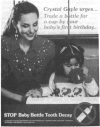
Baby bottle tooth decay (BBTD) is a preventable dental disease which surveys have shown affects more than 50 percent of Native American children. An experimental program to prevent BBTD was implemented in 12 Native American communities. The project represented a cooperative effort by three Department of Health and Human Service agencies: Administration for Children, Youth, and Families, Head Start Bureau; Indian Health Service, Dental Program; and Centers for Disease Control, Dental Disease Prevention Activity. Intervention strategies included the training of parent volunteers, health professionals, and the tribal employees who counseled caretakers of young children and made group presentations. There was also a media campaign in each community that ran for a 3-year period. Numerous educational materials were developed including training manuals, counseling booklets, tippee cups, posters, and bumper stickers. The BBTD project's planners encouraged tailoring the education materials and strategies to fit each community. Preliminary results documented statistically significant decreases in the prevalence of BBTD at the pilot sites. This multidisciplinary, comprehensive intervention offers a model for organizing members of minority communities to prevent health problems.
Full text
PDF


Images in this article
Selected References
These references are in PubMed. This may not be the complete list of references from this article.
- Broderick E., Mabry J., Robertson D., Thompson J. Baby bottle tooth decay in Native American children in Head Start centers. Public Health Rep. 1989 Jan-Feb;104(1):50–54. [PMC free article] [PubMed] [Google Scholar]
- Derkson G. D., Ponti P. Nursing bottle syndrome; prevalence and etiology in a non-fluoridated city. J Can Dent Assoc. 1982 Jun;48(6):389–393. [PubMed] [Google Scholar]
- Dilley G. J., Dilley D. H., Machen J. B. Prolonged nursing habit: a profile of patients and their families. ASDC J Dent Child. 1980 Mar-Apr;47(2):102–108. [PubMed] [Google Scholar]
- Gardner D. E., Norwood J. R., Eisenson J. E. At-will breast feeding and dental caries: four case reports. ASDC J Dent Child. 1977 May-Jun;44(3):186–191. [PubMed] [Google Scholar]
- Johnsen D. C. Characteristics and backgrounds of children with "nursing caries". Pediatr Dent. 1982 Sep;4(3):218–224. [PubMed] [Google Scholar]
- Johnsen D. C., Gerstenmaier J. H., Schwartz E., Michal B. C., Parrish S. Background comparisons of pre-31/2-year-old children with nursing caries in four practice settings. Pediatr Dent. 1984 Mar;6(1):50–54. [PubMed] [Google Scholar]
- Kelly M., Bruerd B. The prevalence of baby bottle tooth decay among two native American populations. J Public Health Dent. 1987 Spring;47(2):94–97. doi: 10.1111/j.1752-7325.1987.tb01983.x. [DOI] [PubMed] [Google Scholar]
- Kotlow L. A. Breast feeding: a cause of dental caries in children. ASDC J Dent Child. 1977 May-Jun;44(3):192–193. [PubMed] [Google Scholar]
- Ripa L. W. Nursing habits and dental decay in infants: "nursing bottle caries". ASDC J Dent Child. 1978 Jul-Aug;45(4):274–275. [PubMed] [Google Scholar]
- Walton J. L., Messer L. B. Dental caries and fluorosis in breast-fed and bottle-fed children. Caries Res. 1981;15(2):124–137. doi: 10.1159/000260511. [DOI] [PubMed] [Google Scholar]