



Abstract
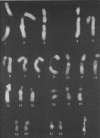
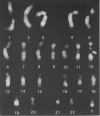
The effects of cryopreservation on the frequency and type of chromosome abnormalities in human sperm have been investigated for the first time. With a technique which enables direct visualization of human sperm chromosomes following in vitro penetration of hamster oocytes, sperm samples from 13 normal men were examined before and after being frozen in liquid nitrogen. The overall abnormality frequencies of 17.8% for fresh semen and 13.4% for previously frozen semen were not significantly different (chi 2(1) df = 3.04, p = 0.08). When specific abnormality types were analyzed, only the category of hypohaploidy was significantly different (chi 2(1) df = 6.75, p = 0.009) before (7.5%) and after (3.4%) freezing. Hypohaploidy was significantly higher than hyperhaploidy both prefreeze and postfreeze, and chromosome loss was random. Because the observed excess of hypohaploid cells may be attributable to technical artifact, the aneuploidy levels were estimated by doubling the number of hyperhaploid cells. Neither the adjusted numerical abnormality frequencies (1% prefreeze vs. 0% postfreeze) nor the overall abnormality frequencies (11.8% prefreeze vs. 10.4% postfreeze) were significantly different. The types and distributions of karyotypically abnormal sperm complements (numerical, structural, or combined) observed before and after freezing were not different. Interdonor variability in sperm chromosome abnormality frequencies and a possible donor-dependent response to cryopreservation were suggested by the data. The sex ratios were not affected by cryopreservation and did not differ significantly from the theoretical 50%. It is concluded that cryopreservation does not affect the type or frequencies of chromosome abnormalities or alter the sex ratio in human sperm.
Full text
PDF


Images in this article
Selected References
These references are in PubMed. This may not be the complete list of references from this article.
- Alfredsson J. H. Artificial insemination with frozen semen. Sex ratio at birth. Int J Fertil. 1984;29(3):152–155. [PubMed] [Google Scholar]
- Behrman S. J., Ackerman D. R. Freeze preservation of human sperm. Am J Obstet Gynecol. 1969 Mar 1;103(5):654–664. doi: 10.1016/0002-9378(69)90562-6. [DOI] [PubMed] [Google Scholar]
- Benet J., Fuster C., Genescà A., Navarro J., Miró R., Egozcue J., Templado C. Expression of fragile sites in human sperm and lymphocyte chromosomes. Hum Genet. 1989 Feb;81(3):239–242. doi: 10.1007/BF00278996. [DOI] [PubMed] [Google Scholar]
- Brandriff B., Gordon L., Ashworth L., Watchmaker G., Carrano A., Wyrobek A. Chromosomal abnormalities in human sperm: comparisons among four healthy men. Hum Genet. 1984;66(2-3):193–201. doi: 10.1007/BF00286600. [DOI] [PubMed] [Google Scholar]
- Brandriff B., Gordon L., Ashworth L., Watchmaker G., Moore D., 2nd, Wyrobek A. J., Carrano A. V. Chromosomes of human sperm: variability among normal individuals. Hum Genet. 1985;70(1):18–24. doi: 10.1007/BF00389451. [DOI] [PubMed] [Google Scholar]
- Chernos J. E., Rattner J. B., Martin R. H. An investigation of human sperm pronuclear chromosome "gaps" using scanning electron microscopy. Cytogenet Cell Genet. 1986;42(1-2):57–61. doi: 10.1159/000132251. [DOI] [PubMed] [Google Scholar]
- Ford J. H., Schultz C. J., Correll A. T. Chromosome elimination in micronuclei: a common cause of hypoploidy. Am J Hum Genet. 1988 Nov;43(5):733–740. [PMC free article] [PubMed] [Google Scholar]
- Friedman S., Broder S. Homologous artificial insemination after long-term semen cryopreservation. Fertil Steril. 1981 Mar;35(3):321–324. [PubMed] [Google Scholar]
- Jenderny J., Röhrborn G. Chromosome analysis of human sperm. I. First results with a modified method. Hum Genet. 1987 Aug;76(4):385–388. doi: 10.1007/BF00272450. [DOI] [PubMed] [Google Scholar]
- Kamiguchi Y., Mikamo K. An improved, efficient method for analyzing human sperm chromosomes using zona-free hamster ova. Am J Hum Genet. 1986 May;38(5):724–740. [PMC free article] [PubMed] [Google Scholar]
- Laufer N., Margalioth E. J., Navot D., Shemesh A., Schenker J. G. Reduced penetration of zona-free hamster ova by cryopreserved human spermatozoa. Arch Androl. 1985;14(2-3):217–222. doi: 10.3109/01485018508988302. [DOI] [PubMed] [Google Scholar]
- Martin R. H. A detailed method for obtaining preparations of human sperm chromosomes. Cytogenet Cell Genet. 1983;35(4):252–256. doi: 10.1159/000131876. [DOI] [PubMed] [Google Scholar]
- Martin R. H., Rademaker A. W., Hildebrand K., Long-Simpson L., Peterson D., Yamamoto J. Variation in the frequency and type of sperm chromosomal abnormalities among normal men. Hum Genet. 1987 Oct;77(2):108–114. doi: 10.1007/BF00272374. [DOI] [PubMed] [Google Scholar]
- Mattei J. F., Le Marec B. Genetic aspects of artificial insemination by donor (AID). Indications, surveillance and results. Clin Genet. 1983 Feb;23(2):132–138. doi: 10.1111/j.1399-0004.1983.tb01861.x. [DOI] [PubMed] [Google Scholar]
- Mortimer D., Richardson D. W. Sex ratio of births resulting from artificial insemination. Br J Obstet Gynaecol. 1982 Feb;89(2):132–135. doi: 10.1111/j.1471-0528.1982.tb04679.x. [DOI] [PubMed] [Google Scholar]
- Sanger W. G., Schwartz M. B., Housel G. The use of frozen-thawed semen for therapeutic insemination (donor). Int J Fertil. 1979;24(4):267–269. [PubMed] [Google Scholar]
- Sèle B., Pellestor F., Jalbert P., Estrade C., Ostorero C., Gelas M. Analyse cytogénétique des pronucleus à partir du modèle de fécondation interspécifique homme-hamster. Ann Genet. 1985;28(2):81–85. [PubMed] [Google Scholar]
- Witherington R., Black J. B., Karow A. M., Jr Semen cryopreservation: an update. J Urol. 1977 Oct;118(4):510–512. doi: 10.1016/s0022-5347(17)58088-x. [DOI] [PubMed] [Google Scholar]