


Abstract
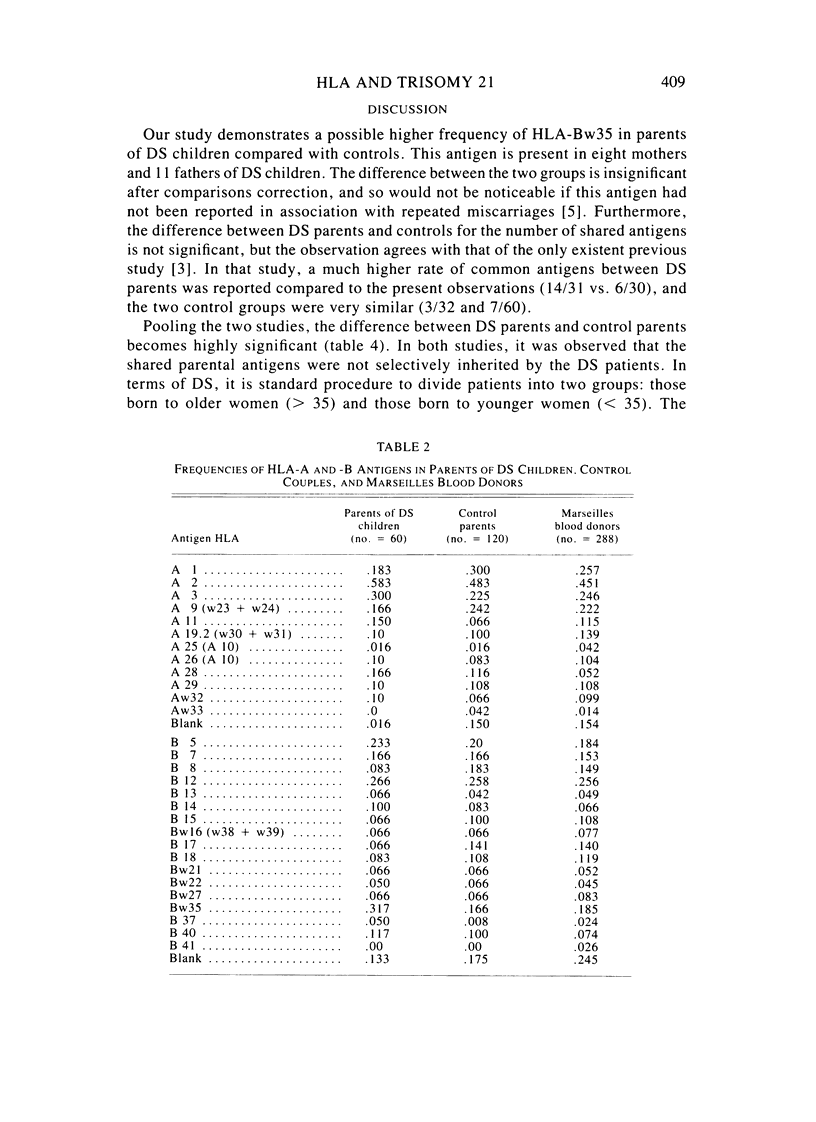
As the HLA system could play a role in the in utero selection process against abnormal fetuses, HLA-A and -B antigens were evidenced in 30 children with trisomy 21 and in their parents, using a standard microlymphocytotoxicity test. The comparison group included 60 families among whom 39 had HLA typing for paternity exclusion and 21 had been previously selected for a segregation study. Both groups consisted of nonconsanguineous Caucasians from the same geographical area. The Down syndrome (DS) children did not show a significant association with a specific HLA antigen. However, six out of 30 couples having a DS child showed two antigens shared at the A and/or B locus, compared to seven out of 60 control couples. The shared parental antigens were not selectively inherited, and the proportion of homozygote children at one locus was lower for DS (5/30) than for controls (13/60). These findings demonstrate the same trend as previously published but need to be confirmed by other investigators. Perhaps a strong selective pressure in favor of heterozygotes contributes to a better survival rate, as suggested from histocompatibility studies in animals.
Full text
PDF




Selected References
These references are in PubMed. This may not be the complete list of references from this article.
- Aymé S., Lippman-Hand A. Maternal-age effect in aneuploidy: does altered embryonic selection play a role? Am J Hum Genet. 1982 Jul;34(4):558–565. [PMC free article] [PubMed] [Google Scholar]
- BENNETT D. ABNORMALITIES ASSOCIATED WITH A CHROMOSOME REGION IN THE MOUSE. II. EMBRYOLOGICAL EFFECTS OF LETHAL ALLELES IN THE T-REGION. Science. 1964 Apr 17;144(3616):263–267. [PubMed] [Google Scholar]
- Beer A. E., Quebbeman J. F., Ayers J. W., Haines R. F. Major histocompatibility complex antigens, maternal and paternal immune responses, and chronic habitual abortions in humans. Am J Obstet Gynecol. 1981 Dec 15;141(8):987–999. doi: 10.1016/s0002-9378(16)32690-4. [DOI] [PubMed] [Google Scholar]
- Erickson R. P. Differentiation alloantigens, histocompatibility loci, and birth defects. Am J Hum Genet. 1975 Jul;27(4):554–557. [PMC free article] [PubMed] [Google Scholar]
- Finn R. Survival of the genetically incompatible fetal allograft. Lancet. 1975 Apr 12;1(7911):835–838. doi: 10.1016/s0140-6736(75)93006-8. [DOI] [PubMed] [Google Scholar]
- Gerencer M., Drazancić A., Kuvacić I., Tomasković Z., Kastelan A. HLA antigen studies in women with recurrent gestational disorders. Fertil Steril. 1979 Apr;31(4):401–404. [PubMed] [Google Scholar]
- Komlos L., Zamir R., Joshua H., Halbrecht I. Common HLA antigens in couples with repeated abortions. Clin Immunol Immunopathol. 1977 May;7(3):330–335. doi: 10.1016/0090-1229(77)90066-6. [DOI] [PubMed] [Google Scholar]
- Purpura M., Coghi I., Nicotra M., Carapella E., Bottini E. HLA Bw35 antigen and human reproduction. J Med Genet. 1980 Apr;17(2):157–158. [PMC free article] [PubMed] [Google Scholar]
- Thomson G. A review of theoretical aspects of HLA and disease associations. Theor Popul Biol. 1981 Oct;20(2):168–208. doi: 10.1016/0040-5809(81)90009-5. [DOI] [PubMed] [Google Scholar]