


Abstract
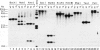
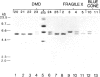
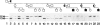
Fifteen human X-chromosome-specific DNA fragments, localized to particular regions of that chromosome, were used to search for restriction fragment length polymorphisms. A screening panel prepared by digesting DNA from only two females and one male with 24 restriction enzymes was sufficient to reveal two-allele polymorphisms among one-third of the probes tested. These polymorphisms, as theoretically anticipated, showed minor allele frequencies above 20%, as a rule. Such high-frequency polymorphism allowed identifying females, from pedigrees segregating three X-linked diseases, who were multiply heterozygous for polymorphic loci spread throughout the X chromosome. In addition, two of the 24 enzymes tested with these X-specific probes, Msp I and Taq I, generate fragment sizes in DNA-blotting experiments that, on average, are significantly larger than expected from nearest neighbor predicted recognition site frequencies.
Full text
PDF


Images in this article
Selected References
These references are in PubMed. This may not be the complete list of references from this article.
- Alpern M., Lee G. B., Maaseidvaag F., Miller S. S. Colour vision in blue-cone 'monochromacy'. J Physiol. 1971 Jan;212(1):211–233. doi: 10.1113/jphysiol.1971.sp009318. [DOI] [PMC free article] [PubMed] [Google Scholar]
- Bishop D. T., Williamson J. A., Skolnick M. H. A model for restriction fragment length distributions. Am J Hum Genet. 1983 Sep;35(5):795–815. [PMC free article] [PubMed] [Google Scholar]
- Boehm C. D., Antonarakis S. E., Phillips J. A., 3rd, Stetten G., Kazazian H. H., Jr Prenatal diagnosis using DNA polymorphisms. Report on 95 pregnancies at risk for sickle-cell disease or beta-thalassemia. N Engl J Med. 1983 May 5;308(18):1054–1058. doi: 10.1056/NEJM198305053081803. [DOI] [PubMed] [Google Scholar]
- Botstein D., White R. L., Skolnick M., Davis R. W. Construction of a genetic linkage map in man using restriction fragment length polymorphisms. Am J Hum Genet. 1980 May;32(3):314–331. [PMC free article] [PubMed] [Google Scholar]
- Brunk C. F., Jones K. C., James T. W. Assay for nanogram quantities of DNA in cellular homogenates. Anal Biochem. 1979 Jan 15;92(2):497–500. doi: 10.1016/0003-2697(79)90690-0. [DOI] [PubMed] [Google Scholar]
- Busslinger M., deBoer E., Wright S., Grosveld F. G., Flavell R. A. The sequence GGCmCGG is resistant to MspI cleavage. Nucleic Acids Res. 1983 Jun 11;11(11):3559–3569. doi: 10.1093/nar/11.11.3559. [DOI] [PMC free article] [PubMed] [Google Scholar]
- Conneally P. M., Rivas M. L. Linkage analysis in man. Adv Hum Genet. 1980;10:209–266. doi: 10.1007/978-1-4615-8288-5_3. [DOI] [PubMed] [Google Scholar]
- Davies K. E., Pearson P. L., Harper P. S., Murray J. M., O'Brien T., Sarfarazi M., Williamson R. Linkage analysis of two cloned DNA sequences flanking the Duchenne muscular dystrophy locus on the short arm of the human X chromosome. Nucleic Acids Res. 1983 Apr 25;11(8):2303–2312. doi: 10.1093/nar/11.8.2303. [DOI] [PMC free article] [PubMed] [Google Scholar]
- Forget B. G., Hillman D. G., Lazarus H., Barell E. F., Benz ej J. R., Caskey C. T., Huisman T. H., Schroeder W. A., Housman D. Absence of messenger RNA and gene DNA for beta-globin chains in hereditary persistence of fetal hemoglobin. Cell. 1976 Mar;7(3):323–329. doi: 10.1016/0092-8674(76)90161-6. [DOI] [PubMed] [Google Scholar]
- Harper P. S., O'Brien T., Murray J. M., Davies K. E., Pearson P., Williamson R. The use of linked DNA polymorphisms for genotype prediction in families with Duchenne muscular dystrophy. J Med Genet. 1983 Aug;20(4):252–254. doi: 10.1136/jmg.20.4.252. [DOI] [PMC free article] [PubMed] [Google Scholar]
- Keshet E., Cedar H. Effect of CpG methylation on Msp I. Nucleic Acids Res. 1983 Jun 11;11(11):3571–3580. doi: 10.1093/nar/11.11.3571. [DOI] [PMC free article] [PubMed] [Google Scholar]
- Kunkel L. M., Tantravahi U., Eisenhard M., Latt S. A. Regional localization on the human X of DNA segments cloned from flow sorted chromosomes. Nucleic Acids Res. 1982 Mar 11;10(5):1557–1578. doi: 10.1093/nar/10.5.1557. [DOI] [PMC free article] [PubMed] [Google Scholar]
- Page D., de Martinville B., Barker D., Wyman A., White R., Francke U., Botstein D. Single-copy sequence hybridizes to polymorphic and homologous loci on human X and Y chromosomes. Proc Natl Acad Sci U S A. 1982 Sep;79(17):5352–5356. doi: 10.1073/pnas.79.17.5352. [DOI] [PMC free article] [PubMed] [Google Scholar]
- Razin A., Riggs A. D. DNA methylation and gene function. Science. 1980 Nov 7;210(4470):604–610. doi: 10.1126/science.6254144. [DOI] [PubMed] [Google Scholar]
- Rigby P. W., Dieckmann M., Rhodes C., Berg P. Labeling deoxyribonucleic acid to high specific activity in vitro by nick translation with DNA polymerase I. J Mol Biol. 1977 Jun 15;113(1):237–251. doi: 10.1016/0022-2836(77)90052-3. [DOI] [PubMed] [Google Scholar]
- Singer J., Roberts-Ems J., Riggs A. D. Methylation of mouse liver DNA studied by means of the restriction enzymes msp I and hpa II. Science. 1979 Mar 9;203(4384):1019–1021. doi: 10.1126/science.424726. [DOI] [PubMed] [Google Scholar]
- Skolnick M. H., White R. Strategies for detecting and characterizing restriction fragment length polymorphisms (RFLP's). Cytogenet Cell Genet. 1982;32(1-4):58–67. doi: 10.1159/000131687. [DOI] [PubMed] [Google Scholar]
- Skolnick M. H., Willard H. F., Menlove L. A. Report of the Committee on Human Gene Mapping by Recombinant DNA Techniques. Cytogenet Cell Genet. 1984;37(1-4):210–273. doi: 10.1159/000132011. [DOI] [PubMed] [Google Scholar]
- Sneider T. W. The 5'-cytosine in CCGG1 is methylated in two eukaryotic DNAs and Msp I is sensitive to methylation at this site. Nucleic Acids Res. 1980 Sep 11;8(17):3829–3840. doi: 10.1093/nar/8.17.3829. [DOI] [PMC free article] [PubMed] [Google Scholar]
- Southern E. M. Detection of specific sequences among DNA fragments separated by gel electrophoresis. J Mol Biol. 1975 Nov 5;98(3):503–517. doi: 10.1016/s0022-2836(75)80083-0. [DOI] [PubMed] [Google Scholar]
- Turner G., Daniel A., Frost M. X-linked mental retardation, macro-orchidism, and the Xq27 fragile site. J Pediatr. 1980 May;96(5):837–841. doi: 10.1016/s0022-3476(80)80552-x. [DOI] [PubMed] [Google Scholar]