



Abstract
Aims—To assess the accuracy of brush cytology in patients investigated for pancreatico–biliary strictures.
Methods—All pancreatico–biliary brush cytology specimens submitted from two major teaching hospitals over a 6.5 year period were reviewed. Four hundred and forty eight satisfactory specimens from 406 patients with adequate clinical and/or pathological follow up data were examined in the study period.
Results—Two hundred and forty six patients (60.6%) were shown to have neoplastic strictures. One hundred and forty seven tumours were identified cytologically, including 87 of 146 pancreatic carcinomas, 29 of 47 cholangiocarcinomas, one of one bile duct adenoma, four of seven carcinomas of the gallbladder, eight of 13 ampullary carcinomas, two of three ampullary adenomas, 10 of 16 malignancies of undetermined origin, none of two islet cell tumours, one of three hepatocellular carcinomas, and five of eight metastatic tumours. The three adenomas identified on brush cytology could not be distinguished from adenocarcinoma morphologically. One hundred and sixty patients (39.4%) had benign strictures, most often as a result of chronic pancreatitis and bile duct stones. There were three false positive cytological diagnoses mainly as a result of the misinterpretation of cases with relatively scant and/or degenerative atypical epithelial cells. Forty one cases were reported as atypical or suspicious of malignancy on brush cytology, of which 29 were ultimately shown to have carcinoma. The overall diagnostic sensitivity and specificity were 59.8% and 98.1%, respectively. The sensitivity increased from 44.3% in the initial third of cases to 70.7% in the final third of cases examined in the series.
Conclusions—Brush cytology, in conjunction with other clinical and radiological investigations, is a useful technique in the assessment of patients with suspected pancreatico–biliary neoplasia.
Key Words: brush cytology • pancreatico-biliary strictures • pancreatico-biliary neoplasia
Full Text
The Full Text of this article is available as a PDF (150.1 KB).
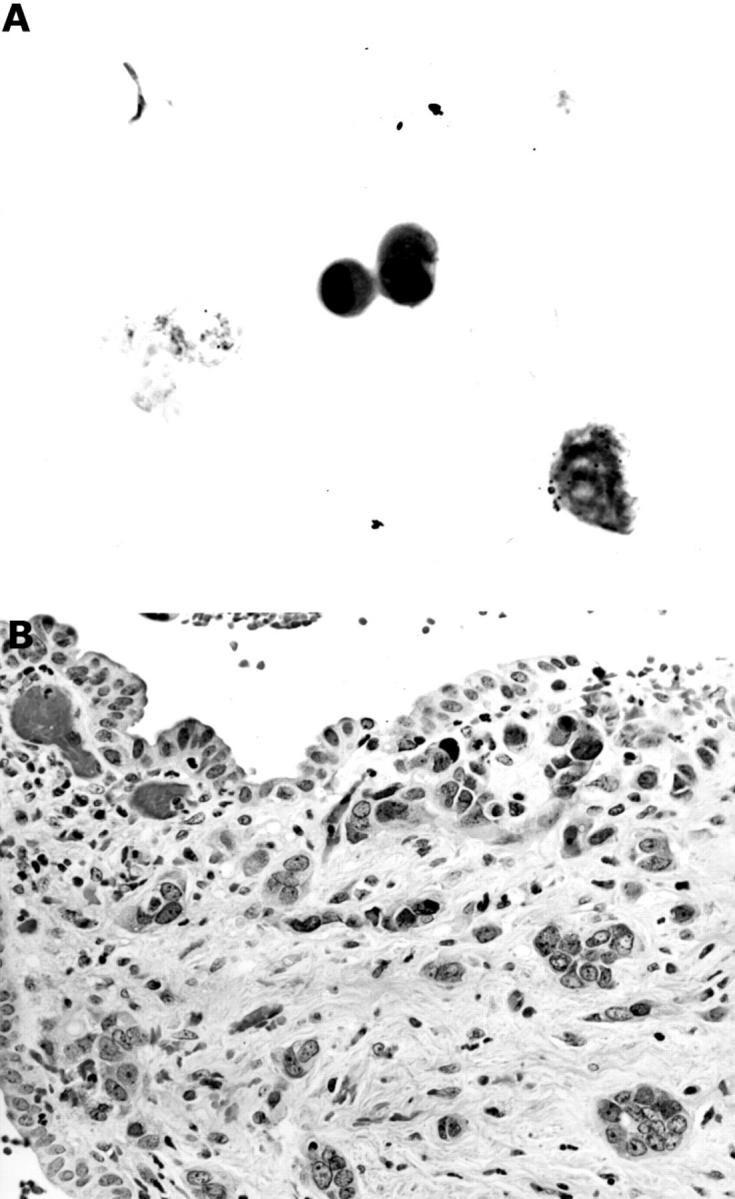
Figure 1 Metastatic lobular carcinoma of breast. (A) Brush cytology showing a small number of malignant cells with eccentric nuclei. (B) Resection showing infiltrating lobular carcinoma adjacent to surface epithelium (above).
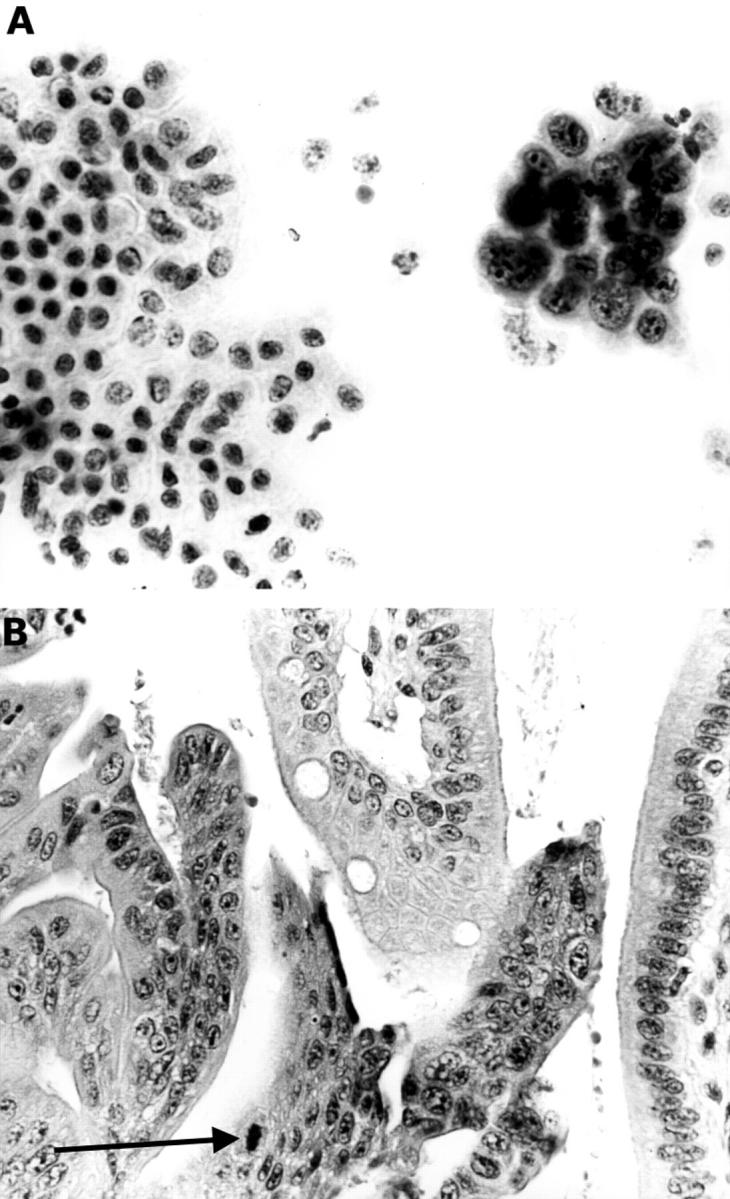
Figure 2 Bile duct adenoma. (A) Brush cytology showing a loosely cohesive and crowded epithelial group exhibiting malignant nuclear features. A group of normal ductal cells is present for comparison (left). (B) Resection showing papillary adenoma with focal high grade dysplasia. Note the mitotic figure (arrow).
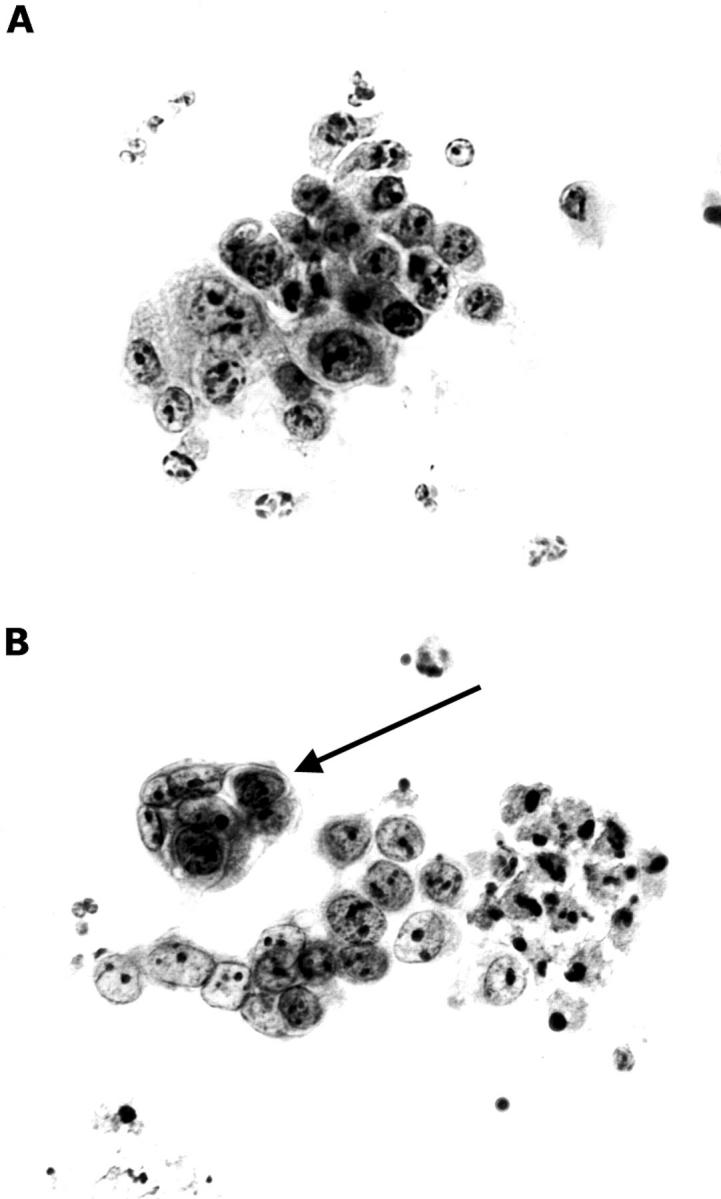
Figure 3 False positive brush cytology (case 1). (A) Loosely cohesive epithelial group showing nuclear variation, coarse chromatin pattern and prominent nucleolation. (B) Moulded atypical nuclei with acinar type cluster (arrow). Note the degenerative cellular changes (right).
Selected References
These references are in PubMed. This may not be the complete list of references from this article.
- Bardales R. H., Stanley M. W., Simpson D. D., Baker S. J., Steele C. T., Schaefer R. F., Powers C. N. Diagnostic value of brush cytology in the diagnosis of duodenal, biliary, and ampullary neoplasms. Am J Clin Pathol. 1998 May;109(5):540–548. doi: 10.1093/ajcp/109.5.540. [DOI] [PubMed] [Google Scholar]
- Desa L. A., Akosa A. B., Lazzara S., Domizio P., Krausz T., Benjamin I. S. Cytodiagnosis in the management of extrahepatic biliary stricture. Gut. 1991 Oct;32(10):1188–1191. doi: 10.1136/gut.32.10.1188. [DOI] [PMC free article] [PubMed] [Google Scholar]
- Ettinghausen S. E., Schwartzentruber D. J., Sindelar W. F. Evolving strategies for the treatment of adenocarcinoma of the pancreas. A review. J Clin Gastroenterol. 1995 Jul;21(1):48–60. [PubMed] [Google Scholar]
- Foutch P. G. Diagnosis of cancer by cytologic methods performed during ERCP. Gastrointest Endosc. 1994 Mar-Apr;40(2 Pt 1):249–252. doi: 10.1016/s0016-5107(94)70183-0. [DOI] [PubMed] [Google Scholar]
- Ishimaru S., Itoh M., Hanada K., Tsuchida A., Iwao T., Kajiyama G. Immunocytochemical detection of p53 protein from pancreatic duct brushings in patients with pancreatic carcinoma. Cancer. 1996 Jun 1;77(11):2233–2239. doi: 10.1002/(SICI)1097-0142(19960601)77:11<2233::AID-CNCR8>3.0.CO;2-Q. [DOI] [PubMed] [Google Scholar]
- Iwao T., Hanada K., Tsuchida A., Hirata M., Eguchi N., Kajiyama G. The establishment of a preoperative diagnosis of pancreatic carcinoma using cell specimens from pancreatic duct brushing with special attention to p53 mutations. Cancer. 1998 Apr 15;82(8):1487–1494. doi: 10.1002/(sici)1097-0142(19980415)82:8<1487::aid-cncr9>3.0.co;2-6. [DOI] [PubMed] [Google Scholar]
- Kocjan G., Smith A. N. Bile duct brushings cytology: potential pitfalls in diagnosis. Diagn Cytopathol. 1997 Apr;16(4):358–363. doi: 10.1002/(sici)1097-0339(199704)16:4<358::aid-dc11>3.0.co;2-j. [DOI] [PubMed] [Google Scholar]
- Kurzawinski T., Deery A., Davidson B. R. Diagnostic value of cytology for biliary stricture. Br J Surg. 1993 Apr;80(4):414–421. doi: 10.1002/bjs.1800800404. [DOI] [PubMed] [Google Scholar]
- Layfield L. J., Wax T. D., Lee J. G., Cotton P. B. Accuracy and morphologic aspects of pancreatic and biliary duct brushings. Acta Cytol. 1995 Jan-Feb;39(1):11–18. [PubMed] [Google Scholar]
- Leach S. D., Rose J. A., Lowy A. M., Lee J. E., Charnsangavej C., Abbruzzese J. L., Katz R. L., Evans D. B. Significance of peritoneal cytology in patients with potentially resectable adenocarcinoma of the pancreatic head. Surgery. 1995 Sep;118(3):472–478. doi: 10.1016/s0039-6060(05)80361-7. [DOI] [PubMed] [Google Scholar]
- Lee J. G., Leung J. W., Baillie J., Layfield L. J., Cotton P. B. Benign, dysplastic, or malignant--making sense of endoscopic bile duct brush cytology: results in 149 consecutive patients. Am J Gastroenterol. 1995 May;90(5):722–726. [PubMed] [Google Scholar]
- Logrono R., Kurtycz D. F., Molina C. P., Trivedi V. A., Wong J. Y., Block K. P. Analysis of false-negative diagnoses on endoscopic brush cytology of biliary and pancreatic duct strictures: the experience at 2 university hospitals. Arch Pathol Lab Med. 2000 Mar;124(3):387–392. doi: 10.5858/2000-124-0387-AOFNDO. [DOI] [PubMed] [Google Scholar]
- Mansfield J. C., Griffin S. M., Wadehra V., Matthewson K. A prospective evaluation of cytology from biliary strictures. Gut. 1997 May;40(5):671–677. doi: 10.1136/gut.40.5.671. [DOI] [PMC free article] [PubMed] [Google Scholar]
- McGuire D. E., Venu R. P., Brown R. D., Etzkorn K. P., Glaws W. R., Abu-Hammour A. Brush cytology for pancreatic carcinoma: an analysis of factors influencing results. Gastrointest Endosc. 1996 Sep;44(3):300–304. doi: 10.1016/s0016-5107(96)70168-2. [DOI] [PubMed] [Google Scholar]
- Merchant N. B., Conlon K. C., Saigo P., Dougherty E., Brennan M. F. Positive peritoneal cytology predicts unresectability of pancreatic adenocarcinoma. J Am Coll Surg. 1999 Apr;188(4):421–426. doi: 10.1016/s1072-7515(98)00327-5. [DOI] [PubMed] [Google Scholar]
- Ponchon T., Gagnon P., Berger F., Labadie M., Liaras A., Chavaillon A., Bory R. Value of endobiliary brush cytology and biopsies for the diagnosis of malignant bile duct stenosis: results of a prospective study. Gastrointest Endosc. 1995 Dec;42(6):565–572. doi: 10.1016/s0016-5107(95)70012-9. [DOI] [PubMed] [Google Scholar]
- Rabinovitz M., Zajko A. B., Hassanein T., Shetty B., Bron K. M., Schade R. R., Gavaler J. S., Block G., Van Thiel D. H., Dekker A. Diagnostic value of brush cytology in the diagnosis of bile duct carcinoma: a study in 65 patients with bile duct strictures. Hepatology. 1990 Oct;12(4 Pt 1):747–752. doi: 10.1002/hep.1840120421. [DOI] [PubMed] [Google Scholar]
- Rupp M., Hawthorne C. M., Ehya H. Brushing cytology in biliary tract obstruction. Acta Cytol. 1990 Mar-Apr;34(2):221–226. [PubMed] [Google Scholar]
- Ryan M. E., Baldauf M. C. Comparison of flow cytometry for DNA content and brush cytology for detection of malignancy in pancreaticobiliary strictures. Gastrointest Endosc. 1994 Mar-Apr;40(2 Pt 1):133–139. doi: 10.1016/s0016-5107(94)70154-7. [DOI] [PubMed] [Google Scholar]
- Sawada Y., Gonda H., Hayashida Y. Combined use of brushing cytology and endoscopic retrograde pancreatography for the early detection of pancreatic cancer. Acta Cytol. 1989 Nov-Dec;33(6):870–874. [PubMed] [Google Scholar]
- Stewart C. J., Carter R., Imrie C. W., Foulis A. K. Brush cytology of intraduct papillary mucinous neoplasm of the pancreas. Cytopathology. 1997 Oct;8(5):343–348. doi: 10.1111/j.1365-2303.1997.tb00559.x. [DOI] [PubMed] [Google Scholar]
- Stewart C. J., Stephen M. R., Ferrier R. K. Hepatocellular carcinoma diagnosis in bile duct brush cytology. Diagn Cytopathol. 1998 Aug;19(2):149–150. doi: 10.1002/(sici)1097-0339(199808)19:2<149::aid-dc18>3.0.co;2-f. [DOI] [PubMed] [Google Scholar]
- Sturm P. D., Rauws E. A., Hruban R. H., Caspers E., Ramsoekh T. B., Huibregtse K., Noorduyn L. A., Offerhaus G. J. Clinical value of K-ras codon 12 analysis and endobiliary brush cytology for the diagnosis of malignant extrahepatic bile duct stenosis. Clin Cancer Res. 1999 Mar;5(3):629–635. [PubMed] [Google Scholar]
- Thuluvath P. J., Rai R., Venbrux A. C., Yeo C. J. Cholangiocarcinoma: a review. Gastroenterologist. 1997 Dec;5(4):306–315. [PubMed] [Google Scholar]
- Warshaw A. L. Implications of peritoneal cytology for staging of early pancreatic cancer. Am J Surg. 1991 Jan;161(1):26–30. doi: 10.1016/0002-9610(91)90356-i. [DOI] [PubMed] [Google Scholar]
- de Peralta-Venturina M. N., Wong D. K., Purslow M. J., Kini S. R. Biliary tract cytology in specimens obtained by direct cholangiographic procedures: a study of 74 cases. Diagn Cytopathol. 1996 Jun;14(4):334–348. doi: 10.1002/(SICI)1097-0339(199605)14:4<334::AID-DC12>3.0.CO;2-L. [DOI] [PubMed] [Google Scholar]
- van Es J. M., Polak M. M., van den Berg F. M., Ramsoekh T. B., Craanen M. E., Hruban R. H., Offerhaus G. J. Molecular markers for diagnostic cytology of neoplasms in the head region of the pancreas: mutation of K-ras and overexpression of the p53 protein product. J Clin Pathol. 1995 Mar;48(3):218–222. doi: 10.1136/jcp.48.3.218. [DOI] [PMC free article] [PubMed] [Google Scholar]