



Abstract
Objectives. Since the 1950 invasion of Tibet by China, Tibetan refugees have attempted to flee into Nepal over the Himalayan mountains. We documented the experiences of a group of refugees making this journey.
Methods. We conducted semistructured interviews with 50 recent refugees at the Tibetan Refugee Transit Centre in Kathmandu, Nepal.
Results. Participants ranged in age from 8 to 56 years, and 21 were female. The average length of their journey from Tibet to Nepal was 34 days. During their journey, a majority of the refugees encountered authorities or became involved in altercations with Nepali Maoist groups. Most of these interactions resulted in extortion and threats of expulsion. Several Tibetans were tortured, beaten with weapons, threatened with being shot, and robbed. Three women were sexually assaulted at gunpoint.
Conclusions. The refugees who took part in this study experienced physical and mental hardships and, often, human rights abuses on their journey to Nepal. International pressure is needed to prevent human rights violations and reduce potential long-term physical and mental health effects associated with this dangerous crossing.
For nearly 40 years, Tibetans fleeing Chinese persecution have sought and been granted asylum in India and Nepal. About 20 000 Tibetan refugees currently live in Nepal; on their journey, which can range from several days to months in duration,1 most use escape routes over the Himalayan mountain range.
The Tibetan Refugee Transit Centre (TRTC), established by the Tibetan Refugee Welfare Office of the Government in Exile in conjunction with the United Nations High Commissioner for Refugees (UNHCR) in Kathmandu, Nepal, estimates that an average of 2500 Tibetan refugees make the journey to Nepal each year.1 The TRTC provides food, clothing, shelter, and medicine to these refugees and plays a crucial role as a negotiator as well, securing the release of refugees detained by Nepalese border patrols. Since 1991, the TRTC has registered Tibetan refugees as “persons of concern” and aided their journey from Nepal to India. In May 2004, when our study was conducted, approximately 1000 refugees were housed at the TRTC, a facility designed for a maximum occupancy of 300 (Figure 1 ▶).
FIGURE 1—

Refugees at the Tibetan Refugee Transit Centre in Kathmandu, Nepal (photo by S. D.).
The Nepalese government historically has maintained an accommodating attitude toward Tibetan refugees, a generous response from such a poor country. However, in 1989, the flow of refugees surged in the wake of a political uprising inside Tibet. In response, the Nepalese government established an arrangement with the UNHCR whereby Tibetan refugees arriving after 1989 would not be allowed to resettle in Nepal. The UNHCR would interview them, designate them as “persons of concern” as appropriate, and facilitate their prompt, safe transit to India for resettlement there. Although never formalized, this arrangement became known as the “gentlemen’s agreement.”1
The Tibetan Government in Exile provides specialized psychological treatment services to refugees who are victims of political violence.2 However, to date, there has been little published literature describing the experiences of Tibetan refugees during their escape from Tibet into Nepal. In an attempt to document these experiences, we conducted a qualitative study with recent refugees.
METHODS
In May 2004, we administered semistructured interviews to 50 recent refugees at the TRTC in Kathmandu, Nepal. The interviews consisted of a set of open-ended questions asked by an experienced interviewer (S. D.). The questions had been pretested with a group of 3 refugees who later worked as coordinators at the TRTC. All interviews were conducted individually, in private, in the Tibetan language. Interviews were audiotaped, and field notes were taken. Data was shown to participants to ensure accuracy. Data were transcribed verbatim in Tibetan.
TRTC staff enrolled a convenience sample of participants. We defined “recent” refugees as those who had been in Nepal 1 year or less. There was no financial incentive to participate.
The data were translated to English, and content analyses were used in examining the data.3 Themes derived from the interviews were grouped in the following categories: physical hardships, psychological hardships, length of journey, costs of journey, and harassment and extortion. StatsDirect (StatsDirect Ltd, Cheshire, England) was used in calculating all descriptive statistics.
RESULTS
We interviewed 50 recent Tibetan refugees (mean age: 22 years; range: 8–56 years). All of those approached agreed to be interviewed. Of the 29 male and 21 female participants, 21 were children or young people less than 18 years of age (median age: 14 years; range: 8–17 years), and 9 were monks or nuns. The refugees had spent an average of 68 days at the TRTC (range: 0–150 days). None of the 50 refugees reported that their escape was a pilgrimage to Dharamsala and that they intended to return to Tibet.
The Journey
All of the refugees interviewed had arrived in Nepal from Tibet over land. The majority had begun the organized portion of their journey from Lhasa, the capital city of Tibet, although departure points were spread throughout Tibet. The average length of the journey was 34 days (range: 2–201 days). Four of the refugees made the entire journey by bus. Two traveled entirely on foot, and all of the others traveled partly by bus and partly on foot. The refugees took buses to the border areas and walked from there across the mountain range.
Among refugees who made the journey at least partly on foot, the average length of the journey was 32 days (range: 2–201). The 2 refugees making the journey entirely by foot traveled together; the length of their trip was 201 days, including 30 days of detainment in Chinese prisons. They began their journey not in Lhasa but in Chamdo.
Most refugees traveled with the aid of a guide (n = 34) for at least part of their journey. All traveled with companions (mean group size: 5; range: 2–15). Seven participants traveled in pairs, while the remainder traveled in larger groups. Those using guides spent an average of ¥2224 (US$268; range: ¥0–20 000 [US$0–$2416]). In 2 cases, the guides did not complete the journey with the refugees, who had to find their way alone:
Our leader told us that he was going to get some cigarettes and never returned. He left us at the border. He also ate all our food and left us with nothing. (Female 17-year-old)
Our leader got sick midway and he left us. So we had to find our own way. We were safe once we reached a monastery. There we received food and directions. (Male 17-year-old)
Encounters With Authorities
During the journey, 30 refugees encountered authorities or became engaged in altercations with rebel groups. Twenty-three refugees encountered Nepalese border guards, and 7 encountered Nepalese Maoist rebel groups. Time spent by refugees in detention as a result of encounters with Nepalese border guards ranged from several hours to 30 days. Two refugees (a monk and a nun) also encountered Chinese border guards and were imprisoned by Chinese authorities for 30 days. Maoist rebels subsequently detained these same refugees for an additional 8 days.
Most interactions with Nepalese border guards resulted in extortion and threats of refoulement (the expulsion of individuals who have the right to be recognized as refugees). Twenty refugees suffered physical abuse by the border guards, and all of these individuals were threatened with refoulement. However, several refugees also experienced severe hardships such as robbery and torture, beatings with rifle butts, threats of being shot, and sexual assaults. Some were beaten on the head and back with weapons.
We encountered 8 Nepalese border guards on the way. They took our guide’s cellular phone. They took away the little money I had saved. They beat us with the end of their guns and sticks for hours. My head was swollen and bleeding from repeated beatings. (Male 20-year-old)
We were caught by the Nepalese guards in Khumbu. They beat us and threatened to deport us. They took all our money, including [the] pair of shoes that I had on. (Male 26-year-old)
We were chased uphill by the Nepalese border guards, who hit us with sticks and gun-ends. Many times they threatened to just shoot us. (Female 24-year-old)
Three women also experienced sexual harassment by the Nepalese guards. They were separated from their groups and, despite attempts to escape, were captured. The women were taken to an outside area where a group of 6 guards disrobed them and sexually assaulted them at gunpoint.
Two of us were singled out from the group. There were 6 Nepalese guards, 2 carrying guns and the others carrying sticks. They beat us first with their guns and sticks. They then told us to take off our pants and started to touch us everywhere. They touched our breasts. We cried and cried. We begged them to stop. (Female 17-year-old)
All of the Tibetans who encountered Maoist rebels experienced extortion or detainment. When they were able to pay the required amounts to the rebels, they received Maoist passes and were allowed to proceed.
On our way here, we encountered Maoist rebels. They asked us for [500 rupees (approximately $6.50)]. We were then issued passes, and the next time we met any other Maoist groups, we showed them our passes and they let us go. (Male 45-year-old)
The 2 refugees who were captured by the Chinese authorities experienced the most severe repercussions. After being captured close to the Nepalese border, they were transferred among 6 prisons during a month-long detainment period. During their detainment, they were beaten and deprived of food.
I was captured with my companions. We were asked many questions. If we made any mistake with our response, the Chinese guards beat us. They beat us all regularly. But they were especially bad to the men. All the men were bedridden for 7 days because they were beaten so badly. The women were isolated and pricked with needles on the back and private areas. Some women had difficulty urinating after the beatings. (Female 15-year-old)
Physical Hardships
We asked refugees whether they had health concerns during their journey. Thirty-six reported that they suffered severe exhaustion during the journey, 24 complained of headaches, and 9 suffered from nausea or vomiting.
I was hiding in a truck under hay and rugs. For 2 days, my brother and I hid without any movement or speech. We had to pee, sit, and sleep in the same spot. I was nauseated and vomited at the same spot. (Female 15-year-old)
Given that journey lengths were unpredictable and that many of the refugees reported being poorly prepared, almost all (n = 45) experienced severe hunger during the journey. On average, those with longer journeys faced considerably more days without any food (range: 1–60) than those with shorter journeys. To hide their intentions of escape from local authorities, the refugees often carried little food. Once preplanned rations had been used, they bartered in local communities for food, sold clothing and blankets, and, in some instances, begged for food. Lack of food sometimes required consumption of shrubs and snow.
We suffered a lot from not having enough food to eat. My twin 7-year-old brothers couldn’t walk because they were too weak. We ate rice porridge when we had money. When there was no food, we ate shrubs growing on the roadside. We went without any food for 15 days. My younger brothers were too weak so I had to carry them. (Male 17-year-old)
We were walking in snow up to our knees. For 20 days, we only had a cup of tea a day. Whenever we could, we begged for food. (Male 26-year-old)
Additional physical hardships included foot injuries, photophobia, and frostbite. Also, sudden changes in climate resulted in rashes and altitude sickness. One of the refugees reported that a 17-year-old girl fell to her death during a nighttime excursion. Moreover, 3 other refugees traveling at night were severely injured after falling from cliffs or falling into ditches.
We were told to walk at night to avoid being spotted and captured. I fell in a ditch while traveling at night. I had leather Chinese army boots, but still my foot was injured. I walked on the injured foot for 3 days. Then my body started to ache. I knew that something was wrong. I was also very dizzy from the high altitude and lack of food. If the 2 monks hadn’t helped me, I wouldn’t be alive today. (Male 22-year-old)
Three refugees had previously attempted to escape from Tibet. They had been captured by Chinese guards and spent 120 days in prisons. Both reported that their companions were also captured. In addition, one of the younger refugees described his mother’s attempt to escape:
My mother tried to escape Tibet in 2000 with my twin brothers, who were 3-years-old at the time. They were traveling through the most dangerous pass and hit very severe weather. They couldn’t complete their journey. When my mother was brought back to Lhasa, they said she was still breathing. I was very young at the time, and I didn’t understand what was happening. She was kept in the hospital for 15 days, but the Chinese guards wouldn’t let us see her. When they finally allowed us to see her, she was already dead. Her limbs were amputated. She had lost her limbs to frostbite while trying to keep her babies safe. After I reached the Tibetan [refugee] house, I called my father. He was in tears and thankful that we made it this time. (Male 17-year-old)
DISCUSSION
To our knowledge, this is the first qualitative study assessing the experiences of Tibetan refugees escaping to Nepal. Our findings indicate that many human rights abuses and preventable hardships continue despite international pressure to employ diplomacy. These findings should be of concern to human rights researchers, policymakers, and health providers. The refugees’ encounters with border guards and Maoist rebels invariably led to extortion, physical violence, or detainment.
There are several important strengths of our study. For instance, our sample was relatively large for a qualitative study, and we were able to enroll participants who had very recently escaped Tibet. Also, we allowed the refugees to explain issues associated with their experiences that were important to them, and we did not impress our expectations on them. Finally, we involved the Tibetan Government in Exile in the conduct of the study.
There are also important limitations of this research. Although, as mentioned, our sample was large for a qualitative study, it should not be expected to produce generalizable results. Because our goal was to assess refugees’ experiences in escaping from Tibet to Nepal, we did not inquire about their reasons for leaving Tibet (these reasons were, however, often reported to us). We translated the findings from Tibetan to English, and, although the translators were fluent in both languages, this process may have reduced the richness of the data. Finally, our sample was a convenience sample of refugees enrolled at the TRTC, and thus this group might differ from other groups of Tibetan refugees.
In a previous article, we reviewed the evidence that rates of posttraumatic stress disorder, anxiety, and depression are high among recent Tibetan refugees arriving in North India.4 Although it is difficult to establish causation with mental health problems, the present findings suggest possible explanations for the types of psychological trauma observed. Many refugees suffered both serious psychological hardships and serious physical injuries as a result of their journey. The Tibetan government must recognize the need for appropriate care programs for refugees, both political and nonpolitical, as well as specialized programs for children.
One of the findings of most concern in our study was the treatment of refugees by the Nepalese border guards. We documented beatings, torture, and sexual assaults at gun-point. In addition, most of the refugees reported the threat of refoulement to Chinese authorities, a finding that is very disturbing given the physically difficult journey to Nepal. In the generally worsening climate for refugees in Nepal,1,5 there have recently been troubling departures from the Nepalese government’s agreement with the UNHCR, with documented occurrences of refoulement.
The findings just described assume particular importance given that, in February 2005, the Nepalese government forcibly closed the Tibetan Refugee Welfare Office, ending the country’s legal representation in Nepal. Restrictions on Tibetan cultural and religious activities in Nepal have since been implemented.5 The UNHCR is currently working to improve conditions for refugees in Nepal; however, Nepal’s government is not obligated to receive refugees.5
The journey from Tibet into Nepal is a treacherous one fraught with physical and mental hardships and egregious violations of basic human rights. Concerted and more effective international pressure is required to ensure that the border governments comply fully with international laws guaranteeing the right to freedom of movement,6 prohibiting the use of torture7 or the persecution of women8 and children,9 and ensuring protection and humane treatment of asylum seekers.10,11 If effective interventions are not in place to make their journeys safer, these refugees may suffer long-term effects on their physical and mental health.
FIGURE 2—
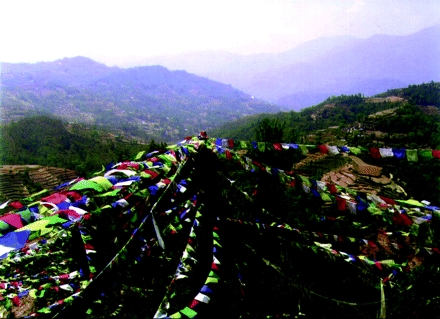
Tibetan prayer flags, Kathmandu, Nepal (photo by S. D.).
Acknowledgments
We thank the study participants and Sonam Tsering for assistance.
Human Participant Protection This study was approved by the institutional review board of the Institute for Education and Research, Toronto, and the Tibetan Refugee Transit Centre, Kathmandu. Participants provided oral informed consent.
Peer Reviewed
Contributors S. Dolma, S. Singh, L. Lohfeld, and E. J. Mills assisted with the concept and planning of the study. S. Dolma and E. J. Mills contributed to data collection. All of the authors contributed to data analysis and to the writing of the article.
References
- 1.Dangerous Crossing 2003: Conditions Impacting the Flight of Tibetan Refugees. Washington, DC: International Campaign for Tibet; 2003.
- 2.Mercer SW, Ager A, Ruwanpura E. Psychosocial distress of Tibetans in exile: integrating Western interventions with traditional beliefs and practice. Soc Sci Med. 2005;60:179–189. [DOI] [PubMed] [Google Scholar]
- 3.Glazer B, Strauss A. In: Lincoln YS, Guba EG. Naturalistic Inquiry. Newbury Park, Calif: Sage Publications; 1985:204–208.
- 4.Mills EJ, Singh S, Holtz T, et al. Prevalence of mental disorders and torture among Tibetan refugees: a systematic review. BMC Int Health Hum Rights. 2005;5:7. [DOI] [PMC free article] [PubMed] [Google Scholar]
- 5.Dangerous Crossing 2004. Washington, DC: International Campaign for Tibet; 2005.
- 6.United Nations. Universal Declaration of Human Rights, Article 14. Available at: http://www.un.org/Overview/rights.html. Accessed July 22, 2006.
- 7.Convention against Torture and Other Cruel, Inhuman or Degrading Treatment or Punishment. Available at: http://www1.umn.edu/humanrts/instree/h2catoc.htm. Accessed July 22, 2006.
- 8.United Nations. Convention on the Elimination of All Forms of Discrimination against Women. Available at: http://www.un.org/womenwatch/daw/cedaw/cedaw.htm. Accessed July 22, 2006.
- 9.United Nations. Convention on the Rights of the Child. Available at: http://www.unicef.org/crc/crc.htm. Accessed July 22, 2006.
- 10.Office of the High Commissioner for Human Rights. International Covenant on Civil and Political Rights. Available at: http://www.unhchr.ch/html/menu3/b/a_ccpr.htm. Accessed July 22, 2006.
- 11.Office of the High Commissioner for Human Rights. 1951 Refugee Convention and 1967 Protocol. Available at: http://www.ohchr.org. Accessed July 22, 2006.