


Abstract
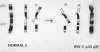
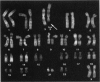
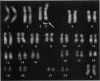
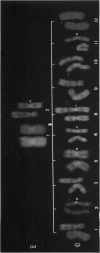
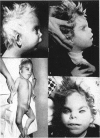
Close phenotypic similarity between two cases carrying a rec(3) dup q,inv(3) (p25q21), 12 additional infants from the same inv (3)(p25q21) kindred who lived less than 1 year, and eight cases studied in other medical centers has led us to postulate the existence of a distinct chromosome 3 duplication-deletion syndrome. In the presence of trisomy for (3)q21 leads to qter and monosomy for (3)p25 leads to pter, the facial dysmorphy is unique: a distorted head shape due to irregular cranial sutures, thick low eyebrows, long eyelashes, persistent lanugo, distended veins on the scalp, hypertelorism, oblique palpebral fissures, a very short nose with a broad depressed bridge and anteverted nares, protruding maxilla, thin upper lip, micrognathia, low-set ears, and a short webbed neck. Port-wine stains, congenital glaucoma, cloudy corneas, cleft palate and harelip also occur frequently. Each infant has difficulty sucking and swallowing. Congenital anomalies of the cardiovascular system, of midgut rotation, and of the urogenital system are noted for the infants who died neonatally. Most frequent is a ventricular septal defect, followed by atrial septal defect, patent ductus arteriosus, patent foramen ovale, and coarctation of the aorta. Omphalocele, umbilical hernia, hyperplastic kidneys, polycystic kidneys, double ureter, hydro-ureter, hydronephrosis, and undescended testes often occur. The extremities are short in proportion to the length of the trunk. Clinodactyly, coxa valga, talipes, and spina bifida are frequently observed.
Full text
PDF


Images in this article
Selected References
These references are in PubMed. This may not be the complete list of references from this article.
- Allderdice P. W., Davis J. G., Miller O. J., Klinger H. P., Warburton D., Miller D. A., Allen F. H., Jr, Abrams C. A., McGilvray E. The 13q-deletion syndrome. Am J Hum Genet. 1969 Sep;21(5):499–512. [PMC free article] [PubMed] [Google Scholar]
- Allderdice P. W., Miller O. J., Miller D. A., Warburton D., Pearson P. L., Klein G., Harris H. Chromosome analysis of two related heteroploid mouse cell lines by quinacrine fluorescence. J Cell Sci. 1973 Jan;12(1):263–274. doi: 10.1242/jcs.12.1.263. [DOI] [PubMed] [Google Scholar]
- Allerdice P. W., Tedesco T. A. Letter: Localisation of human gene for galactose-1-phosphate-uridyltransferase. Lancet. 1975 Jul 5;2(7923):39–39. doi: 10.1016/s0140-6736(75)92988-8. [DOI] [PubMed] [Google Scholar]
- Boon W. H. Familial 2/3 translocation. J Singapore Paediatr Soc. 1967 Oct;9(2):88–93. [PubMed] [Google Scholar]
- Breg W. R., Steele M. W., Miller O. J., Warburton D., DeCapoa A., Allderdice P. W. The cri du chat syndrome in adolescents and adults: clinical finding in 13 older patients with partial deletion of the short arm of chromosome No. 5(5p-). J Pediatr. 1970 Nov;77(5):782–791. doi: 10.1016/s0022-3476(70)80236-0. [DOI] [PubMed] [Google Scholar]
- Combs J. T., Grunt J. A., Brandt I. K. New syndrome of neonatal hypoglycemia. Association with visceromegaly, macroglossia, microcephaly and abnormal umbilicus. N Engl J Med. 1966 Aug 4;275(5):236–243. doi: 10.1056/NEJM196608042750502. [DOI] [PubMed] [Google Scholar]
- Francke U. Quinacrine mustard fluorescence of human chromosomes: characterization of unusual translocations. Am J Hum Genet. 1972 Mar;24(2):189–213. [PMC free article] [PubMed] [Google Scholar]
- LEE C. S., BOWEN P., ROSENBLUM H., LINSAO L. FAMILIAL CHROMOSOME-2, 3 TRANSLOCATION ASCERTAINED THROUGH AN INFANT WITH MULTIPLE MALFORMATIONS. N Engl J Med. 1964 Jul 2;271:12–16. doi: 10.1056/NEJM196407022710102. [DOI] [PubMed] [Google Scholar]
- MCKEOWN T., MACMAHON B., RECORD R. G. An investigation of 69 cases of exomphalos. Am J Hum Genet. 1953 Jun;5(2):168–175. [PMC free article] [PubMed] [Google Scholar]
- Miller O. J., Breg W. R., Warburton D., Miller D. A., DeCapoa A., Allderdice P. W., Davis J., Klinger H. P., McGilvray E., Allen F. H., Jr Partial deletion of the short arm of chromosome no. 4(4p-): clinical studies in five unrelated patients. J Pediatr. 1970 Nov;77(5):792–801. doi: 10.1016/s0022-3476(70)80237-2. [DOI] [PubMed] [Google Scholar]
- Seabright M. A rapid banding technique for human chromosomes. Lancet. 1971 Oct 30;2(7731):971–972. doi: 10.1016/s0140-6736(71)90287-x. [DOI] [PubMed] [Google Scholar]
- Summitt R. L. Familial 2/3 translocation. Am J Hum Genet. 1966 Mar;18(2):172–186. [PMC free article] [PubMed] [Google Scholar]
- Taylor A. I. Autosomal trisomy syndromes: a detailed study of 27 cases of Edwards' syndrome and 27 cases of Patau's syndrome. J Med Genet. 1968 Sep;5(3):227–252. doi: 10.1136/jmg.5.3.227. [DOI] [PMC free article] [PubMed] [Google Scholar]
- Tedesco T. A., Diamond R., Orkwiszewski K. G., Boedecker H. J., Croce C. M. Assignment of the human gene for hexose-1-phosphate uridylyltransferase to chromosome 3. Proc Natl Acad Sci U S A. 1974 Sep;71(9):3483–3486. doi: 10.1073/pnas.71.9.3483. [DOI] [PMC free article] [PubMed] [Google Scholar]
- WARBURTON D., FRASER F. C. Genetic aspects of abortion. Clin Obstet Gynecol. 1959 Mar;2(1):22–35. doi: 10.1097/00003081-195903000-00003. [DOI] [PubMed] [Google Scholar]
- Warkany J., Passarge E., Smith L. B. Congenital malformations in autosomal trisomy syndromes. Am J Dis Child. 1966 Dec;112(6):502–517. doi: 10.1001/archpedi.1966.02090150046002. [DOI] [PubMed] [Google Scholar]